Hi Community,
We'll look at moving InterSystems workload to the public cloud, then take a deep dive into the current architectures on the InterSystems cloud platform:
Cloud computing is an information technology paradigm that enables ubiquitous access to shared pools of configurable system resources and higher-level services that can be rapidly provisioned with minimal management effort, often over the Internet.
Hi Community,
We'll look at moving InterSystems workload to the public cloud, then take a deep dive into the current architectures on the InterSystems cloud platform:
If you're deploying to more than one environment/region/cloud/customer, you will inevitably encounter the issue of configuration management.
While all (or just several) of your deployments can share the same source code, some parts, such as configuration (settings, passwords) differ from deployment to deployment and must be managed somehow.
In this article, I will try to offer several tips on that topic. This article talks mainly about container deployments.
Hi All! For those of you who attended experience labs at the 2021 Virtual Summit, you may recall that one of the lab sessions was around Kubernetes. We've now converted that lab to be fully on-demand. You can launch a small cluster of VMs and follow the exercise to manage your Kubernetes cluster, deploy InterSystems IRIS containers to it, and watch its self-healing nature when destroying a pod.
It's a great introduction to Kubernetes if you are interested! See here: Achieving High Availability with InterSystems IRIS and Kubernetes
Hi Community,
New video is already on InterSystems Developers YouTube:
 Want a commercial grade FHIR® Implementation included in your micro service ecosystem and barely have enough time to fill out your Health plan elections?
Here is a quick way to invite the InterSystems® FHIR®Accelerator Service to your Kubernetes Microservice party for immediate use. The solution uses Nginx proxy ninja moves to get the job done. Though rustic and bound to create some technical arguments, I am pretty happy with the results until this community tells me otherwise, so FHIR® away as they say but it would be great if you heard me out first.
Hey Developers,
Learn about the use and design of the InterSystems FHIR Transformation Service and the InterSystems FHIR Server, and what to expect next:
⏯ FHIR in the Cloud: Understanding New InterSystems FHIR Server
Hi Community,
New video is already on InterSystems Developers YouTube:
⏯ Fast & Efficient Provisioning & Testing with InterSystems Cloud Manager
Folks,
I am looking to migrate a few legacy debt collection applications built using InterSystems Cache to AWS. Does anyone here have any experience, ideas and best practices on migrating Cache products to the public cloud?
Regards
Sudarshan
+1-917-685-3551
Hi all,
I'm deploying IRIS for Health on a Google Cloud VM, and I note that the SuperServer port is 1971, rather than good old 1972. Is this as it's supposed to be? I can't see that it's documented anywhere.
Cheers,
Otto
Hi Developers,
The new video from Global summit 2019 is already on InterSystems Developers YouTube:
I wanted to write it as a comment to article of @Evgeny Shvarov . But it happens to be so long, so, decided to post it separately.
I would like to add a bit of clarification about how docker uses disk space and how to clean it. I use macOS, so, everything below, is mostly for macOS, but docker commands suit any platform.
I have described my efforts to optimize IRIS Mirror deployment in AWS ElasticContainer Service (ECS) in my prior article.
IRIS Mirror in the cloud (AWS) | InterSystems Developer Community | AWS
I have come to the opinion that IRIS Mirror is not as reliable as needed when deployed in ECS. The root of the problem is the fact that ECS randomly assigns one of the available IP addresses to each EC2 host or Fargate task it starts.
These get stored in iris.cpf file in MapMirrors section as shown here:
[MapMirrors.IRISMIRROR]
FAILOVER1=10.2ab.1cd.146,2188,,10.2ab.1cd.
I have been working on redesigning a Health Connect production which runs on a mirrored instance of Healthshare 2019. We were told to take advantage of containers. We got to work on IRIS 2020.1 and split the database part from the Interoperability part. We had the IRIS mirror running on EC2 instances and used containers to run IRIS interoperability application. Eventually we decided to run the data tier in containers as well. Later we switched from using EC2 instances to Fargate “server-less” compute.
Hi everyone,
Learn how to build FHIR applications in the cloud using S3, Azure AD, and a FHIR service:
⏯ Build FHIR Provider & Patient-Facing Applications in the Cloud
Being equipped by science and technology, human being have walked a long way by great inventions such as steam-engines or aeroplannes; while after decades, people gradually recognize that single creation could not lauch an industry-boom again. That is why and when, technologies grow up with a community, where are we now=P. An eco-system of technology would be born with the power of a system and grow up with the power of system-science, such as InterSystems, with which seated the letters "s-y-s-t-e-m". Graduated with M.S.
Hello Developers!
Have you ever had to convert HL7v2 messages to FHIR (Fast Healthcare Interoperability Resources) and found the process complicated and confusing? InterSystems is rolling out a new cloud based SaaS offering called InterSystems FHIR Transformation Service, which makes the process easy. We are excited to announce an Early Access Preview Program for our new offering, and we would love to have you kick the tires and let us know what you think! All you need is a free AWS account, with an S3 bucket to drop in your HL7v2 messages, and another S3 bucket to get your FHIR output.
Hey Community,
Enjoy watching the new video on InterSystems Developers YouTube:
⏯ Creating an HL7 v2 to FHIR Transformation Pipeline with HealthLake Target
Episode 20 of Data Points features a conversation with Bob Kuszewski about the Kubernetes and the InterSystems Kubernetes Operator (IKO). Take a listen to hear about some of the use cases and features of IKO, plus how it compares to InterSystems Cloud Manager (ICM) within the cloud space.
We will start from the examples that we faced as Data Science practice at InterSystems:
Hi Developers,
A new video is already on InterSystems Developers YouTube:
⏯ Creating an HL7 v2 to FHIR Transformation Pipeline with S3 Target
If you're looking for an introduction to Kubernetes as a technology, and a little teaser about the InterSystems Kubernetes Operator, check out the recently released Kubernetes Overview video. This video will introduce you to the functionality and use cases of Kubernetes, and explain a bit about how the InterSystems Kubernetes Operator makes it beneficial to use Kubernetes with InterSystems IRIS.
Hi Community,
Please welcome the new video on InterSystems Developers YouTube:
All source code to the article is available at: https://github.com/antonum/ha-iris-k8s
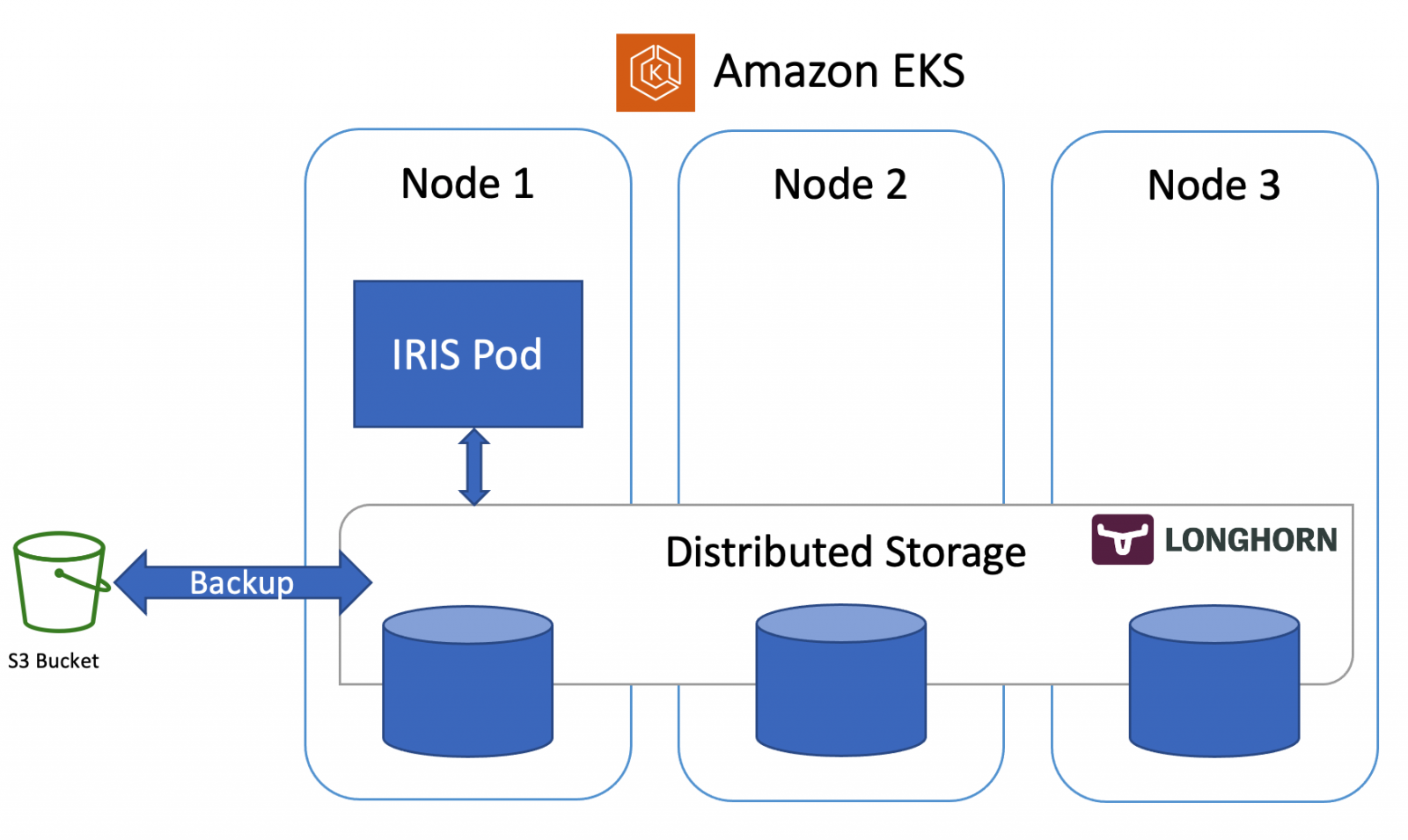
In the previous article, we discussed how to set up IRIS on k8s cluster with high availability, based on the distributed storage, instead of traditional mirroring. As an example, that article used the Azure AKS cluster. In this one, we'll continue to explore highly available configurations on k8s. This time, based on Amazon EKS (AWS managed Kubernetes service) and would include an option for doing database backup and restore, based on Kubernetes Snapshot.
Let's get right to business.
In this article, I am going to give some examples to get your own docker image with InterSystems Caché/Ensemble.
If you do not have direct access to the server that runs your IRIS Docker container
you still may require access to the container outside "iris session" or "WebTerminal".
With an SSH terminal (PuTTY, KiTTY,.. ) you get access inside Docker, and then, depending
on your needs you run "iris session iris" or display/manipulate files directly.
Like hardware hosts, virtual hosts in public and private clouds can develop resource bottlenecks as workloads increase. If you are using and managing InterSystems IRIS instances deployed in public or private clouds, you may have encountered a situation in which addressing performance or other issues requires increasing the capacity of an instance's host (that is, vertically scaling).
One common reason to scale is insufficient memory.
Hi Developers,
Please welcome the new video specially recorded for Developer Tools programming contest:
⏯ Deploying InterSystems IRIS docker solutions to GKE cloud in 5 minutes
greetings Community!
InterSystems Learning Services is working to identify and create libraries of high-quality learning resources for third-party technologies, platforms, and systems that are part of, integrated with, or commonly used with InterSystems products and technologies. we don't create content for these ourselves, but want to support our clients, external and internal, in learning about them and how to use them.
What is Distributed Artificial Intelligence (DAI)?
Attempts to find a “bullet-proof” definition have not produced result: it seems like the term is slightly “ahead of time”. Still, we can analyze semantically the term itself – deriving that distributed artificial intelligence is the same AI (see our effort to suggest an “applied” definition) though partitioned across several computers that are not clustered together (neither data-wise, nor via applications, not by providing access to particular computers in principle). I.e., ideally, distributed artificial intelligence should be arranged in such a way that none of the computers participating in that “distribution” have direct access to data nor applications of another computer: the only alternative becomes transmission of data samples and executable scripts via “transparent” messaging. Any deviations from that ideal should lead to an advent of “partially distributed artificial intelligence” – an example being distributed data with a central application server. Or its inverse. One way or the other, we obtain as a result a set of “federated” models (i.e., either models trained each on their own data sources, or each trained by their own algorithms, or “both at once”).
October 17, 2019
Anton Umnikov
Sr. Cloud Solutions Architect at InterSystems
AWS CSAA, GCP CACE
AWS Glue is a fully managed ETL (extract, transform, and load) service that makes it simple and cost-effective to categorize your data, clean it, enrich it, and move it reliably between various data stores.
In the case of InterSystems IRIS, AWS Glue allows moving large amounts of data from both Cloud and on-Prem data sources into IRIS.