Im using below code to display page number. But i only display as 1,2..etc. I need to display it as I,II,III..etc...
special="page-number"

InterSystems Caché is a multi-model DBMS and application server. See more details here.
Im using below code to display page number. But i only display as 1,2..etc. I need to display it as I,II,III..etc...
special="page-number"
Hello everyone
I have a problem with $ ZF (-1)
I need to delete file from windows folder example c: \ sys \ text.txt, when executing the w $ zf (-1, "c: \ sys \ text.txt") command, the file does not delete.
There is some other cache command that performs this task.
hugs
Davidson
Hi, I found some issues with $ZF(-100) whilst replacing our old $ZF(-1) calls following the security alert. They're easy enough to work around, just figured it might be useful to someone :)
There seems to be some inconsistency with how $ZF(-100) is functioning between Unix and Win, contrary to the documentation. For example, for a simple ‘output directory listing to file’ operation:
Windows:
set dev="dir.txt"
set com="dir"
set options(1)=""
set options(2)="e:\nbupg\webserver\"
w $ZF(-100,"/SHELL /STDERR=""NUL"" /STDOUT="_dev,com,.
I am trying to write a generic process that will take any incoming message but would like to know where it came from so in my code I would like to do something like this
If (Document.Source="some serviceorProcess").Just to be clear in the route you get these features is there a way of accessing them in code
Hi All,
On button click from my zen page am calling the $System.SQL.ShowPlan() to calculate the cost of the SQL query.
In Cache` 2016.2 I faced a problem , when the logged in user didn't have the %development resource(<PROTECT> error).
But in Cache` 2017.2 it's working without the %development resource.
Is there any changes done on this area in the versions above 2016.2.
Thanks,
Dinesh
I try to run below two statements
Set tRS = ##class(%ResultSet).%New("%Dictionary.ClassDefinition:SubclassOf")
set tSC = tRS.Execute("%Persistent")and I always get <PROTECT>check+5^%Dictionary.ClassDefinitionQuery.1
The login user is _SYSTEM and should have all the permissions.
I cannot run queries in the $SYSTEM.SQL.Shell(). I would get <PROTECT>%GenerateMetadata+16^%SQL.StatementMetadata.1
However, when I run the query through SMP, everything is fine.
Any idea where could I start to investigate ?
Thanks.
or "Didn't you say you would cover Persistent Objects in Part 5, Chris?"
Yes, that was the plan. This is a pretty important topic, so it get's its own Article
Up until now, we've display widget JSON that has been created by a basic loop. Clearly this isn't of much value. Now we have our stack connected together, and we can see that the data is flowing to the Welcome page, it's time to complete the stack and start feeding our service from "real" data.
Let's start with our (very basic) Persistent class for Widgets. We have 4 properties to hold Name, Description, Price and current Quantity.
I cannot connect to Cache from node.js
I have installed in Windows 10 the following: CACHE 2016, node.js v 4.4.7 and express .
- where can I get cache.node? The link in the Intersystmes documentation http://globalsdb.org/downloads/ doesn't work. I found cache0100.node and cache0120.node in my Cache instance's \bin directory. But I am not sure if I can use them or not.
- how to install cache.node ? Where do I place it exactly?
Can anyone recommend any tutorial or code example with installation instructions?
Thank you!
Hello Global masters,
I have some question about How can I connect C# to Cache Object without VisM?
I am always using VisM when I want to connect C# to Cache Object becouse I learn it from my co-worker .
but When I asked something in here about Cache Object and someone worte "don't use VisM because it is old thing" like that.
So I want to know about that
Thank you
Minsu.
New to Cache/Studio. Just installed Client option for Cache (cube).
Attempting login to Management Portal for dev/tst/prd environments yields ERROR #822.
Any suggestions on where to begin to resolve would be appreciated.
Thanks!
InterSystems is pleased to announce the availability of Caché and Ensemble 2017.2.2
There are many corrections in these releases. Please find a full list of the corrections in the release notes.
The version number of the kits is 2017.2.2.865.0.
The list of platforms is the same as for 2017.2.1. For complete platform details please refer to the 2017.2 Supported Platforms document.
HealthShare Health Connect based on Ensemble 2017.2.2 is not yet available, but will be announced soon.
Hi DC,
I'm looking for some creative outside-the-box thinking and gaudiness.
I have a device that send its data in UDP Multicast.
I need to parse this data and send it to an outside SQL table (sql outbound adapter)
I planned on a udp inbound adapter but apparently it is not operable.
Can anyone direct me to a thought on how to grab the data and send it to my future process?
I came across this behaviour when debugging some Cache ObjectScript code. I have provided a simple example below.
Example 1:
STARTZBREAK ZBREAK
Trace Output:
Trace: ZBREAK SET VAR3="" at START+5^TRACE

Trace: ZBREAK KILL VAR1 at START+6^TRACE

Trace: ZBREAK KILL VAR2 at START+6^TRACE

Trace: ZBREAK KILL VAR3 at START+6^TRACE
$ZV value:
Notice that the SET statement in the log file only refers to VAR3 - the last variable that was initialised to empty string. Here are a couple of ways to mitigate this issue.
I am working on a TrakCare JIRA issue that requires accessing class properties in a different installation of TrakCare on another machine. For instance, I need to compare the deprecated items in the current version of TrakCare to the deprecated items in a previous release. Is there anything in the built in classes that will allow me to do this, or is it something I'll need to do with a SQL stored procedure or something else I haven't thought of?
Can anybody give me a correct example to kill process started by JOB command?
I have inherited a web-based database application and I'm having a hard time understanding the sequence of events when CSP pages are opened. I have very limited web development experience.
Can anyone recommend a good resource for explaining this? I have already gone through the Cache Cinema tutorial and the Cache CSP documentation.
Among other things, I don't understand when the OnPreHTTP method is invoked, when it is needed, and what belongs in there.
I'm creating a new namespace by the installation manifest XML and in the "database" tag configuration I don't see attribute to configure if I what jounal globals or not to this database.
In the database wizard of the "portal administration", have this option.
Regards,
Lucas Boeing Scarduelli
Hi,
is there way when select a value in filter column and the second column filter use only value referred to the first selection??
we use to active filter to column in table, but not know how relationship the filter between columns of table.
only in the table context in zen page.
I am trying to read some binary data from a local file or through socket.
The binary data is like H.264 codec, I need to read data BYTE by BYTE (even BIT by BIT) and decide the next step based on the data read so far.
I check the documentation and it seems like most of the sample focus on human readable IO, ie: LINE by LINE.
Could I achieve my goal through COS?
Thanks.
I thought I should be able to go to the application error log or look at d ^%ER when I get the following error in the browser when troubleshooting a CSP page:
An error occurred with the CSP application and has been logged to system error log (^ERRORS)
However nothing is being generated in these logs. Where are these logs being made?
Thank you
Hello,
I need to add a new property ("Injection") to an existing database. The existing database contains, in part:
An "ImageStudy" which contains one or more "ImageFiles" defined as follows:
Class PET.ImageStudy Extends (%Persistent)
{
Relationship ImageFiles as PET.ImageFile [cardinality=children,inverse=Study]
...
}
I have this local, containing a list of books of arbitrary length:
set books=2
set books(1, "author") = "Alice"
set books(1, "title") = "Hello"
set books(1, "pages") = "123"
set books(2, "author") = "Bob"
set books(2, "title") = "World"
set books(2, "pages") = "456"
And I want to generate this PDF (there could be more than two tables), each book is a separate table:
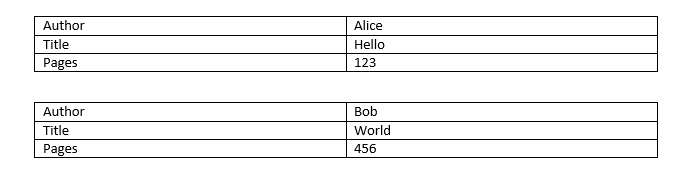
The header is always the same (Author, Title, Page) but the number of tables would be different.
ZEN reports sounds relevant, but I'm not sure how to pass data from local there and how to draw a separate table for each result.
Typically, I have time to review the documentation, which I'm sure is here. However, I have a workaround (TEST1) but I was wondering if anyone could assist me in advising how I would need to adapt the curly brace snippet (TEST2) to provide the same result.
Thanks for any help you can provide.
TEST1(STATUS=1) (
How do I get non latin text in PDF mode for ZEN reports?
Currently cyrillic test is rendered as ####:
Class Test.Zen Extends %ZEN.Report.reportPage
{

Parameter DEFAULTMODE = "pdf";

/// ReportDefinition is a placeholder.
XData ReportDefinition [ XMLNamespace = "http://www.intersystems.com/zen/report/definition" ]
{
<report xmlns="http://www.intersystems.com/zen/report/definition"
    name="MyReport" runonce="true">
  </report>
}

XData ReportDisplay [ XMLNamespace = "http://www.intersystems.com/zen/report/display" ]
{
<report xmlns="http://www.intersystems.com/zen/report/display"
name="MyReport">
<body>
<table ongetData="GetCount">
<table orient="row" ongetData="NamesAndAddresses" style="border:1pt solid black" width="auto" >
<parameter fieldnum="1"/>
<item fieldnum="1" >
<caption value="When I down load a file using a csp page, the application shows the percentage as 37 %, 74 %, and 100 %. I am trying to make changes to the application that it shows one percentage after each read. The first time it reads, it would display 37%. The next run would replace
37 % with 74 % and so on until it completes its download. I have tried adding javascript code to the application however it doesn't work. For example when I enter &js('alert');, the application displays it value on the screen. Also, I tryed putting it between two scripts tags and it doesn't work.
Hi Everybody!
We are pleased to invite you to the upcoming webinar "Optimizing Application Performance" on 29th of May at 10:00 (Moscow time)!
A unique chance to talk about application performance.

I'm facing a specific sort problem.
There are several thousands of articles sold all over.
Users expect to get a description in local language sorted by their specific collation.
Hi folks,
One of my clients want to project a null property of a cache object to an empty XML element. Say, if we have a class:
Class Diabetes.BS.Message.LabReportMessage Extends Ens.Request
{
Property Report As %String;
Property IsRisky As %Boolean;
Property RiskValue As %String ;
}
If the instance of this class has a null RiskValue, after projection, they want the XML as following:
<LabReportMessage>
<Report>Somestring</Report>
<IsRisky>1</IsRisky>
<RiskValue/>
</LabReportMessage>
Is there any way we can do it? Thanks.
I have a CACHE.DAT file that is working under CACHE version 2015.1.0.429.0
I have a second machine with CACHE version 2017.2.0.741.0
When I attempt to add/use the CACHE.DAT in the new version of CACHE, it will not mount.
How do I upgrade/convert the DAT file to make it work under the new CACHE version?
Thx. Larry...
1) I have an oref pointing to an object on disk
2) I save the object which causes an UPDATE / AFTER Trigger to fire, and updates a value in an embedded object property
3) I would like to see that new embedded property value in my in-memory object (for unit testing)
Is there a way to do this via a method call? Or do I need to close the object and re-open it to see the updated value?
Thanks!
Ben