I need to create a standards document for new developers who are coming to Cache from other backgrounds.
Does anyone have an in-house document they could share with me?
Regards
Mike
InterSystems Caché is a multi-model DBMS and application server. See more details here.
I need to create a standards document for new developers who are coming to Cache from other backgrounds.
Does anyone have an in-house document they could share with me?
Regards
Mike
Hi, Community!
Consider I have ResourceA which is used by role RoleA in dev environment and want to deploy it with the solution on a target system.
Would you please share the best practices to make it?
Thank you in advance!
Hello again and welcome to the Part 3 - Using the SQL API!
If you have been wondering about how to use SQL along with Frontier, you came to the right place. That's because since Frontier wraps the common Caché SQL API within it's own, you need to use the API provided from it. But you don't need to worry about its learning curve, because the Frontier SQL API is really simple.
If you arrived here without checking the Part 1, I'd recommend you doing so, because Part 1 covers the essential for getting started with Frontier routers.
The definitions of these two compiler keywords looks very similar to me.
Is there any difference between these two keywords ?
When I declare a parent class as Abstract, its child class could be compiled successfully.
However, when I declare a parent class as NoExtent, some compile errors about storage references get pop up for its child classes.
Thanks.
I have a class name stored as %String,
How could I get the names of all its child classes?
Thanks you.
I have a Powershell script to backup up a Cache database. The script runs through and backs up the database with the normal 4 iterations. The script successfully produces the backup file and an associated log file. However, after completion of the backup there is what appears to be a permission error. I have not been able to find any information that would help me determine if this message impacts the integrity of the back up. From the end of the output of the backup:
Hi, I work on my application and I want to develop rules for extracting values from my database but i've any idea:
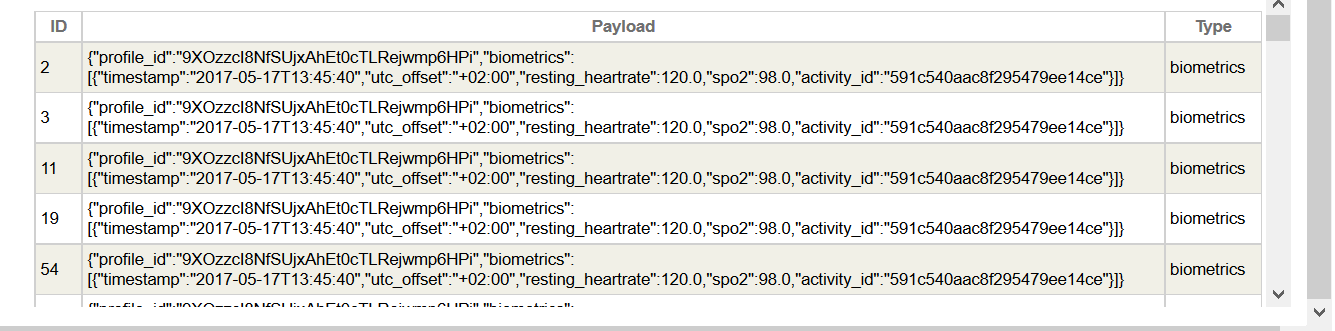
I want to order my records by the most recent timestamps values with profile_id and biometric type as keys, after comparing them with my personal program date (when the timestamp > at my fixed date : an alert message is sent to the patient)
you find here the attached screenshots for my to databases. thank's

Hi guys!
Unique, PrimaryKey and IDKey?
In what contexts does it apply?
IDKey sets the registry key access to the store.
PrimaryKey, Unique, and IDKey define the uniqueness in the records, but what is correct?
I use everyone? What is the context of each?
Hi world ,
when i apply this command :
Hi world,
Hi , World
this is i field in my global:
{"profile_id":"9XOzzcI8NfSUjxAhEt0cTLRejwmp6HPi","biometrics":[{"timestamp":"2017-05-17T13:45:40","utc_offset":"+02:00","resting_heartrate":120.0,"spo2":98.0,"activity_id":"591c540aac8f295479ee14ce"}]}
for information: it's respective key is "peyload"
my question is :
I want to extract the timestamps value , and the profile_id value , how can i do?
thank's
I've mentioned the QEWD project in this group before: it's a Node.js-based platform for web, Native and REST applications which tightly integrates with Cache. It uses a somewhat different philosophy to the use of Node.js than the norm, and I've now published an article that explains this approach and the unique benefits that arise as a result.
It turns out that, integrated via QEWD, Cache is an ideal bed-fellow for Node.js. QEWD makes the integration of Cache and Node.js exceptionally fast, simple and intuitive to use, but also extremely powerful.
Read the article here:
I have a tablepane which uses Sql to get his data:
As you look at the ''Business" column i have to type a number (key Value) to get the [Fashion Retail] value.
How do I have to modify the Built WHERE clause in order to filter on name /description of the Join Fields instead of the key value? I would like to filter on name/description rather than a key value. Some sample code is appreciated! Thanks in advance.
(Photo by Jeremy Thomas on Unsplash)
Dear Developer Community!
My name is Maks.
I developed DeclarativeCOS framework for declarative programming on COS.
Today I want to ask you about New Programming Language.
I have an idea to create new programming language which could be translated to COS classes / routines or even to int-files.
So, lets suppose it is happened. What do you want to see in such language?
Please feel free to say your minds. It is open discussion.
Hy.
Has anyone try to setup Cache DB in Docker Container?
Currently, we are utilizing batch jobs at the OS level to kick off routines that watch for files. We are trying to convert these processes to be performed by the Task Manager.
The routines have while loops and perform while loops so long as the time parameters are being met.
What's the best way to ensure Task Manager kicks them off after the completion of the shutdown/backup/start process is performed, which we do nightly? I want to ensure that it starts it regardless of the time that we've set.
Hoping someone can help.
I need to convert a timestamp from the following format (YYYYMMDDhhmmss e.g. 20160105125915) to UTC time in the same format.
I presume I need to convert it to the system format ( like $HOROLOG ) and then use something like ConvertTimeStampToHorolog or perhaps LocalWithZTIMEZONEtoUTC but not sure of the syntax.
Thanks,
Conor
Hello everybody,
we would like to be able to analyze a rather complex software application, which has been programmed in “M” for a number of years by different developers, by means of a tool.
Our goal is to find a starting point for a code refactoring process. In the long run we would like to gradually eliminate the code growth points.
Does anyone know of a tool that can help us to do this?
So far, we have only found "RE / m" etc. by George James Software, but we do not yet know if these tools will help.
Your support and suggestions will be greatly appreciated. Thanks.
Hi, world , i want to program a task for my adapterless business service for it be invoked each houre in the day by sending a trigger to my business process .
thank's
Hi !
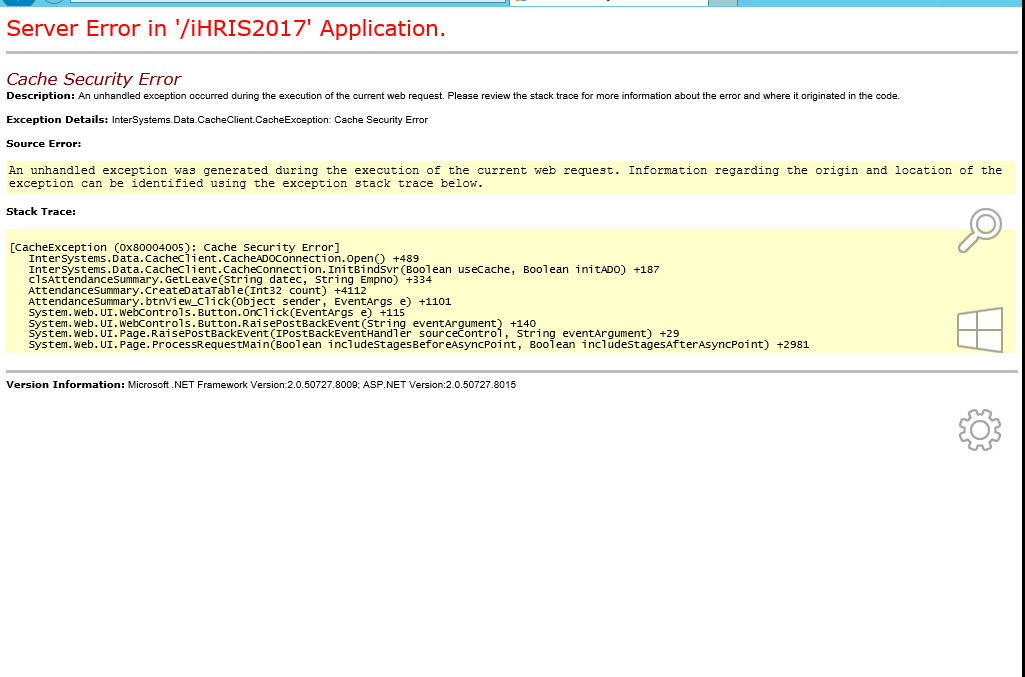
Can any one help me with this error? When the web site is run in localhost it is okay, but when run in server I'm getting this error.
Hello again! Welcome to the Part 2 - Handling payloads!
If you're new to this series, I'd recommend you to check out the Part 1 - Core concepts. You'll need a basic understanding about how Frontier works before continuing with the Part 2.
hi world, i want to browse an sql table on cache, and get min ,max value from one collumn, how can i do it ?
thank's
Hi all.
I have been using a command pipe to open/run UNIX scripts for months without issue. We recently installed the 2016 Caché Upgrade and now I'm getting the following error when opening the pipe:
<PROTECT> *OPEN[Q](|CPIPE|)
I assume some security or permission setting is to blame, but I'm not sure exactly what. Here's the snippet of code...
s cpipename="|CPIPE|" s filepath="/path/script" o cpipename:(filepath:"R"):10
Any feedback would be greatly appreciated!
Hello.
The idea of this post is to introduce Frontier: An abstraction layer that allows Rapid REST development.
REQUIREMENTS:
Why?
Have you ever found yourself dealing with repetitive tasks like mounting objects, serializing them and eventually handling multiple errors for multiple cases? Frontier can boost your development by making you focus on what really matters: your application.
Frontier is made to stop you from WRITE'ing by instead forcing your methods to return values.
It's designed to make you code clean, and you'll see the why pretty soon.
This is the Part 1, where you'll learn he basics about how to work with Frontier. That means at the end of this part you should be capable of
creating GET requests without difficulties. Since this also serves as a way to introduce the framework, I'll be calling this part: Core concepts.
Our application has a SOAP service that is currently exposed via the built-in Apache server inside of Cache. I have configured the application to IIS instead so we can IP-Filter, however I no longer wish to have the management portal or other resources via the built-in Apache server. How can I disable the built-in Apache server so internal resources no longer reply on that server and are instead routed via the IIS site?
I also want the management portal option via the right click on the cube to be pointed towards the IIS URL rather than the old Apache instance with a port number.
Hello guys,
I was wondering whether there is another alternative to extracting a certain string out from a bigger one, rather than using the function $piece.
Maybe regular expressions? Another specific function?
Example:
Big string:
NAD+SLA+++TextIsHereNAD+SLA+++TextIsHere
String I want to extract:
TextIsHere
Function I'm already using:
w $piece("NAD+SLA+++TextIsHereNAD+SLA+++TextIsHere","NAD+SLA+++",2) > Will ouput TextIsHere
w $piece("NAD+SLA+++TextIsHereNAD+SLA+++TextIsHere","NAD+SLA+++",3) > Will ouput TextIsHereThanks!
Hi I am trying to tie all terminal logins in Cache so that rather than the user being presented with the Cache login and password the user is presented with my custom login page.
I can do this via a generic user so that once the generic user logs in they are presented with my Cache login page however is there a way to do this so that I can bypass the below login page and go straight to my login?
Node: myserver, Instance: CACHE
Username:
Password:
Thanks in advance
Jon
Cache 2016.2.1
the system offers $LISTNEXT as a way of looping in $LISTs and the documentation says this is much more efficeint than writing
for i=1:1:$LISTLENGTH(myList) { set value = $LIST (myList,i) }I want to walk backwards in the list,
is there a $LISTPREVIOUS or do I have to use the followng syntax to achie
for i=1:-1:$LISTLENGTH(myList)kevin
Hi guys
Im trying to use an API running in AWS API Gateway.
This API is over https and i am using the SSL/TLS config of Caché.
set httpRequest = ##class(%Net.HttpRequest).%New()
set httpRequest.Server = server
set httpRequest.Https=1
set httpRequest.SSLConfiguration = "SSLPadraoAdapcon"
do httpRequest.SetHeader("Content-Type","application/json")
do httpRequest.EntityBody.Write(json)
do httpRequest.Post("/dev/router")But im getting this error:
So you have a namespace with thousands of .INT files and you want to identify routines that have not been executed in say the last 5 years. How would you do that without amending any existing software?