#Caché

30 Followers · 4.5K Posts


InterSystems Caché is a multi-model DBMS and application server. See more details here.

Documentation.

Article Jon Willeke · Sep 20, 2016 3m read

In OS X 10.8 and earlier, PHP was built with ODBC support, making it easy to connect to a Caché database:

$ php -r 'phpinfo();' |grep 'ODBC Support'
ODBC Support => enabled

However, this support was removed in OS X 10.9:

$ php -r 'phpinfo();' |grep 'ODBC Support'

Some people use Homebrew, MacPorts, or Fink to get their tools back. If you're comfortable coloring a little outside the lines (i.e., using sudo and the command line), you can build the odbc.so or pdo_odbc.so extension (depending on which API you prefer), and use it with Apple's version of Apache and PHP. You'll need the following:

1
0 2699
Question Thembelani Mlalazi · Dec 20, 2017

I am trying to read an xml document using %XML.TextReader and that's is all well and l can get my elements values  but would like to determine where the next record start on the xml without referring to the document path in essence would like to use the same method to read different xml docs. I would like to know if is there a way or a function that I can use to get the start and end of a record in xml  as I would to get the start and end element.

Typical example  l would like to get the highlighted paths please note this would need to go for any xml doc

6
0 907
Question Maarten Van den Vreken · Dec 15, 2017

Hi all,

I have a database with 140 million records containing financial transactions. When I do a query to calculate the sum of those records spanning a number of months it takes around 4 seconds on my database server which seems reasonable. However if I run the same query on an application server it takes around 40 seconds to do the same query.

In just this instance I would like to run that piece of code on the database server instead of the application server. It's a query that is only run a few times a day so I would prefer to have a fast result and don't mind putting a bit more stress on my database server for that.

4
0 891
Question Rick Clayton · Dec 17, 2017

I am trying to install cache 2017.2 on vagrant/VirtualBox and Ubuntu. I have tried both Linux precise64 3.2.0-23-generic #36-Ubuntu and Linux vagrant-ubuntu-trusty-64 3.13.0-137-generic #186-Ubuntu. I am getting an error that i can’t figure out. I have done this:

sudo apt-get install build-essential
sudo apt-get install software-properties-common python-software-properties
sudo add-apt-repository ppa:ubuntu-toolchain-r/test
sudo apt-get install libstdc++6
sudo apt-get install gcc-4.9 g++-4.9
sudo apt-get update
sudo apt-get upgrade
2
0 823
Question Arto Alatalo · Dec 14, 2017

Today %SYS.Namespace.ListAll started to report one namespace, for example USER, two times: once as "USER" and once as USER's database "^^c:\databases\user".

Details: my Cache instance has  50+ local namespaces. Today I have "touched" 3 of them (imported new classes), and now ListAll reports each of these 3 twice. Looks like ListAll is the only one who sees those strange duplicates, in all other places (Portal, Studio) only USER is shown.

Can someone explain what is happening?

9
0 415
Question Jenna Makin · Jun 1, 2016

I would like to write some code to parse a set of HTML pages from the internet in order to gather information from each web page.

All of the web pages are generated using a template, so the format of each of the web-pages is consistent with one-another and the information that I want to gather is always located in the same logical place within the page.

What is the best way to parse an html page in order to gather information at a specific place?

Can XML XPATH be used here?  Does anyone have any examples of parsing HTML content?

6
0 1737
Question Martin Karas · Dec 2, 2017

Hello everyone,

i want an automatic unidirectional syncronization of multiple databases (some tables from .dat file, not the whole .dat file) . 

So far i have tried everything from package %SYNC and the best working class is SyncSet with journals and guids. The problem is initial database transport for example when i want to add another server.  The easiest solution i have found is to transport syncing globals ^OBJ.SYNC.N to another database and then call %SYNC.SyncSet.Import(), however it seems not to work with only the global structure, although it works fine using import files.

7
1 1035
Question Soufiane Amroun · Dec 5, 2017

Hi community ,

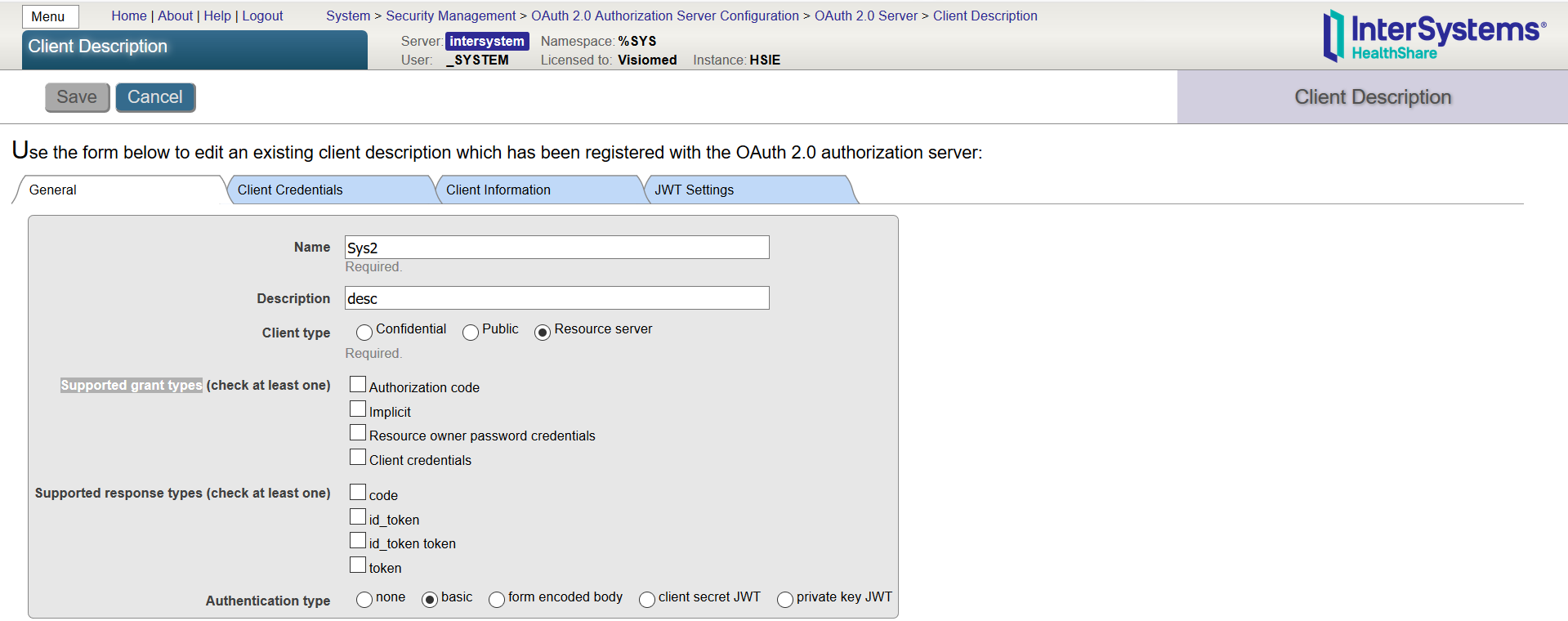
i come back to you , i've a problem with Client description in Oauth2, when i tick the  Supported grant types and i save , there are not registred on the OAuth2_Client.Metadata table .

can you tell me where is the problem please.

you will find attached a screenshot.

thank's

2
0 600
Question Sankar Manogaran · Dec 13, 2017

HI,

We are using Cache 5.0.15 version. We are facing <DISKHARD> error. I tried to copy the dat file, I am getting cyclic redudancy error. I did run the integrity check and repair utility . Nothing works. Now My question is how to recover the dat file with data.

Thanks in Advance! Sankar

1
0 186
Question Sébastien Demoustiez · Nov 21, 2017

Hello Community,

I recently encountered a issue with Caché and I can't figure out where the problem is coming from.

I noticed that the license limit (200)  was reached whenever I was opening my Studio (so it seems). When this occurs, I restart Caché (with the Cube in the Taskbar), and the number of license used is back to 1%, but grows back after.  The time taken before the number of license  grows back again looks pretty random.

Here is a couple of screenshots :

Does anybody know where the problem might come from ?

7
0 1994
Article Eduard Lebedyuk · Dec 7, 2017 3m read

In this article I'd like to discuss asynchronous REST and approaches to implementing it.

Why do we need asynchronous REST? Simply put - answering the request takes too much time. While most requests usually can be satisfied immediately, some can't. The reasons are varied:

  • You need to perform time-consuming calculations
  • Performing action actually takes time (for example container creation)
  • etc.

The solution to these problems is asynchronous REST. Asynchronous REST works by separating request and real response. Here's an example, let's consider the following simple async REST broker:

9
0 1888
Question Denis Zaripov · Dec 10, 2017

Hi, I'm a student, weak programming. I ask for your help, I write a program in C #, there are two tables, but I do not understand how to organize the connection between them many to many. Table in DataGridView1 from DataSet1 on Form1 key connection in DataGridView1 from DataSet1 to Form3

I do this on Form1

1
0 467
Question Sean Connelly · Dec 9, 2017

Has anyone tried adding syntax highlighting to GitHub for Caché CLS files?

Looking at the list of supported languages and extensions...

https://github.com/github/linguist/blob/master/lib/linguist/languages.yml

It looks like Mumps is supported, and there is also an existing language with a .cls extension, which would account for why I see some very odd highlighting going on with some of my code.

There is a page on contributing a new language here...

https://github.com/github/linguist/blob/master/CONTRIBUTING.md

Looks like its possible to use extensions more than once for different languages.

6
0 499
Question Nael Nasereldeen · Dec 10, 2017

Hi,

I'm trying to use the IN operator in SQL.

does not work, can anyone tell me why that could be?

for example:

SELECT * FROM TafnitCore_Logistics_TransferPackage_DB.PackageData  WHERE ID IN ('1||1||9852553062' , '1||1||9852553061' ) ORDER BY Building

And I get the following error:

3
0 528
Article Ponnumani Gurusamy · Dec 9, 2017 1m read
sample
    w "Total No.Of Sticks:21"_!
    s sticks=21
    r "enter machine name: ",a
    r "enter dev name: ",b
    w "Display 1 to 21 sticks"_!
    s i=""
    f i=1:1:21{
        w " "_i_" "
    }
user(sticks)
    w !_"User select 1 or 2 or 3 or 4 sticks:"_!
    r "User enter sticks: ",us
    if us>4 {
        w "please select upto 4 Sticks"
        r "User enter sticks: ",us
    }
    s cnt=sticks-us
    s sticks=cnt
    f i=1:1:sticks {
        w " "_i_" "
    }
    s dev=1
    s machine=0
    d:sticks=0 lost(dev,machine)
    d machine(.sticks,us)
    q
0
0 371
Question Ruslan K · Dec 8, 2017

I set column onclick event, but it is not working

col = ##class(%ZEN.Auxiliary.column).%New()
col.header = "Header"
col.colName = "Data3"
col.onclick = "alert('ok');"

D table.%AddColumn(col)

alert Ok is not show

What is wrong?

1
0 446
Question Thembelani Mlalazi · Dec 5, 2017

I am trying to age based on a given date and current date here is my code:


Property DOB As %Date
Method GetAge() As %Integer
{
   if (..DOB="")
    {
  set today=0 
    }
   else
  {
  set today=$ZDate($HOROLOG,2)-$ZDate(..DOB)
  }
  write "Today's==="_$ZDate($HOROLOG),!
  write today
  return today
}
4
0 2763
Article Vitaliy Serdtsev · Dec 8, 2017 6m read

First-class functionwiki

In computer science, a programming language is said to have first-class functions if it treats functions as first-class citizens. This means the language supports passing functions as arguments to other functions, returning them as the values from other functions, and assigning them to variables or storing them in data structures. Some programming language theorists require support for anonymous functions (function literals) as well. In languages with first-class functions, the names of functions do not have any special status; they are treated like ordinary variables with a function type.

This post continues the article “Declarative development in Caché”.

[2357111317].forEach(function(i) {
  console.log(i);
});

How to do something like this in Caché using COS?

Below are some exercises on this topic.

0
0 532