Hi,
Need your help on executing ##Class(Backup.General).ExternalFreeze() and ##Class(Backup.General).ExternalThaw() operations in
Atelier REST API setup. Please provide us example code if any.

InterSystems Caché is a multi-model DBMS and application server. See more details here.
Hi,
Need your help on executing ##Class(Backup.General).ExternalFreeze() and ##Class(Backup.General).ExternalThaw() operations in
Atelier REST API setup. Please provide us example code if any.
I need to write a script to answer a couple of fairly simple questions:
1) What is the current routine DB (name and location) for this namespace?
2) What is the current data DB (name and location) for this namespace?
3) Is global ^ABC mapped to a different location than the default data DB?
Can anyone point me to some system APIs that would allow me to answer these questions?
Thanks!
Ben
Hello
Please I have a problem to save all name of files attached in table with date and load all files attached in directory
My code HTML
-------------------------------------
<cache block="INC_REAPRO">
<form method="post" id="formupload" enctype="multipart/form-data" action="cache-call:SubmitUpload^MyMac" data-upload-url="cache-call:FileUpload^MyMac">
<input type="hidden" value="##/SERIENR##" name="SERIENR" />
<input type="hidden" value='' name="FILE" id="upload-select-hidden" />
<div id="upload-drop" class="uk-placeholder">
<div id="upload-text" class="uk-text-center">
Hi,
I ran into the Issue https://hibernate.atlassian.net/browse/HHH-10620. The workaround described at https://community.intersystems.com/post/support-java-hibernate-5 worked for me. I'm using Hibernate Version 5.3.2.Final.
It would be nice if someone from InterSystems could fix the the problem in Hibernate. That was mentioned in https://community.intersystems.com/post/support-java-hibernate-5 but it doesn't seem to have happened.
Hi,
Most of my classes are mapped from Globals. I want to access Cache classes from a BI software through ODBC connection.
'Last update' information does not exist in most of the classes. My question is whether there is a 'last update' timestamp that is automatically generated for each line in classes I can extract to external systems?
Thanks
Can anyone tell me how to discover in ObjectScript the operating system and operating system version that Caché is actually running in? (Not the operating system the build was compiled for.)
I need to dynamically create a class based on a parameter passed into a class method. Basically the method takes in a string that contains the name of the class I need to create a new instance of.
I need something along these lines.
ClassMethod someMethod(className As %String)
{
	set classObject = ##class(className).%New()

...
}
Trying to do this right results in a class not found error because it seems to be treating the variable as a literal string.
Working on implementation FHIR to my project, I found interesting project HAPI-FHIR, which could help me to quickly launch my FHIR api server with InterSystems Caché as a storage, because this projects uses Hibernate to connect to database, as an example they use DerbyDB. I tried to change settings to use InterSystems Caché, but unfortunately it does not work and throw some errors inside HIbernate. As I found in Caché documentation, I have not some many options, I just have to set Cache dialect, and set database url. This projects uses Hibernate 5.
Hi Everyone,
I am trying to built a SSIS package thru BIDS Visual Studio 2013. My Datasource is a InterSystems Cache Database, I wanted to Import Tables records from the Datasource to MS SQL Server 2014.
As a Sanity check. I only created one Package to import one Table to MSSQL Server to try out. The connection to the InterSystems Cache Database was successful. The DSN for the InterSystems Cache Database is created in the System for 32 and 64 Bit.
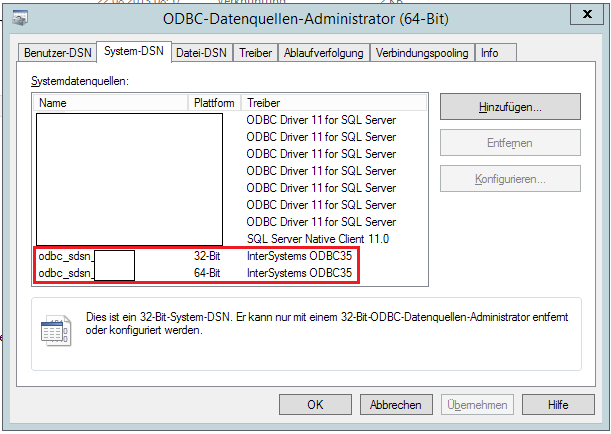
Here is where my Problem lies.
Has anyone worked out a way to use LDAP to define the default namespace on multiple servers? I know that documentation says that intersystems-Namespace-xxx only supports one namespace, but how is this useful? Any workaround to say have intersystems-Namespace-server1-namespaceA and intersystems-Namespace-server2-namespaceB? Is it best practice to use the same "namespace" on every server?
Thanks!
I downloaded and installed the trial version of Caché.
it is installed in c:\intersystems\Trycache
I changed the system environment settings so that
GLOBALS_PATH = c:\intersystems\Trycache
and PATH includes c:\intersystems\Trycache\bin
Caché works, and I can login, use the globals, etc...
when I run any executable like , I receive that exception error on the console :
An attempt was made to load a program with an incorrect format. (Exception from HRESULT: 0x8007000B)
I'm trying to interpret a ObjectScript pattern and I am stumped on the first part. I understand everything else but not sure what 1.A means. I know A stands for Alpha characters just not sure what the 1. means
The following code provides information about software builds. Read the original description below for information about the different methods:
Hello,
I have been trying to pull data through a linked server in SSMS from an InterSystems Cache Database for a while, this is to enable us to join the data to other source systems in our Data Warehouse.
I have set up an ODBC connection and a linked server to the database and can execute queries through OPENQUERY in Management studio, but the data is huge (> 100million rows). So when I execute a SQL query with a WHERE clause the query just spins.
If I SELECT TOP 100 with no where clause the query returns data, so I know that all the connections are correct.
I'm trying to execute a nodejs process to perform some work on a string from Cache/Mumps over to nodejs, then return the result from nodejs as a string back to the code in Cache and I was looking at the `$ZF` logic - it will let me output the results to a file (i.e. temp.
What is the difference between %ID and ID in a database table? Both seem to reference the same column labelled ID.
For context, I am trying to create a viewer class for an existing persistent class.
Let us call the persistent class A, with SqlTableName = OldA.
The viewer class will be B with SqlTableName = A and ViewQuery = {select %ID, <other fields> from <some other class with the same fields as A>}
In A, there exists a class query: select %ID from A. However, A fails to compile, giving an error: "Field '%ID' not found in applicable tables". If the %ID is replaced with ID, the class compiles.
Where do I download the package cache-jdbc-2.0.0.jar. I'm trying to develop a java app that connects to a Cache Database to grab information? Thank you.
Hi All,
We are using BI tool for reporting which required to connect TrakCare system using JDBC Connection
Can some can assist with Jar file which is required for the connection or anyone did befoe?
Thanks,
Syam
Hi,
We are trying to write an external backup application to backup Cache Database. After going through the Cache DB documentation, we have found that in Backup.General class there are methods for creating snapshot (Freeze/Thaw) which is required during backup. Are there REST APIs for the same?
Also we have the option of selecting individual DB instances in the management portal. What are the methods/APIs of getting the DB list, so that user can select individual DB instances in an external backup application ? Do we have the methods/APIs to freeze/thaw the individual DB instances ?
Thanks!
(Originally posted on Intersystems CODE by @Eduard Lebedyuk, 10/12/15) The following code snippet outputs all filenames in the file path "dir" in the Cache/IRIS terminal. The class method "test" runs the code:
Class eduardlebedyuk.filenamesInDir Extends %RegisteredObject
{
	classmethod test() {
		// replace dir with file path you want
		set dir = "D:\directory"
		set dir = ##class(%File).NormalizeDirectory(dir)
		set file=$ZSEARCH(dir_"*")
		while file'="" {
			write !,file
			set file=$ZSEARCH("")
		}
	}
}
Hi!
Is there any way to export a class package to xml file programmatically which will include all the classes of the package?
Attached code contains a very basic $system.WorkMgr example.
It uses several jobs (workers) to update different chunks of rows of a table.
Steps:
In this case, I have tested the example in a 8-core laptop:
USER>do ##class(IAT.S04.WorkMgr.Simple).%DeleteExtent()
USER>do ##class(IAT.S04.WorkMgr.Simple).Populate(100)
USER>do ##class(IAT.S04.WorkMgr.Simple).
Hi,
I would like to know if anyone has had some experience in building systems for multiple end-users.
To keep things simple, in a hypothetical example, say an Event Booking System, where a Venue could sign up to use such a system and define it's Venue, costs, calendars, etc.. and then invite their customers to book the Venue on different days/times.
If I wish to offer such a system to many
I'm trying to set up a webserver (Apache 2.4 on Windows 10) for a CSP application on a Cache which is not running on the same Computer.
My Problem is that in the csp-pages there is a declaration:
<script language="JavaScript" type="text/javascript" src="/jbsscan/javascript/javascriptScanner.js"></script>
When I access the csp pages the stylesheet and javascript file are missing, in the http trace of the csp gateway I see that there is a 404 for these files.
This code snippet contains the class method "test" which sends an HTML email. Change the literal strings in the method to customize the email's from address, to address, subject, and body:
Class objectscript.sendEmail Extends %RegisteredObject
{
classmethod test() {
set m=##class(%Net.MailMessage).%New()
set m.From="user@company.com"
	set m.IsHTML=1

	do m.To.Insert("user@company.com")
	set m.Subject="Sent by IRIS mail"
	set m.Charset="iso-8859-1"
	do m.TextData.Write("<HTML><HEAD><TITLE></TITLE>"_$char(13,10))
	do m.TextData.Write("<META http-equiv=Content-Type content=""text/html; charset=iso-8859-2""></HEAD>"_$char(13,10))
	do m.TextData.Write("<BODY><FONT face=Arial size=2>Test <B>Test</B></FONT></BODY></HTML>")
	set s=##class(%Net.SMTP).%New()
	set s.smtpserver="mail.company.com"
	set status=s.Send(m)
}

}
Here's a link to the code on GitHub
This is my testClient:
Class XXX.RESTClient Extends %RegisteredObject
{
ClassMethod TestXXX()
{
#dim tRequest As %Net.HttpRequest = ##class(%Net.HttpRequest).%New()
set tRequest.ContentType="application/json"
s json=##class(%ZEN.proxyObject).%New()
s json.x="XXX"
d ##class(%ZEN.Auxiliary.jsonProvider).%WriteJSONStreamFromObject(.jsonStream,json)
set jsonText=jsonStream.Read(jsonStream.Size)
set tSC=tRequest.EntityBody.Write(jsonText)
set tSC = tRequest.
From the first glance, the task of configuring LDAP authentication in Caché is not hard at all – the manual describes this process in just 6 paragraphs. On the other hand, if the LDAP server uses Microsoft Active Directory, there a few non-evident things that need to be configured on the LDAP server side. Those who don’t do anything like that on a regular basis may get lost in Caché settings. In this article, we will describe the step-by-step process of setting up LDAP authentication and cover the diagnostic methods that can be used if something doesn’t work as expected.
Is it just set varName = 1 or is there an actual true/false value?
Hi every body
I hope it's the right place & I'm not offending any body.
I'm a veteran Mumps/Cache/Ensemble programmer . I think my only draw back is my age, although my brain is still young & bubbly.
I'm looking a long time for work without success.
I gathered a lot of knowledge & experience during those long years , developed many projects & i'm ready to do any work only to feel useful.
I'll add my resume, I hope & wish that this post will bring some change as I'm desperate to get some work.
Thank you very much Simcha my email is shiluvg@gmail.
Hi,
I was understanding the cluster configuration supported by the Cache. Have couple of queries around that:
1. In Cache version 2018.2, there is a shrading concept which splits the data of a Master Data server into multiple small data server which store shraded data.
How do we protect (backup and restore) such environment, should we also backup/restore the multiple small data servers along with Master data server. Any documentation around this will really help.
2.