I have seen three different type of data structure.
1.^a -> it is global
2. a^ - > It is tree
3. a| -> I don't know what it is.
if any one know as please share your knowledge.

InterSystems Caché is a multi-model DBMS and application server. See more details here.
I have seen three different type of data structure.
1.^a -> it is global
2. a^ - > It is tree
3. a| -> I don't know what it is.
if any one know as please share your knowledge.
I am trying to age based on a given date and current date here is my code:
Property DOB As %Date
Method GetAge() As %Integer
{
   if (..DOB="")
    {
  set today=0
    }
   else
  {
  set today=$ZDate($HOROLOG,2)-$ZDate(..DOB)
  }
  write "Today's==="_$ZDate($HOROLOG),!
  write today
  return today
}In computer science, a programming language is said to have first-class functions if it treats functions as first-class citizens. This means the language supports passing functions as arguments to other functions, returning them as the values from other functions, and assigning them to variables or storing them in data structures. Some programming language theorists require support for anonymous functions (function literals) as well. In languages with first-class functions, the names of functions do not have any special status; they are treated like ordinary variables with a function type.
This post continues the article “Declarative development in Caché”.
[2, 3, 5, 7, 11, 13, 17].forEach(function(i) {
  console.log(i);
});
How to do something like this in Caché using COS?
Below are some exercises on this topic.
Hi Everyone,
I want to get current day name in cache. Does anyone know how to do that?
Is there a way to get one of:
As a return type from callout call?
And related question: is there a way to return several values (which may contain commas) from one callout call. Or rather what's the best approach when doing that?
Hi All,
Am getting the following error while try communicate with one ensemble from another ensemble using SOAP Adapter
ERROR #5002: Cache error: <TRANSLATE>zRead+195^%Net.HttpRequest.1
Any suggestions on this?
Thanks,
Dinesh
We have 1lakh records in table and while using sql select statement , it is taking more than 9mins to 12 mins to get the records. could you please how to optimize this performance issue if we have more records. how to optimize it.
Hi guys,
is there a way to get the Call-Parameter in an UrlMap to call a method that lies in another class?
Example:
I have a generic class 'RestApi' where I define all my routes for the different Rest-Services I offer - in order to get the same URL for every service.
Hi, Community!
Consider you move data from one server to another or make a deployment with persistent data. What do you do with index globals?
Is it always better to rebuild them or there are some cases when it worth to take them too?
Hi Guys,
Can you please guide me to get rid of this issue. Please find the image files with this post.
Please let me know, before we are developing an API what are all the setup/Configuration(Apache/web server) need to do in my machine.
If any lead would be appreciated.
I don't know, in XMLNamespace parameter which URL need to use.
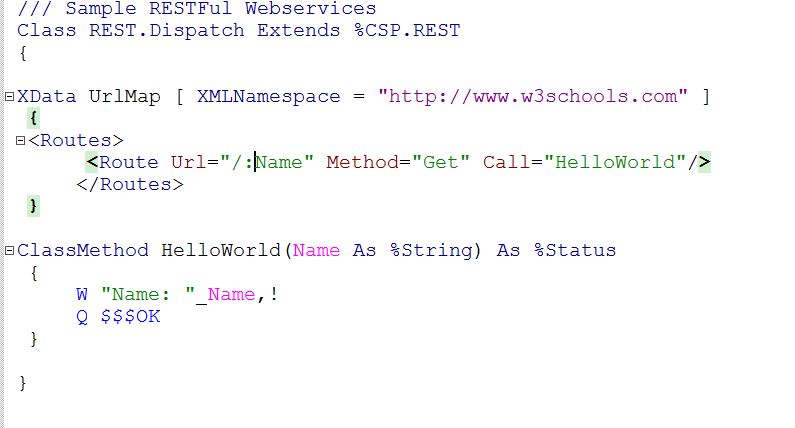 .
.
Thanks,
Arun Kumar Durairaj.
DB Intersystems size = 635 gb, while backup size = 669 gb. Cache version is 2013.1
I am using cache for Cobas infinity IT solutions for medical lab information system.
Any idea why is this happening? When the DB was smaller, the backup was less in size. but later I noticed this issue
thanks
Yasser
Hi All, Can you please tell me how to get the Size of the Global Subcript. In Cache 2016 - they are using ##Class(%GlobalEdit).GetGlobalSizeBySubscript() For Older version how to get the GlobalSize of the Subscript. Because the method is not exist in Older Versions and all.
Hi, folks!
Suppose you have a Caché class with %String property which contains relatively large text (from 10 to 2000 symbols).
The class:
Class Test.Duplicates Extends %Persistent

{

Property Text As %String (MAXLEN = 2000);

}
And you have thousands of entries.
What are the best options to find entries which are duplicates on this property?
... but let’s first look at error handling.
Hi folks!
Is there a one line command to map class package A to Namespace ASPACE?
In short, I wanted to react on CPUusage warnings and alerts with my own actions. It seemed that it was possible in my Caché version (2015.1):
http://docs.intersystems.com/cache201513/csp/docbook/DocBook.UI.Page.cl…
But all my attempts silently failed. Callback code was as simple as possible:
Class %z.Monitor.Health Extends SYS.Monitor.Health.AbstractCallback
I've got my alerts written to alerts.log and cconsole.
I am trying to find documentation on how Cache Studio locks a Routine/Class a developer is editing.
On the flip side, I am looking for documentation on how Atelier does the same.
Ultimately I am looking for the differences and what happens if both Studio and Atelier through different developers go after the same Routine/Class.
I am not asking for an answer (however that would be nice), I am looking for pointers to documentation.
Hi,All,
I did a small coding for the HTTP request and HTTP response. When i tried to use a server with ping i was able to get a response from the HTTP request. But when i tried the same with HTTP response i am getting a empty value in the response why is that?
Thanks in advance.
aa=$zwc(411,1,1,3)/*$bit(1,3,5)*/
bb=$zwc(403,1,0,2)/*$bit(1,3)*/
Is there a handy function to test wether one bit string is covered by another one bitstring? For example, "bb" is covered by "aa".
I currently implement this by one AND operation and then do a bitcount, I just want to know any default function is already out there.
Thanks.
Hello,
I was wondering if there is a way to maybe temporarily alter the [Private] tag dynamically or any other way to run a Unit test against class method, which has been labeled as [Private]?
I mean, I understand there is a workaround to create a non private class method inside this class, which will in turn call this private method and run a Unit test on the non private method, but I am looking for a way to do this without altering the original class.
Thank you,
Alex
Guys,
Can you please guide me to create a RESTful API in our cache with JSON response.
Caché will not change the cryptographic settings in an existing TLS configuration when you upgrade. This means that unless you've updated them yourself, you're still using the values from the very first version you started using SSL in.
If you've upgraded since creating your TLS configurations, take a moment to look at the enabled protocols and ciphersuites to make sure you've enabled all the versions you want, and disabled the old versions you don't want.
Dear community!
I'm currently working on MessagePack implementation by using Cache ObjectScript.
I try to choose suitable representation for binary array.
Should I use $lb or $c or smth else for it?
I have an application in Cache 2013 (No Ensemble) which need to consume a REST web API over internet.
Can somebody please help me by pointing out the documentation or provide me code sample for consuming the REST API from a routine/class.
I am using Cache 2008 (No Ensemble) .
Hello!
Suppose I have a package with classes which I want to rename. All these classes are persistent and they already have a lot of data stored.
The best I can think of to do is the following:
5. finishes successfully.Hello.
We're about to implement an application that could use WebSockets intensely so before we head to that direction we need to figure out about how some few things work. That being said, anyone care to give me some enlightenment?
This is (the end) of a series of programming challenges for beginners and experienced Caché programmers.
For an introduction : go to article https://community.intersystems.com/post/advent-code-2016-day1-no-time-t…
This is the 25th and last challenge of the 2016 series of Advent of Code.
In this challenge, you have to send a signal out, using the assembunny code interpreter that we had to make in earlier challenges.
There is one extra instruction added to the assembunny language, which outputs a value (out x).
Using the instructions as input (see http://adventofcode.
Is there any way to specify in which order indices are built during:
So far I think they are built by name order.
This is a series of programming challenges for beginners and experienced Caché programmers.
For an introduction : go to article https://community.intersystems.com/post/advent-code-2016-day1-no-time-t…
Today, you need to find your way through a maze (again). There are 8 points of interest in the maze, and you have to visit them all, starting with point 0.
You may visit some points more than once, in random order. The challenge is to find the shortest path through the maze while visiting all points.
Dear community!
I have problem with index NULL value. Unique index doesn't work for this case. If I use insert and one of parameter is "NULL". Message of constraint doesn't appear and row is inserted into table successfully. How Can I use index with NULL?
Class TestClassIndx Extends %Persistent
{
Property name As %String [ Private ];
Property age As %String [ Private ];
Property country As %String [ Private ];
Index IndextestUniq On (name, age, country) [ Unique ];
}
INSERT INTO TestClassIndx (name,age,country) VALUES ('1','2',NULL)
Best Regards