Hi Community,
I need to remove first tag from a XML file in service and send file to the process ,how do i remove line from the File and process it
Thanks,
Smythee
InterSystems Business Process Language (BPL) is a language used to describe executable business processes within a standard XML document.
Hi Community,
I need to remove first tag from a XML file in service and send file to the process ,how do i remove line from the File and process it
Thanks,
Smythee
I need to use a context variable in my code block for the table to query. When I use :content.table, it does not work. When using the literal, it does. How do I get the :context to work?
.png)
I have a Service reading a flat file and routing to a Process. Does anyone know how to get the %Source value into a BPL context parameter?
.png)
Very similar question posed here: https://community.intersystems.com/node/467496, but I am missing a piece of this:
How do I correctly call a EnsLib.HL7.MsgRouter.RoutingEngine class from the BPL?I can successfully call the BPL from the EnsLib.HL7.Service.TCPService, and I have the BPL created to delay then call the rule. And I set the context and the result location..png)
This rule is really basic just sending the HL7 content to a EnsLib.HL7.Operation.
.png)
When implementing deferred response there was a problem initially with a few responses which meant we had blank jobs spawned somehow. How do you get rid. All the operation does is:
SET..SendRequestAsyncThese all sent ok and tried to update status to 9 from 6 hoping it would clear the blank jobs but it didn't . The original issue has been resolved weeks ago.
To transfer data between production components I actively use messages of type Ens.StreamContainer class and its descendants. In many cases the content of the message content is not visualised (the 'Body' tab contains a table with a list of selected message properties but the 'Contents' tab is empty). Response messages are never visualised, and request messages are visualised with a fifty-fifty probability. What do I need to do to ensure that messages are always visualised?
In a Business Process (Ens.BusinessProcessBPL), how can you correctly call a classMethod?
I know we can call it in a block <code> :.png)
Or in a <assign>
Are there other ways and/or good practices?
Thanks
Corentin
I want to execute initialization code on the start of my business process.
I thought OnInit is a way to go, but apparently not - ^dbg global remains empty:
Class Test.BP Extends Ens.BusinessProcess
{
Method OnInit() As %Status
{
    Set ^dbg = 1
    Quit $$$OK
}
}
Ideas?
Our TEST environment and PROD environment are on two different versions of HealthShare Health Connect.
| TEST | IRIS for UNIX (Red Hat Enterprise Linux 8 for x86-64) 2024.1 (Build 267_2U) Tue Apr 30 2024 16:06:39 EDT [HealthConnect:7.2.0-1.r1] |
| PROD | IRIS for UNIX (Red Hat Enterprise Linux 8 for x86-64) 2022.1.4 (Build 812_0_22913U) Thu Dec 7 2023 17:06:30 EST [HealthConnect:3.5.0-1.m1] [HealthConnect:3.5.0-1. |
Hello,
First of all: thanks for your help, and thank you for your time.
Thanks for your time.
We have the following situation:
We are in a BPL, and we have defined 4 <call> asynchronous as follows:
First one name: "Enviar a Proceso NEGRIN"
.png)
The second one, named as: "Enviar a Proceso HUNSC"
The third one, titled: "Enviar a Proceso CHUIMI 02"
And the fourth and last one names as: "Enviar a Proceso Fuertev"
Inmediately after the 4 calls, we have a <sync> instruction which should wait for all of them to finish.
I have a BPL iterating over Dynamic arrays. Can I add Dynamic Array (%Dynamic Abstract Object) and also %Iterator.Array to BPL context? I tried and I see Error: %AddToSaveSet method does not exist for %Iterator.Array
I have been trying to track down an issue we are seeing in our TEST environment with Memory usage.
We have Several BP's for years now that take a HL7 message, parse it apart, and make calls to a Custom EnsLib.SQL.OutboundAdapter to have it execute Insert/Select/Update/Delete stored procedures against a MS SQL Database via JDBC connection. We are using Microsoft's JDBC 12.2 driver to do this.
What we are seeing is that IRIS.WorkQueue globals are being defined for these calls but then the IRIS.WorkQueue is not being cleaned up and taking up large amounts of Memory.
<> <> # IRIS-API-Template
zpm "install iris-rest-template"
Make sure you have git and Docker desktop installed.
git clone https://github.com/samuelxabc/IRIS-API-Template.git
docker-compose build
I am still trying to understand and come up with a use case to use FHIR as an enhancement to our existing HL7 messages. Does anyone have an example of taking a FHIR response and transforming it into a SDA?
How does the workflow go? Does it go through 1 BP?
Thanks
Scott
Hello.
I have a business process with an "ASTM" class : .png)
Inside this process i have a business rule. Inside this rule i want to get a specific field inside the message :
So i will use the same logic for HL7 messages. Here is the "path" to the segment and the field :
So i will use this inside the routing rule like i did for HL7 messages.
i have tried MUCH prefix like "ASTM" "X12" "ESI.X12" ..... I only got errors like << PROPERTY DOES NOT EXIST >>
Can someone tell me what i'm doing wrong ?
Thanks.
Thomas.
I have this response, which is a FHIR location resource in a bundle. I would like to load the entry(0).resource into a context property defined as HS.FHIR.DTL.vR4.Model.Resource.Location so I can use it as a source in a DTL. Any help would be greatly appreciated. Thanks.
{"entry":[{"fullUrl":"https://dev-api.hosp.org/idkl/fhir/r4/v1/Location/ATH-1375-PRV-a-1375.D…","resource":{"extension":[{"url":"https://api.hosp.org/idkl/extensions/StructureDefinition/is-messaging-e…","valueBoolean":true}],"id":"ATH-1375-PRV-a-1375.
Does the assign action not work? Why doesn't MSH:7 get updated to the current DT?
.png)
As I begin our adventure into using an External FHIR Repository, I wanted to see what opinions people have about a design Idea I was working on.
I want to create a way that my Team has the ability to send a Message Type, and the system knows from that Message Type which FHIR queries to execute and return the Response back to the user, sort of like a FHIR Query Hub. Does this sound reasonable?
In a HL7 Business Rule, I want to create a custom function that works on an HL7 message object (ENSLIB.HL7.Message). I extended the Ens.Rule.FunctionSet class, and have a class method that accept a ENSLIB.HL7.Message obj -
ClassMethod myfunction(msg As EnsLib.HL7.Message) As %Boolean, so I can call myfunction(HL7) in the rule's condition
The problem is, it seems that I can only use absolute property paths such as msg.GetValueAt("1:9.2") but not a path containing HL7 segment name, for example as in msg.GetValueAt("MSH:9.2"). This is a huge limitation.
Hi
We have a use case whereby very large HL7 MDM messages, which contain many OBX segments, need to be processed by a custom business process. Part of the process is to iterate over each OBX segment and set a value in the same field for each segment.
Testing with a message that is ~500MB and contains over 8000 OBX segments I've encountered <STORE> errors, which surprisingly seems to be due to using SetValueAt. It appears to get through a few thousand segments before it falls over with the memory error, which I assume is because the SetValueAt method keeps in memory each preceding OBX segment?
We have a business process that seems have extra jobs hanging around. This is what we see in the Jobs tab:
.png)
Only the bottom one is actually associated with a process. So what are those other ones? There are no queues and I have no way of finding out why they're there.
Thanks.
IRIS for UNIX (Red Hat Enterprise Linux 8 for x86-64) 2024.1 (Build 267_2U) Tue Apr 30 2024 16:06:39 EDT [HealthConnect:7.2.0-1.r1]
I have a use case where Epic is sending an A60 Allergy transaction is set at the Patient level, but we have a system called VIBE which needs the ADT at an Encounter level instead. Currently we store ADT information in a MS SQL database for years, and we are querying it to get the latest Account Number to insert into the ADT^A60 for VIBE.
This MS SQL Visit Database was built over 20 years ago and is quite cumbersome to keep maintaining.
I have an API that does not have all the data. Like it is truncated. Magic number of characters seems to be 163,280
I do an <assign>
context.RawBundle=##class(%DynamicObject).%FromJSON(context.FHIRResponse.Body)
The error does not happen when the response is < 163,280 chars. And when < 163,280 chars, it is a complete FHIR Bundle. Have anyone experienced this? If so, what is the resolution?
.png)
BPL stands for Business Process Language.
This is an XML format for describing complex information orchestration interactions between systems.
InterSystems Integration engine has for two decades, provided a visual designer to build, configure, and maintain, BPL using a graphical interface.
Think of it like drawing a process flow diagram that can be compiled and deployed.
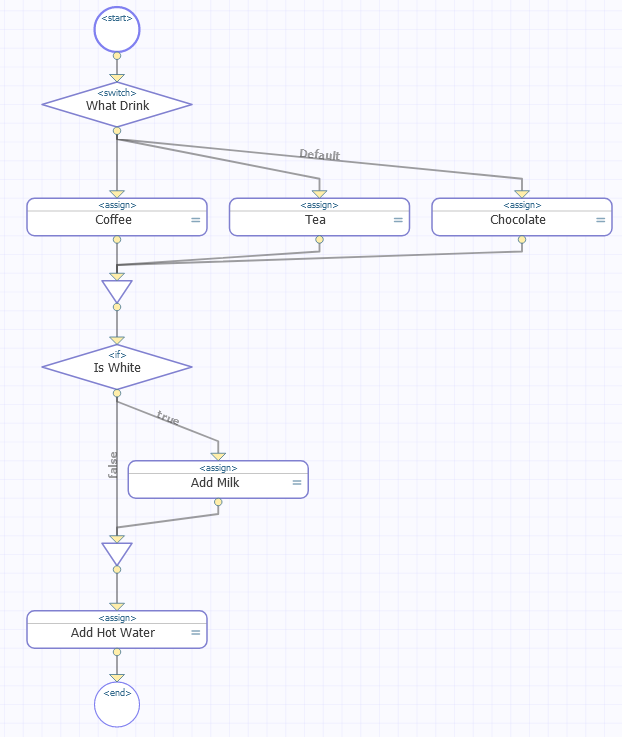
BPL components are added to Integration productions like any other built-in or custom business component.
Hi all,
When making a Business Process reusable, I needed to make the target of a <call> configurable as a business host setting. This can be done through indirection. Here's how:
In The Business Process and the Business Operation, I am using the following code to get the value of TimeCreated and TimeProcessed
BP:
%Ensemble("Process").%PrimaryRequestHeader.TimeCreated
%Ensemble("Process").%PrimaryRequestHeader.TimeProcessed
BO:
..%RequestHeader.TimeCreated
..%RequestHeader.TimeProcessed
But I am trying to use ..%RequestHeader.TimeCreated in Business Service it is not storing any value.
How to get the value of TimeCreated and TimeProcessed in Business Service?
Hi,
Is there a way to send certain message based of source into top of the queue of business operation.. so that that message will processed right away.
Hi Community,
What is Defination of XData which we use using in Object script
we are using XData MessageMap and XData DTL
How can we use XData for different functionalities
Thanks,
Joe
Hi there,
I'm working on a project where I retrieve RawHL7 message(ORU R01 2.3.1) content from a database in a BPL. I've created a context object of type Enslib.HL7.Message, and I need to populate it with the contents from the RawHL7 message so that I can use this context object as source for my DTL transformation.
Does anyone have suggestions on the best approach to achieve this? I'm looking for guidance on how to efficiently transfer the data from the RawHL7 message to the context object.
Thanks in advance for your help!
Hi,
How can I effectively unit test a Business Process Language(BPL) that incorporates three code activities calling methods from distinct ObjectScript classes?.
Appreciate any insights or examples.
Thanks,
Nimisha