Is it possible to lock down health insight so a client can only query their own patients? and Is there a way to use a visualization tool like Tableau instead of the dashboard of DeepSee while still querying from DeepSee?
I need to dynamically create a class based on a parameter passed into a class method. Basically the method takes in a string that contains the name of the class I need to create a new instance of.
I need something along these lines.
ClassMethod someMethod(className As %String)
{
	set classObject = ##class(className).%New()

...
}
Trying to do this right results in a class not found error because it seems to be treating the variable as a literal string.
I am working on my first REST operation concept and had a question about the Property Parameters. If I put a value in CAPTION, does that mean that when I use it in my call that it will come out in the URL?
For example...
Property enumerationType As %String(CAPTION = "enumeration_type");
Then in my operation...
Set tURL=..Adapter.URL_"?q="_pRequest.enumerationType
so when it builds the URL it looks like...
By using the screen "Message Viewer", which parameters have to be specified to know if a segment HL7 exists ; for example, OBX?
Best Regards.
Working on implementation FHIR to my project, I found interesting project HAPI-FHIR, which could help me to quickly launch my FHIR api server with InterSystems Caché as a storage, because this projects uses Hibernate to connect to database, as an example they use DerbyDB. I tried to change settings to use InterSystems Caché, but unfortunately it does not work and throw some errors inside HIbernate. As I found in Caché documentation, I have not some many options, I just have to set Cache dialect, and set database url. This projects uses Hibernate 5.
Hi Community!
Here is the digest of what has happened on the InterSystems Open Exchange in October 2018.
Application Releases
We had 12 releases in October:
Design Pattern in Caché Object Script v.1.0
Caché Simple Rule Engine Example v.2017.1
Adding tools in Studio Caché Intersystems v.1.2
Execute Server Commands from Caché / Ensemble / IRIS v.1.1
String Datatype - Regular Expression v.1.0
Hi Everyone,
I am trying to built a SSIS package thru BIDS Visual Studio 2013. My Datasource is a InterSystems Cache Database, I wanted to Import Tables records from the Datasource to MS SQL Server 2014.
As a Sanity check. I only created one Package to import one Table to MSSQL Server to try out. The connection to the InterSystems Cache Database was successful. The DSN for the InterSystems Cache Database is created in the System for 32 and 64 Bit.
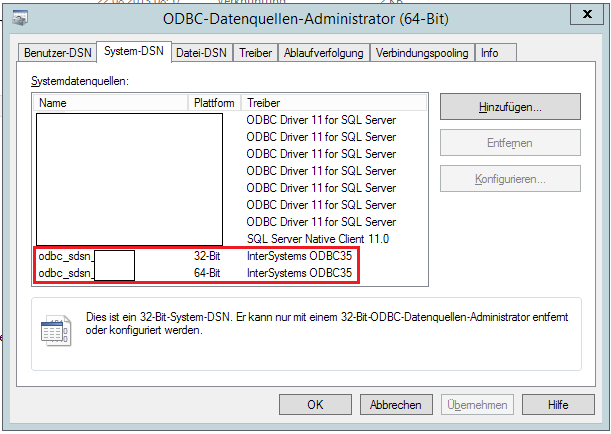
Here is where my Problem lies.
|
|
The minimum interval between invocations of the adapter by the Ensemble framework. For adapters that poll for external events, this is the polling interval. However, most polling adapters will process all inputs immediately if several are detected at one time. This is also the interval at which each Business Service will check for shutdown requests. Is this interval duration in Milliseconds or Seconds ? What is the highest or lowest that I can set in the Call Interval ? |
Hi, I want to create a service which on start will simply go through a list of values in a global and compare dates. If criteria is met, it will send an email.
But what kind of Adapter do I use? I see SQL, FILE, HTTP etc..etc.. But I dont want to use them
Please can you advice on how I should go about this?
Should I create a BS. Class and do onAdapterTASK() and simply build a method? Even then it is asking the kind of adapter I want
Would appreciate some guidance on this
Regards,
Eric
Has anyone worked out a way to use LDAP to define the default namespace on multiple servers? I know that documentation says that intersystems-Namespace-xxx only supports one namespace, but how is this useful? Any workaround to say have intersystems-Namespace-server1-namespaceA and intersystems-Namespace-server2-namespaceB? Is it best practice to use the same "namespace" on every server?
Thanks!
Here I’ll walk you through the process of creating a simple Node/Express API and connect it to a InterSystems IRIS instance.
I won't go into much detail about how to work with any of the technologies I will mention in this tutorial but I will leave links, in case you want to learn more.
The objective here is to give you a practical guide on how to set up and connect a node.js back-end API to IRIS.
Before we get our hands dirty, make sure you have Node.js running on your machine. So I'll check:
➜ node --version
v8.12.0
v8.12.0
Version 8.12.0 is the current LTS (Long Term support) version of node.js.
Hello guys,
I want to be able to export a range of messages from my production (from within a specific date interval), but while digging into intersystems documentation, it isn't giving me any details on how to perform this task.
It teases me saying "Ensemble provides a Message Viewer page for HL7. You can use this page to display, transform, and export HL7 messages (either external files or messages from the Ensemble message archives).", but then there are no signs of further information.
https://docs.intersystems.com/latest/csp/docbook/DocBook.UI.Page.cls?
Hi Developers!
New video from Global Summit 2018 is available now on InterSystems Developers YouTube Channel:
Unit Test Coverage in InterSystems ObjectScript
I downloaded and installed the trial version of Caché.
it is installed in c:\intersystems\Trycache
I changed the system environment settings so that
GLOBALS_PATH = c:\intersystems\Trycache
and PATH includes c:\intersystems\Trycache\bin
Caché works, and I can login, use the globals, etc...
when I run any executable like , I receive that exception error on the console :
An attempt was made to load a program with an incorrect format. (Exception from HRESULT: 0x8007000B)
I have an Ens.StreamContainer which holds XML that was received, and I need to validate that against an XSD schema. The schema is very simple, only looking at the root element and maybe a couple other items to ensure the XML is what we expect before continuing the data flow.
I have imported my XSD into the Ensemble XSD wizard, so it is available, but I'm struggling to find a method that does the validation.
I created a record map and my DTL works fine. I would like to query one of the values in my input record mapped class. How would I do that? I've tried request.Field1, document.Field1 and can't see to get my rule to work. Any help would be appreciated. Thanks.
I'm trying to interpret a ObjectScript pattern and I am stumped on the first part. I understand everything else but not sure what 1.A means. I know A stands for Alpha characters just not sure what the 1. means
Hi,
This must be a really easy question but for some reason I am unable to do this
I have a string name = "ERRORMSG"
I want to remove the first 2 characters in the string, so the result should be string newname = RORMSG
Please can you advice on how I can do this?
The following code provides information about software builds. Read the original description below for information about the different methods:
Hello,
I have been trying to pull data through a linked server in SSMS from an InterSystems Cache Database for a while, this is to enable us to join the data to other source systems in our Data Warehouse.
I have set up an ODBC connection and a linked server to the database and can execute queries through OPENQUERY in Management studio, but the data is huge (> 100million rows). So when I execute a SQL query with a WHERE clause the query just spins.
If I SELECT TOP 100 with no where clause the query returns data, so I know that all the connections are correct.
Hi, Community!
This is a digest of the Developer Community postings in October 2018.
Most viewed
IRIS API Explorer Application 204
Global Summit 2018 Highlights 158
Configuring LDAP authentication in InterSystems Caché using Microsoft Active Directory 137
Running Cache Studio on Linux 124
Time Loop in Cache Object Script 120
InterSystems Global Summit 2018 Highlights 118
Profiling code using Caché Monitor 116
JSON array or JSON object? 115
Creating complex JSON objects and accessing elements within 113
InterSystems IRIS Example Reference Architectures for Google Cloud Platform (GCP) 97
Execute Server Commands from Caché / Ensemble / IRIS 95
How to Publish an Application on InterSystems Open Exchange? 91
Create a Node/Express BackEnd and connect it to IRIS in less you say 'Mississippi' 66
Configuring Apache to work with InterSystems products on Linux 61
Caché eXTreme for .NET - direct access to globals from C# 52
I am currently using InterSystems for patients data management related to intake treatment planning and delivery of dose.
should I create a new attribute to track Patient ID or using an existing attribute within Audit log ? what are the good practices guidelines?
If I use Event Data field to record Patient_ID is it possible out of the box to search entries for a specific Patient_ID ?
Hi Community!
See all the Key Notes videos from Global Summit 2018 in a dedicated Global Summit 2018 Keynotes playlist on DC YouTube Channel!

I'm trying to execute a nodejs process to perform some work on a string from Cache/Mumps over to nodejs, then return the result from nodejs as a string back to the code in Cache and I was looking at the `$ZF` logic - it will let me output the results to a file (i.e. temp.
What is the difference between %ID and ID in a database table? Both seem to reference the same column labelled ID.
For context, I am trying to create a viewer class for an existing persistent class.
Let us call the persistent class A, with SqlTableName = OldA.
The viewer class will be B with SqlTableName = A and ViewQuery = {select %ID, <other fields> from <some other class with the same fields as A>}
In A, there exists a class query: select %ID from A. However, A fails to compile, giving an error: "Field '%ID' not found in applicable tables". If the %ID is replaced with ID, the class compiles.
Hi all,
I have a FTP.Inbounding service that read a file and move it to a other folder when it is processed. The problem is that is not working fine in SFTP server.
The code is coppied from How to - Customize Ensemble Settings article.
// begin customization code// get the Filename, attach the time stamp to it and move the file into the Archive directory// the Rename method below is using RNFR and RNTO FTP commands (RFC 959), effectively moving the file into the new directorypInput
It works if I'm using a simple FTP server, however if I use SFTP it doesn't work.
Hi Community!
I'm pleased to announce that InterSystems Developer Community reached 5,000 registered members!
Thank you, developers, not only for registering but rather for making this place more and more helpful for everyone who develops and supports solutions on InterSystems Data Platforms all over the world! Big applause to all of us!
We had our first meetup of the Prague Meetup for InterSystems Data Platform last Thursday!
As it was our first such venue, the attendance was not large, but we believe it was a good start. Those who attended could learn about new features that InterSystems IRIS brings to our partners and customers as well as listen to a presentation discussing what it takes to migrate from Caché or Ensemble to InterSystems IRIS and eventually containerizing their applications.
We all enjoyed excellent assortment of various tea species, accompanied by vegetarian food.
Where do I download the package cache-jdbc-2.0.0.jar. I'm trying to develop a java app that connects to a Cache Database to grab information? Thank you.


I was understanding the cluster configuration supported by the Cache. Have couple of queries around that:
1. In Cache version 2018.2, there is a shrading concept which splits the data of a Master Data server into multiple small data server which store shraded data.
How do we protect (backup and restore) such environment, should we also backup/restore the multiple small data servers along with Master data server. Any documentation around this will really help.
2.