I build a simple text string from an HL7 message in the DTL. What target message type and Business Operation should I use to write the text to a file?
Hi Community,
Enjoy the new video on InterSystems Developers YouTube:
⏯ Case Studies in InterSystems Supply Chain Orchestrator @ Global Summit 2024
I have VS Code with extensions connected to IRIS for Health. One top-level ObjectScript package is not displayed in the workspace for this namespace. This package exists in the namespace and is visible in SMP. If I create a new class with a different top-level package name (package that didn't previously exist) it will immediately appear in the workspace.
Is there any debug logging I can enable to look for errors or do any other troubleshooting?
Forgot to mention: the missing package is custom, not a system package.
In a containerized environment, you can manage your container time via the TZ variable or via the /etc/timezone and /etc/localtime directories:
environment:
      - TZ=Europe/Paris
volumes:
- "/etc/timezone:/etc/timezone:ro"
- "/etc/localtime:/etc/localtime:ro"You can find complete examples here:
My main goal of this article was to prove the use of InterSystems IRIS for Health for REST FHIR interoperability between multiple applications. In this use case, some initiating application makes a REST call to IRIS for Health (which is merely a passthrough for REST calls) to retrieve FHIR data from an Oracle Health R4 FHIR repository. Ideally, it simplifies the syntax for calling the Oracle Health APIs.
Hello,
I'm trying to add another segment to an HL7 MDM message. More specifically OBXgrp(1).OBX. The addition itself works,. When I look at the message in the trace, the segment with the content can be seen. However, it is not displayed as an OBX segment.
Build Map Status = 'ERROR <EnsEDI>ErrMapRequired: Missing required OBXgrp(1) element at segment 6'
'ERROR <EnsEDI>ErrMapSegUnrecog: Unrecognized Segment 6:'' found after segment 5 (TXA)'
.png)
// HL7-Nachricht klonen
    Set response = msg.%ConstructClone()

// OBX-Segment erstellen
Set tSegmentOBX = ##class(EnsLib.HL7.Segment).Hey Community,
More than 1000 applications are already available for everyone to download on the InterSystems Open Exchange.
And now it's time to announce the best developers and the most downloaded apps of 2024!
%20(2).jpg)
Let's take a closer look at our heroes and their apps:
Hello I try to implementing this service, and try to convert HL7v2, FHIR on both sides.
https://github.com/grongierisc/iris-healthtoolkit-service/
I download this service and tried run docker-compose but after that I get some error.
Building iris
[+] Building 8.Iris Healthtoolkit Service
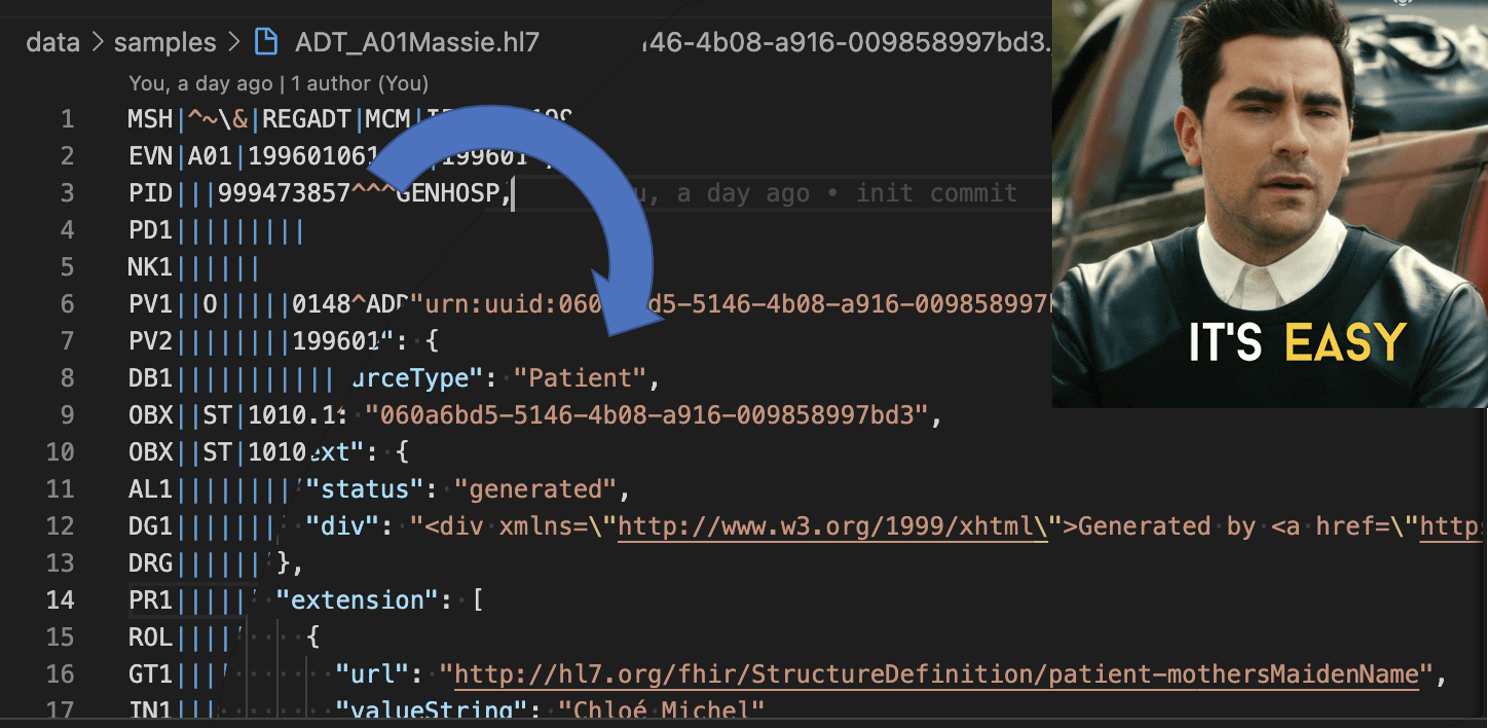
Easy to use HL7v2 to FHIR, CDA to FHIR, FHIR to HL7v2 as a Service.
The aim of this project is to provide an REST API that can convert easily various health formats. Post the desire format in the REST body, get the answer in the new format.
-
:fire: Official Version : https://aws.amazon.com/marketplace/pp/prodview-q7ryewpz75cq2 :fire:
-
:tv: Video : https://youtu.be/lr2B7zSFkds :tv:
Install
Clone this repository
git clone https://github.com/grongierisc/iris-healthtoolkit-service.You need to install the application first. If not installed, please refer to the previous article
Application demonstration
After successfully running the iris image vector search application, some data needs to be stored to support image retrieval as it is not initialized in the library.
Image storage
Firstly, drag and drop the image or click the upload icon, select the image, and click the upload button to upload and vectorize it. This process may be a bit slow.
.png)
This process involves using embedded Python to call the CLIP model and vectorize the image into 512 dimensional vector data.
Is it possible to get the length of queue for a production using Python code?
I'm using embedded Python at the moment.
I'd like to use the Python external language server later - the Python external server will not start in my environment.
If it is possible to query the production queue length programmically, please advise how?
It would also be nice to show the number of messages processed per second, if IRIS keeps track of this.
Hey Community,
Enjoy the new video on InterSystems Developers YouTube:
I am looking for a link to documentation that shows what responses are available to commands like:
^%GI, ^%GO, ^%RO, ^%RIMF
tried search in docs.intersystems.com "https://docs.intersystems.com/iris20243/csp/docbook/Doc.Results.cls?doc…"
So far had a suggestion just go to the code to figure it out.
Hi Community,
🏥Are you using HealthShare® Health Connect Cloud™ to integrate your data?
Learn more aboutdeployments, integrations, and source control tools so you can optimize your use of this cloud-based managed service.

While working on getting JSON support for some Python libraries, I discovered some capabilities IRIS provided.
- JSON_OBJECT - A conversion function that returns data as a JSON object.
- JSON_ARRAY - A conversion function that returns data as a JSON array.
- IS JSON - Determines if a data value is in JSON format.
- JSON_TABLE function returns a table that can be used in a SQL query by mapping JSON.
- JSONPath support - is a query language for querying values in JSON.
Hello and welcome to the Open Exchange Annual 2024 Recap.
General Stats:
✓ 139 new apps in 2024
✓ 7,069 downloads in 2024
✓ 1,029 applications all time
✓ 38,243 downloads all time
✓ 2,981 developers joined
✓ 7,069 downloads in 2024
✓ 1,029 applications all time
✓ 38,243 downloads all time
✓ 2,981 developers joined
Hello and welcome to the Developer Community Q&A Annual 2024 Recap.
General Stats
✓ 1,000 questions published in 2024
✓ 9,066 questions published all time
We are using a DTL transformation to take HL7 and transform into custom XML. But the nodes in the resulting XML are appearing out of sequence - and therefore failing validation against the schema.
The XSD schema for the XML looks fine when imported into Ensemble: root node in the XSD looks like this:.png)
And shows in Ensemble like this:.png)
The transformation looks like this, and we can see the text from the trace elements at lines 5, 12 and 19 appear in the correct order in the event log:
.png)
HOWEVER, the resulting XML has the <allergies> nodes before the <patientNotes> nodes.
We are using a DTL transformation to take HL7 and transform into custom XML (XML is a virtual document, held in an EnsLib.EDI.XML.Document object). The schema specifying the format of the XML says one element should occur no more than 24 times (maxOccurs="24" in the XSD schema). However, the transformation to produce one such element always produces 24 elements, all but the last one blank, when tested stand-alone. And when the sub-transform producing one element is incorporated into the full transformation to produce the whole XML object, it produces the wrong output.
Hi,
We are currently switching from Studio to VSCode and central GIT with Serverside Development and have a few start problems.
I have set up a system with Git.
The baseline commit including remote push works.
But now I have a problem with the VSCode. When I create and compile a new class, it saves it correctly. But if I want to make further changes to the class, it saves the class and loads it again with the previous status. So the changes I made are gone again.
I have deactivated CompileOnSave without success.
The log shows the following
exporting new version of Utils.HL7Documentation.
Hi Community!
We hope you know that when you have an interesting idea about InterSystems products or services, you should publish it on the Ideas Portal. And those Developer Community members who implement the proposed ideas are added to the "Hall of Fame". Want to get accepted to the InterSystems Ideas Hall of Fame? Read on to learn how you can get on the list.

Hi All,
I don't know if I am doing something wrong or maybe a setting is off.
But while in Cache Studio, under the Edit menu, when I use "Find in Files . . ." nothing is returned, regardless of what I am trying to find.
Weird.
Hello,
Very much keen if we could gather the per namespace and business component utilization of InterSystems cache server.
For e. I have a PRD server where its CPU utilization is at max all the time and I want to know which namespace and its business process (service/Operation/Process) is utilizing what number of CPU and memory.
** I can get the CPU and Memory utilization per Cache.exe and PID, but not able to get the Namespace and ConfiguratioName to which that particular PID belongs.
Thank you,
Our target system requires a blank ROL segment whenever the ROL segment does not exist in an A08 from our source system. I'm not sure if this can be done with the DTL gui tools or if some sql or other code is required (coding is not in my wheelhouse). Here is what I've tried, but this does not yield the "ROL|1|" I'd like to create. Any help would be greatly appreciated.
.png)
Here is the input message that I'd like to add the ROL segment to:
MSH|^~\&|EPIC|MWH|||20250103094903||ADT^A08|175519|T|2.
I am a volunteer at a nonprofit that is attempting to connect to a product that uses InterSystems Cache (Clinisys LIMS). I have not used this database before, but I have used many others (MS-SQL, Oracle, etc.). I am hoping IRIS is compatible enough with Cache for this project.
I downloaded IRIS. I learned about Terminal [IRIS]. Using it I was able to create a new table, insert data, and retrieve it. I also used the Management Portal to query the new table. It also returned the data.
Next I attempted to connect with Visual Studio (MS VS 2022 Profesional). I downloaded the InterSystems.Data.
HealthShare Patient Index – Virtual February 19-21, 2025 9:00am-5:00pm US-Eastern Time (EST)
- Configure, tune, and work with HealthShare Patient Index, an Enterprise Master Patient Index.
- This 3-day course teaches the installation, configuration, and use of HealthShare® Patient Index.
- Day one focuses on patient identification issues, and the tools that can be used for reviewing records identified by the system for human attention.
- This session is appropriate for both technical staff and administrative staff who manage patient identification issues.
Hey Community,
Enjoy the new video on InterSystems Developers YouTube:
I'm looking for a new position. Part time/full time/temp. I'm flexible.
I have 20 years healthcare IT background - most recently with a startup where I built/supported interfaces in Mirth.
Even a temp project that needs someone to test or help with workflow. I have a background in end-to-end integration between systems (Saas/APIs, etc)
We have a vendor that can only send us a uu-encoded PDF. Is there a way to decrypt it in Ensemble?
Thanks
Scott Roth
The Ohio State University Wexner Medical Center