Is it possible to run a test case by classname instead of loading it from a directory?
I need to skip any directory loading completely since the directory with the source code does not exist.
Software testing is an investigation conducted to provide stakeholders with information about the quality of the software product or service under test.
Is it possible to run a test case by classname instead of loading it from a directory?
I need to skip any directory loading completely since the directory with the source code does not exist.
Hello everyone,
I am André from MedVertical. We are exploring InterSystems-native ways to operationalize continuous FHIR conformance: repeatable regression runs, baseline/delta comparisons, and evidence-style reporting to detect drift after releases and IG changes.
In many FHIR implementations, validation is done “point-in-time” in pre-prod, but conformance degrades in production due to IG/profile updates, terminology changes, mapping evolution, upstream releases, and configuration drift.
In the previous article, we examined how we can use the %CSP.Request and %CSP.Response classes to test a REST API without having the API fully set up and accessible across a network with an authentication mechanism. In this article, we will build on that foundation to perform some simple unit testing of one of our REST API methods.
The unit testing framework requires a couple of setup steps before we can use it. First, we have to ensure that the unit testing portion of the management portal is enabled so we can review the results of our tests.
Hi, Community!
Building integrations with InterSystems products? Find out about the latest UX enhancements available in version 2025.3!
Building Integrations: A New User Experience Version 2025.3
In this video, @Aya Heshmat, Product Manager for HealthShare® Health Connect, walks through:
💡You can opt into these enhancements for an improved experience with navigation and monitoring, as well as streamlined DTL creation and testing!
There seems to be a generous use of ClassMethods in ObjectScript code generally. I hope my own experiences aren't representative, but I bet they are. Forgive me for giving away the ending of this article, but in short: don't use them. Unless you can make a pretty convincing case that you have to, just never use them.1
What is a ClassMethod? In an ObjectScript class, you can define methods in two different ways: in a Method, you must instantiate an instance of the class to call the method, and in a ClassMethod, you can call the method without instantiating the class. Of course, in a ClassMethod, you don't have access to any properties of the object (because there's no object), but you can access globals (they are global, after all) and Parameters (which are class constants).
There are numerous excellent tools available for testing your REST APIs, especially when they are live. Postman, various web browser extensions, and even custom ObjectScript written with %Net.HttpRequest objects can get the job done. However, it is often difficult to test just the REST API without inadvertently involving the authentication scheme, the web application configuration, or even network connectivity. Those are a lot of hoops to jump through just to test the code within your dispatch class. The good news is that if we take our time to understand the inner workings of the %CSP.REST class, we will find an alternative option suited for testing only the contents of the dispatch class. We can set up the request and response objects to invoke the methods directly.
Hello!!!
Data migration often sounds like a simple "move data from A to B task" until you actually do it. In reality, it is a complex process that blends planning, validation, testing, and technical precision.
Over several projects where I handled data migration into a HIS which runs on IRIS (TrakCare), I realized that success comes from a mix of discipline and automation.
Here are a few points which I want to highlight.
1. Start with a Defined Data Format.
Before you even open your first file, make sure everyone, especially data providers, clearly understands the exact data format you expect. Defining templates early avoids unnecessary bank-and-forth and rework later.
While Excel or CSV formats are common, I personally feel using a tab-delimited text file (.txt) for data upload is best. It's lightweight, consistent, and avoids issues with commas inside text fields.
PatID   DOB Gender  AdmDate
10001   2000-01-02  M   2025-10-01
10002   1998-01-05  F   2025-10-05
10005   1980-08-23  M   2025-10-15
Make sure that the date formats given in the file is correct and constant throughout the file because all these files are usually converted from an Excel file and an Basic excel user might make mistakes while giving you the date formats wrong. Wrong date formats can irritate you while converting into horolog.
Developing and testing REST APIs in InterSystems IRIS often requires a significant amount of boilerplate code. While ObjectScript provides powerful tools for building APIs, writing consistent and repeatable tests can be time‑consuming. This is where IrisOASTestGen comes in.
IrisOASTestGen is a utility designed to generate the structure of test classes and the supporting utility code directly from an OpenAPI 2.0 specification
Yes, that's right, a Cache 2017.1 question. Let's all take a trip in the Wayback Machine.
The company I'm working for is in the process of starting to use the %UnitTest framework, and we are experiencing some errors in the code with some existing logic. Long story short, it looks like the best way to handle the issue would be to recognize we're executing the job as a part of a unit test. Is there any sort of variable or property that can be checked to confirm the process is indeed executing a unit test?
.png)
KWOK, Kubernetes WithOut Kubelet, is a lightweight tool that simulates nodes and pods—without running real workloads—so you can quickly test and scale IrisCluster behavior, scheduling, and zone assignment. For those of you wondering what value is in this without the IRIS workload, you will quickly realize it when you play with your Desk Toys awaiting nodes and pods to come up or get the bill for provisioning expensive disk behind the pvc's for no other reason than just to validate your topology.
Here we will use it to simulate an IrisCluster and target a topology across 4 zones, implementing high availability mirroring across zones, disaster recovery to an alternate zone, and horizontal ephemeral compute (ecp) to a zone of its own. All of this done locally, suitable for repeatable testing, and a valuable validation check mark on the road to production..png)
InterSystems IRIS interoperability production development involves using or writing various types of components. They include services (which handle incoming data), processes (which deal with the data flow and logic), and operations (which manage outgoing data or requests). Messages flowing through those components constantly require being adapted to consuming applications. Therefore,Data transformations are by far the most common component in interoperability productions.
In the early stages of data transformation development, thetest tool from the Management Portal becomes quite handy.
Hi, Community!
Looking for ways to improve your application testing? See how to build requirements such as performance and scalability into your development workflow:
If you like what you see please support this in the Developer Tools 2025 contest. Voting closes at midnight EDT on Sunday 3rd.
Overview I'm excited to announce the release of testcontainers-iris-node, a Node.js library that makes it easy to spin up temporary InterSystems IRIS containers for integration and E2E testing. This project is a natural addition to the existing family of Testcontainers adapters for IRIS, including testcontainers-iris-python and testcontainers-iris-java.
Why testcontainers-iris-node? As a Node.js developer working with InterSystems IRIS, I often faced challenges when setting up test environments that mimic production. testcontainers-iris-node solves this by leveraging the testcontainers-node framework to create isolated IRIS environments on-demand.
This is particularly valuable for:
Features
Well... It's time for testing. We know that often, it's already over. So, what now? Can I improve the quality of my development?
The answer is: YES. Yes, you can. The Toolqa tool aims to do just that. It's a facilitator. What's its goal?
To ensure that APIs meet pre-established business requirements, while also protecting against <sarcasm> future failed attempts </sarcasm> to destroy your application, website, app, or anything else that uses your API.
Now you might be wondering, how does this happen? Where's the magic?
The ToolQA.tool.
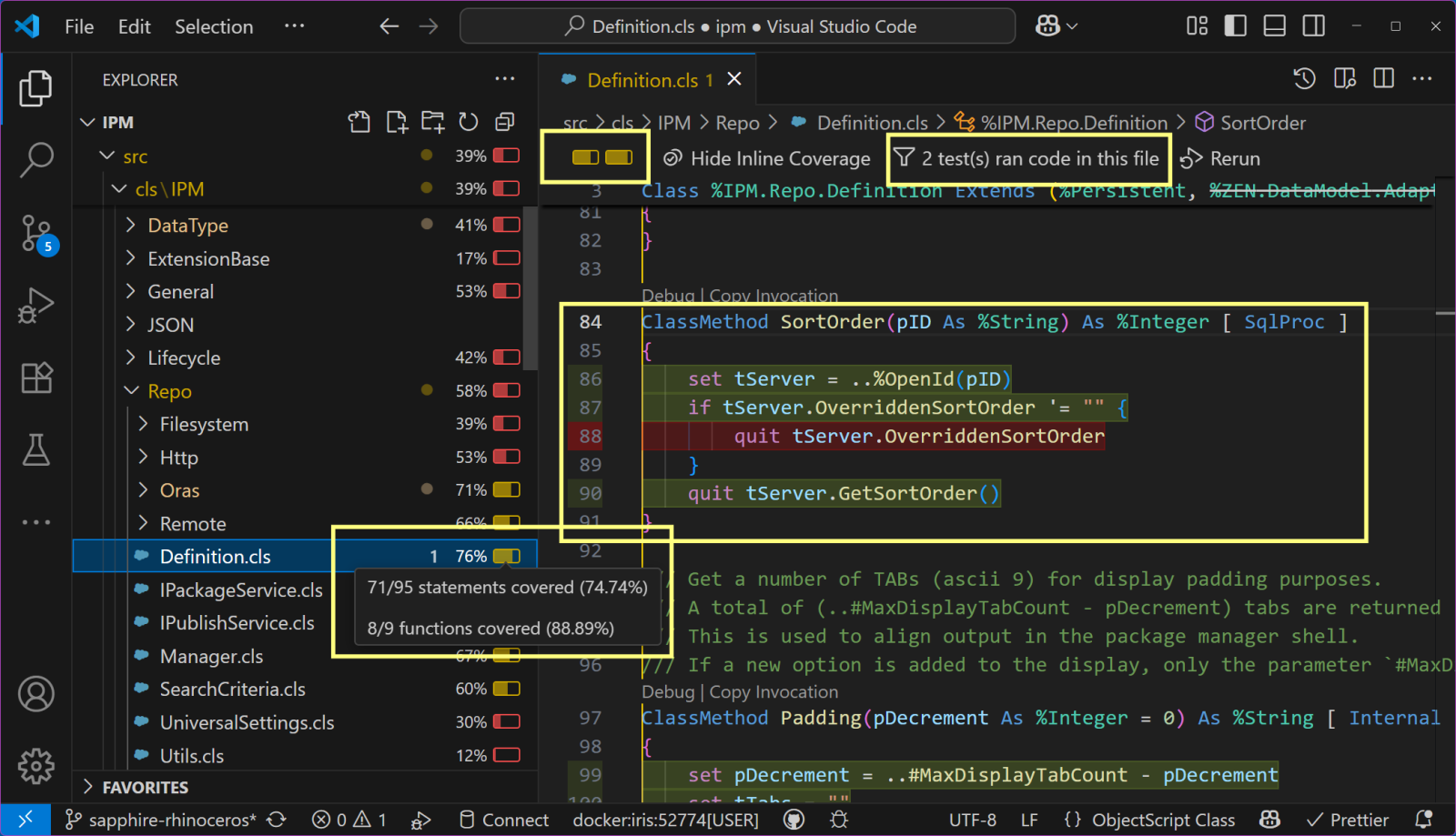
The new version of InterSystems Testing Manager which I released last week brings @Timothy Leavitt's cool
Test Coverage Tool to VS Code, and is my entry for the 2025 Developer Tools contest.
Here's a teaser screenshot showing how the unit tests of the IPM project don't yet cover a feature that apparently allows an IPM repository to override its sort order.
Now that we have a good understanding of Python and its features, let's explore how we can leverage Python within IRIS.
Are you curious about how to run Python scripts directly in your InterSystems IRIS or Caché terminal? 🤔 Good news it's easy! 😆 IRIS supports Embedded Python, allowing you to use Python interactively within its terminal environment.
How to access the Python Shell?
To launch the Python shell from the IRIS terminal, simply run the following command:
do ##class(%SYS.Python).Shell()This opens an interactive Python shell inside the IRIS terminal. From here, you can write and run Python code just as you would in a normal Python environment.
Users of the %UnitTest framework can now get test coverage information inside VS Code by combining the latest release (v2.0.0) of the InterSystems Testing Manager extension with @Timothy Leavitt's impressive Test Coverage Tool.

Above you can see the Test Coverage pane, which I have moved to the secondary sidebar on the right so it can more easily be explored in conjunction with the Test Explorer on the left.
Notice how the most recent test run (of all Test Coverage Tool's own unit tests) covered the BitValue method of TestCoverage.Procedures but not the BitCount method (nor 6 other methods).
Hey Community,
Last week, the InterSystems team held our monthly Developer Meetup in a new venue for the first time ever! In the AWS Boston office location in the Seaport, over 71 attendees showed up to chat, network, and listen to talks from two amazing speakers. The event was a huge success; we had a packed house, tons of engagement and questions, and attendees lining up to chat with our speakers afterwards!

Jayesh presents on Testing Frameworks for Agentic Systems to a full house
At hackathons that InterSystems participated and I supported, many students were asking how all their teammates could use the same IRIS database that they spun up in a container. I suggested using ngrok to expose their localhost IRIS and realized we don't have documentation on that. Hence, I thought this would be great to let more people knwo about this powerful technique for enhancing collaboration during development and testing.
This guide will walk you through the process of exposing your local InterSystems IRIS instance using ngrok.