#Kubernetes

1 Follower · 103 Posts

Kubernetes (commonly stylized as k8s) is an open-source container-orchestration system for automating application deployment, scaling, and management. It aims to provide a platform for automating deployment, scaling, and operations of application containers across clusters of hosts. It works with a range of container tools, including Docker.

Learn more

Question Tani Frankel · Feb 8, 2023

Does anyone happen to have a sample Configuration (CPF) Merge file that includes Action parameters setting up authentication methods (e.g. Password, Kerberos) for certain Services and Web Applications (e.g. via the ModifyService or Modify/CreateApplication AutheEnabled property)?

Thanks!

2
0 295
Announcement Anastasia Dyubaylo · Nov 11, 2022

Hi Community,

Watch this video to get a brief overview of the near- and long-term plans for HealthShare containerization and Kubernetes adoption, as well as a preview/demo of our current progress.

⏯ The Future of HealthShare in the Cloud: Containers/ Kubernetes @ Global Summit 2022

0
0 339
Question Kesav Kumar Kolla · Oct 29, 2022

Hi

I'm thinking to deploy healthshare using kubernetes. Has any one done this before? How will the TCP listeners in healthshare work with kubernetes? Will they automatically create a service endpoint so that I can route traffic?

Please advise me on how to think about this.

Thanks

9
1 370
Announcement Anastasia Dyubaylo · May 15, 2020

Hey Developers,

We're pleased to invite you to join the next InterSystems IRIS 2020.1 Tech Talk: DevOps on June 2nd  at 10:00 AM EDT! 

In this InterSystems IRIS 2020.1 Tech Talk, we focus on DevOps. We'll talk about InterSystems System Alerting and Monitoring, which offers unified cluster monitoring in a single pane for all your InterSystems IRIS instances. It is built on Prometheus and Grafana, two of the most respected open source offerings available.

Next, we'll dive into the InterSystems Kubernetes Operator, a special controller for Kubernetes that streamlines InterSystems IRIS deployments and management. It's the easiest way to deploy an InterSystems IRIS cluster on-prem or in the Cloud, and we'll show how you can configure mirroring, ECP, sharding and compute nodes, and automate it all.

Finally, we'll discuss how to speed test InterSystems IRIS using the open source Ingestion Speed Test. This tool is available on InterSystems Open Exchange for your own testing and benchmarking. 


6
1 646
Question Joost Platenburg · Mar 21, 2022

Hi,

Are we correct to assume that the IKO topology only allows for the use of one 'data' node type, and one 'compute' node type? So if we want to use several different iris based compute nodes (or data nodes) we have to apply several yaml files? So the following topology config is not possible:

topology:
    data:
        image: dvza.healthexchange.nl/mmres:0.1
    data:
        image: dvza.healthexchange.nl/mmauth:0.1
    data:
        image: dvza.healthexchange.nl/somethingelsethatisbasedonirisimage:0.1

Thanks in advance.

1
0 305
InterSystems Official Bob Kuszewski · Mar 15, 2022

The InterSystems Kubernetes Operation (IKO) version 3.3 is now available via the WRC download page and the InterSystems Container Registry.

IKO simplifies working with InterSystems IRIS or InterSystems IRIS for Health in Kubernetes by providing an easy-to-use irisCluster resource definition. See the documentation for a full list of features, including easy sharding, mirroring, and configuration of ECP.

IKO 3.3 Highlights:

  • Support for 2021.2 and 2022.1 editions of InterSystems IRIS & IRIS for Health
  • Support for Kuberentes 1.21
  • Deploy common System Alerting and Monitoring (SAM) configurations as part of your irisCluster
  • InterSystems API Manager (IAM) can now also be deployed and managed as part of the irisCluster
  • Automatic tagging of mirror pair active side, so a service can always point to the active mirror member.
0
0 286
Announcement Anastasia Dyubaylo · Jan 19, 2022

Hey Developers,

Watch as the presenter uses IKO to deploy the WebGateway, SAM, and InterSystems API Manager with the latest version of the InterSystems Kubernetes Operator: 

⏯ IKO: The InterSystems Kubernetes Operator (Version 3.0)

0
0 472
Announcement Derek Robinson · Jan 12, 2022

Hi All! For those of you who attended experience labs at the 2021 Virtual Summit, you may recall that one of the lab sessions was around Kubernetes. We've now converted that lab to be fully on-demand. You can launch a small cluster of VMs and follow the exercise to manage your Kubernetes cluster, deploy InterSystems IRIS containers to it, and watch its self-healing nature when destroying a pod.

It's a great introduction to Kubernetes if you are interested! See here: Achieving High Availability with InterSystems IRIS and Kubernetes

0
1 285
Article Mikhail Khomenko · Jan 5, 2022 8m read

We’ve already considered how to run an IRIS-based application in GCP Kubernetes in Deploying InterSystems IRIS Solution into GCP Kubernetes Cluster GKE Using CircleCI. Additionally, we’ve seen how to run an IRIS-based application in AWS Kubernetes in Deploying a Simple IRIS-Based Web Application Using Amazon EKS. Now, let’s look at how to deploy an application to the Azure Kubernetes Service (AKS).

0
0 753
Article sween · Dec 3, 2021 4m read

image Want a commercial grade FHIR® Implementation included in your micro service ecosystem and barely have enough time to fill out your Health plan elections?
Here is a quick way to invite the InterSystems® FHIR®Accelerator Service to your Kubernetes Microservice party for immediate use. The solution uses Nginx proxy ninja moves to get the job done. Though rustic and bound to create some technical arguments, I am pretty happy with the results until this community tells me otherwise, so FHIR® away as they say but it would be great if you heard me out first.

Disclaimer

0
1 623
Article Mikhail Khomenko · Nov 25, 2020 18m read

Introduction
Several resources tell us how to run IRIS in a Kubernetes cluster, such as Deploying an InterSystems IRIS Solution on EKS using GitHub Actions and Deploying InterSystems IRIS solution on GKE Using GitHub Actions. These methods work but they require that you create Kubernetes manifests and Helm charts, which might be rather time-consuming.
To simplify IRIS deployment, InterSystems developed an amazing tool called InterSystems Kubernetes Operator (IKO). A number of official resources explain IKO usage in details, such as  New Video: Intersystems IRIS Kubernetes Operator and InterSystems Kubernetes Operator.

2
2 1111
Article Mikhail Khomenko · Oct 11, 2021 9m read

In this article, we’ll look at one of the ways to monitor the InterSystems IRIS data platform (IRIS) deployed in the Google Kubernetes Engine (GKE). The GKE integrates easily with Cloud Monitoring, simplifying our task. As a bonus, the article shows how to display metrics from Cloud Monitoring in Grafana

Note that the Google Cloud Platform used in this article is not free (price list), but you can leverage a free tier. This article assumes that you already have a project in the Google Cloud Platform (referred to as <your_project_id>) and have permission to use it. 

0
2 509
Announcement Derek Robinson · Jun 16, 2021

If you're looking for an introduction to Kubernetes as a technology, and a little teaser about the InterSystems Kubernetes Operator, check out the recently released Kubernetes Overview video. This video will introduce you to the functionality and use cases of Kubernetes, and explain a bit about how the InterSystems Kubernetes Operator makes it beneficial to use Kubernetes with InterSystems IRIS.

0
0 224
InterSystems Official Steven LeBlanc · Aug 21, 2020

I am pleased to announce the availability of InterSystems Container Registry. This provides a new distribution channel for customers to access container-based releases and previews. All Community Edition images are available in a public repository with no login required. All full released images (IRIS, IRIS for Health, Health Connect, System Alerting and Monitoring, InterSystems Cloud Manager) and utility images (such as arbiter, Web Gateway, and PasswordHash) require a login token, generated from your WRC account credentials.

14
7 2323
Question Luiz Raeder · Feb 1, 2021

In the context of IKO (Iris Kubernetes Operator) the question of Service not redirecting dynamically to the correct Pod is still pending.
In production this can be dangerous since an overload (or any other simpler problem) can cause you to change the main Pod and leave the application inoperable until we intervene.

Intersystems support warned that this is still an issue of IKO, but there are some possibilities that I am studying.

To explore an idea I had, I would like the help of this Forum to answer the following question:

3
0 382
Article Evgeny Shvarov · Mar 20, 2020 3m read

Hi colleagues!

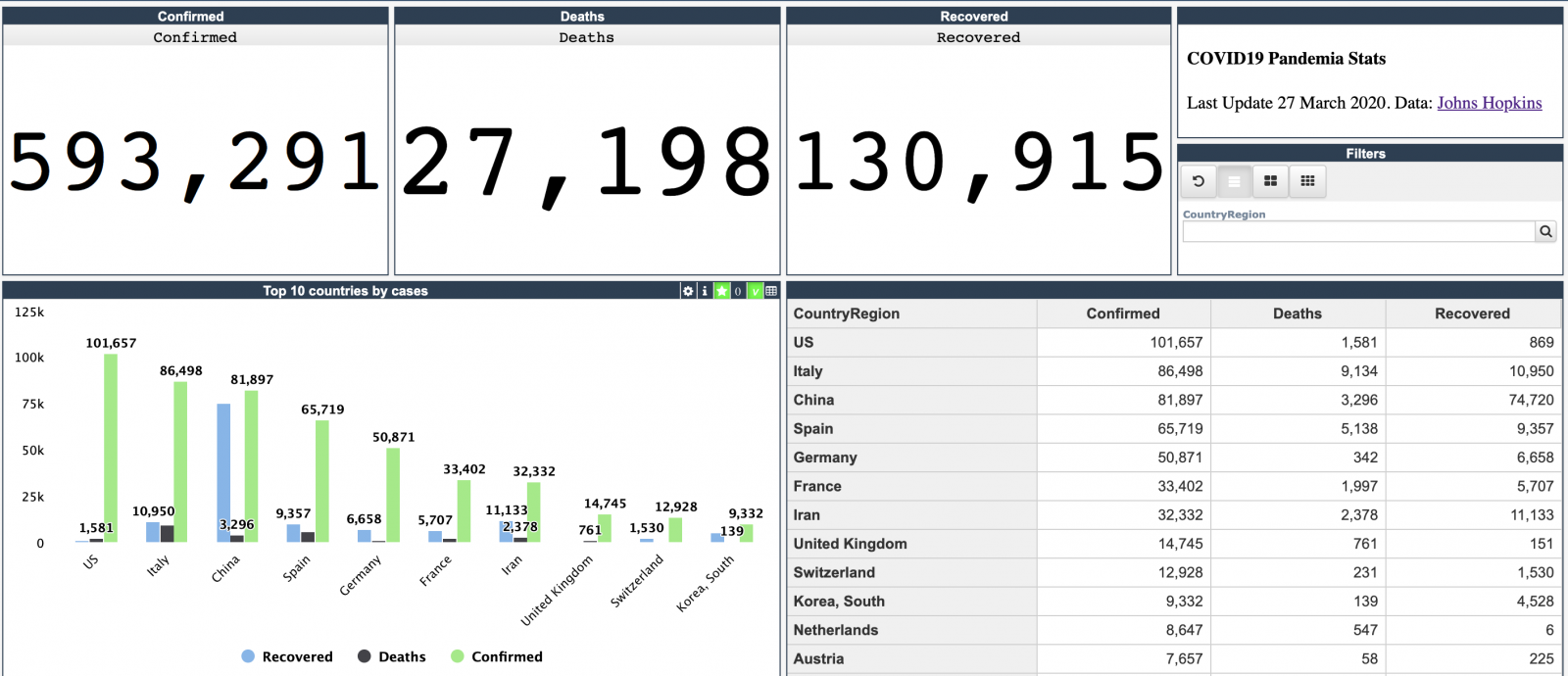
Every day Johns Hopkins University publishes new data on coronavirus COVID-19 pandemic status.

I built a simple InterSystems IRIS Analytics dashboard using InterSystems IRIS Community Edition in docker deployed on GCP Kubernetes which shows key measures of the disease outbreak.

This dashboard is an example of how information from CSV could be analyzed with IRIS Analytics and deployed to GCP Kubernetes in a form of InterSystems IRIS Community Edition.

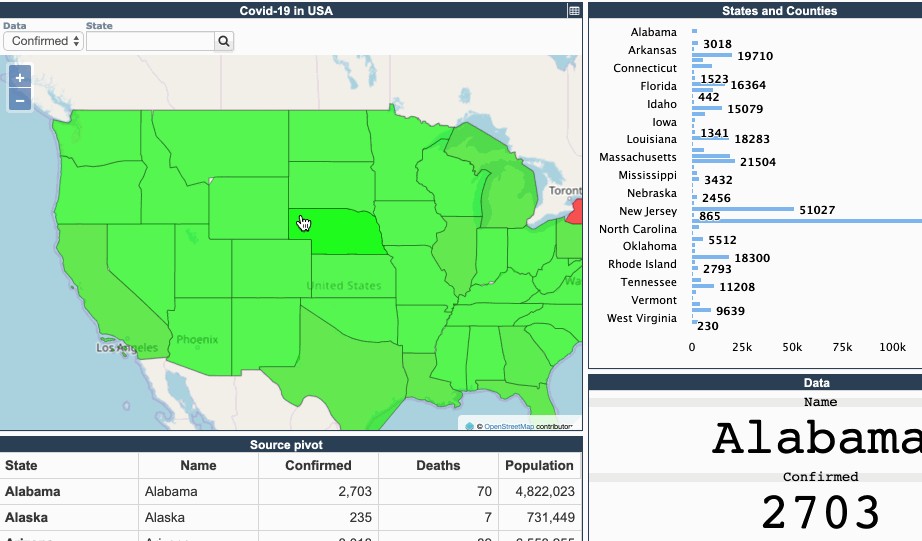
Added the interactive map of the USA:

13
3 1118
Article Mikhail Khomenko · Apr 20, 2020 14m read

This article is a continuation of Deploying InterSystems IRIS solution on GKE Using GitHub Actions, in which, with the help of GitHub Actions pipeline, our zpm-registry was deployed in a Google Kubernetes cluster created by Terraform. In order not to repeat, we’ll take as a starting point that:

1
1 753
Article Mikhail Khomenko · Mar 12, 2020 23m read

Imagine you want to see what InterSystems can give you in terms of data analytics. You studied the theory and now you want some practice. Fortunately, InterSystems provides a project that contains some good examples: Samples BI. Start with the README file, skipping anything associated with Docker, and go straight to the step-by-step installation. Launch a virtual instance, install IRIS there, follow the instructions for installing Samples BI, and then impress the boss with beautiful charts and tables. So far so good. 

Inevitably, though, you’ll need to make changes.

1
1 1288
Article Mikhail Khomenko · Feb 11, 2020 17m read

In an earlier article (hope, you’ve read it), we took a look at the CircleCI deployment system, which integrates perfectly with GitHub. Why then would we want to look any further? Well, GitHub has its own CI/CD platform called GitHub Actions, which is worth exploring. With GitHub Actions, you don’t need to rely on some external, albeit cool, service.

In this article we’re going to try using GitHub Actions to deploy the server part of  InterSystems Package Manager, ZPM-registry, on Google Kubernetes Engine (GKE).

1
1 1090