Hi All,
I know hundreds of people have done this but I'm looking for some DTL's as a start to do HL7 to FHIR, I appreciate everyone's HL7 is slightly different, but just some starter DTL's would be much appreciated? Can anyone help?
Regards
IRIS supports Data Transformation Language (DTL) for describing data transformations. DTL is an XML language. Ensemble provides wizards and graphical tools for creating, editing, and testing DTL transformations. A data transformation is a Caché class like the following. If you prefer you can use Studio to edit the class definition directly and bypass the wizards and graphical tools.
Hi All,
I know hundreds of people have done this but I'm looking for some DTL's as a start to do HL7 to FHIR, I appreciate everyone's HL7 is slightly different, but just some starter DTL's would be much appreciated? Can anyone help?
Regards
Someone may have asked this before but is there a way to return the TRACE statements that we have placed in the Data transformation within the DTL Editor Testing Tool (EnsPortal.Dialog.TestTransform.cls)? Is this something we can get in an Enhancement request in for?
It would save sometime in troubleshooting where an error might be in the DTL.
Just wondering...
Thanks
Scott
Cache for UNIX (IBM AIX for System Power System-64) 2018.1.3 (Build 414U) Mon Oct 28 2019 11:24:02 EDT [HealthShare Modules:Core:15.032.9026 + Linkage Engine:15.032.9026]
Hi all
Another newbie question.
A small percentage of our patients have an extra hospital number which was imported from the previous PAS but is no longer in use. We only need to send MRN and NHS number and would like to suppress CMRN. Could you please advise me how to do it in DTL?
PID|1|E05088888^^^RTPMRN^MRN^CD:14248745|00550972^^^RTPCMRN^CMRN^CD:4528185~E05088888^^^RTPMRN^MRN^CD:4528185~4449999999^^^NHSNBR^NHSNMBR|
Hi
Newbie question. Could you please help me implement the following using DTL only - no programming.
We have a problem where our system sends longer addresses e.g. block of flats in an unexpected format
e.g. address below:
Flat 22 Kings Court
49 Kings Road
Gateshead
NE10 8AW
Would be sent as
Flat 22^Kings Court^Gateshead^""^NE10 8AW^GBR^HOME^49 Kings Road^
With Road being sent right at the end after the post code and country etc. Shorter addresses are OK.
Hello Developers,
I am pretty new to developing using HealthShare, I am working on a project and need to create a custom DTL that will List multiple patients. Anyone have an idea on how to create this? Any help is much appreciated.
I have come across several cases where I need to set a Date filter to send only send any admit/scheduled date past a certain point. We have a couple different date comparison functions but none looking at the true date. Most of them are date + 15 or etc. Does anyone have a good date function they have written to say if x > 20170102 ?
Thanks
Scott
I need to add some extensions to the HS.FHIR.vSTU3,Model.Resource.Patient class and then use those extensions to convert incoming FHIR JSON to the FHIR Patient Resource and Likewise add functionality to create A FHIR Patient (target class) from my patient database into the FHIR Patient Resource Object (target class)
many months ago I found a tutorial that explained all of this but can no longer find that tutorial.
Yours
Nigel Salm
I am putting together a new interface to take in a CSV file and output an HL7 message.
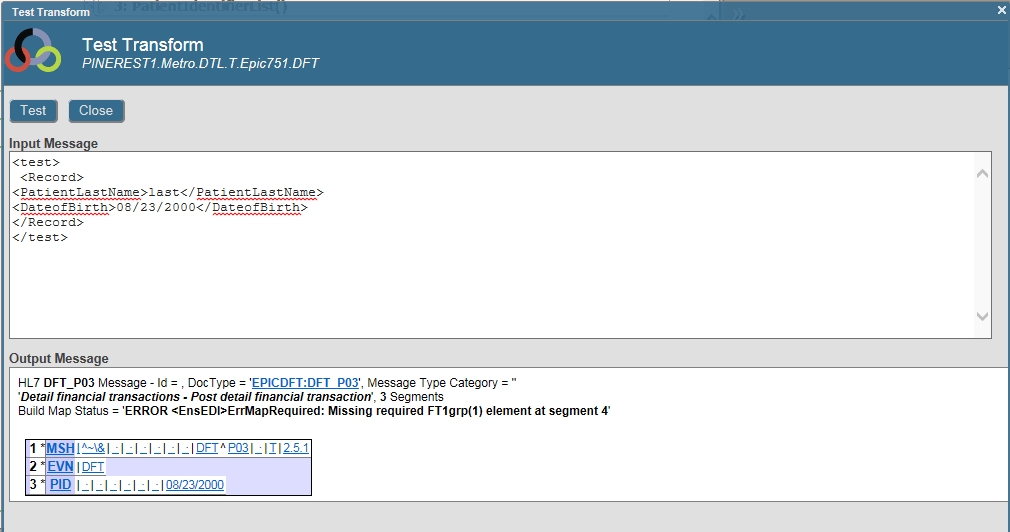
I have used the record mapper to create the source class and I am putting together the transform, but when trying to test it I am not seeing the data populate the HL7 as intended.
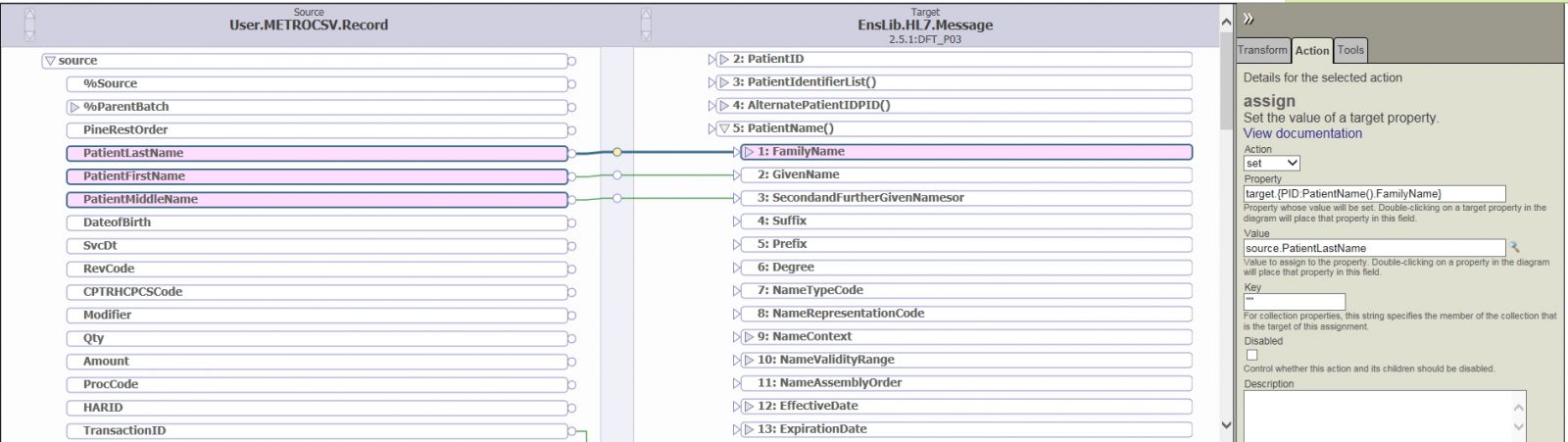
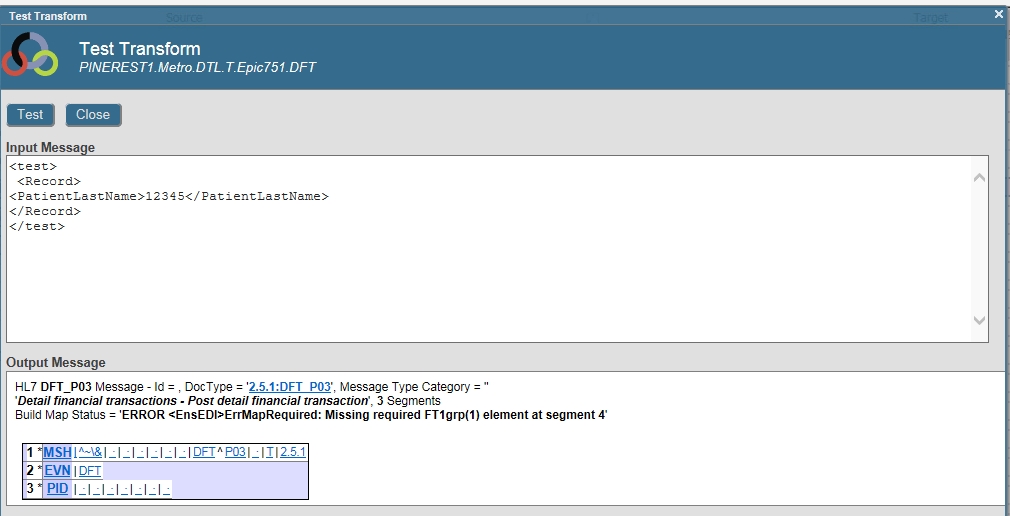
Also.... if I put a <DatofBirth> in the tester, it shows up in the HL7 as I would expect..... that's what really has me scratching my head here.
Greeting IRIS Community,
I need some help converting XLT (XML) into DTL (XML) pragmatically using COS or any other available options in IRIS for health.
It is for HL7-TO-nonHL7 translation.
See the following xlt content as an example that i have in XML Format.
<?xml version="1.0" encoding="UTF-8"?>
<?xml-stylesheet type="text/xsl" href="../../server/stylesheet/xltconfig.xsl"?>
<xltconfig name="accenture-1.xlt" site="thac">
<input>
<description>HL7 2.2/2.2 ADT_A16</description>
<href>thmaster/formats/hl7/2.2/22/index.xml</href>
</input>
<output>
I am having difficulties with using the ..Strip() function in my DTL to strip the slash ( / ) from the phone number portion of an x12 834. There are very few records that have the slash in the phone number, so I am trying to filter out any characters other than numbers so that all phone numbers are formatted 1112223333.
Here is the code portion of the strip:
Set HomePhone ..Strip(source.{loop2000(k1).loop2100A.PER:CommunicationNumber},"*AW","-()/").
I am then checking the length of HomePhone.
Hi,
Can anyone point me to an example of a DTL & Class method that can pull a base64 encoded PDF out of a MDMT02 message?
This is really asking for two things;
- how to make a DTL that extracts a specific subfield of an HL7 2.3 message into a message of its own,
and
- how to transform an base64 encoded document into its original binary form for writing to a file.
I'd also love to see an example of an HL7 2.n MDM^T02 ==> HL73.ITK2 non-coded CDA
I've seen some snippets in the community Q&A, but I've not been able to find any examples either here, or in the documentation or training materials.
We have a bunch of CSV files of a few different types, which contain patient and medication data, among other things, which we need to load into Healthshare, so the information can be compiled together and then viewed from the Clinical Viewer/reports made on the data as well.
I cannot find a straightforward example or any documentation about this particular case, which I would expect to be fairly common.
I need to set and use some context variables in a transformation (written in DTL), but the code is manually written.
When writing the same as BPL I define context variables and they are visible in transformations called by that process.
In something like this my.DTLtransform sets HL7 message fields to values in context variables:
Set qStatus = dtl.Transform(pRequest, .msg)
However, when I create a business process using custom code option, I don't see an obvious option, as well as documentation covering that area.
.png)
As I've become a little more familiar with HealthShare, I'd like to start exploring different ways of doing things. To date, the bulk of my data transformations have been using DTL; only using ObjectScript for a few operations that write to external SQL tables that were largely based on examples provided by my sales engineer.
I'd like to trying doing all of the data transformation in a process using ObjectScript.
Good day all -
I am attempting to use the Data Transformation Builder (for ease of use for my other engineers) to build up a web service request object to send to an outbound operation. The source is a custom persistent class (extends
When attempting to use a for each on one of the serialized properties of the source object, the for each works (source.
Hi Everyone,
We are trying to migrate old server to new infrastructure and need to sync all the DTL cls from old one to new one. There are hundreds of DTL in system and we tried to export from production but cannot select all at once which might cause some missing classes. Not able to connect to studio or atelier with that server neither. Is there any way that we are able to do mass export from system which will save some effort? Please let me know your thoughts. Thanks.
Hello,
In the DTL, is there a way to set a value for the HL7 data element in the code section?
For example,
set target.SetValueAt("PID:3(k1).1)") = mrn (mrn is the value returned from the SQL query)
When I ran the test utility, I got this error message.
ERROR
I tried both target.SetValueAt("PID:3(k1).1)") and target.GetValueAt("PID:3(k1).1)"). That didn’t make a difference. The code still error out.
- Currently we are receiving one NTE (See Below) from the source system
NTE|1|Result Comment|TESTING:\.br\\.br\This is a test results. \.br\\.br\This test is a Test.
- We would like to create multiple NTE segments and send to destination system by using ".\br\"(Line Break)
NTE|1||TESTING:
NTE|2||
NTE|3||This is a test results.
NTE|4||
NTE|5||This test is a Test.
Bit we are running into compile issue on the code block. NOt sure if there is a better way to do this. Any help is greatly appreciated.
.png) code:
code:
set iTotCnt=$L(sNTE,"\.br\")
for i1=1:1:iTotCnt d
. s sTmp=$p(sNTE,i1)
. s target.{ORCgrp(k1).
Hi,
Is there a way to hide a property in Data Transformation UI in Interoperability for IRIS?
I would like the property not to appear in the list of available properties to set.
Thanks,
Blaise
We have a data transformation where source is object collection (populated from a json file) and target is EnsLib.EDI.XML.Document.
If source file is large enough, transformation fails and we get <store> error and I quickly found this:
https://docs.intersystems.com/irislatest/csp/docbook/DocBook.UI.Page.cls?KEY=EBPLR_DTL_foreach which at the bottom in "Avoiding <STORE> Errors with Large Messages" section tells to:
"As you loop over segments in a message or object collections, they are brought into memory.
In my Data Transformation, the Target class needs to create a new List of objects (ListOfObj), depending on some conditions of Source class (Source/Target are completely distinct/different classes).
I experimented with Lists of 'primitive' data types (ListOfDT), and I could add new %String items (as an example) to a List of %String property, with "append" action in DT.
Does anyone have an example, or guidance, how to create new Lists of Objects in data transformation?
For example, if I have a 'container' class like this, it works:
Class Json.SalesOrderContainer Extends (%RegisteredObject,%XML.Hello,
We need to convert this structure, where we observe empty component separators "^":
MSH|^~\&|sistemaExterno|anonymized^anonymized|anonymized|anonymized|anonymized||RSP^K22^RSP_K21|anonymized|P|2.
Ensemble beginner here. One of the downstream applications requires to send two A02 messages instead of one A17. We do it easily in Cloverleaf - either in translation or TCL. How do I create 2 target messages out of one source message in DTL?
I'm not sure what the purpose of this is, but the Management Console causes the browser to refresh periodically. If you're in a form or an editor such as the DTL or Routing Rule editors, you may lose work unless you save frequently. This did not occur in Caché 2018 and earlier releases.
I've had a couple of incidents where I've created a number of rules in the DTL editor, answered the phone or stepped away for a few minutes, then come back to find any work since the last save erased.
I've noticed this in both 2019 and 2020 releases of IRIS.
Heads up!
Hi everyone,
I am very pleased to announce that the Readmission Demo has been released as open source. Many thanks to the Solution Factory team that worked hard on making this possible.
Here are the changes:
Hi,
I’m working on a project to add specific PID data to an ORU_R01 message by querying our patient system and adding it to the ORU. Here is what I have
managed to do thus far:
- Received ORU_R01 message
- Created Q21 message using the PID data included in the ORU message and sent to patient system to query.
- Received a K21 message with the required PID data
I’m stuck at this point now. I want to add a specific piece of the K21 PID data (highlighted below) to the original
ORU_R01 PID and was hoping you would be able to assist.
I am doing this using Studio. I want to avoid using a BPL.
I have to write a DTL with the Data Transformation Builder to convert messages from HL7 ORU R01 v2.1 to HL7 ORU R01 v2.5. The incoming messages contain a text in OBX-5. This text contains LF characters (only LF - Segment separator is CR). Therefore it is not possible to parse the incoming message. While testing the transformation the OBX Segment ends at the first occurence of LF. Is there a way to replace the LF character before parsing?
Hi All,
I am planning on doing some maintenance in 2020, I was wondering if it is possible to run a query to get a log on when a DTL and/or Business Rules was called in HEALTHSHARE, the idea behind this is to do some cleaning and remove some clutter.
Your help or ideas are highly appreciated.
LW21
Hi,
I've heard from two different sources the SMP (or parts of it) and for sure the DTL front end (in studio? via SMP?) have been rewritten to be more modern. But on a latest IRIS Community download everything looks the same to me. Am I missing something or is this Marketting Spin?
Hopefully I won't get banned for this post aswell......
Hi,
I am trying to add an OR condition in the DTL but not able to. Sorry if this is a silly question, but can you advice?
I want to add a condition where if source.45 is "" or "..." then map "" to the target. But I am not able to add the OR condition
Currently I have as below

What will I need to do to add an "OR" condition to the DTL?
Would appreciate your guidance
Regards,
ED