hi
I execute sql from Terminal
SET result=$SYSTEM.SQL.Execute("SELECT TOP 5 name,dob,ssn FROM Sample.Person")
but I got error "<METHOD DOES NOT EXIST> *Execute,%SYSTEM.SQL"
Why?
Thanks
InterSystems Caché is a multi-model DBMS and application server. See more details here.
hi
I execute sql from Terminal
SET result=$SYSTEM.SQL.Execute("SELECT TOP 5 name,dob,ssn FROM Sample.Person")
but I got error "<METHOD DOES NOT EXIST> *Execute,%SYSTEM.SQL"
Why?
Thanks
Hello. I am a student from Syktyvakar Forest Institute(Russia).
I need to make Research : "Databases for working with spatial data
Consider MySQL, PostgreSQL and 1 to choose from". I want to explore Cache with subject library of spatial data.
Help.
Does Someone from the developers write the libraries of spatial data?
Caché offers a number of methods for going through a collection and doing something with its elements. The easiest method uses a while-loop and lets you fulfill the task in an imperative manner. The developer needs to take care of the iterator, jumping to the next element and checking if the loop is within the collection.
Good day, I have this issue. I have global like: ^myglobal(varX) = $LB(var1,var2). I need to delete all globals that have variable var1 in that list same without a need to iterate through all globals and checking their value.
Exact example:
- in database exist following:
Good day, I would like to find out the size of Caché ObjectScript variable in order to guarantee that my program will not leak, equally in terminal and Caché globals. For example how huge number I can store in that variable ? And what happen in Caché when variable will leak ? How is this behavior treated? (how much memory is reserved for common variable?)
Thanks in advance for your answers.
How do we generally create an error object of %Status?
Set status=$SYSTEM.Status.Error($$$GeneralError,"Something went wrong")
Now, like $$$GeneralError there are many more macro defined within %occErrors include file by Intersystem which we can use.
In my cache studio i couldn't find the a namespace of iknow so how can i check is my studio version is compatible to to the one i am using now. If i don't have one then can be able to create a new namespace in studio?
Hi Every Body
I'm studying AngularJS now ( looking for a substitute for my zen-mojo application ) , I would like to understand how can I connect from the client (AngularJS) with the server , passing data & invoking methods server side.
Hi.
It is easy to receive JSON representation or dynamic Array from %ListOfDataTypes:
set l=##class(%ListOfDataTypes).%New()
do l.Insert("a")
do l.Insert("b")
do l.Insert("c")
set arrStr=l.$toJSON()
zwrite arrStr
set arr=l.$compose([])
zwrite arr
How to make backward conversion? How to receive %ListOfDataTypes from dynamic Array an JSON string?
I've tried
Hello...
I need to convert a array (JSON) in a List Of String. I think, there is some method that does it directly.
Something like that:
SAMPLES>set list = ##class(%ListOfDataTypes).$fromJSON("[""a"",""b"",""c""]")
%FromObject+21^%Library.RegisteredObject.1 *%Exception.General Compose Compose %FromObject Unable to map frm %Library.Array instance to %Library.ListOfDataTypesI have reading about this but I don't found some trick to help me.
https://community.intersystems.com/post/how-convert-json-listofdatatypes
Thanks!!
Sometimes, it comes in very handy (especially for the EAV model) to use array properties in a class and be able to qickly search by their elements: both the key and the value.
Let’s take a look at a simple example:
Hi everyone!
We have many severs (DEV, QA and LIVE) besides many other slave servers (about 133) that are running Caché instances. Before writing this utility myself, I would like to know if anyone has done it before. We need to change the SuperUser password and do other credential setups like this on all of these servers and we don't want to do it one by one.
A few customers have seen this happen, so I thought it would be worth mentioning here on the Developer Community. This could affect users running versions between 2014.1.3 and latest who install or upgrade Wireshark. There is a bug in the Visual C++ 2013 redistributable shipped with the current Wireshark 2.2.1.
This is from Microsoft’s bug report https://support.microsoft.com/en-us/kb/3138367 :
I would like to start a discussion regarding Caché Objects and Caché SQL.
It is my understanding that the creators of Caché Objects see Caché SQL as the reporting arm of Objects and as such SQL is essential to Caché Objects.
I once met a Caché Objects programmer who was writing code to $Order through the Globals because that person thought that Caché SQL was too slow and inefficient. I attempted to convince the person otherwise.
So, what say you? Is SQL essential to Caché Objects?
Or
Is Caché SQL a nice to have but we can do without? Is it too slow? Is it too inefficient?
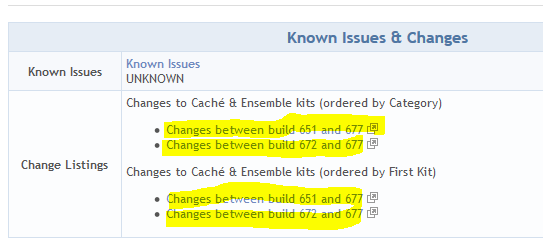
FYI, on the Field Test page, the links highlighted below are currently broken:
UPDATE: this is now working again.
Can we use iknow in the Cache tool means if i don't have deepsee tool to work on like for doing some sample programs. Because i don't have deepsee tool with me?
And is there any open source for downloading deepsee?
This is a translation of the following article. Thanks [@Evgeny Shvarov] for the help in translation.
This post is also available on Habrahabrru.
The post was inspired by this Habrahabr article: Interval-associative arrayru→en.
Since the original implementation relies on Python slices, the Caché public may find the following article useful: Everything you wanted to know about slicesru→en.
Note: Please note that the exact functional equivalent of Python slices has never been implemented in Caché, since this functionality has never been required.And, of course, some theory: Interval treeru→en.
All right, let’s cut to the chase and take a look at some examples.
Hi,
I would like to retrieve the O.S version (Windows or Unix) and Cache installed directory.
which COS apis should I use ?
Thanks for your help.
I would like to invoke some unix/windows commands from COS, any API could do that?
Also, I would like to set up some Environment Variables for this process which would execute the above external command.
Anyway to achieve that?
Thanks for your help.
This post is originally posted on GitHub.
This discussion is open to anyone who use or know about WebTerminal project. It is a result of a long story of the project development, testing and maintaining.
InterSystems is pleased to announce the availability of the Caché and Ensemble 2016.1.4 maintenance releases.
For a complete list of the corrections, please review the release notes.
Caché and Ensemble 2016.1.4 are available on the same platforms as 2016.1.3. For complete platform details, please refer to the Supported Platforms document.
Availability of HealthShare Health Connect will be announced separately.
The version number of the kits for these releases is 2016.1.4.104.0
Hello,
I have a problem when i take the adapter: EnsLib.FTP.OutboundAdapter.
I want to write a file, but if the file already exist using the method ..Adapter.PutStream(name,file) and in my setting "overwrite" is true. FTP response me this message:
Hi all,
I trying build a project with .NET and Entity Framework in the Code First method, but Caché return the error " 'VARBINARY' is not a supported type for CAST" when run this sql code:
Hi There
New to the cache sql commands looking for how to create a parameter within a sql statement like with MSSQL is @ and Oracle is :
What is cache's?
I try to find a function, which generates hash values of columns. In MS SQL Server I can use
select hashbytes('sha2_256', my_column) ...
to create hash values of my_column. Is it possible to use such things in Caché?
Thank you
André
When working at a terminal prompt the %SS routine lets me see what's running on the instance:
USER>d ^%SS
But sometimes I'm only interested in knowing what's running in my namespace. In which case, here's what I use:
USER>d THIS^%SS
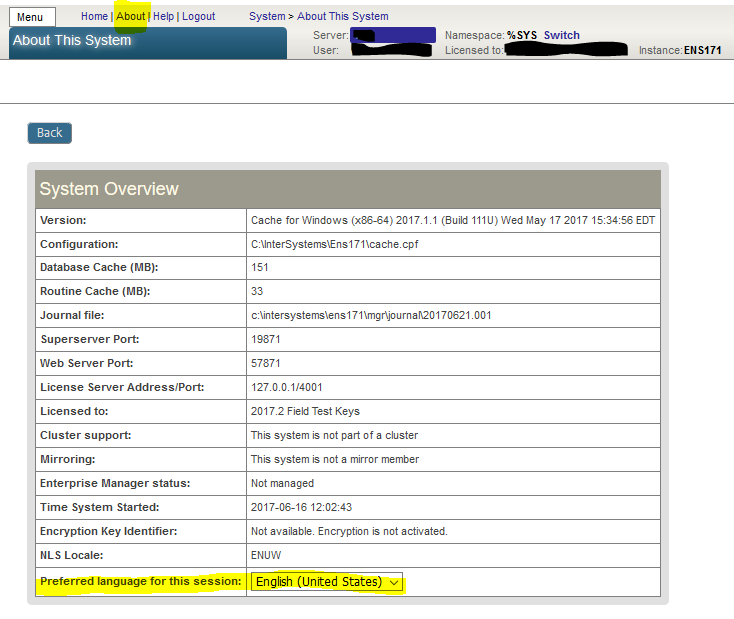
Recently I was conducting a remote support session with a site. The desktop they were sharing with me was on a PC configured with German as the native language. Since my German is rather rusty, and virtually non-existent when it comes to computing terms, I was glad to be able to switch the Portal session into English.
This is done from the page that appears when you use the About link:
All I needed to remember was that the About link is the second one, and the language selection dropdown is at the foot of that page.
It is possible to update Cache object property from Python using the following Python code, with import of intersys.pythonbind3:
my_object.set("my_property",["A","B","C"])
However, I am unable to save 2D %List with 2D Python array like the following:
my_object.set("my_property",[["A","B","C"],["1","2","3"]])
I am not sure whether this is Python-Cache bind flaw or design issue. Is there any alternative/ workaround to do the same for above?
Hi, Community!
How do you store the source files of your Caché project? What is the directories structure? What are the benefits?
I prefer the following structure:
/cls/package/subpackage/class.cls /mac/package/routine.mac /int/package/routine.int /inc/macro.inc /dfi/folder/sample.pivot.dfi
Benefits:
What is your approach?
Hi,
I want to attach one local namespace on instance A to the database on instance B.
How could I use ECP to achieve my goal?
Should I config instance B as ECP data server? If so, how could I explicitly specify which database on instance B could be exposed ?
Thanks for your help.