what class or API I shall be using to execute a piece of sql to another server from one server? From within cache itself not java or python or any other languages.
Come and say hi to us in the Partner Pavilion at the Global Summit!
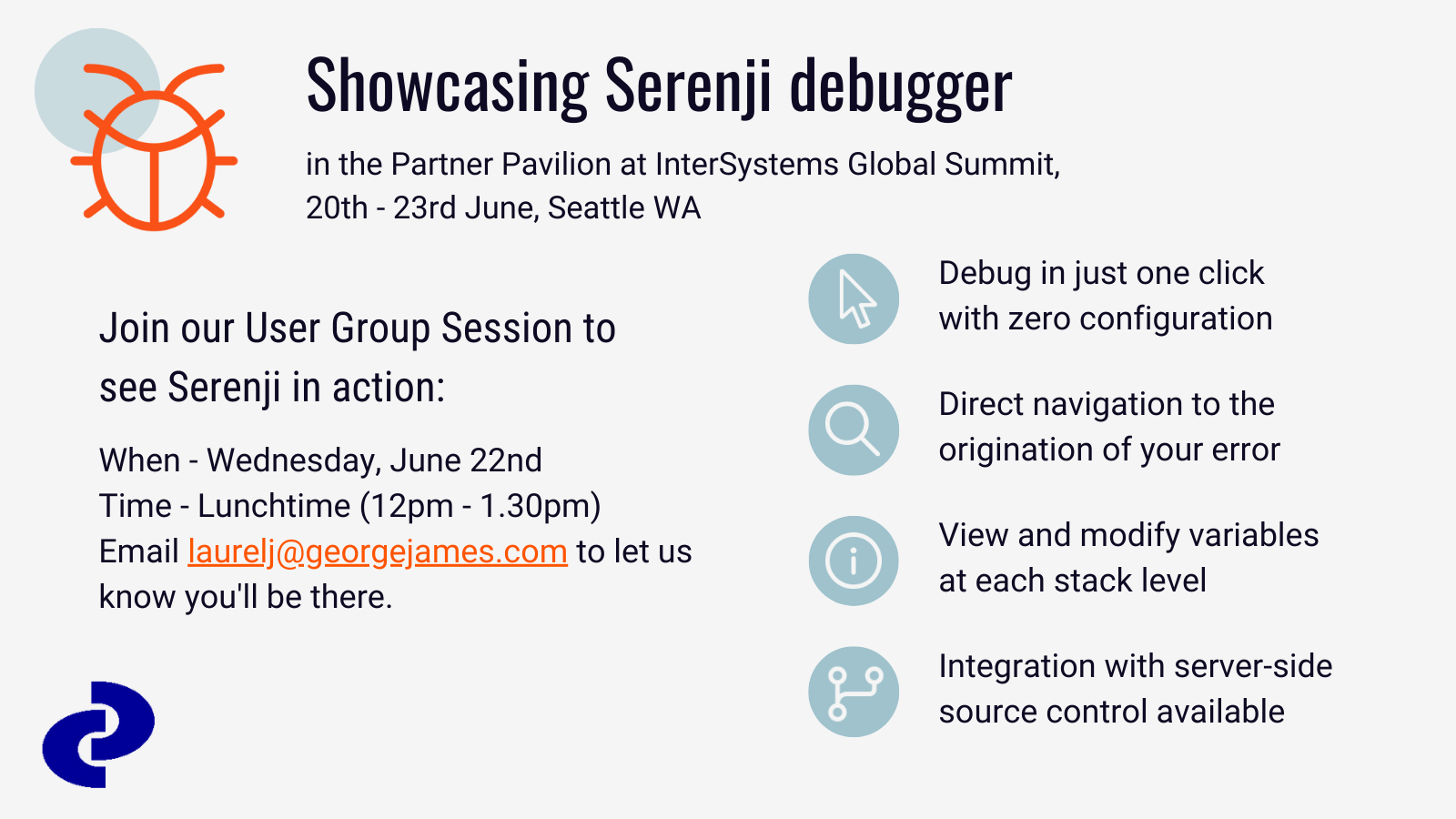
We’ll be showcasing our Serenji on-the-spot debugger which has undergone some big changes in the last year—users can now enjoy a seamless debugging experience with zero configuration, along with taking advantage of the latest features in VS Code itself, enabling users to smoothly identify and quickly fix errors in your code, contributing to the production of quality, maintainable code.
If you want to see Serenji in action look for us in the Partner Pavilion, we'll be on hand to show you a demo. Prospective users are also welcome to join our User Group Session during the lunchtime session on Wednesday, June 22nd. Email laurelj@georgejames.com to let us know you'll be there.
I have a question that seems really simple but it's quite a pain in my ass right now.
I had to rename (take a file from a directory and move it to another) which is a .hl7. Whenever this file has been displaced, I have to change the extension from .hl7 to .OK without using the rename method. Maybe using the attribut?
Do you have any ideas how I could do it?
This should follow the step i have explained right before.
I have a service to take the file but i need an operation to rename it then change his name.
I would like to capture any NACK's that is sent back to the Operation. The Operation is already setup to "Save Replies/IndexNotOK's", but I would like to see if we can query Cache and pull those NACK's into an extract.
Has anyone experienced any issues when using Cloudflare in front of a csp application?
I keep getting 502 errors when Cloudflare is active?
Strangely, the SMP works but only if I remove the trailing question mark from the url but it doesn't resolve the issue when I try any other csp application URL's.
I have a database with almost 1T of free space. I want to run the compaction process to reclaim and subsequently free that space. I am aware that this process is a background process but will the level of processing required to move this volume of space to the end of the file to allow for reclamation impact system usage while this process is running. Essentially, does this process run at a low priority and use processing as available. I am trying to determine if I should run this over a weekend or can this be run at any time.
Currently we are using an older Healthshare instance but I am not opposed to using IRIS as we will upgrade eventually.
Currently for monitoring productions we have a Montior screen. We have both the Queues page and a Deepsee dashboard which has current status of our services. The issue with the Deepsee method we currently have with traffic lights is 1) the page is a bit slow to load the metrics 2) any new services from the team a new widget needs created and although this is easy enough to do it just is time consuming.
I am looking for a reporting tool (Analytics purpose) which can be built using cache object script/MUMPS. Basically my requirement is to find a tool where I can implement cache code to report data for my application.
I am unaware of DeepSee and how it works. Please assist for the same.
I'm writing an import Routine to read files into a global. The code is working fine except for the 'Delete' command. The files are being imported, copied but not deleted. Maybe someone has an Idea what ist happening.
I get the low level return value of -32 but i couldn't find anywhere to show me what that actually means. And my Caché version doesn't support the $ZU command.
In various tests I used both and found no real reason to prefer the one or the other. Eventually I missed some limits. At least I didn't hit any. What is the general opinion? Where to use the one or the other?
Need help on HL7 message processing without use of Ensemble. Any sample code on how inbound HL7 messages using TCP/IP streaming mode can be processed through COS?
I ran into an interesting ObjectScript use case today with a general solution that I wanted to share.
Use case:
I have a JSON array (specifically, in my case, an array of issues from Jira) that I want to aggregate over a few fields - say, category, priority, and issue type. I then want to flatten the aggregates into a simple list with the total for each of the groups. Of course, for the aggregation, it makes sense to use a local array in the form:
agg(category, priority, type) = total
Such that for each record in the input array I can just:
I am able to enable OS level authentication for an instance from the UI (System Administration => Security => System Security => Authentication/CSP Session Options) but is there a way this can be done from command line as well?
We have a requirement for one webpage that should be access in our VPN with out authentication. If it asks user name password that also fine.
This page should be a dashboard for the ensemble health monitoring. Support Team seating Area we have big SMART Monitor which always shows this webpage. Support engineers keep on eye on this monitor, if it shows action required then . they will act upon immediately. Expecting some widgets like
I have an error connecting the InterSystems cache with the odbc driver with the ODBC-2017.2.2.865.0-lnxrhx64.tar version using the ubuntu versions 20.04 and version 18.04 (which works with the .Net Core 3.1 version) with the Net 6.
We need a web-based SQL tool to connect to Ensemble/Cache, that will offer more functionality than what the Management Portal offers. It needs to be web based, so that we can host it on a machine that has connectivity to the server via the superserver port. We (the devs and support) only have browser access to the environment via Remote Desktops, hence the requirement.
Has anyone gotten OmniDB to connect to Ensemble/Cache? If so, can you please advise on how to configure it?
Any other suggestions for such a tool are also welcome.
I am sure I came across this in the past with Cache and just saw this again in IRIS.
When rebuilding or swapping a DAT file for a database it retains the Resource of the DAT file, not the Resource of the Database it is being used for.
For instance, if I have a local Database called APP with a resource %DB_APP and I want to refresh the data from another Database called TEST that has a Resource %DB_TEST I can just copy the DAT file from the TEST folder to the APP folder.
Does anyone know where the user generated code resides, the stuff one might write for a production, I presume it lives in a table somewhere within a database?
Basically, I want to do some dependency analysis of what I've written - find out what's in use, how it's referenced, etc. I know I can export it to an XML file and work on that, but direct access on a table would be quicker for me.