Hi, Community!
Please welcome a new session recording from Global Summit 2017:
Hyper-Converged Infrastructure
Hi, Community!
Please welcome a new session recording from Global Summit 2017:
Hyper-Converged Infrastructure
Hi Guys,
I've a working that sent Http request to a REST API and is working fine,
Set Body ##class
but now I'm looking to basically add an array or data inside the body so that it looks like this:
{
  "ElectronicMailAddressT": "string",
  "TelephoneMinimalN": "string",
  "Emp": [
    {
       "EmploymentPayrollNumberId": "string",
      "TaxFileNumberId": "string",
      "FamilyName": "string",
      "GivenName": "string",
        "PaymentSummary": [
        {
          "Tax": 0.1,
          "SuperTax": 0.1,
            }
      ]
    }
  ]
}If you're using Atelier, you may have noticed a project called "RemoteSystemsTempFiles" in the Atelier Explorer and Project Explorer views. This project is automatically created by the Eclipse Remote Systems Explorer (RSE) on start-up. The RSE allows you to connect to and work with a variety of remote systems.
You can either hide this project within your views, or remove it completely by following the steps below.
What happens if you don't declare a Persistent value when you call ExecuteQuery()? What does Ensemble set as the key value for your query? I have a query that I've executed on SQL Server, and I get 15 rows, but because this is my second time querying the data Ensemble thinks it exists.
The Method in question is SelectProviderClarityAudit. If I call this query multiple times it is not returning the same number of results each time in Ensemble.
Class osuwmc.CPD.ClarityDBPoll Extends Ens.BusinessOperation [ ClassType = "", ProcedureBlock ]
{
Parameter ADAPTER = "EnsLib.SQL.
Hi,
I have the Atelier plugin (latest stable release) installed in Eclipse Oxygen running on Ubuntu 16.04.2. Working well except for the BPL visual editor. When I select it, it displays a pixelated image in the view tab. Not sure if this is a Atelier issue or an Eclipse/GTK issue? Has anyone else seen this behavior?
Thanks
Hello
I'm in the process of creating a TestClass which simulate a HTTP POST call to REST-based web services and while I am having success, I'm struggling on how to parse out the results to a JSON format
Here is down the code part which concerns parsing the HttpResponse.Data variable into JSON :
s httprequest=##class(%Net.HttpRequest).%New()
s httprequest.Server="http://127.0.0.1"
s httprequest.Port="57772"
s httprequest.Https = 0
s httprequest.ContentType="application/json"
s httprequest.Authorization = "Basic X1N5c3RlbTpTWVM="
d httprequest.EntityBody.Write(json)
s sc = httprequest.Post("http://127.0.0.1:57772/api/v0/bwxpert/visiocheck/account")

Do $$$AssertStatusOK(sc,"HTTP POST OK")

Set Result= httprequest.HttpResponse.Data
Set DynamicObject = {}.%FromJSON(Request.HttpResponse.Data)

Do $$$AssertEquals(Result.syncType,"ADMIN_SYNC","sync OK")
 write DynamicObject.%ToJSON(),!
My questions are regarding ClassMethods with a private keyword tags.
When we use a wizard to add a new method, we are given a options to
select private checkbox to make it a private method as well as
Class Method checkbox in the same time.
1. What would be the reason and the case to select and use them both?
2. Secondly, if there is such a case in already developed application is it
safe to remove the private tag from ClassMethod? Obviously if it's not a
ClassMethod private tag cannot be removed as easily.
Thank you,
I've inherited a business service that takes a large XML document with repeating elements, extracts them via %XML.Reader and chunks them into separate persistent objects for delivery to a EnsLib.MsgRouter.RoutingEngine-based routing rule. Unfortunately, the lack of GetValueAt() for the message's class leaves me without much in the way of complex decision-making options.
I've hacked together a rather inefficient mechanism for getting at what I need by using %XML.Adaptor's XMLExportToString() and EnsLib.EDI.XML.
Hi,
I want to monitor some variables in my program.
So I do this "zb *varname", however, i don't really want to get break went the program touch "varname" every time.
I only want to get break when certain conditions are meet. For example, $d(varname(1,2,3)) > 0, then break.
Is there any way to achieve this?
Thanks.
Hello everyone,
What has been the best way for you to store and retrieve session information about a user for CSP projects? I can use these methods easily:
however I'd like to know if there's a better way to keep more permanent information, or should it all be kept in a class?
Additionally, using whatever method, what would be the best way to block user access to certain portions of the website or entire pages? Such as an admin section. With normal web development this wouldn't be too difficult, but I need help connecting this into CSP terms.
Thank you!
Hi all,
I've configured my Ensemble instance to use IIS 7, according to the instructions CSP Gateway configuration Guide and I've configure the CSP Virtual application.
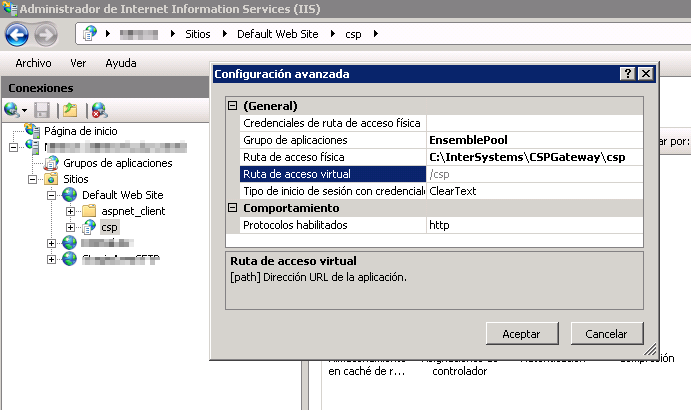
All the process about Native modules is done.
If I open http://localhost/csp/bin/Systems/Module.cxw I see that it is using the IIS as I expected.
I've created a WebApi and I've deployed in my server
If I call the check method it works
however, if I call it directly (localhost/myapi/check) it doesn't work.
Error HTTP 404.0 - Not Found
If I check the list of application access in the CSP Web Gateway management, it is in the list.
Hi Guys,
Basically I'm looking for a sample what I can send data in aJSON format to a a webservice using an http request pls?
I've found some documentation on %Net.HttpRequest but a sample on how to connect to a Webservice and send data to it would be really helpful?
Our clients are running Cache & Ensemble 2014
Thanks
Is there any way to extend the lookup table to have more than one value against a key?
Hi,
I installed Cache2015. I went to %SYS namespace and d ^JOBEXAM it shows around 12 background jobs running. Can i know what is the purpose of that jobs?
Thanks, Selvakumar
I use zf(-2) to spawn a external a Java application in a *nix instance.
I would like to kill this process after some conditions met.
I would like to leverage $zf("kill ... ") but this requires its the pid of this child process.
So is there a way to acquire the pid for the child process when I create it ?
If not, how is the suggested way to kill this process?
Thanks.
I could launch a external process via $zf(-2).
However, this child process need to refer some shared libraries in RUNTIME,so I have to set up the proper paths to the environment variable LD_LIBRARY_PATH, is anyone know how to do this?
Thank for your help.
Hi all,
I have started using the UPS in my application for shipment and cancellation.
I have the WSDL from the UPS.
I have imported the WSDL via Studio->Tools->addins and finish the process to get the Package implemeted in my studio.
Now the SOAP method contains a URL which is for their live system so i manually changed the URL with their Testing URL.
They are also providing the sample shipment numbers which we can use to test the cancellation process.
I am trying that shipment number to void(cancel) the shipment by call the method.
And i am facing the error as below,
<ZSOAP>zInvokeClient+205^%SOAP.
In part 1, part 2, and part 3 parts of this series we set up three user types. In part 4 we saw how to secure model elements and DeepSee items. In this last part of the tutorial we conclude with some remarks on DeepSee security and troubleshooting tips. In particular, we see how pivot tables in User Portal can be "hidden".

In part 1 we started working on a security model for DeepSee and create a user type having privileges typical of end users. In this part we are going to create a second user type with ability to edit and create DeepSee pivot tables and dashboards.

This is probably a very naive question but :
Is it possible to create a Windows executable file from a Cache MUMPS (COS) routine, such that the routine can be run directly from Windows ?
If so, could some kind soul direct me to a source of information that describes the process.
I am using the free Intersystems Cache installation (CachePCkit V2017.1) on Windows 10 for my own use & personal development.
Thanks
Hi,
Our ensemble instance has grown significantly since it was first implemented in 2014, and the old interfaces diagram is no longer useful. We started with a few HL7v2 ADT and demographic interfaces, but our use of Ensemble* has grown to include document interfaces, orders and results, ITK and inbound and outbound interfaces from other organisations.
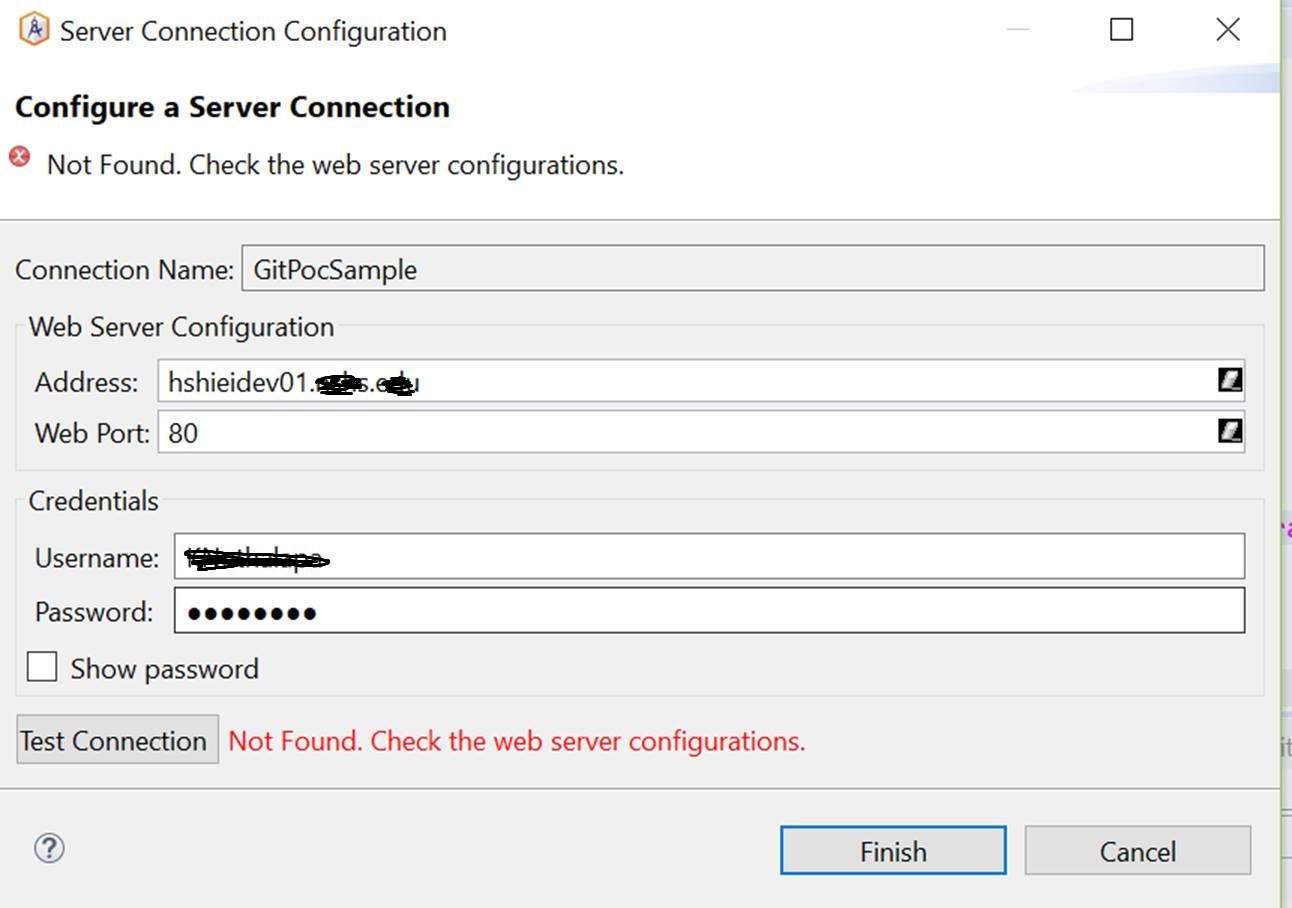 Working fine in localhost. While connecting to remote server getting the above error. Tried with Web Port 1972 and 80 both. Also there is no log in audit viewer.
I am using the free Intersystems Cache installation (CachePCkit V2017.1) on Windows 10 for my own use & personal development.
I am writing routines in Studio & running them in the Cache terminal TRM:3672 (TRYCACHE).
From a routine, how do I control print position within the terminal screen. I have tried using $X and $Y but this does not work and I cannot find what I need within the Cache terminal documentation.
Hope this question is not too simplistic for Members.
Any suggestion would be appreciated.
Hi, Community!
Someday you find yourself having a wonderful class package which can be helpful in several projects. So it is a library package.
How to make the classes available for different namespaces in Caché? There are two ways (at least two ways familiar to me):
1. Start the name of the package with %, like %FantasticLib.SuperClass. Wrong way.
If you do that the class would be placed in %SYS and would be available in other namespaces.
This is wrong because of the two reasons:
1. The class will be wiped out with the next Caché update (as all the %SYS Namespace).
2.
Hi, Community!
Please find the digest of the best articles you posted on DC in 2017 regarding InterSystems Data platform.
We had 280 articles in 2017 and split them into 3 categories: posts gathered most of the views, most voted posts and most commented posts.
Here we go!
TOP 20 Most viewed
Vue.js: getting started with a basic HTML/REST/JSON example, by Ward De Backer 1936
InterSystems Data Platforms and performance – VM Backups and Caché freeze/thaw scripts, by Murray Oldfield 1752
Hi All,
I am new to webservice and UPS. I have tried the sample URL's that UPS have given for testing in PHP codes and it works just perfect for me.
But when i try to hit the same URL's in Ensemble. it gives some errors from UPS.
If anyone of you guys here has any knowledge about UPS integration or the webservice please help me. it will be much appreciated and helpful.
The ensemble code that i am trying with is,
set AuthToken=##class
Thanks,
I have read here and tried to use the supplied examples to see what they do but keep on getting error please advice:
Method GetXMLDocFromFile(file = "C:test2.xml") As %XML.Document
{
    set reader=##class(%XML.Reader).%New()
    set status=reader.OpenFile(file)
    if $$$ISERR(status) {do $System.Status.DisplayError(status) quit $$$NULLOREF}
    set document=reader.Document
    set reNo=##class(%XML.Node).%New()//check here//how to use the below method
the error I am getting is as follows