Hi Community,
Please welcome the new video on InterSystems Developers YouTube:
Hi Community,
Please welcome the new video on InterSystems Developers YouTube:
Hello,
I am attempting to setup a DICOM Routing to Storage Production using Ensemble 2017.1. I have followed the Routing to Storage production given in Ensemble Demo Namespace. I have created association with appropriate “Presentation Context” for inbound and outbound PACS system. I am attempting send a Computed Radiography Image from one PACS to another via Ensemble but its failing when sending the image to the receiving PACS with following error :
ERROR <Ens>ErrException: <READ>zAcceptPDU+4^EnsLib.DICOM.Adapter.TCP.1 -- logged as '-' number - @' Use .
Hi All, I am a Data Architect and am trying a method of deploying alter statements onto Cache DB.
My Data Modeling tool generates alters as this.. So question is if the Cache has a way to rename table? If so what is it?
ALTER TABLE <SchemaName>.GROUP_TYPE_NODES RENAME TO GROUP_TYPE_10082019140110000
;
This is giving error.
SQL Error [25] [37000]: [SQLCODE: <-25>:<Input encountered after end of query>]
[Location: <Prepare>]
[%msg: < Input (IDENTIFIER) encountered after end of query^ALTER TABLE xxx.GROUP_TYPE_NODES RENAME>]
Probably a simple question, but where do I find the list of Translate Tables? The documentation wasn't clear.
Thank you,
I like to be able to call an "autohotkey" executable message box from within a running Cache routine executing as a jobbed routine. The autohotkey executable displays a small pop-up window with a message and an "OK" button .. and will time out in 10 seconds if the user does not press the OK button.
Although $ZF(-1,cmd) executes (where "cmd" contains a simple batch command e.g. @c:\autohotkey\warning.
Hello community,
Our organization is looking to expand our Coding Standards to be more in alignment with best practices.
I was wondering if the there are developers here that would not mind sharing any existing documents. Our scope would be this document be applicable to new hires learning Cache all the way up the chain.
Thanks in advance,
-SH
Hi-
I have a need to store a password in an object property of a User object.
What would be best practice for data type assigned to the "Password" property and securing that password against prying eyes, both just browsing the global as well as via SQL? Better yet, how can I prevent a specific property from being projected to SQL?
Thanks
Hello All,
I connected the Cache from Power BI using ODBC connection. And I can able to view the tables but I could't able to view the data records. getting some error when I shoot on the table name. I couldn't trace what I'm missing. Please help me.
Error Message: "Value cannot be null. Parameter name: exceptionType"
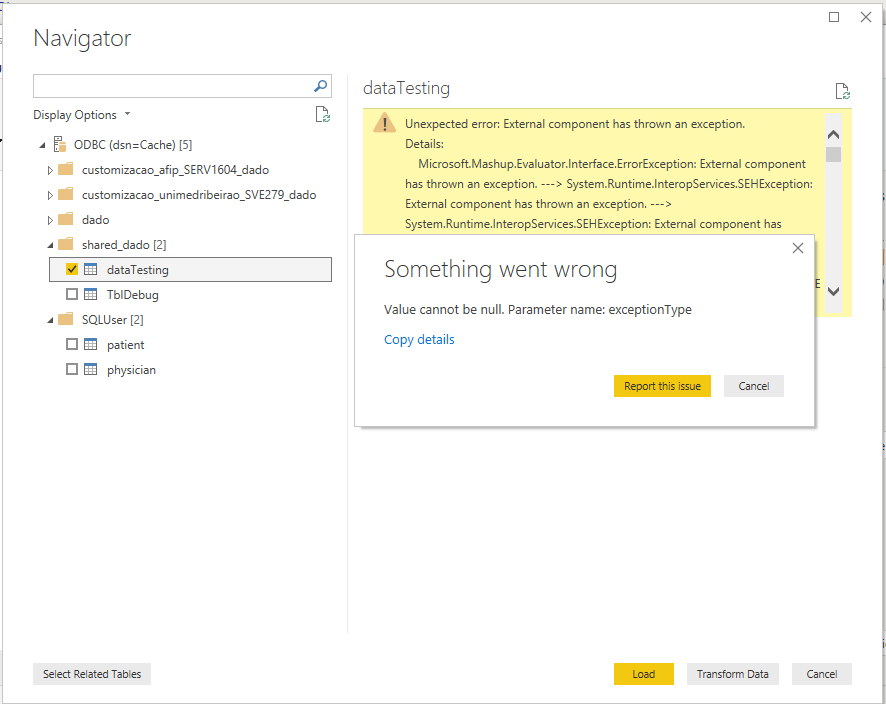
Thanks,
Vikram
Hey folks - I'm working on some training materials and I'm looking for a paragraph or two and/or a diagram that illustrates their record IO flow. Does anyone know of a good outline of how records are moved into the database and committed?
Hi Community!
We are pleased to invite all the developers to the upcoming InterSystems Analytics Contest Kick-off Webinar! The topic of this webinar is dedicated to the Analytics contest.
On this webinar, we’ll demo the iris-analytics-template and answer the questions on how to develop, build, and deploy Analytics applications using InterSystems IRIS.
Date & Time: Monday, December 7 — 12:00 PM EDT
Speakers:
🗣 @Carmen Logue, InterSystems Product Manager - Analytics and AI
🗣 @Evgeny Shvarov, InterSystems Developer Ecosystem Manager
Hi, we suddenly noticed that one of the edge storage increased by 30% and it was due to ERROR globals which was throwing repeated error for 7 days and it consumed 35GB space. Is there a way to log the storage of edge production on daily basis and compare the increase in storage with previous day and if increase is 5% more than trigger an email to system admit to look why the storage increased suddenly.
Is it possible see the execution plan of a SQL sentence in IRIS?
Like this:
explain plan for
select  e.ename,r.rname
from    employees  e
join    roles       r on (r.id = e.role_id)
join    departments d on (d.id = e.dept_id)
where   e.staffno <= 10
and     d.dname in ('Department Name 1','Department Name 2');
That returns this:

InterSystems IRIS Business Intelligence provides the Cube Registry as an interface for managing and scheduling build and synchronize tasks for your cubes. The Cube Event Monitor is a new tool on Open Exchange to help you keep track of those events' status and performance, the number of records being updated, and any build errors (errors when processing individual records) that have occurred.
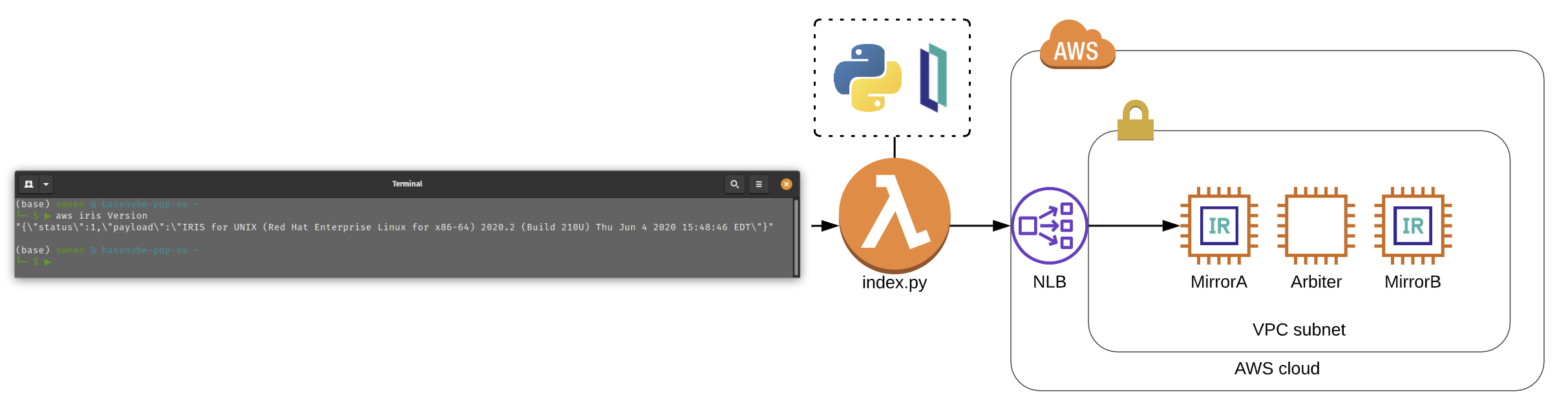
If you are looking for a slick way to integrate your IRIS solution in the Amazon Web Services ecosystem, server less application, or boto3 powered python script, using the IRIS Python Native API could be the way to go. You don't have to build out to far with a production implementation until you'll need to reach out and get something or set something in IRIS to make your application do its awesome sauce, so hopefully you will find value in this article and build something that matters or doesn't matter at all to anybody else but you as that is equally important.
Hi Developers!
Here're the technology bonuses for the InterSystems Multi-Model Contest that will give you extra points in the voting:
See the details below.
Hi,
I've a Service utilising the Adapter EnsLib.SQL.InboundAdapter, which uses a Credentials item set with the details of a local SQL account. This currently works, however, we're looking to use the credentials of an AD domain account.
The domain account is a member of an AD security group, which has the required permissions on the source SQL database. I've checked that access is possible with this account via SQL studio.
I've tested setting the Credential username as domain\username and username@FQDN, but neither create a successful connection.
Hello,
I like to know if we need to have the message in a file to process a Record Map?
I am working with Interoperability Production that processes files /messages using Record Maps. My team was asked to redesign the solution for deployment in AWS. We use containers. We had problems with having multiple containers processing files from the same directory. We are considering Amazon Simple Queue Service instead of having files on a shared file system.
Has anybody migrated a Record Map to a Schema Definition to validate a message as a Virtual Document as I have seen with X12 messages?
Is IRIS supports imap to integrate with email server?
Hi,
in a Business Operation
I have a Gateway ResultSet obtained by ..Adapter.ExecuteQuery() from table A (MS SQL) which i would like to copy to table B (MS SQL).
what would be the best way to do this ?
Thanks
In Oracle database, the synonym is an alternative name for objects such as tables, views, sequences, stored procedures, and other database objects.
You generally use synonyms when you are granting access to an object from another schema and you don't want the users to have to worry about knowing which schema owns the object.
Is IRIS SQL sintax has something like this: (oracle sintax)
CREATE PUBLIC SYNONYM suppliers
FOR app.suppliers;
This first CREATE SYNONYM example demonstrates how to create a synonym called suppliers
Hey Intersystems Community-Member,
Following Issue: When I update a SQL table like (update OnlineV3Admin.ParameterApp set popuptext = '' where ID = '1') and then read it for my Json WebService there is a /"x00" in my Json.
What is the best option to disable that? I need here a empty String and not /x00.
Any ideas?
Best regards,
Florian Hansmann
Hi Community,
See how to build a REST API with InterSystems IRIS in just five minutes, leveraging Docker containers:
What is the best way to create an HL7 message from JSON input file?
We have JSON file available with data required for building the HL7 message . I am trying to use a standard file/FTP Business service to pick up the file and convert the input %FileCharacterStream into a dynamic Object and use the stand JSON features to read /process the data and build the HL7 message.
Is there any other better way to do this? or any standard built-in functionality available in HealthShare?
Thanks you for your help
Mary
Hello,
I need to create a util function that loops thru every character in the data, execute a $ASCII() against it. If it falls outside the realm of extended ASCII we toss it.
the function should receive a string, execute a for...loop across it's length and use $ASCII to evaluate the character. Also the function should return an output argument that indicates if the string is UTF8 valid or not.
could anyone help me with this?
Hi guys,
I have this method to create object from XML
ClassMethod XMLNew(doc As %XML.Document, node As %Integer, contOref As %RegisteredObject = "") As TruLaser.ProductionPackage
{
Set id="" Set tmpnode=doc.GetNode(node)
Do tmpnode.MoveToFirstChild()
Do {
//compare data node to the string given by the NAMEOFEXPORTID parameter
//which indicates the XMLNAME of the ids for this object
If tmpnode.NodeData=..#NAMEOFEXPORTID {
//get the text from this node; this corresponds to an id in the database
Do tmpnode.GetText(.id)}
} While tmpnode
Hey all,
I am currently working on a website (with Angular) for displaying the results of UnitTests.
Everything is working fine, except that I can not run a test inside a ClassMethod.
I have 2 classes: One for handling which test class should be invoked and then a test class that is extending %UnitTest.TestCase
The test class:
Class my.class.path.testing.EingangTest Extends %UnitTest.TestCase Method
In the handler class I tried something like this:
testCase = {The problem is that I am getting an "INVALID OREF"-Error pointing to the "$$$AssertStatusOK".
This message contains six recent HealthShare Advisories, which are available below.
Those of you who run and support older-style legacy systems on IRIS may be interested in learning about and trying out a new framework I've built on top of my colleague Chris Munt's mg_web technology (details at https://github.com/chrisemunt/mg_web).
There are quite a few older-style and legacy applications out there whose useful life can be extended by making their functionality available as REST APIs. To make this something that can be done quickly and easily, using modern, industrial-strength web servers, I've created what I'm calling mgweb-server:
GA releases are now published for the 2020.3 version of InterSystems IRIS, IRIS for Health, with IntegratedML!
This is the first InterSystems IRIS release that includes IntegratedML, a new feature that brings "best of breed" machine learning to analysts and developers via simple and intuitive SQL syntax. Developers can now easily train and deploy powerful predictive models from within IRIS, right where their data lives. Documentation for IntegratedML is available as a User Guide. Virtual Summit 2020 features a number of sessions and an Experience Lab featuring IntegratedML, see overview here
Hello, I have an SSL / TLS configuration that used TLSv1.0 encryption.
However, I need to update to the TLS 1.2 version of encryption, and apparently Caché 2012.1 does not support it according to this link: https://community.intersystems.com/post/tls-v12-support-cach%C3%A9
Can I add a library to the Cache, enable TLSv1.2 in some way, or just a version update?
.png)