New
Hi Community,
Enjoy the new video on InterSystems Developers YouTube:
⏯ Learning InterSystems Reports - A Real World Use Case @ Ready 2025
Hi Community,
Enjoy the new video on InterSystems Developers YouTube:
⏯ Learning InterSystems Reports - A Real World Use Case @ Ready 2025
Welcome to another installment of the Platforms Update. A few notables to highlight:
For those newly acquainted with these communications, this update provides details about recent enhancements as well as anticipated changes based on current information; however, future projections remain uncertain and the content should not be interpreted as a definitive product roadmap.
Today, coding assistants like Claude, GitHub Copilot and Cursor have transformed the way developers write code. However, these tools are limited by being isolated from the systems and data sources that developers work with daily. This limitation can be overcome through the Model Context Protocol (MCP), an open standard designed to connect AI assistants to external data sources and tools in a secure and standardized way.
In this review article, we'll explore the current state-of-the-art regarding the MCP within the InterSystems ecosystem.
I was really surprised that such a flexible integration platform with a rich toolset specifically for app connections has no out-of-the-box Enterprise Service Bus solution. Like Apache ServiceMix, Mule ESB, SAP PI/PO, etc, what’s the reason? What do you think? Has this pattern lost its relevance completely nowadays? And everybody moved to message brokers, maybe?
Wiki time: An enterprise service bus (ESB) implements a communication system between mutually interacting software applications in a service-oriented architecture (SOA) .
When IRIS 2023.2 reaches general availability, we’ll be making some improvements to how we tag and distribute IRIS & IRIS for Health containers.
IRIS containers have been tagged using the full build number format, for example 2023.1.0.235.1. Customers have been asking for more stable tags, so they don’t need to change their dockerfiles/Kubernetes files every time a new release is made. With that in mind, we’re making the following changes to how we tag container images.
Major.Minor Tags: Containers will be tagged with the year and release, but not the rest of the full build number.
For a variety of reasons, users may wish to mount a persistent volume on two or more pods spanning multiple availability zones. One such use case is to make data stored outside of IRIS available to both mirror members in case of failover.
install below 3 extensions
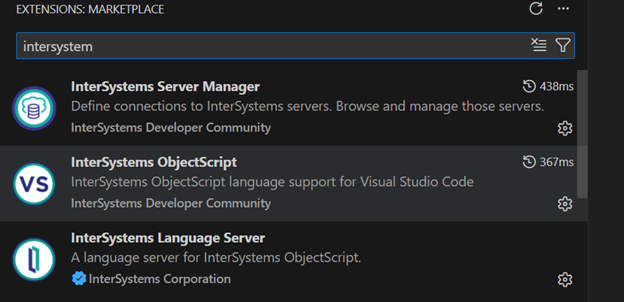
input connection details
IP:localhost
Port: 52773
choose global & http connection method
Input username and password of Intersystems management portal
screenshot for success connection:
Hello, thanks for your time reading this question.
We are receiving each day, alerts from one of our four Production nodes. It always has the same text:
[InterSystems IRIS SEVERE ERROR gchciris4.canariasalud:ENSEMBLE] [Utility.Event] [SYSTEM MONITOR] CSPGatewayLatency(127.0.0.1:443) Alert: CSPGatewayLatency = 5001.304, 5001.233, 5000.964 (Max value is 2000).
We have looked for it in the documentation here:
https://docs.intersystems.com/latest/csp/docbook/DocBook.UI.Page.cls?
1. vscode extensions : intersystems.language-server-2.8.0@linux-arm64.vsix
2. api/atelier web application is enabled

3. vscode connect failed.
The third developer previews of InterSystems IRIS® data platform, InterSystems IRIS® for Health, and InterSystemsHealth Connect™ 2026.1 have been posted to the WRC developer preview site. Containers can be found on our container registry and are tagged latest-preview.
These developer previews includes the dropping of Mac Intel support starting from 2026.1.0, and the adding back of Windows Server 2019 support to 2026.1.0.
Initial documentation can be found at these links below:
#North American Demo Showcase entry.
>> Answer the question below to be entered in the raffle!
⏯️ AI-Assisted Rare and Complex Disease Detection
This demo shows how InterSystems Health Gateway can be used to pull in outside patient records from networks like Carequality, CommonWell, and eHealth Exchange, creating a more complete longitudinal view in a clinical viewer. That full record is then analyzed by AI to surface potential rare disease considerations with clear reasoning, helping clinicians see patterns they might otherwise miss.
Presenters:
🗣 @Jesse Reffsin, Senior Sales Engineer at InterSystems
🗣 @Georgia Gans, Sales Engineer at InterSystems
🗣 @Annie Tong, Sales Engineer at InterSystems
At READY 2026, for the very first time, we held a customer hackathon — and it was an amazing experience!
The hackathon took place on the pre-event day at 9 am. Some participants, like me, arrived early due to jet lag—but that actually helped us connect with fellow hackers before the event kicked off.
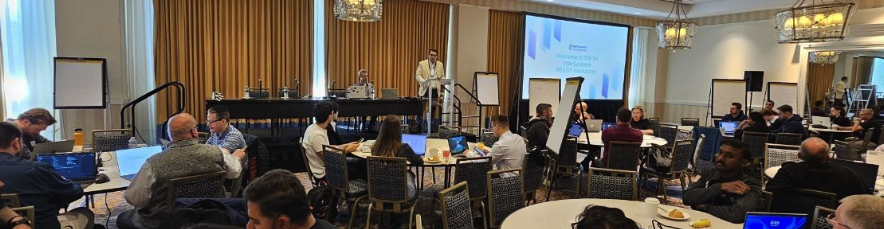
The Beginning
Hi Community,
In our two preceding articles, we explored the fundamentals of the Interoperability Embedded Python (IoP) framework, including message handling, production setup, and Python-based business components.
In this third piece, we will examine advanced methodologies and practical patterns within the IoP framework that are pivotal for real-world interoperability implementations.
We will explore the following topics:
✅ DTL (Data Transformation Language) in IoP
✅ JSON Schema Support
✅ Effective Debugging Techniques
Collectively, these features help us create maintainable, validated, and easily troubleshootable production-grade interoperability solutions.
This article presents a straightforward approach to automatically and efficiently tune hyperparameters for machine learning models using Optuna as the optimisation framework. We explore how to use both Optuna’s native storage options and InterSystems IRIS as a database backend to track the progress of hyperparameter searches. We also show how MLflow can be used to monitor experiments and manage models through its tracking and model registry UI.
This article is based on this Kaggle Notebook, which you can run and directly edit yourself.
If you ever wondered how to debug some requests that are being made to or from IRIS, well here is a little tutorial on how to do that.
During a complex project, usually you get the specifications and implement the communication between IRIS and other things based on that. But from the paper to the real world there's usually a huge gap and you need to know why you are receiving an error on a parameter, on a header, you are not receiving the data and so on.
Hi Community,
Enjoy the new video on InterSystems Developers YouTube:
⏯ Advanced InterSystems IRIS Automation Using Ansible @ Ready 2025
Data privacy regulations such as GDPR, LGPD, and HIPAA demand that organizations know exactly where Personally Identifiable Information (PII) lives inside their databases. Yet in practice, most teams rely on manual inventories, tribal knowledge, or external scanning tools that require data to leave the database engine — a process that itself creates privacy and security risks.
This article presents an MVP that takes a different approach: it runs PII detection inside InterSystems IRIS using Embedded Python, analyzing data where it lives and never exporting it to an external process.
Hi Developers,
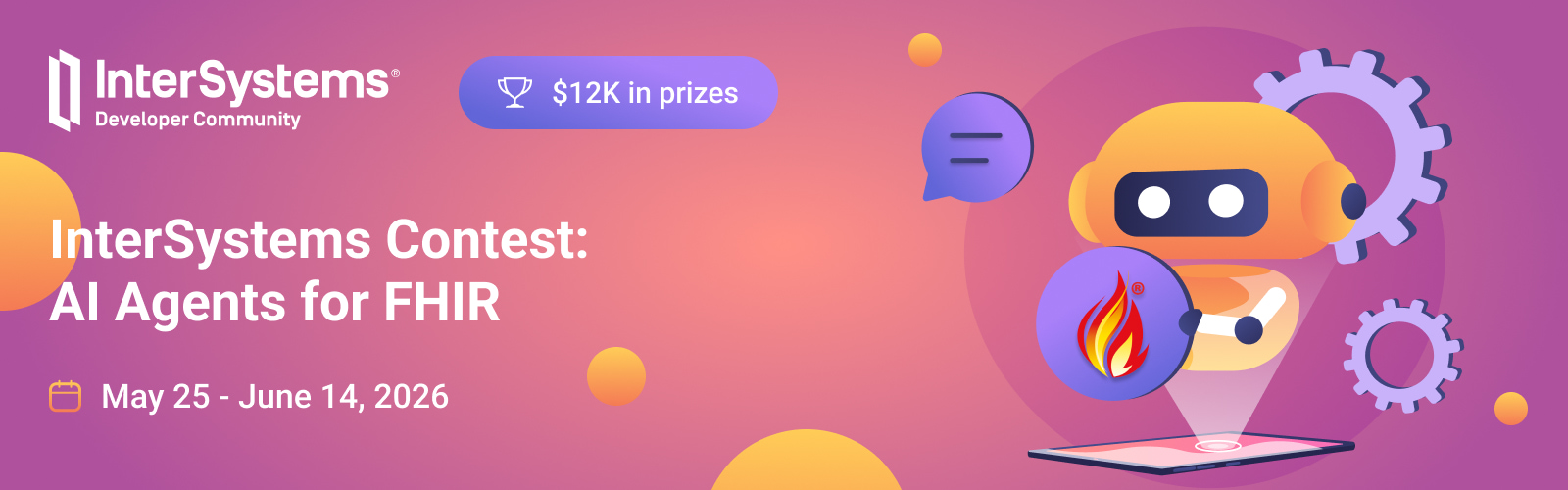
We are happy to announce the new InterSystems online programming contest:
🏆 InterSystems Programming Contest: AI Agents for FHIR🏆
Duration: May 25 - June 14, 2026
Prize pool: $12,000
In case you're planning on deploying IRIS For Health, or any of our containerized products, via the IKO on OpenShift, I wanted to share some of the hurdles we had to overcome.
As with any IKO based installation, we first need to deploy the IKO itself. However we were getting this error:
Warning FailedCreate 75s (x16 over 3m59s) replicaset-controller Error creating: pods "intersystems-iris-operator-amd-f6757dcc-" is forbidden: unable to validate against any security context constraint:
proceeded by a list of all the security context constraints (SCCs) it could not validate against.
I have a daily service that consumes x number of files, each file name chronologically suffixed sequentially by _1, _2, etc. I only want to process the latest file.
How do I build a business rule so it will only process the last file?
What is wrong with the *inc file code below:
#define ArrayToString(%array,%out,%del) set %out="" for { ##continue
set key=$order(%array("")) quit:key="" ##continue
set %out=%out_%del_key ##continue
} quit
Compilation at calling classmethod as : Set tQStr = $$$ArrayToString(pQArray,tQStr,"##") brings error as:
Hi Community,
We have some exciting news! It's time for the next InterSystems writing competition:
✍️ InterSystems Technical Article Contest 2026 ✍️
Write an article on any topic related to the InterSystems products and services.
🎁 Gifts for everyone: A special gift for each author participating in the competition!
Hi Community,
Enjoy the new video on InterSystems Developers YouTube:
⏯ Productive Data Science with InterSystems IRIS and Python @ Ready 2025
READY is right around the corner, and this year the Application Services team from InterSystems will be hosting a CCR Users GroupMeeting during the conference!This will be held Wednesday, April 29th during breakfast from 7:30 – 8:30 (breakfast will be served at the meeting room starting at 7:00am).
I need to analyse and improve the performance on some old SQL statements.
One statement uses NVL in the WHERE clause (no wonder why it's slow) but I still have to improve the performance and the data really needs to be the same when returned.
SELECT *
FROM TOURHead, TOURFIND, SGNRFIND, TNRHead
WHERE TOURHead.cl = '123'
AND TOURHead.cl = TOURFIND.cl
AND TOURHead.TOURNR = TOURFIND.TOURNR
AND TOURFIND.cl =* SGNRFIND.cl
AND TOURFIND.SGNR    =* SGNRFIND.SGNR
AND TOURFIND.cl = TNRHead.cl
AND NVL(TOURFIND.TNR, SGNRFIND.TNR) = TNRHead.TNR;
Really hope someone can help me with this one.
I want to develop a REST API for uploading PDF files. I started with OPENAPI spec file. When I test, I get error 8727 referencing missing required parameter file.
"{"$c(13,10,9)"""errors"":[ {"$c(13,10,9,9,9)"""code"":8727,"$c(13,10,9,9,9)"""domain"":""%ObjectErrors"","$c(13,10,9,9,9)"""error"":""ERROR #8727: Parameter required: file."","$c(13,10,9,9,9)"""id"":""RESTRequired"","$c(13,10,9,9,9)"""params"":[""file"""$c(13,10,9,9,9)"]"$c(13,10,9,9)"}"$c(13,10,9)"],"$c(13,10,9)"""summary"":""ERROR #8727: Parameter required: file.
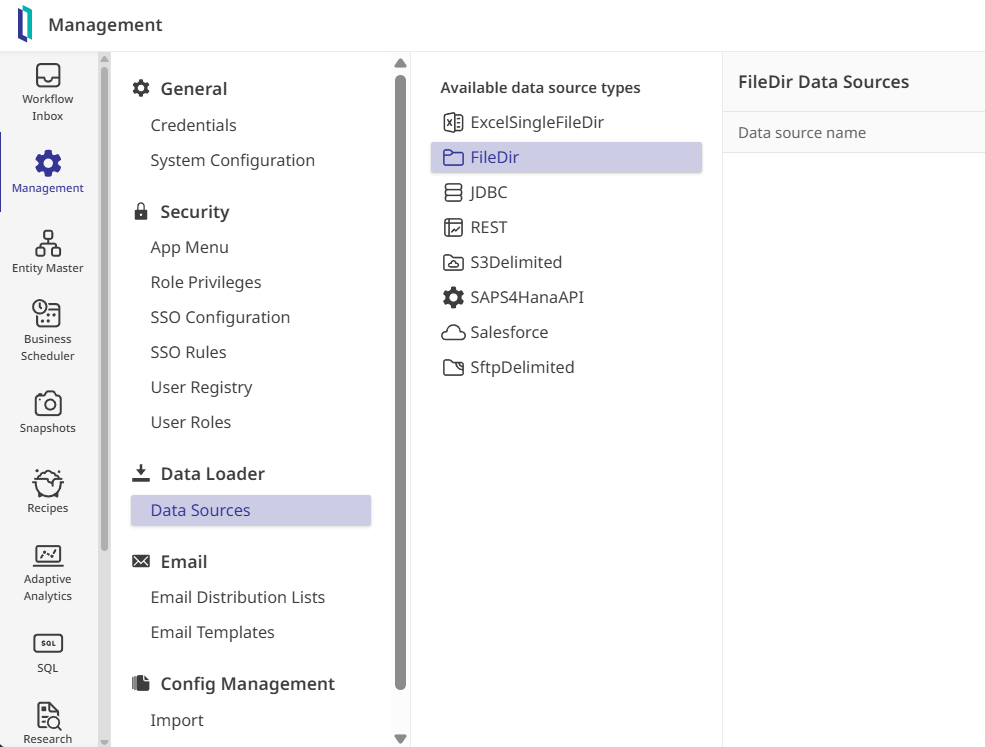
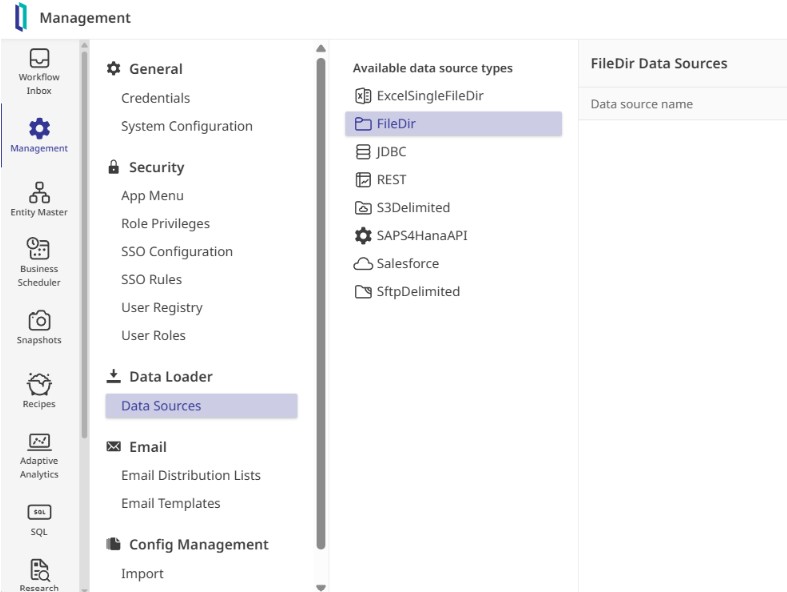
The recently published tutorial "Introduction to InterSystems Data Studio" inspired me to check out this product. And I think it’s an interesting look at how to manage a data fabric without deep-diving into complex code. It allows you to connect disparate data silos, transform the data through automated pipelines, and load it into a unified environment for analysis. So, I decided to write up an example of how you can use it. Basically, I'll walk you through the tutorial in case you don't have time to do it on your own. Though I would definitely suggest you actually follow the tutorial - it has lots of useful information.
To see how it works, I stepped into the shoes of a system administrator, logging in with the provided credentials to explore the interface. The layout centers on a few core pillars: defining where data comes from, cataloging its structure, and building automated "recipes" to move it into production.
And the very first step is to establish a connection to my data.
Sorry for the weird question, but mumps skills are very rusty.
Am trying to create globals dynamically, but with using names from an array. For example:
S Names="A,B,Y,Z"
S A=$L(Names,"$")
F I=1:1:A D
//Create globals based on names from database
//^A, ^B, ^Y, ^Z etc.. Hi Everyone,
We are looking for a way to disable production Business Services concurrently so that the whole process takes shorter amount time than just going sequentially in a loop and disable them one at a time (very slow). This is necessary for us to be able to stop all traffic to IRIS so that no data remains after we perform full production stop.
Thank you!