I try it with the COLLATE instruction, but doesn't work.
Any ideas ?
Tkanks.
I try it with the COLLATE instruction, but doesn't work.
Any ideas ?
Tkanks.
Hi,
We are trying to implement a client side data provider as a component (ZEN) that will use JQuery to do rest calls to a desired URL, in this case, a %CSP.Rest service implemented by ourselves.
This component will be used within our application that is authenticated with a correct user configured on Caché management portal and therefore using one license unit. As we are using a Ajax call from client side this connection creates a new session that will use a new license.
We are using ZAUTHENTICATE routine to manage the session authentication for new REST connections but we couldn't get the "cal
Hi all,
For custormer support reasons we would like to know if its possible to activate some kind of flag or see/redirect wich is the code (lines) being executed when some misterious problems appear.
Is there any way to view the stack of execution code on a deployed code environment? Is there any other equivalent way to track the execution stack for a certain period of time?
Best regards
Is there an API I can call to determine the size of a routine in a CACHE.DAT file so that I don't have to directly reference the ^ROUTINE global?
Given the following data type:
<DataType name='TN' description='telephone number'>
<DataSubType piece='1' description='telephone number'/>
</DataType>
What is the point in setting a SegmentSubStructure's datatype to "TN" instead of "ST"?
NewBie's Corner Session 17 New command
Welcome to NewBie's Corner, a weekly or biweekly post covering basic Caché Material.
New command
The New command limits a variable's scope or range of use. In theory the New command is simple, in reality the New command is powerful and needs to be respected and understood. In Caché ObjectScript and MUMPS an entire chapter is devoted to it.
There are three variations of the New command:
When used without variables
When used with variable(s)
When used with variables in parenthesis
New command used without variables
We have an incoming ADT adapter and the ACK MODE is set to IMMEDIATE. This is what the docs say:
An inbound ACK shows up as a square in the visual trace. These do not. How can I view them?
Please Explain "$h"
Did some searching online with no luck. In Studio, is it possible to add comments to .HL7 schema files? For instance
<!-- This is a comment -->
//or maybe this is
<MessageStructure name='ACK' definition='MSH~MSA~[~ERR~]'/>
Difference Between Macro and routine?
I wrote a macro in studio. Its how to run with Terminal.
do macro name ^filename is correct are not
what are the difference between Deepsee and Ensemble , and how to access the ensemple .Please Tell me
Sir, please give a sample program for cache with database . It is useful for my individual learning.
Can anyone explain me how to create a dynamic session in CSP?
Process-private Globals can be used as a data global in storage definition. That way, each process can have its own objects for the class with ppg storage. For example lets define a pool, which can:
Here's the class:
/// Stores unique identifiers
Class Utils.Pool Extends %Persistent
{

Property Value As %String;

Index IDKEY On Value [ IdKey, PrimaryKey, Unique ];

Method %OnNew(Value As %String = "") As %Status [ Private, ServerOnly = 1 ]
{
    Set ..Value = Value
    Quit $$$OK
}

ClassMethod AddHi, Community!
We want to introduce tag Tips & tricks.
It's not a snippet sometimes, but some small piece of best practice and useful experience.
Please vote if you think it makes sense and we need this tag and we'll introduce it as the first level tag in taxonomy.
I am learning cache in beginning level . But confused .Give an idea for how to i learn cache easily and improve programming level
We want to isolate the storage of our CCDAs from our HL7 V2 data, but keep them under the same namespace. From my understanding, I should create a new database then store those classes related to CCDAs in that database. Is this the correct approach?
I'm running into difficulty calling a javascript method from a Zenmethod. I pass in a parameter, but in the javascript method the parameter is undefined. Here is the code:
...
<button id="btnSave" caption="Save " onclick="zenPage.doSave();" controlClass="bButton"/>
...
Method doSave() [ ZenMethod ]
{
If (..ID = "AddNew"){
//do save code here
&js<zenPage.doAddNew();> //this works just fine, but there's no parameter
}Else{
//do update code here
//call javascript method from ZenMet
NewBie's Corner Session 16 Introduction to New Concepts
Welcome to NewBie's Corner, a weekly or biweekly post covering basic Caché Material.
A number of new concepts are introduced in this session that will be developed more fully in subsequent sessions. It is necessary to at least introduce these concepts here because they are all interrelated.
Older style of MUMPS Programming
A routine has access to all the variables it creates. When Routine-A calls Routine-B and Routine-B calls Routine-C, and so forth, this is known as a Call Stack. All routines in the Call Stack may modify any variable created
Problem: I have a REST broker, and if I hit a code block, which does IO redirection, the REST reply becomes broken in one of the following ways:
Consider the following REST broker:
Class A.REST Extends %CSP.REST
{

XData UrlMap
{
<Routes>
<Route Url="/Test/:redirect" Method="GET" Call="Test"/>
 </Routes>
}

ClassMethod Test(Redirect As %Boolean = {$$$YES}) As %Status
{
    Set str = $TR($J("",4098)," ","1") // Get a string with the length of 4098 symbols

Do:Redirect ..OutputToStr($Classname(), "UnrelatedIn HSCore 15.01, there is a new way to store custom data elements. HealthShare now had the ability to use custom extensions on many SDA elements.
This article will:
How to get a user input in cache . Below this program run in browser but displayed the error of "
Caché Server Pages Version 2016.1.1.108.0
Error Condition The processing of the request was interrupted
CSP application closed the connection before sending a complete response"
<html>
<head>
<title>User input </title>
</head>
<body>
<script language="Cache" runat="server">
r "enter 1ST num",x
r "Enter 2ND num",y
s z = x+y
w z
</script>
</body>
</html>
Are Excercise parts avilable in documentation of InterSystems cache . Please Give the link. Thank you
What are Prerequisite (.dll files) to Configure CSP in IIS 7
OS:windows 7 *64bit
Cache version 2014.1.0.507.0 (Installed as Developer)
I have the following Ensemble request:
Class MyApp.MyRequest Extends (%Persistent, Ens.Request)
{
Property idToTokenArray As %ArrayOfDataTypes;
}
On SMP Testing service page it looks like this:
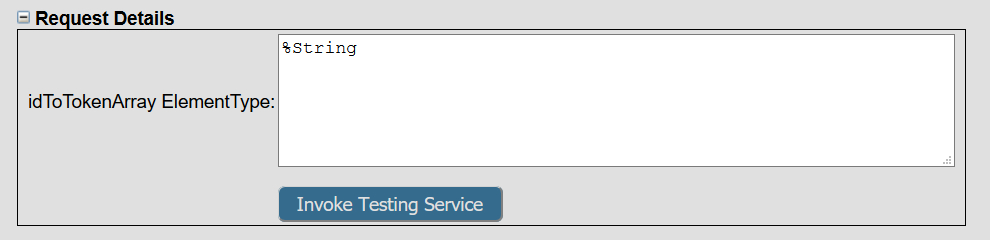 But my attempts to set idToTokenArray have not yielded any positive results so far. How do I need to fill it?
Hello community,
I have productions running in several different namespaces. They all use a common credentials ID for sending email, which is set up in only one of the namespaces. The documentation says that credentials are entered by namespace. When I ran a production in a second namespace, the error log said that credentials were not found (expected), but later attempts to send a file thorugh the production did successfully send an email. I'm wondering if Ensemble is able to look in other namespaces for the same credentials ID?
I just want to make sure, since I'm moving this to a li
Hi,
I create a cache class program. Its compile it. But how to run it?
Please send one sample program with output
I'm with a problem in a property, where she has two parameters that conflict, DISPLAYLIST and VALUELIST.
In screen when I'll go to set value in the field, the CACHE transform internally the property of LOGICAL to DISPLAY with propertynameLogicalToDisplay(propertyname), far so good.
My problem is in the property, why, by default she send the value as DISPLAYLIST, in hour of transformation as the value is DISPLAY MODE the error occurs.
How I do to that default value be VALUELIST and not DISPLAYLIST?
This is the fourth article in a series on iKnow demo applications, showcasing how the concepts and context provided through iKnow's unique bottom-up approach can be used to implement relevant use cases and help users be more productive in their daily tasks. Previous articles discussed the Knowledge Portal, the Set Analysis Demo and the Dictionary Builder Demo, each of which gradually implemented slightly more advanced interactions with what iKnow gleans from unstructured data.
This week, we'll look into one more demo application, the Rules Builder Demo, in which we'll build on previous work but again climb a step on the level ladder, implementing a more high-level use case than in the previous ones. The idea came from an opportunity where we were asked to help the customer in the finance sector make sense of vast volumes of contract data. They wanted to semi-automate the extraction of logical rules from that text (in fluent legalese!), so they could be fed into other systems. While this was an exciting use case to work on (and more on it in this GS2016 presentation), we've also used it in other cases, for example to extract mentions of ejection fraction from Electronic Health Records.