Hi Community!
We've reached the end of this #GlobalSummit23 - the last day! And this is our day - programmers' day. The keynotes today were all dedicated to the developers, their growth, aspirations and innovations.

Hi Community!
We've reached the end of this #GlobalSummit23 - the last day! And this is our day - programmers' day. The keynotes today were all dedicated to the developers, their growth, aspirations and innovations.
I am writing a custom business class. I need to use the business service name that will be using the class within a SQL statement. How can I get the business service name that is using the class?
It's time to announce the Winners for May! Please welcome our awesome Global Masters Heroes!
The storm of applause goes to these developers and their great contribution to DC in May:
🥇 @Robert Cemper, ex Senior Sales Engineer from InterSystems, Austria
🥈 @Luis Angel Pérez Ramos, Sales Engineer, InterSystems, Spain
🥉 @Pietro Montorfano, Systems Management Specialist, InterSystems, Italy

Learn more about the competition and our awesome winners below.
Hi Community,
We're pleased to invite all the developers to the upcoming kick-off webinar for the Grand Prix Contest 2023!
During this webinar, we will describe how you can win up to $10,000 in prizes! We'll talk about the topics we expect from participants and show you how to develop, build and deploy applications on InterSystems IRIS data platform. Let us remind you, this contest allows you to use any element of our data platform - IntegratedML, FHIR SQL Builder, Embedded Python, Interoperability, etc - in your project.
Date & Time: Monday, June 12 – 12 pm EST | 6 PM CEST
Who has never been through in the following situation:
I have an application/global configuration that is not and cannot be mapped to a class, but it is necessary to provide a stored procedure so that a report tool using ODBC/JDBC or even using the resultset of IRIS itself, can access the data and generate the report.
In IRIS we have a functionality that allows us to create a query that can be accessed internally and also be exposed as a stored procedure, with our own logic. That functionality is Custom Class Query.
Does IRIS products have capability to generate dynamic HL7 message
Good morning,
I was wondering:
Given the following scenario where we have a string where each two items are being splitted by "|" as follows: "squadName|initialLetter"
"Alfa|A|Bravo|B|Charlie|C|Delta|D|Echo|E|Foxtrot|F|Golf|G|Hotel|H|India|I|Juliett|J|Kilo|K|Lima|L|Mike|M|November|N|Oscar|O|Papa|P|Quebec|Q|Romeo|R|Sierra|S|Tango|T|Uniform|U|Victor|V|Whiskey|W|X-ray|X|Yankee|Y|Zulu|Z"
And we would need to generate a String structure like:
[
    {
        "number""number 1"
How would you propose to do that functionality?
I would suggest:
%StringWe would call it as follows:
"Alfa|A|Bravo|B|Charlie|C|Delta|D|Echo|E|Foxtrot|F|Golf|G|Hotel|H|India|I|Juliett|J|Kilo|K|Lima|L|Mike|M|November|N|Oscar|O|Papa|P|Quebec|Q|Romeo|R|Sierra|S|Tango|T|Uniform|U|Victor|V|Whiskey|W|X-ray|X|Yankee|Y|Zulu|Z"Hi Community!
Just want to share with you an exercise I made to create "my own" chat with GPT in Telegram.
It became possible because of two components on Open Exchange: Telegram Adapter by @Nikolay Solovyev and IRIS Open-AI by @Kurro Lopez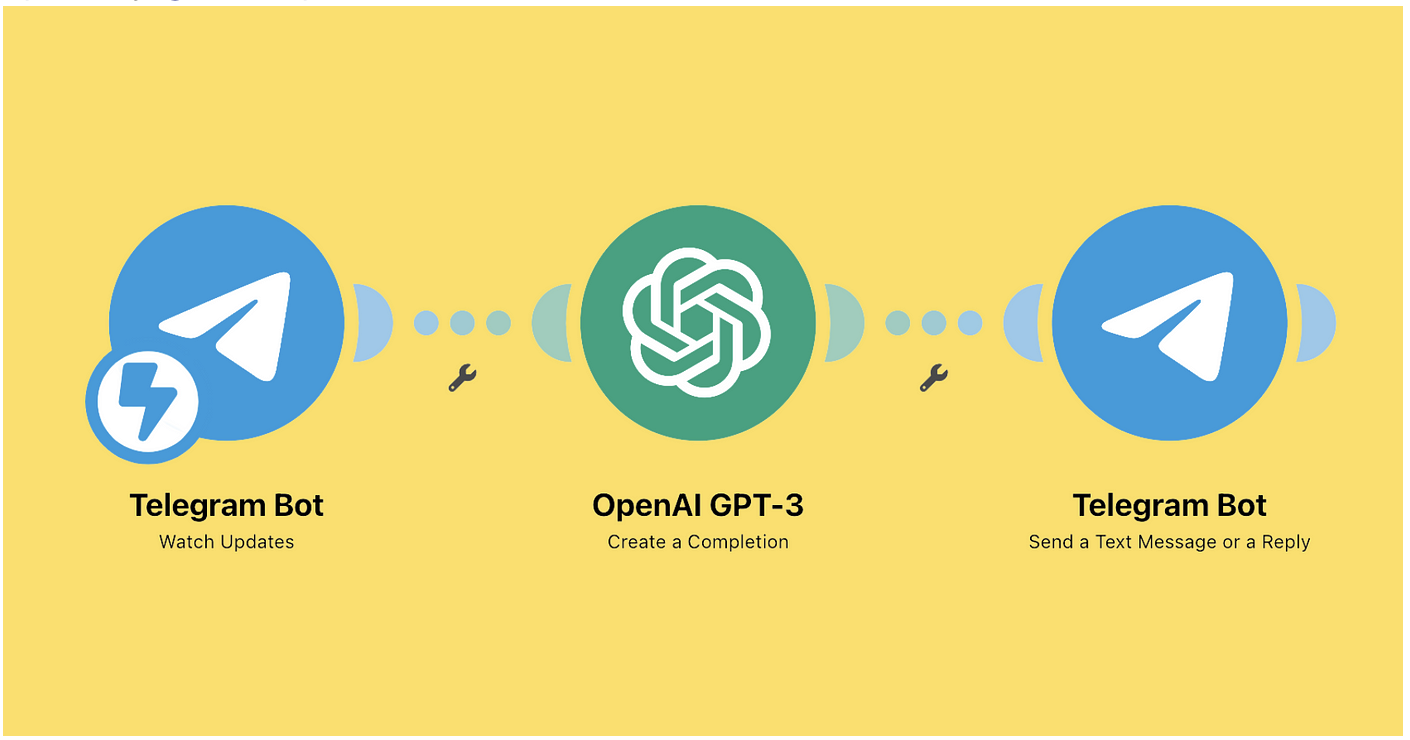
So with this example you can setup your own chat with ChatGPT in Telegram.
Let's see how to make it work!
Written in reply to community post for can Python create HL7 Message dynamically.
Use an integration enabled namespace.
Note: USER namespace is not enabled for interoperability by default.
If following suggest create a new interoperatibility namespace to explore functionality.
# Switch to
ZN "[Interoperability Namespace Name]"
# Launch interactive Python shell:
Do $SYSTEM.Python.Shell()
#Load dependencies

import datetime as dt
import uuid

# Cache current time in CCYYMMDDHHMMss format
hl7_datetime_now=dt.datetime.now().strftime('%Y%m%d%H%M%S')

# Create HL7 Message
hl7=iris.cls("EnsLib.HL7.Message")._New()

# Set the doc type
# 2.5.1:ORU_R01 - Unsolicited transmission of an observation message
hl7.PokeDocType("2.5.1:ORU_R01")Hi folks!
Is it possible to use Environment variables for production settings?
E.g. I have a telegram adapter for which I need to setup token(part of the production below):
<ItemName<</Could someone direct to any E2E Test Automation solutions for IRIS Data platform product? either proprietary or open source also works
Is there not a way to use the Red Hat 8 install package to do an `irisinstall`? If not, how does one get the IRIS Community .tar.gz file for "Red Hat 9"?
I am having code like this,
set args = []
set resultSet = ##class(%SQL.Statement).%ExecDirect( , sql_whereClause, args)
Instead of placing args[1],args[2] etc into the above I want to pass the whole args at a time if it possible.?
We often get questions about recent and upcoming changes to the list of platforms and frameworks that are supported by the InterSystems IRIS data platform. This update aims to share recent changes as well as our best current knowledge on upcoming changes, but predicting the future is tricky business and this shouldn’t be considered a committed roadmap.
With that said, on to the update…
As we said yesterday. our EMPI can receive data from multiple sources, REST, HL7 messaging, etc. But it is possible that the standard fields are not enough and we want to expand the patient information to help discriminate and uniquely identify them. How could we customize patient data? Modifying the standard classes to our liking? NOOOOO!
Hello,
I would like to get a list of all globals that have been read or written during a given context. In Portal, there are counters in dashboard that give the number of read/write to globals in general.
What I am looking for :
- some handler (eg: like $ZTRAP) that will be called everytime something is read/written to a global.
- to activate a "global log mode" in Portal that will dump some information to a file (like ^ISCSOAP for SOAP requests).
I understand this is something that can considerably slow down IRIS, but it's intended to be used only for debbuging and under no load.
I have a repository on github. I wanna setup that repo into my local IRIS instance and also I want to work on different branch and commit those back to the same repo.
Please help me through this.
I also have a .DAT file which i think contains code and data and not .git folder. So how can i sync that to my git repo for further development.
Hi,
Getting the following error when activating a foundation namespace(FHIR Server). Anyone had this issue before:
|
<THROW>zAddRecordToLogPersistence+7^HS.HC.Util.Installer.1 *%Exception.StatusException ERROR #5001: Attempt made to use $$$ActivationLog* macros before HSSYS exists |
Thanks
how can i use git for versioning while working in IRIS.
I am having directory that i created while working in iris. How can i manage version control using git in this case.
Is it possible with vscode terminal or with a normal terminal in mac.
Is there a reason why calling %ExecDirect() (or %Execute) won't set the %SQLCODE of the result set to 100 even when the query returns no data?
Here is the code in question with a bit of contrivance to force the issue:
set statement = ##class(%SQL.Statement).%New()
set result = ##class(%SQL.Statement).%ExecDirect(statement,"select top 0 0 from Example.Testing")
w result.%SQLCODE
The %SQLCODE is set to 0 in this case. The same happens if I use %Prepare and %Execute, e.g.
set statement = ##class(%SQL.Statement).%New()
set status = statement.%Prepare("select top 0 0 from Example.
Hi there,
Please, could anyone tell me how can I set up VSCode terminal to IRIS terminal? I already saw this working in a video with docker version from IRIS Community. I have the Intersystems Extension Pack and IRIS Community locally installed.
Thanks
Hi folks!
Those who actively use unittests with ObjectScript know that they are methods of instance but not classmethods.
Sometimes this is not very convenient. What I do now if I face that some test method fails I COPY(!) this method somewhere else as classmethod and run/debug it.
Is there a handy way to call the particular unittest method in terminal? And what is more important, a handy way to debug the test method?
Why do we have unittest methods as instance methods?
Since SELECT ... FOR UPDATE is implemented in many RDBMS as a method of explicit row lock acquisition, I think there are many cases where this function is used.
This syntax is not an error for InterSystems products, but it does not acquire row locks as expected.
This article will show you how to achieve equivalent functionality.
DECLARE CURSOR C1 IS
SELECT Name FROM Person WHERE Name LIKE 'A%' FOROPENUsing the Config.Configuration class and SYS.Database class methods, you can create and register a namespace database from the terminal.
Below is a series of execution examples that create database file /CacheDB/AAA/cache.dat and register database AAA and namespace AAA in the configuration file (cache.cpf).
* Execute in the %SYS namespace. *
* Make sure that this script runs as the user that is used for all IRIS processes to ensure that the directory has appropriate ownership and permissions *
Hi All.
Had an empty Ensemble namespace (interoperability enabled) which the customer had requested renaming before beginning development, so was wondering about best practice to achieve this.
I saw on the docs (https://docs.intersystems.com/irislatest/csp/docbook/DocBook.UI.Page.cl…) that this can be done with management portal and terminal commands but it seemed simpler to just create a new namespace and delete the old. The way I did this was to create a new namespace using 'Copy from' the existing, then delete the old one.
my questions are:
1.
Hello Team,
please can someone help me in the below.
I'm trying to call a Rest API below specification working in postman, and receiving perfectly the response:
POST /PharmacyServices/api/Pharmacy/Upload?Key=aaaa&Username=bbb&Password=ccc HTTP/1.1
Host: abc:38440
Content-Length: 240
Content-Type: multipart/form-data; boundary=----WebKitFormBoundary7MA4YWxkTrZu0gW
------WebKitFormBoundary7MA4YWxkTrZu0gW
Content-Disposition: form-data; name="File"; filename="///xxxx/POC/CSV/20230607.
Hi Community!
We're pleased to invite all DC members to the InterSystems Global Masters Gamification Platform to get points and prizes for your contribution to the Community, learn with selected content about InterSystems technology, network with your peers and have fun!

▶️ What is Global Masters?
Global Masters is a gamification platform, where you learn technology, complete tech quizzes, watch videos, etc. You will be completing challenges (tasks) related to ISC technology, earning badges & points, and exchanging points for a variety of rewards.
Hi Guys,
I'm using the below code to download, extract files in a file directory then save data into a global, and remove the file directory as not needed anymore, but the issue is that the class(%File).RemoveDirectoryTree is not deleting, also tried class(%File).RemoveDirectory and same thing.
I'm suspecting that maybe because the process is still considering the file or the directory is opened or still in use !? I also tried to run the class(%File).RemoveDirectoryTree("D:\SpaceSense2014\LIVE-SPACESENSE\NodeJS\FFTData_20019082") from the terminal and still nothing ?
The two class(%File
Just for knowledge purpose. Is there any disadvantage of using IRIS on Mac/Linux machine over a windows system
|
This post backs the demonstration at Global Summit 2023 "Demos and Drinks" with details most likely lost in the noise of the event. This is a demonstration on how to use the FHIR SQL Capabilities of InterSystems FHIR Server along side the Super Awesome Identity and Resolution Solution, Zingg.ai to detect duplicate records in your FHIR repository, and the basic idea behind remediation of those resources with the under construction PID^TOO|| currently enrolled in the InterSystems Incubator program |