Hi Community,
The new video from Global Summit 2019 is available on InterSystems Developers YouTube:
Hi Community,
The new video from Global Summit 2019 is available on InterSystems Developers YouTube:
The healthcare technology market is in strong evolution. Gartner's wave chart for healthcare technologies demonstrates what these technologies are, very well reflected by healthcare.digital. I call this HealthTech See:
These technologies can use InterSystems technologies (ISC Health Tech), see:
Consent Management uses InterSystems Healthshare Stack to do MPI and consent management, see:
Is there a better way (i.e., without string commands) to remove the fractions of seconds from a %Library.PosixTime value?
This works, but seems inefficient:
set posix = 1154669852181849976w##class(%Library.PosixTime).LogicalToTimeStamp(posix)
2025-05-2712:06:15.003set str = ##class(%Library.PosixTime).LogicalToTimeStamp(posix)
set stripped = $P(str,".",1)
w##class(%Library.PosixTime).TimeStampToLogical(stripped)
1154669852181846976set newposix = ##class(%Library.PosixTime).TimeStampToLogical(stripped)
w##class(%Library.PosixTime).LogicalToTimeStamp(newposix)
2025-05-2712:06:15I have a vendor that only wants results on patients that arrive to the ED via EMS/Ambulance. The value I need for filtering is in the PV2;38. Some of the results requested do not allow the PV2 segment to be added to the schema in the EMR. I was told that other orgs have used a lookup table that is populated with the PV1;19 value when an ADT messages that meets the criteria is sent in. This table is then referenced in the business rule for the results that do not have PV2;38 and if Encounter number from result message exists on the Table, the result is sent. Has anyone done this before?
I have been walking through this with a few team members and as such I thought there might be others out there who could use it, especially if you work with HL7 & Ensemble/HealthConnect/HealthShare and never venture out past the Interoperability section.
First, I would like to establish that this is an extension of the already established documentation on importing and exporting SQL data found here: https://docs.intersystems.com/iris20241/csp/docbook/DocBook.UI.Page.cls?KEY=GSQL_impexp#GSQL_impexp_import
There is a way to remove the web source control in the web page of BPL?.png)
i already disabled a configuration in the production and works fine:.png)
But in the BPL page, it doesn't worked. There is a way to disable this configuration at portal?
#InterSystems Demo Games entry
This demo introduces an AI-powered clinical decision support tool built on InterSystems IRIS. The use case addresses clinician burnout by unlocking the wisdom trapped in 30,000 unstructured clinical notes. We showcase IRIS's powerful vector search to perform hybrid (semantic + keyword) queries for complex diagnostic challenges. The highlight is our multi-modal Retrieval-Augmented Generation (RAG) assistant, which analyzes clinical video content in real-time to find similar past cases and synthesize evidence-based recommendations, transforming how clinicians access and utilize institutional knowledge.
🗣 Presenter: @Vishal Pallerla, Sales Architect, InterSystems
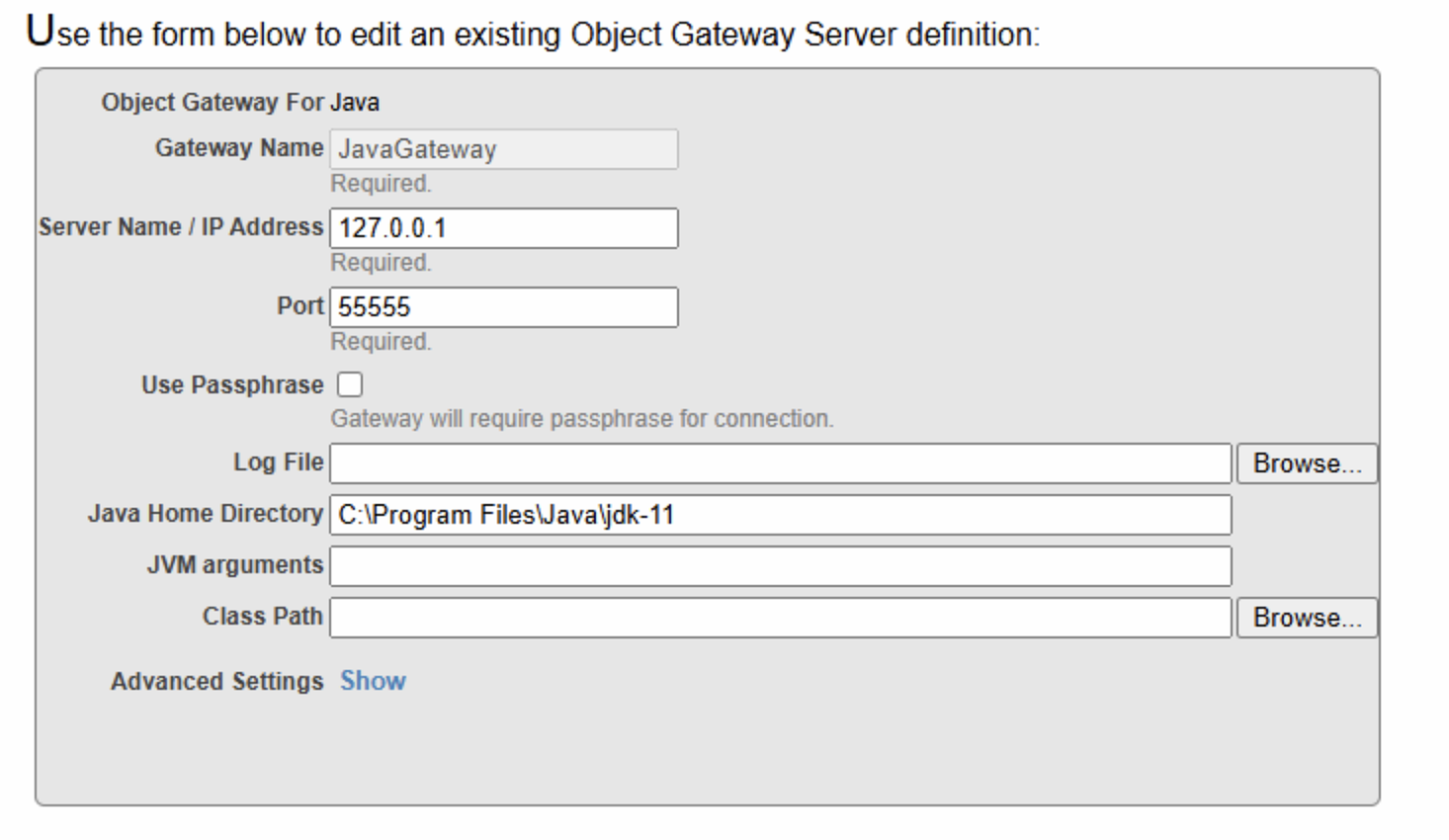
We currently have Business Operation that we built to use the EnsLib.SQL.OutboundAdapter so we can make Microsoft SQL Server Stored Procedure calls. The BO is attached to a Java Gateway Service.
Some of our MS SQL Databases have moved from being OnPrem to Azure Cloud. We have started seeing where we are receiving errors on the BO saying that we cannot connect to the Azure Database, but we never receive a Disconnect from the Azure Database.
Hi Everyone,
So after @Ariel Glikman posted a custom operation example, I'm stuck on another dilemma, and here it is:
Hello community.
I have a request from a client who wants to do the following.
Currently, they have a data upload process via FTP in which they have implemented a RecordMap to store the information of the CSV files that are uploaded to the FTP directory.
Now they want to have another directory so that it is ONLY executed through an external instruction, not when the file is uploaded to the directory.
Hi
I'm a newbie in productions and I've received the below business operation from a client that I need to include in a production,
So not sure if I'm supposed to create a new Business operation with a new name and select the class as below but then what's next and what should be the output type in X12 tab or if it should be type SCOSwarm.Message.SX3ScheduleResponse?
Or should I be ignoring this class for now, create a new business operation called SCOSwarm.Operation.SX3ScheduleOp copy the code across ...etc but how can I include EnsLib.NullAdapter ?
Thanks
Hi Community,
We’ve got something exciting for you — it’s time for a new demo video contest, and this time, you’re in the judge’s seat!
📺 Demo Games for InterSystems Sales Engineers 📺
For this contest, InterSystems Sales Engineers from around the world submitted short demo videos showcasing unique use cases, smart solutions, and powerful capabilities of InterSystems technologies.
Now it’s your turn! We’re opening up voting to the entire Developer Community. Your insight and perspective as developers make you the perfect experts.
.jpg)
Given the code below, I need help with getting the collected column widths from the Demo.Configuration table and stored in the columnWidths zne page property. As I understand it, I should be able to retrieve it using zenPage.columnWidths in the setColumnWidths or dgRender clientMethods but the alert is showing that it cannot be retrieved as it shows a value of Null. Once I can retrieve those values, then I want to set the widths of the colmns of the dynaGrid according to the values in the ^Demo.Configuration table. The data pulled in from the CSV file that creates ^Demo.Import can have a
Hey folks! Having recently onboarded to InterSystems, I realized that despite having a totally free and awesome Community Edition, it's not super clear how to get it. I decided to write up a guide highlighting all the different ways you can access the Community Edition of InterSystems IRIS:
Working with a containerized instance of the Community Edition is the recommended approach for folks who are new to developing on InterSystems IRIS, and in my opinion it's the most straightforward. InterSystems IRIS Community Edition can be found on DockerHub; if you have an InterSystems SSO account, you can also find it in the InterSystems Container Registry.
In either case, you'll want to pull the image you want using the docker CLI:
docker pull intersystems/iris-community:latest-em
// or
docker pull containers.intersystems.com/intersystems/iris-community:latest-emNext, you'll need to start the container: In order to interact with IRIS from outside the container (for example, to use the management portal) you'll need to publish some ports. The following command will run the IRIS Community Edition container with the superserver and web server ports published; note that you can't have anything else running that depends on ports 1972 or 52773!
docker run --name iris -d --publish 1972:1972 --publish 52773:52773 intersystems/iris-community:latest-emIf you want to raise an arbitrary custom error in a TRY block, you can pass an exception with a throw as follows. In the following example, a custom error is raised if Stcount is less than 1.
FHIR Server
A FHIR Server is a software application that implements the FHIR (Fast Healthcare Interoperability Resources) standard, enabling healthcare systems to store, access, exchange, and manage healthcare data in a standardized manner.
Intersystems IRIS can store and retrieve the following FHIR resources:
Fast Healthcare Interoperability Resources (FHIR) is a standardized framework created by HL7 International to facilitate the exchange of healthcare data in a flexible, developer-friendly, and modern way. It leverages contemporary web technologies to ensure seamless integration and communication across various healthcare systems.
Hi Community,
Are you already InterSystems certified, or thinking about taking that next step?
InterSystems certification is a great way to showcase your skills and open new doors—but we'll let our certification holders speak for themselves:
Hi
I have a large tree outside my window. Here in Phoenix, Arizona, USA it's still warm and sunny so our plants are still covered in lush foliage despite so many other places in the full throws of Autumn. My desk is oriented such that I can look out at the tree throughout the day. Part of the reason I like having my desk facing the tree is because I need the break from staring at the computer screens but the other reason is because I need reminders from nature from time to time.
Today I'm reminded of two things:
I am trying to help another group within our organization access a SQL Table that I have created to populate Epic Department Data within our environment and came across the ability to use SQL Seach REST Interface using iKnow.
However, I am having issues trying to get it to work via POSTMAN before I hand off the solution...
the POST URL... https://<servername>/api/iKnow/latest/TESTCLIN/table/osuwmc_Epic_Clarity.DepartmentMaster/search
where osuwmc_Epic_Clarity.DepartmentMaster is the table
In the body...
Hey Community,
It's time for the new batch of #KeyQuestions from the previous month.

Often times when working with FHIR data, for example with IRIS For Health, you'll find it useful to create a custom FHIR operation. The FHIR Standard comes with a set of defined operations (such as $everything) but a custom operation comes in handy when you need to create some extra functionality that goes beyond the set of standard FHIR operations. The docs take you step-by-step (though this comment may be helpful to those of you just getting started). One thing I would highlight, purely for aesthetic purposes, is how to syntactically name your function such that you can call it with hyphens.
We have a task that runs objectscript code to load data into a linked external table. After upgrading from 2024.1 to 2025.1, the load is throwing an error, with error code -400, and no error message. The data DOES get loaded into the external table in its entirety, so with no meaningful error message, its hard to determine what the issue is. The result is the same with and without the USING clause, so don't let that confuse you. We have logs of this statement succeeding before upgrade, and were able to get this statement to work in our production environment, which is still on version
Welcome to the 2025 third quarter update.
Last quarter, we had a few important announcements that are worth reiterating this quarter.
Mirroring only synchronizes database files.
To synchronize other files required for your application (CSP files, images, documents, etc.) between the two servers that make up the mirror set follow one of the approaches:
Hello,
I am currently maintaining a legacy application that was developed in ObjectScript and accesses data by working directly with globals.
For a new program, however, I plan to access the same global data through SQL-mapped classes.
I have two questions regarding this approach:
..Contains(source.{ORCgrp(x1).OBRuniongrp.NTEi2(x2):Comment(x3)},"(")&&..Matches(source.{ORCgrp(x1).OBRuniongrp.NTEi2(x2):Comment(x3)},"^[A-Z][0-9][0-9]$")
I want to do this to match strings such as X98. Community AI tells me this is correct but I get an error in testing. Specifically, this is the part causing the error;
..Matches(source.{ORCgrp(x1).OBRuniongrp.NTEi2(x2):Comment(x3)},"^[A-Z][0-9][0-9]$")
.png)
What do I need to change?
Dear, Community!
I have a concern about using %Stream.TmpCharacter for storage purposes. Reading the class's source code, I can understand a bit about how it works. But I'd like to know from the community how it actually works. Is it necessary to use the .Clear() method to clear this buffer, or is it done automatically upon disposal?
Note: Please forgive my poor English.