New
Article Iryna Mykhailova 路 Feb 20 3m read

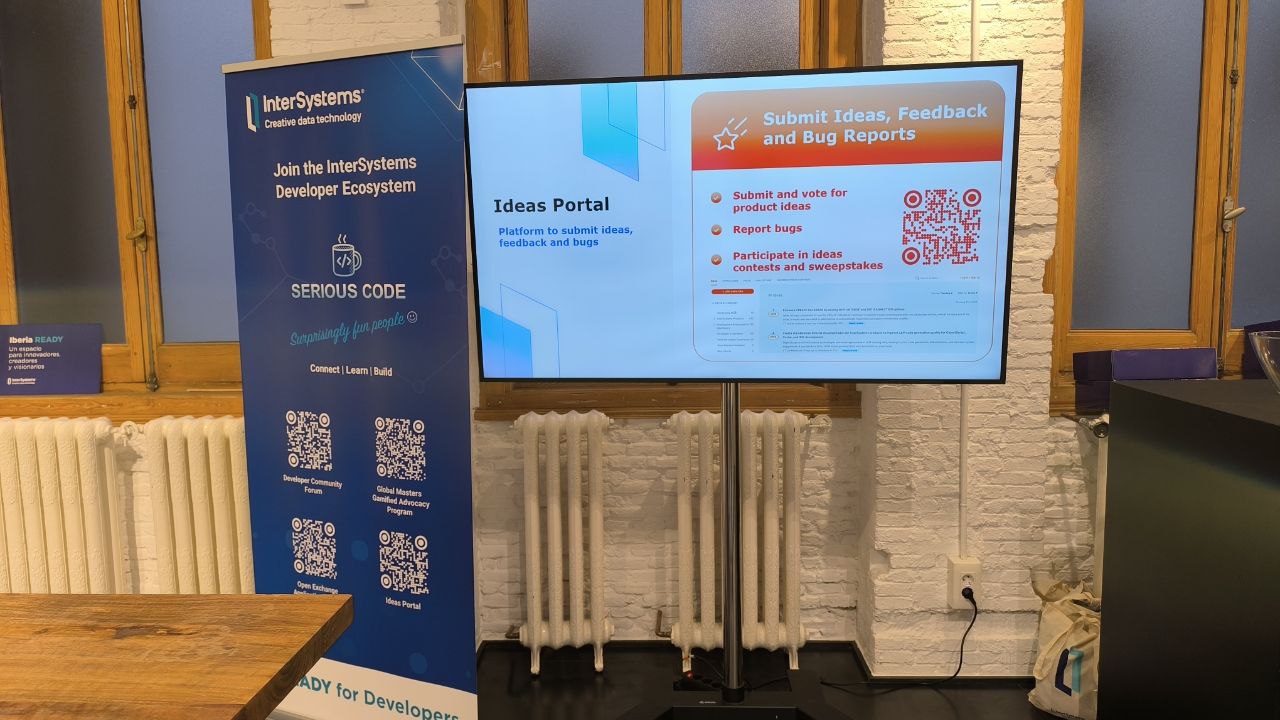
I'm happy to share that I was invited to present on the Developer Ecosystem and how it helps everyone become better programmers at the meetup during Iberia READY 2026. Thus, I had a chance to participate in this great event. And you have a chance to see how it went on, because as usual, I will share photos and impressions!

When I arrived, the first thing I saw was the Developer Zone and my presentation about the Ecosystem 馃ぉ

3
0 52
Article Iryna Mykhailova 路 Feb 4 2m read

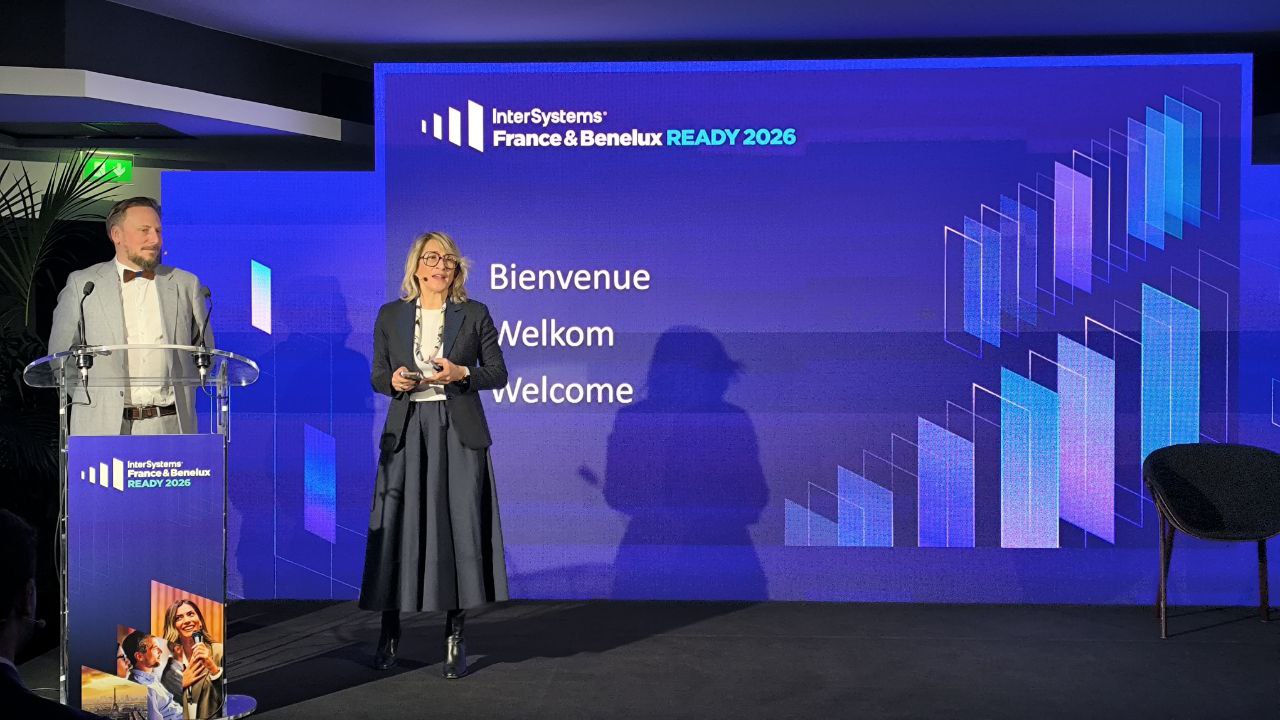
France & Benelux READY 2026 has just come to an end, and once again, these two days demonstrated how dynamic, curious, and engaged the Developer Community truly is. Here is a look back in words and images at this great edition.

The event kicked off with welcome remarks from @Adeline Icard and @Geoffroy Vitoux, setting the tone for the days ahead: innovation, sharing, and collaboration.

0
0 42
Article Iryna Mykhailova 路 Jan 12 4m read

InterSystems IRIS is built on an architecture that separates the logical organization of data (namespaces) from its physical storage location (databases). Understanding this separation and the distinction between Namespaces and Databases is crucial for effective data management, security, and especially, high-performance data sharing.

In this article, I will discuss these foundational components and provide a practical guide on leveraging global mappings to share native data structures (globals) across different logical environments.

Databases: Physical Reality

A database represents the physical reality of where the data is stored on the disk. First and foremost, it鈥檚 a file in a file system called IRIS.dat (e.g., <Install folder>\mgr\user\IRIS.DAT). The maximum size of this file is 32TB. It is the container for all the actual data and the code. Databases are managed by the IRIS kernel, which handles caching, journaling, and transaction logging at the physical file level.

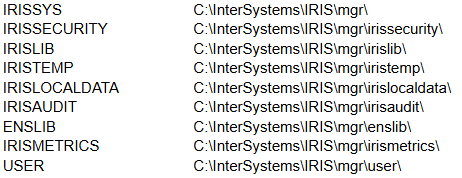
When you install InterSystems IRIS DBMS, the following databases are installed automatically:

0
2 98
Article Iryna Mykhailova 路 Nov 30, 2025 4m read

In the previous article, we talked about ODBC and connecting from C#. And now, let's look at JDBC and Java. The InterSystems JDBC driver is the recommended, high-performance way to integrate your Java applications.

Here is a step-by-step guide to getting your Java application connected to an IRIS instance using the JDBC driver.

Step 1: Obtain and Include the InterSystems IRIS JDBC Driver

Unlike ODBC drivers, which are often installed system-wide, JDBC drivers are typically distributed as JAR files that must be included in your Java project's classpath.

If InterSystems IRIS is installed on your local machine or another you have access to, you can find the file in install-dir/dev/java/lib/ or similar, where install-dir is the installation directory for the instance. Conversely, you can download the jar file from Driver packages page.

Or as suggested by @Dmitry Maslennikov in the comments, use the maven central repository for Maven:

<dependency><groupId>com.intersystems</groupId><artifactId>intersystems-jdbc</artifactId><version>3.10.5</version></dependency>

or for Gradle:

implementation("com.intersystems:intersystems-jdbc:3.10.5")

Include the jar file in Project:

  • Maven/Gradle: If you use a build tool, the simplest method is to add the InterSystems JDBC driver as a dependency in your pom.xml or build.gradle file. This automatically downloads and manages the JAR.
  • Manual: For simple projects, you must place the JAR file in a project directory (e.g., /lib) and explicitly add it to your classpath when compiling and running.
2
0 148
Article Iryna Mykhailova 路 Nov 20, 2025 4m read

For developers building external applications, especially those using familiar technologies like C#ODBC (Open Database Connectivity) is a crucial, standardized bridge to any relational database, including InterSystems IRIS. While InterSystems offers its own native ADO.NET provider, the ODBC driver is often the most straightforward path for integration with generic database tools and frameworks.

Here is a step-by-step guide to getting your C# application connected to an IRIS instance using the ODBC driver, focusing on DSN-less connection string.

Step 1: Install the InterSystems IRIS ODBC Driver

The InterSystems ODBC driver is installed by default when you install InterSystems IRIS on a Windows machine.

  • If IRIS is on the same machine: The driver is already present.
  • If IRIS is on a remote server: You must download and install the standalone ODBC client driver package for your client operating system (Windows, Linux, or macOS) and bitness (32-bit or 64-bit) from WRC website if you're a client or by installing Client components and copying ODBC driver.

Once installed, you can verify its presence in the ODBC Data Source Administrator tool on Windows (look for the InterSystems IRIS ODBC35 driver).

0
1 101
Article Iryna Mykhailova 路 Oct 13, 2025 8m read

In my previous article, Using LIKE with Variables and Patterns in SQL, we explored how the LIKE predicate behaves in different scenarios, from Embedded SQL to Dynamic SQL, and what happens to performance when wildcards and variables come into play. That piece was about getting comfortable writing a working LIKE query. But writing SQL that works is only the starting point. To build applications that are reliable, scalable, and secure, you need to understand the best practices that underpin all SQL, including queries that use LIKE.

This article takes the next step. We鈥檒l look at a few key points to help strengthen your SQL code, avoid common pitfalls, and make sure your SELECT statements run not just correctly, but also efficiently and safely. I'll use SELECT statements with LIKE predicate as an example along the way, showing how these broader principles directly affect your queries and their results.

*This is what Gemini came up with for this article, kinda cute.

0
1 241
Article Iryna Mykhailova 路 Aug 15, 2025 3m read

The August Article Bounty on the Global Masters article caught my attention, and one of the proposed topics sounded quite interesting in regard to its future use in my teaching. So, here's what I'd like to tell my students about tables in IRIS and how they correlate with the object model. 

First of all, InterSystems IRIS boasts a unified data model. This means that when you work with data, you are not locked into a single paradigm. The same data can be accessed and manipulated as a traditional SQL table, as a native object, or even as a multidimensional array (a global). It means that when you create an SQL table, IRIS automatically creates a corresponding object class. When you define an object class, IRIS automatically makes it available as an SQL table. The data itself is stored only once in IRIS's efficient multidimensional storage engine. The SQL engine and the object engine are simply different "lenses" to view and work with the same data.

First, let's look at the correlation between the relational model and the object model:

Relational Object
Table Class
Column Property
Row Object
Primary key Object Identifier

It's not always a 1:1 correlation, as you may have several tables represent one class, for example. But it's a general rule of thumb. 

7
2 189
Article Iryna Mykhailova 路 Aug 12, 2025 7m read

Over the years, I鈥檝e noticed that certain SQL questions come up repeatedly on the InterSystems Developer Community, especially about using the LIKE predicate in different contexts. Common variations include:

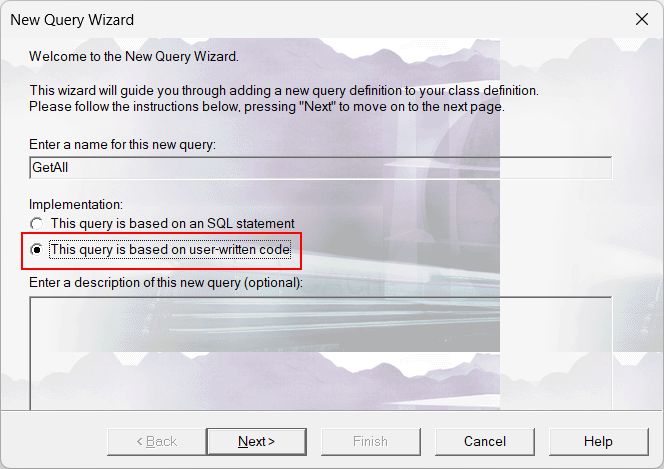
and many more derivatives. So, I decided to write an article that focuses on how LIKE works in InterSystems IRIS SQL, especially when used with variables in Embedded SQL, Dynamic SQL, and Class Queries, while touching on pattern escaping and special character searches.

First of all, I'd like to mention that InterSystems IRIS SQL offers most of the capabilities available in other relational DBMS that implement a later version of the SQL standard. But at the same time, it's important to mention that apart from relational access, in IRIS you can also use other models to get the same data, for example, object or document models. 

On this note, let's look at the LIKE predicate and how this tool is used in SQL for pattern matching. 

2
4 375
Article Iryna Mykhailova 路 Nov 10, 2024 2m read

If you like Java and have a thriving Java ecosystem at work into which you need to incorporate IRIS, it's not a problem. Java External Language Gateway will do it seamlessly, almost. This gateway serves as a bridge between Java and Object Script in IRIS. You can create objects of Java classes in IRIS and call their methods. You just need a jar file to do this.

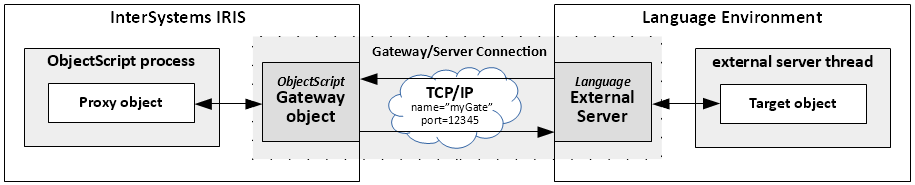
Connection diagram: proxy object <-> Gateway object <-> TCP/IP <-> External server <-> target object

0
4 441
Article Iryna Mykhailova 路 Jul 22, 2024 12m read

One good thing about COVID-19 is that it taught people that online work and study are possible. I remember a week before the lockdown started, everyone said that working online was impossible, not secure, etc. And what do you know, it all became possible and "secure" in the blink of an eye. As with everything, it depends on whether a person is capable of organizing his or her day and their work or study attitude. Thus, I became a great believer in online education. As an associate professor who teaches databases, I find it beneficial to my schedule and students. One thing that studying online brings is flexibility. Another one is accepting third-party courses to grant credits to my students 馃槈 

Considering that I'm teaching the basics of IRIS, I thought a new course, Getting Started with InterSystems IRIS for Coders, could be a relevant addition to my course. Therefore, I decided to follow the new Learning Path and see how it corresponds to my Syllabus and how many ECTS credits I can give for finishing it.

2
2 542
Article Iryna Mykhailova 路 Jun 1, 2024 3m read

Columnar storage is one of the newer offers provided by InterSystems IRIS. Unlike traditional row-based storage, it optimizes query processing by storing data in columns rather than rows, enabling faster access and retrieval of relevant information.

A couple of articles have been written on when it should be used to give a system the biggest boost, how to create tables like that using SQL

CREATETABLEtable (column1 type1, column2 type2, column3 type3) WITH STORAGETYPE = COLUMNAR  -- ex 1CREATETABLEtable (column1 type1, column2 type2, column3 type3 WITH STORAGETYPE = COLUMNAR)  -- ex 2

and even the performance tests.

As we all know, InterSystems IRIS is a multi-model DBMS and it gives seamless access to the same data using relational and object access. So the former is covered in other articles, but what about the latter?

0
2 423
Article Iryna Mykhailova 路 Mar 24, 2024 3m read

What I find really useful about IRIS when teaching my subject of Postrelational databases is the fact that it is a multi model database. Which means that I can actually go into architecture and structure and all that only once but then show the usage of different models (like object, document, hierarchy) using the same language and approach. And it is not a huge leap to go from an object oriented programming language (like C#, Java etc) to an object oriented database.

However, along with advantages (which are many) come some drawbacks when we switch from object oriented model to relational. When I say that you can get access to the same data using different models I need to also explain how it is possible to work with lists and arrays from object model in relational table. With arrays it is very simple - by default they are represented as separate tables and that's the end of it. With lists - it's harder because by default it's a string. But one still wants to do something about it without damaging the structure and making this list unreadable in the object model.

So in this article I will showcase a couple of predicates and a function that are useful when working with lists, and not just as fields.

2
1 435
Article Iryna Mykhailova 路 Mar 18, 2024 2m read

Recently, the question came up while discussing the access to the data stored in IRIS from different languages with my students if it was possible to initiate the connection and get data from Cloud solution (InterSystems IRIS CloudSQL) from Microsoft Excel, not the other way around. Considering the many varied ways one can get data in Excel (import data from external sources, connecting to databases using ODBC drivers, using power queries and web queries etc.) the obvious choice was to try ODBC driver. The only task left was to try to connect to the database in the cloud using the ODBC driver.

4
0 449
Article Iryna Mykhailova 路 Mar 11, 2024 8m read

We all know that having a set of proper test data before deploying an application to production is crucial for ensuring its reliability and performance. It allows to simulate real-world scenarios and identify potential issues or bugs before they impact end-users. Moreover, testing with representative data sets allows to optimize performance, identify bottlenecks, and fine-tune algorithms or processes as needed. Ultimately, having a comprehensive set of test data helps to deliver a higher quality product, reducing the likelihood of post-production issues and enhancing the overall user experience. 

In this article, let's look at how one can use generative AI, namely Gemini by Google, to generate (hopefully) meaningful data for the properties of multiple objects. To do this, I will use the RESTful service to generate data in a JSON format and then use the received data to create objects.

4
0 866
Discussion Iryna Mykhailova 路 Aug 24, 2023

Hey guys,

I do love Global Masters (and all the rewards that I get from it) and one of my favourite activities is answering quiz questions. And just now I've had a really cute question What is the result of: WRITE "99" + "cents"? which brought a smile to my face (because I do love to add questions like this to the tests for my students). This made me think that I would really like to somehow show my appreciation to the author of this question. 

3
0 253
Article Iryna Mykhailova 路 Mar 31, 2023 3m read

Saw the other day an article with the usage of the %ZEN package when working with JSON and decided to write an article describing a more modern approach. At some recent point, there was a big switch from using %ZEN.Auxiliary.* to dedicated JSON classes. This allowed to work with JSONs more organically.

Thus, at this point there are basically 3 main classes to work with JSON:

  • %Library.DynamicObject - provides a simple and efficient way to encapsulate and work with standard JSON documents. Also, there is a possibility instead of writing the usual code for creating an instance of a class like
set obj = ##class(%Library.DynamicObject).%New()

it is possible to use the following syntax

set obj = {}
  • %Library.DynamicArray - provides a simple yet efficient way to encapsulate and work with standard JSON  arrays. With arrays you can use the same approach as with objects, meaning that yu can either create an instance of the class
set array = ##class(%DynamicArray).%New()

or you can do it by using brackets []

set array = []
  • %JSON.Adaptor is a means for mapping ObjectScript objects (registered, serial or persistent) to JSON text or dynamic entities.
5
2 1974
Article Iryna Mykhailova 路 Mar 16, 2023 6m read

InterSystems IRIS has quite a few different kinds properties. Let鈥檚 put them in order so that they make better sense.

First of all, I would divide them into categories:

  • Atomic or simple properties (all those %String, %Integer, %Data and other system or user datatypes)
  • References to stored objects
  • Built-in objects
  • Streams (both binary and character)
  • Collections (which are divided into arrays and lists)
  • Relationships (one-many and parent-children)

Some of these kinds of properties are quite straightforward. For example, atomic properties:

Property Name As %Name;Property DoB As %DateProperty Age As %Integer
4
3 682
Question Iryna Mykhailova 路 Jan 12, 2023

Hello,

Created my Learning Lab yesterday evening and for the first hour or so everything was fine, but after that it just stopped working and I get Server unavailable for Management Portal:

And nothing would load in VSCode

Is there anything to be done? Because I wanted to upload my student's test on it. And the system wouldn't allow me to create another server, because I already have one.

2
0 329
Article Iryna Mykhailova 路 Jan 3, 2023 8m read

Because I had no idea how to build an integration solution for HL7 and didn't know where to start, I decided to follow the course Building Basic HL7 Integrations with InterSystems on Learning portal to get at least the idea of where to begin. After I studied all of it, I decided it might be a good idea to share my thoughts and reflections about it with everyone.

1
4 1082
Article Iryna Mykhailova 路 Dec 19, 2022 7m read

In the previous article, we talked about the flow of data to request the test and receive the results of the requested test. Now let's talk about one of the most important messages of HL7v2 standard.

Every time a receiving application accepts a message and consumes the message data, it is expected to send an ACKnowledgement (ACK) message back to the sending application. The sending application is expected to keep on sending a message until it has received an ACK message. It is done to inform the sending application that its message was successfully received, that it is (not) valid in accordance with HL7 rules and, if it is compliant, that it will be processed at some point.

0
0 1891
Article Iryna Mykhailova 路 Dec 12, 2022 12m read

In the previous article, we've seen the structure of one of the most used types of HL7 message - ADT (Admit, Discharge, Transfer) and an example of ADT^A04 with the description of all its fields. Now let's look at another flow of data having to do with ordering and fulfilling the orders of tests. I'm talking about ORM (as of version 2.5 you should use specific messages to order tests, like OMG, OML, OMD, OMS, OMN, OMI, and OMP), ORL and ORU messages. In a very simplified case, the exchange of data may look like this.

Let's look at these messages in more detail.

0
1 3540
Article Iryna Mykhailova 路 Dec 8, 2022 11m read

In the previous article, we've discussed the origin of the standard HL7v2, the structure and the types of messages. Let's now look at one of the most used types of messages and an example of its structure. I'm talking about ADT.

HL7 ADT messages (Admit, Discharge, Transfer) are used to communicate basic patient information, visit information and patient state at a healthcare facility. ADT messages are one of the most widely-used and high volume HL7 message types, as it provides information for many trigger events including patient admissions, registrations, cancellations, updates, discharges, patient data merges, etc. 

1
4 16618
Article Iryna Mykhailova 路 Nov 29, 2022 6m read

HL7 (Health Level 7) is a set of technical specifications for computerized exchanges of clinical, financial and administrative data between hospital information systems (HIS). These specifications are variously integrated into the corpus of formal American (ANSI) and international (ISO) standards.

The L7 of HL7 indicates that it is a standard that operates at layer 7, in other words at the application layer, of the OSI model. This means that HL7 does not have to take into account exchange security considerations, or those of message transport (this being ensured by lower-level layers such as SSL/TLS for security or TCP for the transport of data for example). To be more precise, layer 7 supports communications for end-user processes and applications and the presentation of data for user-facing software applications. As the highest layer of the OSI model, and the closest to the end user, layer 7 provides application-specific functions such as identifying communication partners and the quality of service between them, determining resource availability, considering privacy and user authentication, and synchronizing communication, as well as connecting the application to the lower levels of the OSI model.

Returning to the HL7 standard, the HL7 version 2 standard (also known as Pipehat) was originally created in 1989 but is still being used and updated regularly, resulting in versions 2.1, 2.2, 2.3, 2.3.1, 2.4, 2.5, 2.5.1, 2.6, 2.7, 2.7.1, 2.8, 2.8.1, 2.8.2 and 2.9. The v2.x standards are backward compatible (e.g., a message based on version 2.3 will be understood by an application that supports version 2.6) and in higher versions, you will see some fields are left just for it.

Despite it being more than 30 years old, HL7v2 remains the most widely used healthcare interface standard by a large margin according to the HL7.org portal that tells that:

4
1 1790
Question Iryna Mykhailova 路 Nov 9, 2022

Hi guys!

My student asked my why his unit tests don't work as they should, and I just could answer him. Here is the simplified case.

There is a class with a required unique property Name:

Class Test.NewClass [ Abstract ]
{
Property Name As%String [ Required ];
Index NameIndex On Name [ Unique ];
}

And there is an inherited class:

Class Test.NewClass1 Extends (%Persistent, Test.NewClass)
{
}

What I expect to happen, is when I save two objects of class Test.NewClass1 with the same value of property Name, for the second one to get an error stating that it violates the unique index.

9
0 755