It feels like a couple of months since the last update (1.0.255) to the Field Test version.
The Ens.Config.Production class has a property called SubProductions
Are sub-productions a work-in-progress within Ensemble? I'm not aware of any documentation or UI related to them.
While testing Atelier 1.0.255 I noticed that the namespace subtree of my Atelier project used different icon shading for the top-level Classes folder compared with the top-level Routines one:

Drilling down into parts of the Wasabi package helped me work out the significance of white-filled icons versus brown-filled ones:
A package is white if there are no classes in it, but only subpackages.
As a footnote, this only happens when browsing the namespace within Atelier Explorer.
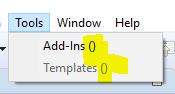
I am using the latest publicly available build, 1.0.255. Here's what my Tools menu looks like, with highlights added by me to indicate the parts I'm trying to understand the purpose of:
My recent Ensemble posting here contains a wink emoji in its first sentence, but when rendered on the DC homepage summary list it shows as the text "wink".
For those who don't have a chance to vote elsewhere today, or for those who want to vote more than once  , here's a poll for Ensemble users.
I'm pleased to see this in the documentation of the just-published 2017.1 Field Test of Ensemble:
"In certain circumstances, it is useful to create namespaces that are not enabled for Ensemble. In this release you can do this by clearing the
I used the Members option from the Community button to look up Evgeny's profile. Above the tabs ("View", "Mentions", "Posts (53)" etc) his name was displayed (correct).
Then I clicked on the "Posts (53)" tab. It showed his posts, but displayed my name above the tabs.
We at George James Software recently released a new version of Deltanji, the native source code management tool for Caché, Ensemble and HealthShare.
Version 6.1 includes several enhancements, including easy creation of labels. Bulk transfer of large codesets is also now available from the browser UI.
A perpetually free "install and go" Solo Edition of Deltanji is available. Licenses can be purchased for other editions that provide more advanced code management and deployment features.
Deltanji is compatible with Atelier. It can also manage external files.
Please visit http://georgejames.com/deltanji
Here's what I get when I check for updates from my 1.0.245 on Windows:
Cannot complete the install because one or more required items could not be found.
  Software being installed: Atelier IDE 1.0.255 (com.intersys.eclipse.feature.estudio.feature.group 1.0.255)
  Missing requirement: Connection Manager 1.0.255 (com.intersys.eclipse.connmgr 1.0.255) requires 'bundle com.fasterxml.jackson.core.jackson-databind 0.0.0' but it could not be found
  Cannot satisfy dependency:
    From: Atelier IDE 1.0.255 (com.intersys.eclipse.feature.estudio.feature.group 1.0.255)
    To: com.intersys.eclipse.connmgr [1.0.255]
"Loading lists of CSP resoorces from XXX"

I was recently troubleshooting a problem on a Linux (RHEL) instance of 2016.1 at a site. For policy reasons their sysadmins wanted to update the Caché installation so it used network accounts for its cacheusr and iscagent users and groups instead of the locally-created ones that had been set up during original install of Caché.
To do this they ran various commands including chown
Afterwards non-root users couldn't obtain a terminal session using the csession command.
I just got a digest email alerting me to a change in the article https://community.intersystems.com/post/studio-tip-running-cos-commands…
and when I use the list-style view of the dashboard it appears at the top with a recent "updated" timestamp:

But when I open the article the date info on the article and on all of the comments all points to changes 5 or 6 months ago.
I wonder if someone voted up the article earlier today and perhaps that triggered the update notification. If so, I think that's a bug. I don't want to know every time someone votes up (or down) an article.
The FT keys InterSystems currently make available to us in the zips from the download pages are due to expire at the end of this month (31-Aug-16). Will there be new keys soon?
Also wondering when we might expect new FT builds for 2016.2 and 2016.3. The last published ones were 24-Jun-16 and 16-Jun-16 respectively.
I haven't seen an Atelier update for a while either.
Studio's "Package Information" dialog, accessed from the context menu of a package on the Namespace tab of the Workspace pane, includes a field titled "Routine Prefix"

Help says this is a "String that is used as a prefix for the routines generated from classes in this package".
But if it set a string here, then recompile a class in the package, it doesn't affect the name of the generated routine(s). Nor does it influence the routine names generated when I create new classes in the package and compile them. I have tested on 2016.1.
We at George James Software are pleased to announce the release of version 2.6 of Serenji, our editor and debugger for Caché, Ensemble and HealthShare.
The main enhancement in 2.6 is the ability to run on a Linux <edit> or OS X </edit> workstation using Wine 1.8. More release details are here.
This is a free upgrade to users already holding an activation key. For new users a free 30 day evaluation period is granted upon installation.
John Murray
Senior Product Engineer
George James Software
If there isn't yet, maybe consider a DC enhancement to add an adornment to their name or photo to indicate this.
Please make these dialogs easier to use, for example by treating a double-click on a list item as a signal to select the item and effectively click the "Next" or "Finish" button. Using Tools\Add-Ins as my example, on the first page:

I want to double-click on a project and get to the next page. At the moment I have to click it, then click the "Next" button. And on the next page:
it's not as easy as it could be to select and run my chosen add-in.
I'm pleased to see the new Source Control menu in the recent 1.0.165 build. This gives me access to the features of the same server-side source control class as Studio has always supported. It is particularly relevant for our Deltanji source control tool.
Our class makes use of CSP to serve up some dialogs through which the user controls the source control operation. Two observations so far:
1. In Atelier the window you display our CSPs isn't resizable. In Studio it is.
2. Atelier isn't detecting the page we send that's supposed to close the dialog.
I just used Help\Check for Updates and updated my Atelier from 1.0.158 to 1.0.165. Is there any information published about what's new/fixed in this compared to previous public builds? Having that information might help us target our testing and so increase the value of our feedback to you.
Just today I've started getting some digest emails referring to threads that don't show any recent updates.
Is anyone else experiencing the same?
Here's a screenshot from the summary page, highlighting a couple of timestamps:

But when I open the article, here's what the posting reports:
And the timestamps of the two answers:
So why does the summary page report that the posting and the last answer are many hours more recent than they seem to be when I look at them?
I'm using Atelier 1.0.145 on Windows (x64). When I open the Help menu from the menubar the final entry (About Atelier) has a huge version of the Atelier icon alongside it. This distorts the menu. I can't post a screenshot here because my simplistic screen capture tool causes the faulty menu to close. But the large icon I see is also (correctly) displayed on the About box itself:

This isn't a new problem in build 145. I also had it in earlier ones and had been holding off from reporting it, assuming that it had already been noticed by someone at ISC.
My comments here relate to Atelier 1.0.137 on Windows connecting to Ensemble 2016.2 FT build 627.
I've been looking at what the Atelier Explorer view (hereafter AE), whose root elements are projects, lets us do with the contents of the namespace that the project is connected to:

versus what the Server Explorer view (here after SE) gives us:
Here are my observations so far.
1. CSP files are only accessible in SE. I'm guessing this is because Atelier's support for CSP files is so new as not to have propagated yet to everywhere that it's planned to cover.
2.
I think it'd make more sense to have them in alpha order rather than as they currently are, which is sorted by their internal value:
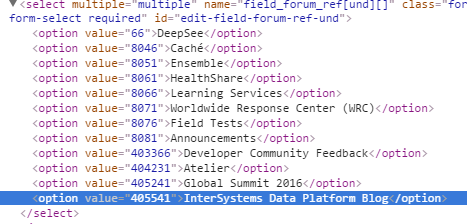
Here is a screenshot from my 2016.2 FT instance of Studio and Ensemble:
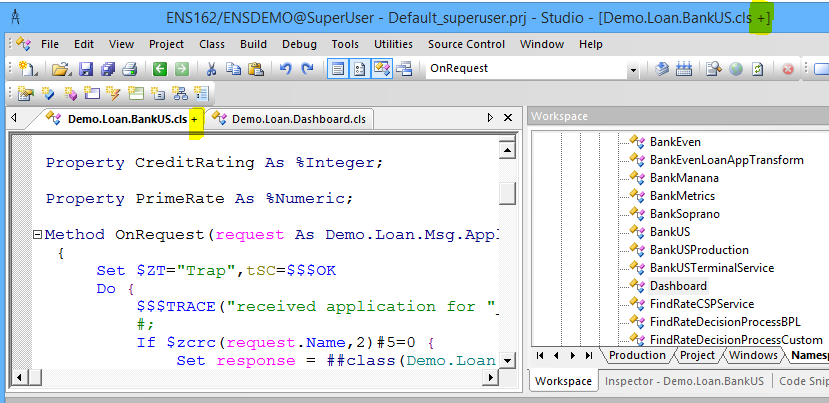
I don't recall having seen the highlighted "+" suffix on document names previously. Who can tell me what it denotes?
I originally posted this in the Field Tests group but it turned out to be a 2016.1 feature that I hadn't previously noticed. So I subsequently moved the post to the Cache group.
I create a new blank post. Then I choose a group (I picked Caché). Next I click int the "Related Topics" field. At this point Firefox stops responding. It happens with FF 45.0.1 on 32-bit Windows and with 46.0.b7 on 64-bit Windows.
I'm posting this report using Chrome.

When I check for updates from by 1.0.116 I get this:

When the Group field on the Create Post page was a list, if I started my post from a group's homepage such as https://community.intersystems.com/group/developer-community-feedback then this group was preselected.
Now that the Group field is a set of radiobuttons I have to select the group.
Is this a bug or an intentional change?