1. Integrated ML Demonstration
This repository is a demonstration of IntegratedML and Embedded Python.

Python is an interpreted high-level programming language for general-purpose programming. Created by Guido van Rossum and first released in 1991, Python has a design philosophy that emphasizes code readability, notably using significant whitespace
This repository is a demonstration of IntegratedML and Embedded Python.
Hi everyone!
I am recruiting on a fully remote Intersystems Developer. This role will be a long term contract to begin with high likelihood of extensions or conversion permanent. Please check out the job description down below and feel free to send me an email with your resume: Spencer.Frey@insightglobal.com
The Healthcare Integration Developer is responsible for designing, developing, and deploying the complex near real-time and real-time data interoperability solutions using Healthcare industry-standard data formats/specifications (HL7, FHIR, EDI, etc.).
In the previous articles, we learned the basics of using IMAP protocol to handle messages from mailboxes in an e-mail server. That was cool and interesting, but you could take advantage of implementations created by other ones, available in libraries ready to use.
One of the improvements to the IRIS data platform is the ability to write Python code alongside ObjectScript in the same IRIS process. This new feature is called Embedded Python. Embedded Python lets us bring to our ObjectScript code the power of the huge Python ecosystem’s libraries.
This GitHub is the simplest way to scrap using IRIS and Python, all of that already incorporated in an IRIS PRODUCTION.
From here you can build any IRIS production in full Python or in ObjectScript as this module is interoperable.
See for more information
In this GitHub we gather information from a csv, use a DataTransformation to make it into a FHIR object and then, save that information to a FHIR server all that using only Python.
The objective is to show how easy it is to manipulate data into the output we want, here a FHIR Bundle, in the IRIS full Python framework.
In this GitHub we fine tune a bert model from HuggingFace on review data like Yelp reviews.
The objective of this GitHub is to simulate a simple use case of Machine Learning in IRIS :
We have an IRIS Operation that, on command, can fetch data from the IRIS DataBase to train an existing model in local, then if the new model is better, the user can override the old one with the new one.
That way, every x days, if the DataBase has been extended by the users for example, you can train the model on the new data or on all the data and choose to keep or let go this new model.
Hey Developers,
Don't miss this hands-on session hosted by @Don Woodlock, Vice President of InterSystems Healthcare:
⏯ Machine Learning 201 - Neural Networks and Image Recognition
Hey Developers,
Enjoy watching the new video on InterSystems Developers YouTube channel:
Hi Developers!
We have great new articles for your to read and enjoy, thanks to our wonderful participants of the 3rd InterSystems Tech Article Contest: Python Edition!
And now it's time to announce the winners!
Let's meet the winners and their articles:
Continuing to observe the possibilities of Django, and usage with IRIS. The first we have looked how to define models and connect to tables already existing in IRIS, than we extended embedded Django Administration portal, with an ability to see what data we have in that models, with filters, editing and even pagination.
Time to go to real action, now we a going to create some REST API, on Django, based on the same data, we used before from the package posts-and-tags.
To do so, we will use Django REST Framework

Django REST framework is a powerful and flexible toolkit for building Web APIs.
Some reasons you might want to use REST framework:
In the first part, I've shown how to start a new project on Django, as well as define new models and add already existing models.
This time, I'll introduce an admin panel, available out of the box and how it can be useful.
Important note: do not expect that if you try to repeat actions from this post it will work for you, it does not. During the article, I had to do some fixes in the django-iris project, and even in DB-API driver made by InterSystems to fix some issues there as well, and I think this driver is still in development, and we will get more stable driver in future. Let's decide that this article only explains how it could be if we would have all done.
In this article, I am trying to identify the multiple areas to develop the features we can able to do using python and machine learning.
Each hospital is every moment trying to improve its quality of service and efficiency using technology and services.
The healthcare sector is one of the very big and vast areas of service options available and python is one of the best technology for doing machine learning.
In every hospital, humans will come with some feelings, if this feeling will understand using technology is make a chance to provide better service.
Hi developers! In this article I’m going to explore the use of Iris Python Native API in a specific problem: large strings to store.
Python Native API for Intersystems IRIS offers an useful way to persist data that you can’t have control over the schema or if the schema changes frequently. Combining the Native API with the IRIS Globals, you can easily use Iris Database as an Document Store. You can also see more details of globals use in this video in online learning (https://learning.intersystems.com/course/view.php?name=Native%20API%20for%20Python)

Hey Community!
Here are the bonuses for participants' articles that take part in InterSystems Tech Article Contest: Python Edition:

Following this GitHub we will see how the FIX protocol can be implemented easily using IRIS and Python.
If you don't have much time focus on the Send a Quote before the Order part near the end, as it will, in a matter of minute, tell you how to send a Quote Request followed by an Order Request and show you the result from the server, and that in no more than five clicks.
Implementation of the fix protocol using an IRIS python container for the initiator and a regular python container for the acceptor.
Hello,
I became aware of Python in the early 2000s when I started automating tasks. Some of our processes utilized python scripts. I never figured it out very well, and we decided to do away with Python because nobody on our team was familiar with it.
Along the way, I heard a lot about Python. My interest was renewed when InterSystems offered bonus points for using Python in contests.
The things I like the most about Python so far is how easy it is to find the mean of the ages of all Titanic passengers. For my test-data app I wanted to find the largest value in the ‘Qty’ column in a CSV file.
![ObjectScript Kernel Logo][ObjectScript Kernel Logo] Jupyter Notebook is an interactive environment consisting of cells that allow executing code in a great number of different markup and programming languages.
To do this Jupyter has to connect to an appropriate kernel. There was no ObjectScript Kernel, that is why I decided to create one.
You can try it out here.
Here's a sneak peek of the results:

There are several ways to create a Jupyter Kernel. I decided to make a Python wrapper kernel.
We have to create a subclass of ipykernel.kernelbase.Kernel
Hi Community,
We are excited to announce that InterSystems Developers Meetups are finally back in person!
The first Python-related meetup will take place on July 21 at 6:00 at Democracy Brewing, Boston, MA. There will be 2-3 short presentations related to Python, Q&A, networking sessions as well as free beer with snacks and brewery tours.
AGENDA:
Hi Community,
This post is a introduction of my open exchange iris-climate-change application.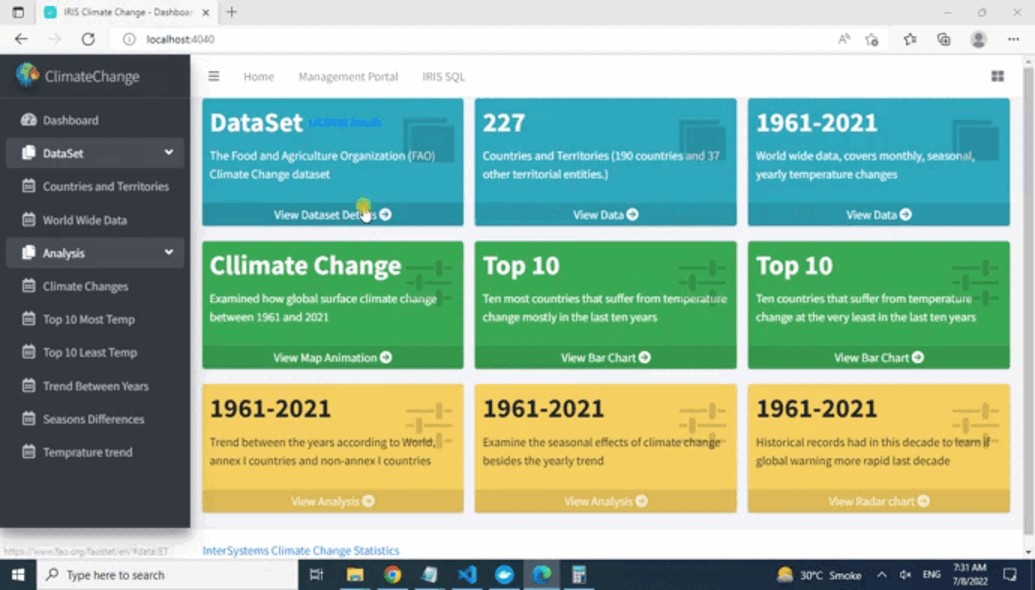
iris-climate-change web application Imports The Food and Agriculture Organization (FAO) Climate Change dataset by using LOAD DATA (SQL) functionality and analyze and visualize data with the help of Python Flask Web Framework, Pandas Python data analysis Library, Plotly Open Source Graphing Library for Python and Plotly JavaScript Open Source Graphing Library.
InterSystems Native SDK for Python is a lightweight interface to InterSystems IRIS APIs that were once available only through ObjectScript.
I'm especially interested in the ability to call ObjectScript methods, class methods, to be precise. It works, and it works great, but by default, calls only support scalar arguments: strings, booleans, integers, and floats.
But if you want to:
You'll need to write some glue code or take this project (installs with pip install edpy). edpy package gives you one simple signature:
call(iris, class_name, method_name, args)
which allows you to call any ObjectScript method and get results back.
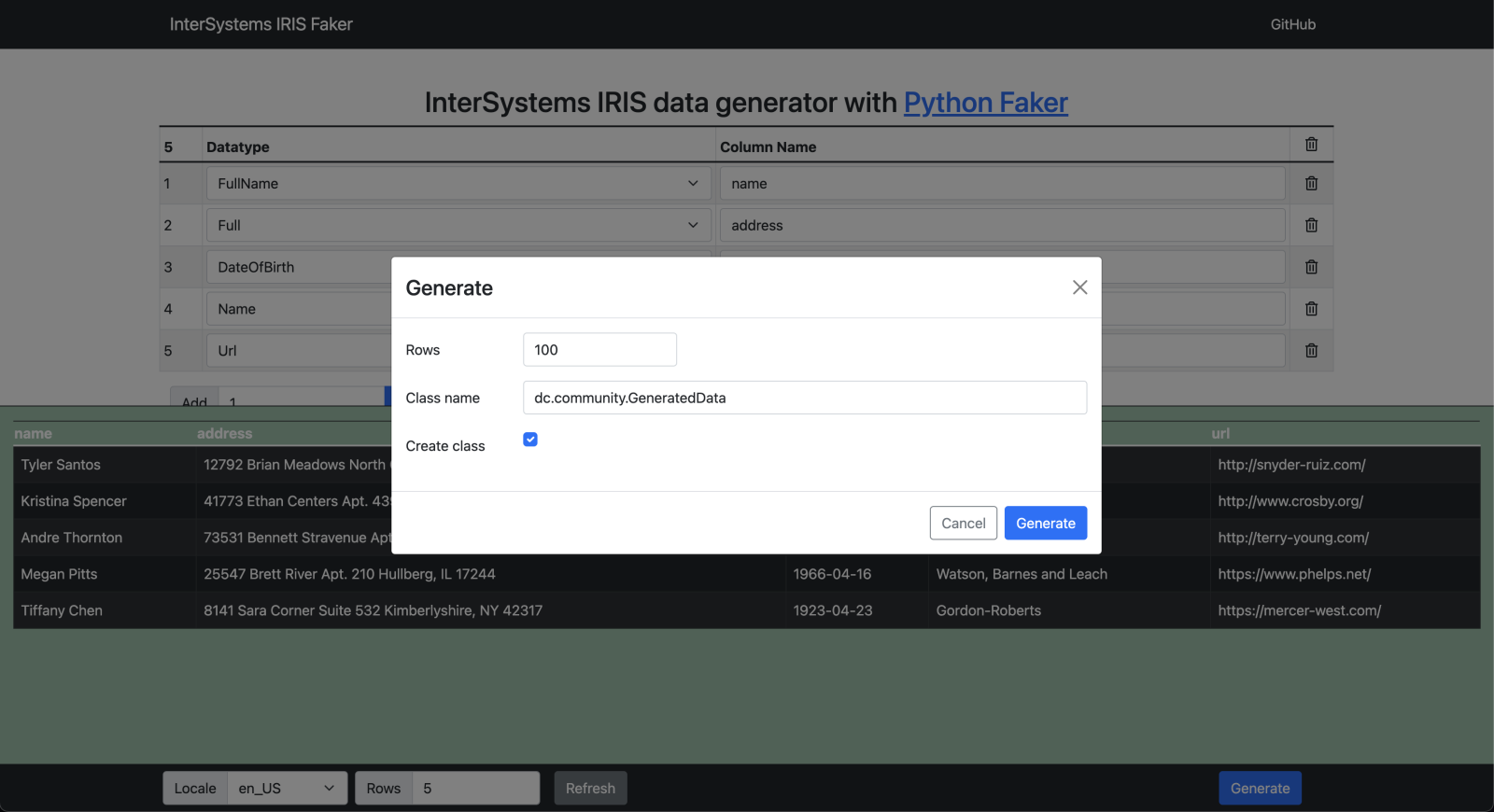
I think it's a known fact that Populate Utility has very limited functionality. It supports only one language and one country. The list of possible values does not have so many options.
There is a kind of tool that now can help with it, named Faker. It has implementations in different languages, including Python. Since IRIS has now had the Embedded Python feature, Python faker can be implemented in IRIS.

This formation, accessible on my GitHub, will cover, in half a hour, how to read and write in csv and txt files, insert and get inside the IRIS database and a distant database using Postgres or how to use a FLASK API, all of that using the Interoperability framework using ONLY Python following the PEP8 convention.
This formation can mostly be done using copy paste and will guide you through everystep before challenging you with a global exercise.
We are available to answer any question or doubt in the comment of that post, on teams or even by mail at lucas.enard@intersystems.com .
Hey Developers,
You're very welcome to join the upcoming InterSystems webinar called "InterSystems IRIS Tech Talk: Python"!
Date: Wednesday, June 08, 2022
Time: 11:00 AM EDT
In this tech talk, we’ll go into detail about the breadth of support Python developers have using the InterSystems IRIS data platform, including:
This project was thought of when I was thinking of how to let Python code deal naturally with the scalable storage and efficient retrieving mechanism given by IRIS globals, through Embedded Python.
My initial idea was to create a kind of Python dictionary implementation using globals, but soon I realized that I should deal with object abstraction first.
So, I started creating some Python classes that could wrap Python objects, storing and retrieving their data in globals, i.e., serializing and deserializing Python objects in IRIS globals.
Client: Northwell Health
Role: Senior Developer
Location: Remote
Duration: 6+ Months
Description:
Team Overview:
The FHIR Platform team is tasked with providing the core infrastructure in providing access to Northwell HIE patient data complying with HL7 FHIR and USCDI standards.
Position Summary:
The primary purpose of this role is to provide technical design, coding, testing and documentation for multiple components in the FHIR solution.
Responsibilities:
• Develop end-to-end solutions, participate in code reviews, unit test and deploy.
This is a simple fhir client in python to practice with fhir resources and CRUD requests to a fhir server.
Note that for the most part auto-completion is activated, that's the main reason to use fhir.resources.
This is a benchmark built in python and objectscript in InterSystems IRIS.
The objective is to compare the speed for sending back and forth a thousand request/message from a BP to a BO in python and in objectscript.
See https://github.com/LucasEnard/benchmark-python-objectscript for more information.
IMPORTANT : Here are the results of time in seconds, for sending 1000 messages back and forth from a bp to a bo using python, graph objectscript and objectscript.
String messages are composed of ten string variables.
Hi Community,
See how you can develop in Python and connect to InterSystems IRIS® data platform with PyODBC and the Native API:
I tried to convert IRIS globals to pandas dataframe.
I can do it as follows if there are no Japanese included in globals,
USER>zw ^ISJ2
^ISJ2=4
^ISJ2(1)=$lb("Name","Age","Address")
^ISJ2(2)=$lb("Sato","50","Tokyo")
^ISJ2(3)=$lb("Kato","40","Osaka")
^ISJ2(4)=$lb("Ito","30","Kyoto")

USER>do $system.Python.Shell()

Python 3.9.5 (default, Jan 31 2022, 17:55:36) [MSC v.1927 64 bit (AMD64)] on win32
Type quit() or Ctrl-D to exit this shell.
>>> mysql = "select name,value from %library.global_get('user','^ISJ2',,2,2)"
>>> resultset = iris.sql.exec(mysql)
>>> dataframe = resultset.dataframe()
>>> print (dataframe)
       name                        value
0     ^ISJ2                            4
1  ^ISJ2(1)  $lb("Name","Age","Address")
2  ^ISJ2(2)     $lb("Sato","50","Tokyo")
3  ^ISJ2(3)     $lb("Kato","40","Osaka")
4  ^ISJ2(4)      $lb("Ito","30","Kyoto")
>>>When looking at the "Current License Usage Summary" web page, there is a line for both local and distributed "Maximum Connections". I have scrutinized every class that seems reasonable to contain this information but have found nothing that matches the values on the web page. I do not believe these are related to license specifically though I did review all of the potential attributes of the license related classes to no avail.