I am looking to get the exec statement when we call the SP with
Get the exec string: exec pSPName '1', '2', '3'
InterSystems ObjectScript is a scripting language to operate with data using any data model of InterSystems Data Platform (Objects, Relational, Key-Value, Document, Globals) and to develop business logic for serverside applications on InterSystems Data Platform.
I am looking to get the exec statement when we call the SP with
Get the exec string: exec pSPName '1', '2', '3'
Hey Intersystems-Developer,
I have already used that and know its possible, but can't find it anymore :(
I need dynamic access on proxy objects. For example:
set key = "lastName"
set name = obj.name
set lastName = obj.key <- Not possible
set lastName = obj.GetAt(key) <- Not possible
How can I get access to that object with my dynamic variable "key" ?
Best regards.
Hi guys!
As you know there are two (at least) ways to get the stored value of the property of InterSystems IRIS class if you know the ID of an instance (or a record).
1. Get it by as a property of an instance with "Object access":
ClassMethod GetPropertyForID(stId As %Integer) As %String
{
set obj=..%OpenId(stId)
return obj.StringData
}
2. Get it as a value of a column of the record with "SQL access":
It’s often useful to make changes inside the current transaction, that would not be rolled-back if transaction is rolled-back. For example to do some logging.
This can be achieved by using global that is mapped to temporary database -- IRISTEMP. All globals that start with ^IRIS.Temp* are mapped to IRISTEMP by default. Problem with such approach is that IRISTEMP is cleaned on InterSystems IRIS restart, so this log is lost.
What else you can do is -- suspend transaction temporarily, do the logging, and then resume the same transaction.
Hi Dev Community,
My team is currently working on a project where we need to post pdf documents to a 3rd party REST API.
The API specifies a field in the JSON request message to contain the 'physical content' of the file as an array of bytes, example of the JSON request as follows - data truncated for readability purposes:
{
"CaptureSource":2,
"RecipientID":"ID34",
"Document": {
"Guid":"5D847A4E9CC1485382DC4A5F5DC80D6C",
"EventDate":"2019-01-14T13:23:46",
"FileExtension":"pdf",
"FileContent":"JVBERi0xLjQNCiXi48/TDQoxIDAgb2JqDQogIDw8DQogICA.
How can I remove elements from $lb property? Specifically last element?
$list does not work with $lb properties.
$listupdate can't remove elements
The only solution I found is a temp variable and $list, but isn't there something better?
Hello,
Working on to learn very basic CUSTOM Business Service which sends to a
But operation is not writing to File and erroring out (No Stream contained in StreamContainer Request")'.
How do convert the object to STREAM and wrap in the StreamContainer so the operation does not error and write to a file.
Thanks.
Persistent Class
{
Property PatientId As %Stream.FileCharacter;
Property PatientName As %Stream.FileCharacter;
.
Hi,
We have a function that takes two parameters, the second one is for output value:
MyFunc(Param1,Param2)
S Param2="it's all good"
Q 1
How can we detect if the caller called the function with one, or two arguments?
Meaning, how to distinguish this call:
S Result=$$MyFunc(1)
from this call:
S Result=$$MyFunc(1,.OutVal)
Thanks!
Nael
Hello,
Can anyone please provide me with a guide I can follow to create an entry in Cache's SSL/TLS configuration that would allow me to "speak" to an website via the Post method using SSL.
I need to simulate functionality that is provided by my browser but from with Cache.
The topics I have are:
1. From where do I source the certificate that will be used for this process?
2. What processing must I do on it to make it acceptable for Cache's SSL/TLS
3. What settings are required when filling the the form
I have been reading on the %Net.HTTPRequest (thanks to @SeanConnelly)
Thanks
Charles
Just like Caché pattern matching, Regular Expressions can be used in Caché to identify patterns in text data – only with a much higher expressive power. This article provides a brief introduction into Regular Expressions and what you can do with it in Caché. The information provided herein is based on various sources, most notably the book “Mastering Regular Expressions” by Jeffrey Friedl and of course the Caché online documentation. The article is not intended to discuss all the possibilities and details of regular expressions. Please refer to the information sources listed in chapter 5 if you would like to learn more. If you prefer to read off-line you can also download the PDF version of this article.
Noticed some unexpected behavior when using $ZTH
Resultant values less than 1 are treated as strings and values >=1 are numbers. Causing heartburn in $Query / $Next / $Order loops. Is there a setting somewhere that can change this?
Example:
// Parse the time out of a text string whose format is YYYYMMDDHHMMSSsssssssss (lower case s = fractional parts)
Set MsgDT = "20180405000000001005933"
Set MsgDTH = $ZTH(($E(MsgDT,9,10)_":"_$E(MsgDT,11,12)_":"_$E(MsgDT,13,14)_".
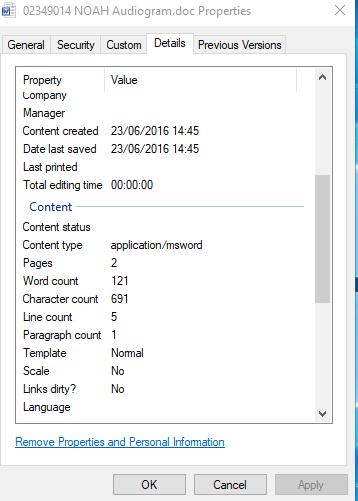
I am trying to pull the word count from Microsoft Word document into Cache. Is there anyway to get the values of the extended file properties without opening the word document? If I right click on a word document (Word does not need to be installed) I can see the additional properties that I want to reference however don't know how to access these without calling out to VBA or poweshell.

Hi,
I have a project that requires me to post a form. I am following the documention at https://developers.clicksend.com/docs/http/v2/#send-an-sms .
In code I need to be able to do the following:
https://api-mapper.clicksend.com/http/v2/send.php ? method=http&username=xxxx&key=xxxx&to=+61411111111,+61422222222,+61433333333,+61444444444,+14055555555,+14055555666,+447777777777,+447778888888,+8615555555555&message=This is a test
From within a browser I am getting the expected response.
PS: the numbers I am using a testing numbers: https://developers.clicksend.
is there a way to send commands to the CMD in windows form COS I would like to run an application within COS by sending a command to the CMD
Curious if there is a string function which can transform a delimited string into an array without looping through $Piece...such as "a,b,c,d,e,f" into array(0)=5,array(1)="a",array(2)="b" etc
Hey developers,
I have great news for you. A few days ago, GitHub was updated with the latest version of linguist project, which is being used to recognize source code types in repositories. It helps to determine which programming language had been used in every file of the repository. Repository statistics section shows the results of this module work.

Also, you can search across all available GitHub repositories for any chosen language.
Say you have a DICOM document with an input information sequence with many sequence items. You could access every item one by one by looping and querying the path by passing it to the GetValueAt method as demonsrated below.
This works but there are some performance issues on my system if the document has to be read for each query (as far as I know, that is the case on my system). Is there a way of querying a path, which would return the sequence items as an array? I think I am missing something. With 900 items the process takes around 20 seconds currently.
Hi Community!
I have very good news for the developers, who are using GitHub to host projects with InterSystems ObjectScript. GitHub introduced the support of InterSystems ObjectScript this week!
How does it work?
Now all the .cls files in your repository are considered as InterSystems ObjectScript and highlighted according to the language rules of ObjectScript. For example WebTerminal, Samples-Data.
During testing your code you are often confronted with the need to examine
the actual content of an object. Either using ZWRITE or $system.OBJ.Dump()
you get a picture of simple properties as "--- attribute values ---"
while "--- swizzled references ---" are more confusing than informative
and with "--- calculated references ---" you are just left in the lurch.
This small helper class allows you to dump an object to terminal or
e.g in background to some stream for later review.
By default, you see just properties with content,
DO ##class(Z.obj).I have a custom process that is parsing HL7 and inserting it into a table. Periodically the inserts fail with # due to error: ERROR #5803: Failed to acquire exclusive lock on instance of....
Traditional databases would wait until the lock is removed then do the insert, but cache fails. I'm sure it's my coding approach.
How can I work around this? A Try/Catch loop?
Thanks in advance.
I have one persistent, xml-enabled class.
I need to convert objects of this class to XML.
However I need to project each object in different ways (depending on
where I send it), for example:
Is there a way to do that with XML Adaptor?
Hello,
I assume there is a simple explanation for this, but I do get <OBJECT DISPATCH> error, when I am trying to set a global to a value.
My example is huge, but I reproduced it using Samples namespace:
First I delete the Title from ##class(Cinema.Film) - 3
Secondly:
SAMPLES>s ref=##class(Cinema.Film).%OpenId(3)
SAMPLES>w ref.Title
SAMPLES>set ^AK(1)=$G(ref.Title)
SET ^AK(1)=$G(ref.Title)
^
<OBJECT DISPATCH> *Property 'Title' in class 'Cinema.Film' must be MultiDimensional
$D also does not work, same error, however this works fine: if ref.Title S ^AK(1)=ref.
Hi Community!
Please welcome a new video on InterSystems YouTube Channel:
InterSystems and Python QuickStart
Hello,
I want to search a process ID in Object Script using the reference variable e.g. 1119102928 and kill that process ID. Please guide how it can be achieved.

Thanks in advance.
Vinay Purohit
PHP, from the beginning of its time, is renowned (and criticized) for supporting integration with a lot of libraries, as well as with almost all the DB existing on the market. However, for some mysterious reasons, it did not support hierarchical databases on the globals.
Globals are structures for storing hierarchical information. They are somewhat similar to key-value database with the only difference being that the key can be multi-level:
Hi,
The app of the week is the 'ObjectScript Visual Editor'.
It looks interesting but the GitHub ownload link[1] given on the InterSystems ObjectScript Visual Editor Open Exchange page[2] fails.
[1] https://github.com/intersystems-ru/objectscript-visual-editor/releases
[2] https://openexchange.intersystems.com/package/ObjectScript-Visual-Editor
Does anyone know the github url for download?
.png)
I have a class defined like this:
Class test.ABC Extends %RegisteredObject {
Property myProp As %Binary [ Internal, Private ];
}Is there a way to get a value of myProp from outside of the object?
I can't modify or extend the class obviously.
We have a business service that extends
This service polls for json files in a folder.
Method signature is like this:
And inside that method it tries to read the content like this:
if ($$$ISERR(tStatus)) quit
set tJSON = {}.%FromJSON(tData)
I added some trace calls before and after lines and noticed it's always that last line that fails if content is larger than 32kb.
Any workaround for this?
Hi All,
Just wondering if anyone had got this working.
In the documentation it says to set the username and password properties of the connection object but these properties don't exist and without authentication I can't connect to the MQ queue.
Any help would be greatly appreciated,
Dave Moss
Hey Community!
The latest webinar, recorded by InterSystems Sales Engineers @Sergey Lukyanchikov and @Eduard Lebedyuk, is already on InterSystems Developers YouTube! Please welcome:
"Machine Learning Toolkit (Python, ObjectScript, Interoperability, Analytics) for InterSystems IRIS"