Hi,
Can you please suggest how to import vR4 packages for my FHIR application implementation. I can see SDA3 packages but want to work with vR4.
Is there any version compatibility for SDA3/vR4? What is the difference of SDA3 and vR4?
Thanks,
Fast Healthcare Interoperability Resources (FHIR, pronounced "fire") is a draft standard describing data formats and elements (known as "resources") and an application programming interface (API) for exchanging electronic health records
Hi,
Can you please suggest how to import vR4 packages for my FHIR application implementation. I can see SDA3 packages but want to work with vR4.
Is there any version compatibility for SDA3/vR4? What is the difference of SDA3 and vR4?
Thanks,
This YouTube video about submitting a FHIR transaction bundle impressed me. It shows me two things:
Hi,
How to send PDF/Image as attachment along with FHIR Resource.
Thanks
Hello Community!
I want to share with you an interesting solution that will allow you to perform integration testing for your healthcare applications. Let me introduce you to Pandora – a FHIR server testing software designed by Fyrstain, offering cutting-edge solutions for healthcare interoperability testing.
InstallFoundation method is missing (IRIS 2023.2+)
Recently IRIS 2023.2 was released. This version removed this method InstallFoundation from this class HS.HC.Util.Installer. This was a private method and it was not documented. But it was widely used by the community to install FHIR server.
So if you encounter this error:
<METHOD DOES NOT EXIST> *InstallFoundation,HS.HC.Util.Installer
While build a demo our your own FHIR server, you can fix it by replacing this line:
do ##class(HS.HC.Util.Installer).InstallFoundation(namespace)
to
Do ##class(HS.Util.Installer.Foundation).Install(namespace)
Hi developers,
We have received quite a lot of interest in using SQL on FHIR data. As you know, FHIR data is encoded in the form of a complex directed graph, and thus you can not easily query it with traditional SQL queries or business intelligence tools. Some customers have noticed that the "FHIR search tables" in IRIS for Health have flattened part of the FHIR graph, and have tried to use them for analytics. This is an undocumented and unsupported part of IRIS for Health, and can change without notice.
Hi,
Here are the requirements for implementing a new project using FHIR and JSON.
The FHIR JSON resource types - Patient, Encounter, etc. - need to be converted to HL7 messages using DTL.
Does %JSONImport() allow direct conversion of JSON into HS.SDA3.Patient objects?
Could anyone suggest an easy way to convert FHIR objects for DTL use?
.png)
The FHIR® SQL Builder, or Builder, is a component of InterSystems IRIS for Health. It is a sophisticated projection tool used to create custom SQL schemas using data in an InterSystems IRIS for Health FHIR repository without moving the data to a separate SQL repository. The Builder is designed specifically to work with FHIR repositories and multi-model databases in InterSystems IRIS for Health.
Hey Developers,
Watch this video to learn more about the FHIR, how it came to be and the future of the standard:
⏯ The Concept of FHIR: A Healthcare Data Standard Designed for the Future
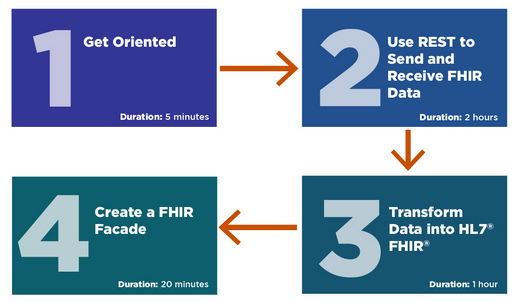
Did you know that with InterSystems IRIS for Health™, you can create a FHIR Facade that enables healthcare apps to send and receive HL7® FHIR® data?

Find out how in this learning path (3h 30m), which includes a hands-on exercise (20m).
I have been successfully able to transform hand-written medical test results documents to HL7 ORU_R01 v2.x, then to SDA, which will be trasformed to FHIR or C-CDA.
However, I have a category of documents which contains reference range in multiple date formats, which are measured for each gestation period.
For example, below is one of the documents.
Analyte: HCG, Value: 1968, Unit: mlU/mL
Reference Range:
Week of gestation: 3, Range: 5.8-71.2
Week of gestation: 4, Range: 9.5-750
Week of gestation: 5, Range: 217-7138
Week of gestation: 6, Range: 158-31795
FHIR has revolutionized the healthcare industry by providing a standardized data model for building healthcare applications and promoting data exchange between different healthcare systems. As the FHIR standard is based on modern API-driven approaches, making it more accessible to mobile and web developers. However, interacting with FHIR APIs can still be challenging especially when it comes to querying data using natural language.
Hello again everyone.
In our previous article we saw how to configure our EMPI to receive FHIR messages. To do this we installed the FHIR Adapter that InterSystems made available to us that configured a REST endpoint to which we could send our FHIR message. We would then get the message and transform it to a %String that we would send via TCP to the output of our EMPI configured in our HSPIDATA namespace.
Alright, it's time to see how we retrieve the message, transform it back to a %DynamicObject and parse it to the class used by the EMPI to store the information.
Hi all! Wanted to share a recent video we created with InterSystems FHIR expert, Russ Leftwich, covering some of the most frequently asked questions with FHIR. Let us know if you have more questions for a future iteration of this!
We return to the attack with our EMPI!
In previous articles we have seen how to configure and customize our EMPI, we have seen how we can include new patients in our system through HL7 messaging, but of course, not everything is HL7 v.2 in this life! How could we configure our EMPI instance to work with FHIR messaging?
As said in the previous article about the iris-fhir-generative-ai experiment, the project logs all events for analysis. Here we are going to discuss two types of analysis covered by analytics embedded in the project:
In order to extract useful data to apply analytics, we used the iknowpy library - an opensource library for Natural Language Processing based in the iKnow for IRIS Data Platform. It makes possible identifies entities (phrases) and their semantic context in natural language text in several languages.
With InterSystems IRIS FHIR Server you can build a Strategy to customize the behavior of the server (see documentation for more details).

This repository contains a Python Strategy that can be used as a starting point to build your own Strategy in python.
This demo strategy provides the following features:
Account resourceObservation resource
Observation resource is returnedObservation resource is not returnedThis project is an experiment to use OpenAI API to answer to user prompts in the healthcare domain using FHIR resources and Python code.
<iframe width="560" height="315" src="https://www.youtube.com/embed/WDTG5_SVvTg" title="YouTube video player" frameborder="0" allow="accelerometer; autoplay; clipboard-write; encrypted-media; gyroscope; picture-in-picture; web-share" allowfullscreen></iframe>Hi colleagues!
InterSystems Grand Prix 2023 unites all the key features of InterSystems IRIS Data Platform!
Thus we invite you to use the following features and collect additional technical bonuses that will help you to win the prize!
Here we go!
In a fast-paced clinical environment, where quick decision-making is crucial, the lack of streamlined document storage and access systems poses several obstacles. While storage solutions for documents exist (e.g, FHIR), accessing and effectively searching for specific patient data within those documents meaningfully can be a significant challenge.
Hi Community,
I would like to know how I can query a list of patients that were revoked on HealthShare for the month of April and May.
Messages are sent using FHIR and a revoke is handled with active:false as seen below. A non-revocation will have active: true on the patient resource.
I wanted to check SQL tables but I am not sure which one to check if so. Please advise on how to go about getting this report.
Regards,
Hey Developers,
Watch this video to learn about InterSystems TrakCare Innovation Toolkit which is a free download that enables TrakCare users to quickly access their data in standard HL7® FHIR® format, making the system of record a system of transformation:
⏯ Introduction to the TrakCare Innovation Toolkit @ Global Summit 2022
Hi,
Getting the following error when activating a foundation namespace(FHIR Server). Anyone had this issue before:
|
<THROW>zAddRecordToLogPersistence+7^HS.HC.Util.Installer.1 *%Exception.StatusException ERROR #5001: Attempt made to use $$$ActivationLog* macros before HSSYS exists |
Thanks
Hi all,
I am looking for a way to serialize fhir content received via interoperability adapter into it´s corresponding ISC model class (e.g. HS.FHIR.DTL.vR4.Model.Resource.DiagnosticReport) for later use. In my opinion the outline to accomplish this would be something like
1) Receive the FHIR data
2) Get quick stream containing the JSON data
3) Examine if bundle or single ressource
4) For resource serialize to coressponding model class (HS.FHIR.DTL.vR4.Model.Resource.*)
5) further use of newly created object of type HS.FHIR.DTL.vR4.Model.Resource.*
Hi Developers,
Enjoy watching the new video on InterSystems Developers YouTube:
Hi,
This is Jayanth from OAK Technologies.
Hope you are all doing well!!
We have a position for InterSystems IRIS Technology Role for our client if anyone is interested, please drop your resume to jayanth@oaktechinc.com
Job Role: IRIS technology role
Location: Chicago, Illinois (Remote Work)
Contract:1+ Year W2 OR 1099 Contact
Hi folks!
Playing with InterSystems FHIR server.
You can easily install it in IRIS for Health using FHIR template:
zpm "install fhir-server"
NB! For now the IPM command mentioned above works for a namespace called FHIRSERVER only.
I have a FHIR server in a local docker container with endpoint:
localhost:52773/fhir/r4