Hey Developers,
Watch this video to learn how to deploy your FHIR server using AWS, EKS, and Kubernetes: advantages and disadvantages of cloud deployment and demo a deployment:
Fast Healthcare Interoperability Resources (FHIR, pronounced "fire") is a draft standard describing data formats and elements (known as "resources") and an application programming interface (API) for exchanging electronic health records
Hey Developers,
Watch this video to learn how to deploy your FHIR server using AWS, EKS, and Kubernetes: advantages and disadvantages of cloud deployment and demo a deployment:
We conclude this series of SMART On FHIR articles with Auth0 and InterSystems IRIS FHIR Repository by reviewing our application developed in Angular 16.
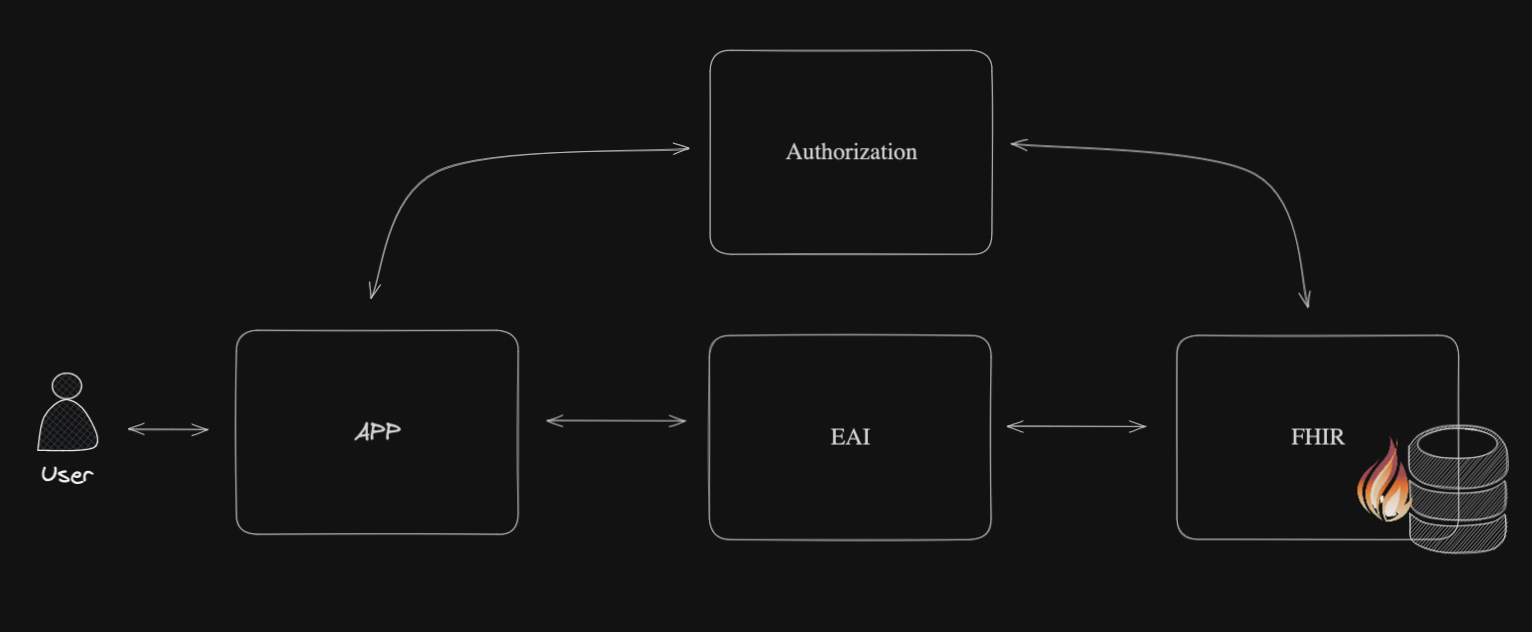
Let's remember what the architecture defined for our solution is like:
Our front-end application corresponds to the second column and as you can see it will be in charge of two things:
Hi,
how to add x-api-key to FHIR repository header using objectsctipt?
Thanks,
Prasanth
🌐Explore the world of HL7® FHIR® at your own pace with a curated YouTube playlist from Learning Services.
I recently participated in a fantastically organized hands-on by @Patrick Jamieson in which an Angular application was configured together with an IRIS FHIR server following the protocols defined by SMART On FHIR and I found it really interesting, so I decided to develop my own Angular application and thus take advantage of what I learned to publish it in the Community.
Let's see what Google tells us about SMART On FHIR:
We resume our series of articles on the FHIR Adapter tool available to HealthShare HealthConnect and InterSystems IRIS users.
In the previous articles we have presented the small application on which we set up our workshop and showed the architecture deployed in our IRIS instance after installing the FHIR Adapter. In today's article we will see an example of how we can perform one of the most common CRUD (Create - Read - Update - Delete) operations, the reading operation, and we will do it by recovering a Resource.
This is where FHIR (Fast Healthcare Interoperability Resources) comes in, a standard that has revolutionized data exchange in healthcare.
The introduction above is an example generated by AI, and as you can see, AI is around us everywhere, accessible to everyone…
We need to learn more about using AI to our advantage, making life easier in every aspect.
In 2021, I participated as an InterSystems mentor in a hackathon, where a newcomer to FHIR asked me if there was a tool to transform generic JSON data containing basic patient information into FHIR format. I informed her that I didn't know anything like that, unfortunately.
But that idea stays in my mind...
Several months later, in 2022, I came up with an idea to experiment: to train a named entity recognition (NER) to identify FHIR elements into generic texts. The training involved synthetic FHIR data generated by Synthea and the spaCy Python library.
Striking a Balance Between Health Analytics and Engaging Features
In today's digital era, health and lifestyle apps have flooded the market, promising a wide array of benefits from fitness tracking to nutrition planning and focusing on trendy features, such as step counting, calorie tracking, and habit monitoring. While the surge in app development is undoubtedly a positive sign of society's growing interest in health and wellness features can be engaging and motivate users to adopt healthier lifestyles, they often lack the depth required for serious health analytics.
According Wikipedia a mind map is a diagram used to visually organize information into a hierarchy, showing relationships among pieces of the whole. It is often created around a single concept, drawn as an image in the center of a blank page, to which associated representations of ideas such as images, words and parts of words are added. Major ideas are connected directly to the central concept, and other ideas branch out from those major ideas. Mind maps can also be drawn by hand, either as "notes" during a lecture, meeting or planning session, for example, or as higher quality pictures when
Hi Developers!
We are happy to present the bonuses page for the applications submitted to the InterSystems FHIR and Digital Health Interoperability Contest 2024!
I created this application considering how to convert images such as prescription forms into FHIR messages
It recognizes the text in the image through OCR technology and extracts it, which is then transformed into fhir messages through AI (LLA language model).
.png)
Finally, sending the message to the fhir server of IntereSystems can verify whether the message meets the fhir requirements. If approved, it can be viewed on the select page.
.png)
Sometimes we need to convert FHIR message to HL7 V2, e.g. to register a patient to the PACS system.
In this article, I will explain the steps to achieve the desired by using IRIS FHIR Server production.
Below are the steps we need to follow:
Let's review the steps in detail.
Open the production page and make sure Production is started. In the next step, we need to make sure business service HS.FHIRServer.Interop.Service is registered with FHIRServer.png)
We return with our example of using the FHIR Adapter, in this article we are going to review how we can configure it in our IRIS instances and what the result of the installation is.
The steps taken to configure the project are the same as indicated in the official documentation, you can review them directly here. Well, let's get to work!
Hi Community
This document mainly enriches the content of the previous article and introduces the use of the application.
Perhaps you have already read the previous article, but I still want to say,
After completing the initialization operation (including model creation and training), the Fhir HepatitisC Predict application then predicts HepatitisC
You need to input some information on the application, of course, only the results of some checks, not including privacy data.
1、Background
When I first encountered FHIR, I encountered a problem with its message format. It was difficult for me to determine whether the message I created met the format, and it was also difficult to easily create an FHIR message from scratch.
So, through fhir server of IntereSystems’fhirserver API, I created this application for quickly generating/validating FHIR messages.
Surely you have all heard about FHIR as the panacea and solution to all interoperability and compatibility problems between systems. Right here we can see one of his classic defenders holding a FHIR resource in his hand and enjoying it immensely:
But for the rest of us mortals we are going to make a small introduction.
🔥 Curious about the FHIR standard that everyone's talking about?
📚 Read on for a brief introduction, then try a brand-new learning path to get more in-depth knowledge!
The HL7® FHIR® standard has revolutionized the way healthcare developers take on the challenges of data interoperability. FHIR allows healthcare systems to exchange information seamlessly, and patient data can be consolidated in real time, regardless of where it's stored.
With the development of technology, the medical industry is also constantly advancing, and humans often pay more attention to their own health,
By learning and processing datasets through computers, diseases can be predicted.
Pre condition: Ability to use FHIR and ML
Firstly, our dataset is obtained from kaggle and transformed into FHIR resources based on patient gender, age, ALP or ALT, and imported into the FHIR resource repository
Hi Developers,
We have exciting news! The new InterSystems online programming contest dedicated to all things health-related will start very soon!
🏆 InterSystems FHIR and Digital Health Interoperability Contest 🏆
Duration: January 15 - February 4, 2024
Prize pool: $14,000
.png)
All FHIR resources have a Meta element containing metadata about the resource. Some attributes are updated by the server, others are populated by the app constructing the resource.
1. versionId
This is an ID that identifies a saved version of the resource on the FHIR server. Many servers use a GUID here, others use an integer. But it’s a string value, so don’t write code against this assuming a sequential integer, regardless of what the server does.
Job Description
Planning, building, training, and manage (Program and Project) to convert HL7 inbound messages (coming from primarily Epic) to InterSystems FHIR.
Looking for a person who can develop (well versed in InterSystems FHIR experience), demo, train/mentor the team, manage the project.
In the context of HL7 FHIR (Fast Healthcare Interoperability Resources), the terms "id" and "identifier" refer to specific elements used for identifying resources within the FHIR data model. For a newbie, these terms can be confusingly similar, but they serve distinct purposes.
Look at the below Patient resource for August T. Faulkner:.png)
The resource has an id of “1” — generated by the FHIR server when the resource was created.
Patient August T. Faulkner also has a identifier (Medical Record Number) — possibly provided by the hospital — of 78510398960
We are in the process of installing a FHIR server on our InterSystems interface engine and have encountered a few questions. Your expertise and insights would be greatly appreciated:
Hi Developers!
Here are the technology bonuses for the InterSystems FHIR and Digital Health Interoperability Programming Contest that will give you extra points in the voting:
See the details below.

clinFHIR is a web application that has been developed pretty much over the same time as FHIR has.
Originally developed to help clinicians visualize FHIR (hence the ‘clin’ in the name) it has become more widely used by the FHIR community for learning FHIR and assisting with design. It is maintained by David Hay - one of the FHIR Management Group co-chairs with support from InterSystems, which is much appreciated!
There are 4 modules that may be of interest to participants in the upcoming Interoperability contest.
I’ve created a longer post on google docs that goes into a little more details of these modules, with links to other resources such as my blog and the R4 Specification and R5 FHIR specification. I’ll be enhancing that over time - feel free to comment.
A note with regard to FHIR versions. The latest version is R5 (release 5), though many in the community still use R4. In most cases, if you're not sure then use R4. If you're not sure which version a FHIR Server supports, examine its CapabilityStatement which you can get from the server endpoint [host]/metadata
I should also point out that clinFHIR doesn’t currently use SSL. It is on the roadmap, but there are a few issues to work through. The consequence of this is that if you enter ‘clinfhir.com' into the browser, it may not find it. You sometimes have to specify http://clinfhir.com/ .
If you need further assistance, I would alway recommend using the FHIR chat, and if your question / comment / suggestion is related to clinFHIR then there’s a specific stream there.
We're pleased to invite you to the upcoming webinar in Spanish:
👉 OAuth 2.0, OpenID Connect & LDAP: Monitoring access to FHIR resources
🗓️ Date & time: February 1, 4:00 PM (CET).
Hoping someone can help,
I have the "Sample FHIR Production" installed ( as described in the documentation) with the following Components:
Service: HS.Gateway.ECR.SDA3XMLFileService
Processes: HS.FHIR.FromSDA.DTL.Transaction.Process
Operations: HS.FHIR.Repository.Operations
Hey Developers,
Watch this video to learn how UC Davis Health uses InterSystems API Manager to satisfy business-partner demand for access to both custom and FHIR APIs:
⏯ How UC Davis Health Uses InterSystems API Manager @ Global Summit 2023