Hi guys,
I have a %Time filed with (Format=1) to allow showing hh.mm.ss and the field is showing fine in display mode eg:
.png)
it should show 00:07:30 but the seconds are cut off from it as below :
any ideas pls?
thanks

InterSystems Ensemble is a complete and easy-to-use integration platform that enables users to connect people, processes, and applications in record
time.
Hi guys,
I have a %Time filed with (Format=1) to allow showing hh.mm.ss and the field is showing fine in display mode eg:
it should show 00:07:30 but the seconds are cut off from it as below :
any ideas pls?
thanks
Hi Team,
I am Working on one data transformation, In the data transformation the data transformation data needs to be saved in the globals.
Can you please help me to save the data into the globals in a Persistent class.
Thanks in advance
I have a linked procedure class and SQL gateway setup and I can't seem to get any response, status or error from using the stored procedure, I think it must be something big I'm missing to not even get a status.
Can someone see what my problem is please, any help would be very much appreciated.
Class generated by linked procedure wizard:
Include %occInclude ///
Class dbo.MrnLookup [ Not ProcedureBlock ]
{ ClassMethod MrnLookup(pp01 As %String(MAXLEN=8), ByRef mrn As %String(MAXLEN=20)) As %Integer [ ProcedureBlock = 1, ReturnResultsets, SqlName = MrnLookup, SqlProc ]
{
    if '$isobject($g(%sqlcontext)) s %sqlcontext=##class(%Library.ProcedureContext).%New() s RETURNVALUE=$g(RETURNVALUE)
 s pp01=$g(pp01)
 s mrn=$g(mrn)
 s hdbc=$$GetConnection^%apiGTW("MRNLookup")
 i hdbc="" s %msg=$$$ERROR($$$GTWCConnectionError) s %msg=$$GetErrorText^%apiOBJ(%msg) g setError
 s QHandle=$zf(-5,%SQLGateway,5,hdbc)
 i QHandle="" s %msg=$$$ERROR($$$GTWCAllocationError) s %msg=$$GetErrorText^%apiOBJ(%msg) g setError
 s err=$zf(-5,%SQLGateway,$s(%SQLGateway("-uv"):37,1:3),QHandle,"{?=call dbo.""MrnLookup;1""(?,?)}")
 i err g getError
 s err=$zf(-5,%SQLGateway,62,QHandle,1,4,1,4,10,0,10)
 s err=$zf(-5,%SQLGateway,62,QHandle,2,1,1,12,8,0,8)
 s err=$zf(-5,%SQLGateway,9,QHandle,$lb(pp01),2)
 i err g getError
 s err=$zf(-5,%SQLGateway,62,QHandle,3,2,1,12,20,0,20)
 s err=$zf(-5,%SQLGateway,9,QHandle,$lb(mrn),3)
 i err g getError
 s err=$zf(-5,%SQLGateway,4,QHandle)
 i err g getError
 s %ROWCOUNT=$zf(-5,%SQLGateway,31,QHandle)
    set tConnection = ##class(%Library.SQLGatewayConnection).%New() set tConnection.DLLHandle = %SQLGateway, tConnection.ConnectionHandle = hdbc
    set rrs = ##class(%SQL.Gateway.ODBCResultSet).%New(tConnection,QHandle)
    while $Isobject(rrs) {
        if rrs.%GetMetadata().columnCount do %sqlcontext.AddResultSet(##class(%ResultSet.Static).%New(rrs))
        set rrs = tConnection.getNextResultSet(QHandle)
    }
 s RETURNVALUE=$li($zf(-5,%SQLGateway,22,QHandle,1))
 s mrn=$li($zf(-5,%SQLGateway,22,QHandle,3))
setError ;
 If ($g(%sqlcontext)'=$$$NULLOREF) {
 Set %sqlcontext.%SQLCODE = $g(err)
 Set %sqlcontext.%Message = $g(%msg)
 Set %sqlcontext.%ROWCOUNT = $g(%ROWCOUNT)
 }
  s err=$zf(-5,%SQLGateway,16,QHandle)
 QUIT $g(RETURNVALUE)
getError ;
 s %msg=$li($zf(-5,%SQLGateway,12,hdbc,QHandle)) g setError
} }Hi everyone.
I'm using a Buisness operation which have a SOAP outbound Adapter :
.png)
Hi Guys,
I know that there a way to view global content from the Terminal rather the SMP but I can't remember the command, I think it's something like D ^Global or something !?
Thanks
I need to remove double quotes (") from a string and can't remember how to escape it in input string in ReplaceStr or Strip.
Thanks in advance
Hi everyone,
We are trying to verify a signature against a certificate without success.
Apologies in advanced if my post lack info.
I've added the cert under the X509 credentials under the management portal (alias Cert).
The code snippet that we are using to verify the cert:
set tX509 = ##class(%SYS.X509Credentials).GetByAlias("Cert")
set tData = "hello"
set tSignature = "CUBMPlVbEKbjFg0nUNz3pwuSwq7tJPg4obsj6LpwbMsEQaDNNw/93V9X0BdgBVzoWN1K7XrG1WX1focFj+EIkeXOJJF7KjQv4p9Xc8JT0wWZ9ivw0+pYvBtMSzP9JEVzapt2Cr+QoBT47yEMeCAxt7Ka7q7xLpxxpAvDQ+QE3Mg="
set isValid = $SYSTEM.Encryption.
Hi Guys,
I'm using the below code to export to excel and it's working fine for one client but not for another and both clients are running the same version of IE 11.
for the second client the code generates an empty xlsx file and when I try to open it it says file corupted although data exits in the resultset, so is there a flag or setting needs be done in the client server or IE?
Class MSDS.UI.Serenity.Report.ExcelExport Extends %ZEN.Report.
Hi Guys,
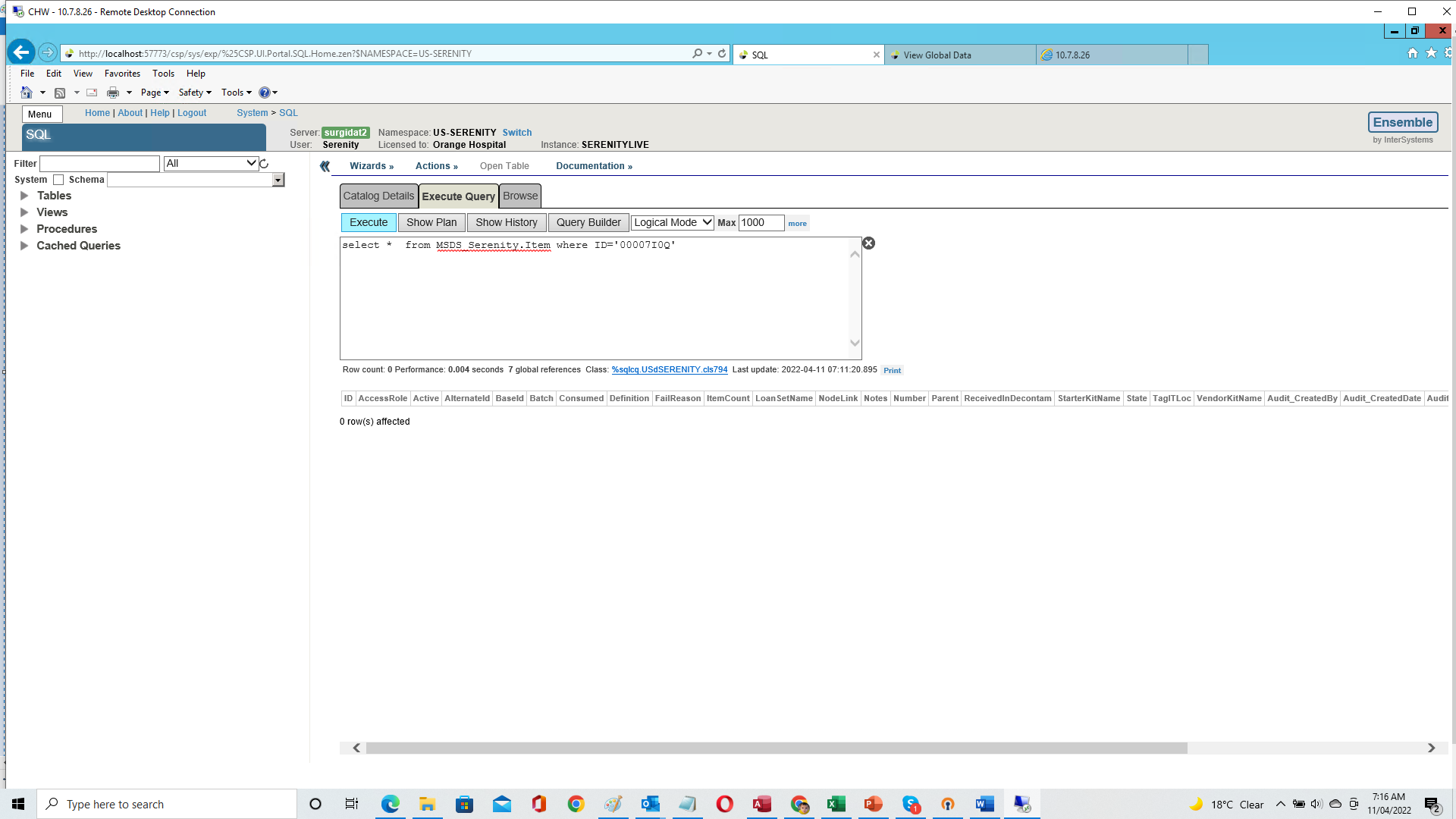
I'm a bit confused where if I run a query trough SMP I don't get any result which should be true but if I run the same query from a classmethod I get a query result which shouldn’t be even if I pass any gibberish parameter into my class method because I'm sure there should be any data? see attached
Thanks
Hi Team,
I am working on data transformation ADT^A01 from ADT^A01 ,In both source and target MRG segment is not available. How can i create a new MRG segment in Target. Kindly share your ideas how to create a new segment in Data transformation.
Thanks in advance
Hi Guys,
I'm using seconds counter then save those seconds in a field defined as string where eg. I do :
S time=30
S time = $zt(time,1)
Update myclass se timeSpent = :time
which now shows up as 00:00:30 if I do an sql query which good but the problem if I run a query to get average timeSpent I get 00:00.
having the field defined as integer would allow selecting avg but running a query in my Zen page wouldn’t show me a time format
so how can I get an average on my a filed defined as string in a sql query?
thanks
I have been struggling trying to understand "Response From" and "Response Target Config Names" as I am trying to track down Orphaned messages. I have noticed that when a Business Rule, or Business Process sends to a File Based Operation, there is always a NULL value response being returned. I am thinking these NULL values are causing some of the orphaned message problems we are seeing.
.png)
If the Business Operation is a File based operation, how do I prevent the NULL value from being sent back? Is this because our "Response From" and "Response Target Config Names" is blank?
Hi
How do I run a CSP page from within VS Code.
Secondly I have installed an extension called "Live Server" which will run .html pages within VS Code. Have any of you made use of this extension and if so can you specify that .csp pages are html pages?
If I press F5 in VS Code (just as you would in Cache Studio) in order to view a csp page when I press F5 in vs code it tries to open
http://localhost:57772/csp/bootstrap/
without the csp page name
If I add the csp page name in the url it works. The question is how do I link the csp page to the url passed to the browser
Nigel
Hi all,
I am looking for a best practise approach for providing an ITI-41 based webservice to allow a subsystem to send a provide and register document set transaction via webservice route the request to a registry and loop back the response from the repository to the originating service. Since we need to use Ensemb le 2017.2 I am looking for a best practise to takle that reuirement. As for health connect I could prove a webservice wich supports the named IHE transaction and route it to the registry quite simple. Anyway how would you cope with this requirement under Ensemble?
Hi Guys,
I'm using a Modal Group but whenever I click outside it the Modal gets minimised, so How can I change the view so that whenever pops up the view get locked until I'm finished with my modal then click exit to endModal ?
thanks
Hi Community,
This article is aimed at developers implementing DICOM productions, specifically for cases with third-party endpoints that cannot handle the DIMSE timeout themselves.
For DICOM applications, the DIMSE timeout is a maximum time to wait for the next DICOM request (-RQ) or a response to a request (-RSP), after an association has been established. Unlike the ARTIM (association establishment) and TXTIM (data transfer) timeouts, the DIMSE timeout lives at a higher level than individual PDUs, with the application-level request/response logic.
Hi,
Currently I am working on HL7 Ver 2.3. Just want to know what is the best container image for this version?
Thanks
Hi Guys,
I've the below tablePane and for some reason when it's populated always the last row is selected by default, I've many tablePanes defined the same way but none of them has the last row selected when populate, so not sure why this grid is doing this?
I am still trying to track down orphaned messages and have noticed that when we have Business Rules that send to a Business Process that some times there is an orphaned message that is generated as result of that send.
Hello Community,
I am still pretty new to Ensemble, Cashé, or ObjectScript. My question is this how can I tell when a file was finished and read fully? Currently, I have an EnsLib.FilePassthroughService reads a file from a designated file path and moves it to an archive file path. I need to set up an alert or a notification that can tell me once the file has been read in its entirety and has been moved out of its current file path.
Any help you can give me would be greatly appreciated, or if you need further clarification I can do my best to answer any question you have. Thank you.
Hi everyone.
I was wondering how people manage viewing messages that use a character encoding incompatible with the Management Portals use of UTF-8.
For example, a message that looks like this in Windows-1252/Latin1:
.png)
Will display as this under the message "Full Contents"
and this under the "Raw Contents"
*EDIT*
I tripped myself up early on, but this covers how I went wrong - https://www.i18nqa.com/debug/table-iso8859-1-vs-windows-1252.html
Good morning,
We would appreciate your support:
Developing an integration to perform a "Query / Retrieve" circuit with DICOM medical imaging studies, we would need the following:
Options of invocation of the DICOM TCP service that has been published for this integration, alternatives to the command line option.
Specifically we have read: Receive DICOM document with an embedded PDF and metadata.
Adapting the example, we use the line:
./storescu -b10.136By which we simulate the sending of a DICOM document with a PDF.
Hi Team,
I am trying to call Datetime in CUSTOM.Training.Functions class please refer the below line.
My Datetime method
ClassMethod DateTime(DateTime As %Integer)
{
Set Year = msg.SetValueAt(,"PIDgrpgrp().PIDgrp.PID:7.1","set")
Q Year
}
But i am not able to get the value of date of birth into the Datetime method, Kindly help how to get data of date of birth value into the method.
Thanks in advance
I am using SQL Outbound adapter and inserting a HL 7 Message by executing a stored procedure and getting an error
|
ERROR #6022: Gateway failed: Execute. |
The reason i found is that segment delimiter is causing an issue and following is sample code
Method AddMessage(pRequest As EnsLib.HL7.Message, Output pResponse As Ens.Response) As %Status
{
Set tQuery="{call dbo.HL7Message_Insert(?,?,?
Hi Guys,
Can I insert a new row and enforcing my own ID not the default id increment?
&sql(INSERT INTO Sample.Person
(ID,Name,SSN)
VALUES ('205','Swift,Jonathan','111-22-3333'))
IF (SQLCODE = 0) {
Write "New Person inserted with ID: ", %ROWID,!
}
else
{WRITE !,"SQLCODE=",SQLCODE," ",%msg }
I tried this in samples and got the below error:
SQLCODE=-111 INSERT of Default Only RowID Field 'ID' in table 'Sample.Person' not allowed
thanks
I'm trying to create a general business rule, not an HL7 message router. (This is because i want to return values from the rules and message routing rules don't appear to be able to return values.) But, I want the business rules to be able to look at HL7 messages; I've copied a simple when condition from an HL7 message router but the error log throws up <PROPERTY DOES NOT EXIST> ...... *HL7
I'm guessing that because it's a general business rule the 'HL7.' syntatic shortcuts aren't available.
Hi Guys,
is there an easy way to import MS Access database into ensemble?
Thanks
Business services are powerful components that pull data in from external sources. In most cases, pre-built components do the job, but sometimes you need to code custom business services. There are a few best practices to keep in mind when doing this:
I have over 25+ years in Health Care integration and 10+ years experience with Ensemble interface development.
Rolling off my project soon and looking for my next contract.
Looking for long term projects where I can leverage my Ensemble and Epic Bridges experience
Hi Community,
Can I customize below Monitoring page and expose as webpage outside as webpage.
http://localhost:52773/csp/sys/%25CSP.UI.Portal.EnsembleMonitor.zen
Please give the source code location of this webpage in studio?
Thanks,
Prashanth