I want to determine what service (eg. %Service_Console) is used for current process.
I can probably use some workarounds, i.e.
- Is %request object present
- Does $Device contain |TRM|
- etc
But is there any centralised way to get current service?
I want to determine what service (eg. %Service_Console) is used for current process.
I can probably use some workarounds, i.e.
But is there any centralised way to get current service?
Here are a few tips that might be useful to people who are running applications in an environment that's configured to use InterSystems mirroring.
Hello, Community!
We announce the Second Developer Community Contest:
Developer Community MVP of the March!
The rules are the same: win Developer Community MVP award in March and receive a free registration to the Solution Developers Conference at InterSystems Global Summit 2016!
The Solution Developers Conference is like the live version of the Developer Community. It’s where you can connect with your peers and with InterSystems developers and product managers face-to-face You’ll hear about our newest technologies, and how they can be used to super-charge your development projects.
Hello everyone,
Is there a required bandwith between client and server for using Studio on a normal basis ?
Thanks
Hi,
posted some weeks ago in the "old" ZEN Google Group, maybe someone here can help to understand how to properly setting up a csp applications and contributing from the build-in caché security mechanism.
I´ve created a webapplication and wan´t to add further security to it using the smp. But... first things first.
I have two Databases let´s say DB1-LOGIN and DB2-Application. Each of this DBs has a resource assigned. DB1-LOGIN has a resource %DB1-LOGIN which has a public permission of 'read'.
Among the outputs of our Yuzinji tool are two code metrics that it can be interesting to track over time as a development project proceeds. These are Size and XS. The first is fairly straightforward. As you write more code the size of your codebase increases. The XS metric (pronounced "excess") aims to quantify excessive structural complexity. XS is explained in some detail in this 2006 whitepaper from Headway Software, whose Structure101 toolset Yuzinji leverages.
By analyzing a codebase using Yuzinji at key milestones we can investigate how these metrics change.
We have to route messages in a Process Class by their source (using either the SourceConfigName from the Message Header or the Source in the Message Body.
The inputs are standard HL7 messages from different Services but need to be routed on to different Processes depending on where they come from (not my design & I can't change it now) does any one have any suggestions how I could do this?
Thanks
[SOLVED]
added
to redirect the output to the stdout. Somehow the javac has wierd behavior with the output on errors and verbose information.
Hi,
i want the JAVA-Projections and wrappers to compile after Caché created the files. The creation of the files works 100%.
My addition to createProjection in our Projectionclass is following:
When you create an Ensemble production your namespace acquires a new class definition. For example here is what the class that defines the Demo.Loan.BankUSProduction production in the ENSDEMO namespace looks like when opened in Studio:
Class Demo.Loan.BankUSProduction Extends Ens.Production [ ClassType = "", ProcedureBlock ]
{
XData ProductionDefinition
{
<Production Name="Demo.Loan.BankUSProduction" TestingEnabled="true">
<ActorPoolSize>2</ActorPoolSize>
<Item Name="Demo.Loan.BankUSTerminalService" ClassName="Demo.Loan.Some thins I have noticed, which I am not sure are bugs or features to come.
1.) Go to type declaration (F3 or ctrl+click on a class/variable/method)
It doesn not work on object variables and methods
Where it does work, it opens the related class but it is not editable.
2. )There is no code indentation correction/ctrl+L ?
Is this planned?
I would very much prefer to have formatting even if it means loosing some COS "functionalty".
We have different flags for DeepSee advisors to look into the execution details and the methods DeepSee is using to do calculations.
flag [flagname] [on|off] – Turn a diagnostic on or off.
flag cmbr on|off – Show current member processing.
flag compound on|off – Show rewrite of compound queries.
flag crossjoin on|off – Show crossjoin processing.
flag relations on|off – Show relationship processing.
flag rewrite on|off – Show rewrite of query.
flag subquery on|off – Show subquery processing.
To process a query, DeepSee performs the following steps:
1. Preparation, which occurs in process (that is, this step is not launched as a background process). In this phase:
This cache is different from cache reset. Cache reset clears everything in the namespace but “cache off” only clears the cache in ^DeepSee.Cache.Results and ^DeepSee.Cache.Axis global node for the corresponding cube. The difference is quite smaller in the case as below, but in some cases it can be a big difference.
^DeepSee.Cache.Results, which contains values for each query previously executed for a given cube.
This method is provided as a convenience for developers for use on development or test systems. You should not use this method on production systems as it will have immediate effect on the performance of end user operations.
DeepSee Shell can show MDX query stats and result set stats.
>>stats on
Stats are: on
>>SELECT {[Measures].[%COUNT],[Measures].[Allergy Count],[MEASURES].[MEDIAN TEST SCORE]} ON 0,NON EMPTY HEAD(NONEMPTYCROSSJOIN([AgeD].[H1].[Age Group].Members,[AgeD].[H1].[Age Bucket].Members),2000) ON 1 FROM [PATIENTS] %FILTER [GenD].[H1].[Gender].&[Female]
Patient Count Allergy Count Median Test Scor
1 0 to 29->0 to 9 69 45 73.50
2 0 to 29->10 to 19 74 47 75.50
3 0 to 29->20 to 29 80 56 68.If I have defined a class query in one of my classes and I want to use that query from a method of another class, what are the pros and cons of using the %SQL.Statement interface versus the %Library.ResultSet interface?
I believe %SQL.Statement is the newer interface.
So if the old way is:
USER>s rs=##class(%Library.ResultSet).%New("%Library.File:FileSet")
USER>s sc=rs.Execute("c:\s\","*.txt")
USER>w sc
1
USER>while rs.%Next() {w !,rs.Data("Name")}
...then the new way is:
USER>s oStmt=##class(%SQL.Statement).%New() USER>s sc=oStmt.
Hello!
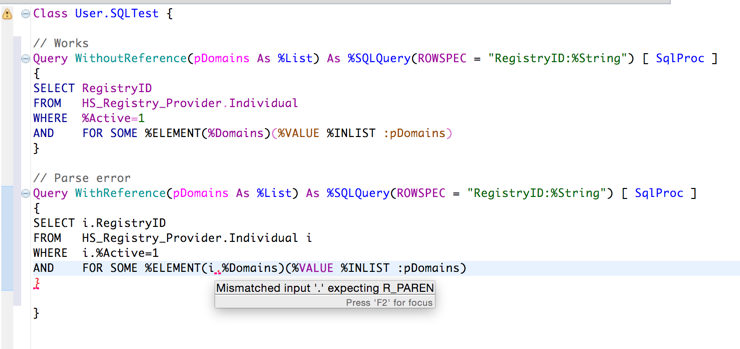
I'm trying to run a simple SQL query in atelier but it complains about the manager. I'm not sure if this is the best way to do it but here is what I got so far:
ZNSPACE "User"
SET domId = 1
SET flister=##class(%iKnow.Source.SQL.Lister).%New(domId)
SET myloader=##class(%iKnow.Source.Loader).%New(domId)
SET myquery="select top(10) EntityValue, CorpusFrequencyAsRelation, CorpusSpreadAsRelation from %iKnow_Objects.In the documenations at this location http://docs.intersystems.com/enscomm20152/csp/documatic/%25CSP.Documati…, the normalize method applies normalizaion for text using the defined manguage and dictionary.
I want to normalize my iFind queries. How can I use the normalize method ? any code sample ?
I want also to delete properly the iFind index. Deleting all the rows in the table is sufficient ?
When quering iFind is it possible to get also TFIDF scores ? any code sample for this ?
Thank you for the help.
I have a tablepane in my Zen page that is tied to a class query. When the page first loads, the table is empty. A button onclick event causes the tablepane query to execute and load query results into the table. I want an onchange event from a datalistbox to clear the tablepane so that it looks empty as it was when the page first loaded. I have had no luck fiddling with javascript in the datalistbox's onchange.
A simple and rather automated search portal leveraging iFind capabilities for rich text search in 2016.1. It has simple faceting, result ranking, highlighting of search results etc and just works off any table you point it to that has an iFind index by appending ?t=MyPackage.TableName to the URL.
See also https://github.com/bdeboe/isc-iknow-ifindportal for more details and the latest version.
What is the best way to deploy DeepSee Termlists?
Has anybody managed to get Enterprise Monitor to work to monitor multiple namespaces on manay instances?
I am hitting an issue trying to get a local instance namespace working.
I have this error for my first local namespace sytem configured.
"Ensemble encountered an error while loading this page"
Hi, Community!
The Second Global Summit Free Registration Contest is running and we have only one week to celebrate new winner!
Here is current leaderboard amongst non-InterSystems DC Members after a half of the race:
(If you want to see contribution from InterSystems employees just set the filter value in the Deepsee dashboard)
John Murray contributed more than others last week. John is a leader, but he did the result only for one week!
There is one week more and so everyone can be a winner!
I need to perform additional checks before Cache user logins (let's say in a terminal for simplicity) and allow access only to those, who passed them. How do I do it?
I would like to know how to get the key value from a dropdownmenuitem placed on a navbar.
I have tried to get from onselect and onchange events of the template class, but it didn´t work.
According to the snapshot attached I am trying to retrieve the values from 'action-1' and 'action-2'.
I have attached a ZIP file with a snapshot which value I am trying to retrieve and example classes.
Thanks.
This advisory concerns the recently announced vulnerability CVE-2016-0800, aka DROWN, which is due to weaknesses in SSLv2. For more information, see https://drownattack.com. This vulnerability may be relevant to InterSystems customers as InterSystems products have the capability to utilize SSLv2.
Hi,
Can a Cache Mirror be used in the cloud ? (ie stand up a Primary and Backup member instances in a High Availability Cache Mirroring configuration)
I'm investigating the validity of this configuration, because I was of the understanding that this may not possible due to these cloud servers not (typically) having fixed ip addresses, which interferes with the Virtual IP settings for the mirror set.
Is this correct, and if there are workarounds (like Load Balancing ?) can I have details on how this should be configured ?
Documents may be edited on the client independently of a connection to a Caché server. However, when a connection is established with a server for the purposes of saving, compiling and debugging code, then the client and server should agree with respect to the version of documents that are being operated upon. When they achieve this agreement, we say that they are “in-sync” and that the synchronization process is completed.
I have 2 projects in atelier, A and B which map to namespace A and B on the same server.
Namespace B has some classes mapped from namespace A.
I then edit a mapped class in project A and save it(I can see the changes in cache studio as well).
atelier A:

studio:

However in project B the class does not change, even if I click the "syncronize all files with associated namespace " button.
atelier B:

I just saw this new posting by Mike Kadow on the "Caché, Ensemble, DeepSee" Google Group announcing the availability of his new book, "Caché and MUMPS - Part II"
There's also more information about it at his site http://www.cosmumps.org/