Hi Everyone!
September is coming fast and so are plans for the Solution Developers Conference at our Global Summit 2018, September 30 — October 3 in San Antonio.

Hi Everyone!
September is coming fast and so are plans for the Solution Developers Conference at our Global Summit 2018, September 30 — October 3 in San Antonio.
Hello everyone,
Im just wondering if there is any possibility to "Listen" to a cache DB? We have our cache DB somewhere else provided by a different company, we are provided the interface to connect to that cache DB so we can extract the cache DB every night.
Im just curious if theres a way to "listen" to the cache DB, so if theres any changes on the table in the cache DB, I could make a trigger to extract the table again.
I know i could just set my ETL every hour or so... but that would extract all the tables in cache DB.
Thanks a lot for any help and information.
Kind regards,
mark
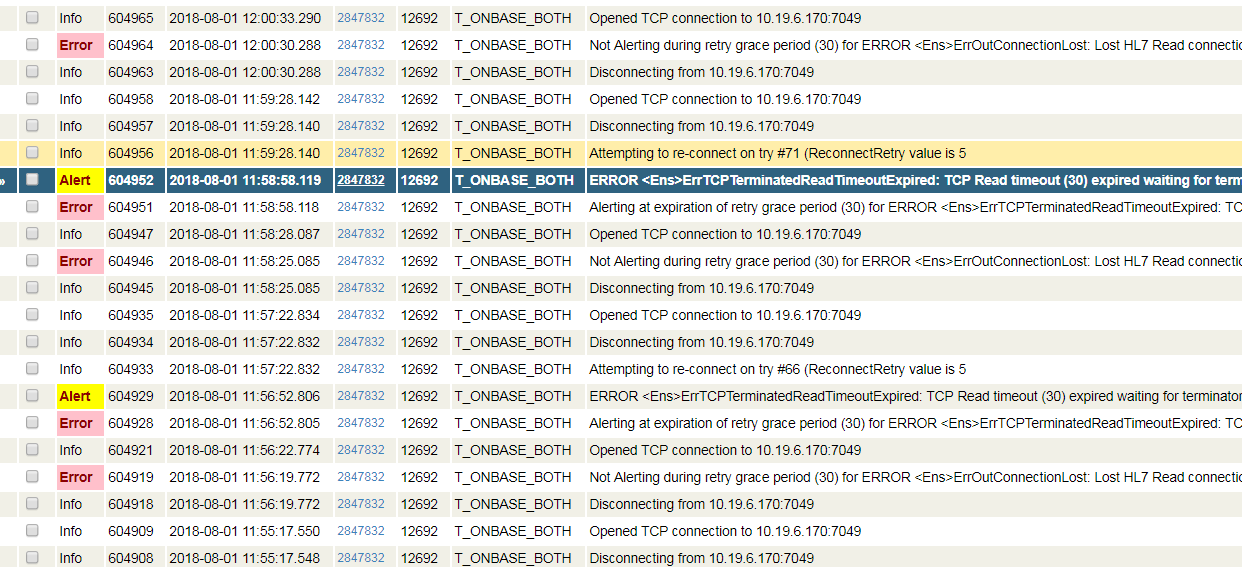
I am receiving this alert every couple of minutes. I am trying to figure out what is causing this and if it is just the settings on my TCP operation or if this indicates an actual issue. Is it an issue with my framing (MLLP) or reply code actions (not set)? Something else?
Error:
ERROR <Ens>ErrTCPTerminatedReadTimeoutExpired: TCP Read timeout (30) expired waiting for terminator SegTerminatorAscii=13, on |TCP|7049|12692, data received =''
(alert request ID=2071)
Screenshot:
Here are the settings on my operation:
| Class Name | EnsLib.HL7.Operation. |
I have a web application and one of the CSP pages contains the following snippets:
<script language='javascript'>
function SubmitForm(pid,sid) {
//code to process form
alert ("study saved");
self.document.location="newpage.csp";
}
<form name="Studyform" method="post" onsubmit='return SubmitForm(#(SubjObj.%Id())#,#(StudyObj.%Id())#);' >
<!-- form contents -->
The form is correctly processed, the object is saved, and the alert appears, but the new page does not get loaded and I cannot figure out why.
Any suggestions?
InterSystems is pleased to announce availability of a field test version of Caché and Ensemble 2018.1
These kits can be downloaded from the Field Test portal page.
There are hundreds of bug fixes, and several new features, including:
All platforms are available, except Oracle Solaris 10, 11 for x86-64.
We expect to update the field test kits about once a week, until release.
Hi,
I'm getting mad trying to get data from an external REST service that uses Basic Authentication from Ensemble. The BO worked fine when I was using a test server without authentification, but as soon as we need to go to production I cannot have it working.
So far, I've created the username/password at the credentials page (Ensemble-Configure-Credentials). I've setup the BO to use this credentials. But nothing happens.
I've tried with the Rest Client (addon for Mozilla), and using the same address, port and user/pwd works just fine.
(Originally posted by @Eduard Lebedyuk on Intersystems CODE, 6/26/14) This code snippet determines the difference between two ObjectScript lists. The class method "test" runs the code, and its parameters are detailed in the comments:
Hi Guys,
I' am using Cache Object Binding for .NET, our Cache Version is Cache for Windows (x86-64) 2010.2 (Build 454U).
How can I set the connection for Cache List of Objects? Here is my sample code.
//CACHEObject as my file generated from OBJECT BINDING
CACHEObject.ContainerImco containerImco = new CACHEObject.ContainerImco(cacheConnection);
CacheListOfObjects<CACHEObject.ContainerImco> lcontainerImco = new CacheListOfObjects<CACHEObject.ContainerImco>();
//Already tried this one but fails
//lcontainerImco.Connection.ConnectionString = "Server=" + Properties.Settings.Default.
As a developer, usually I'm concerned about how my code health is, and how the other coders code can affect to my own work. And I'm quite sure most of us feel very similar.
In our company we use a Static Code Analysis tool to analyze code for different languages to ensure we are writing high quality and easily maintainable code by following a few best practices in terms of code structure and content. And the question was: why should be different for Caché ObjectScript language?
Hi, Community!
This is a digest of the Developer Community postings in July 2018.
Most viewed
Atelier and Studio 1070
Caché and Ensemble 2018.1 Field Test Release 268
GraphQL for InterSystems Data Platforms 191
Cache Dynamic SQL Pagination 155
InterSystems Platform Functions 127
Docker with overlay support 124
Atelier. Compilation returns "Failed to read /api/atelier/v1/..." 123
Error: CSP application closed the connection before sending a response 122
Use GZIP to compress/decompress files 112
K-Means clustering of the Iris Dataset 76
Intersystems Cache Python Object-Relational Mapper 74
The way to launch Apache Spark + Apache Zeppelin + InterSystems IRIS 72
Continuous Delivery of your InterSystems solution using GitLab - Part VIII: CD using ICM 70
Storage Performance Series - NetApp All-Flash FAS (AFF) A300 69
Load a ML model into InterSystems IRIS 57
Most voted
GraphQL for InterSystems Data Platforms 7
Caché and Ensemble 2018.1 Field Test Release 7
The way to launch Apache Spark + Apache Zeppelin + InterSystems IRIS 6
Use GZIP to compress/decompress files 3
Check audit settings programmatically 3
K-Means clustering of the Iris Dataset 3
Load a ML model into InterSystems IRIS 3
Storage Performance Series - NetApp All-Flash FAS (AFF) A300 2
Most commented
Error: CSP application closed the connection before sending a responce 30
Cache Dynamic SQL Pagination 10
Using regular expressions in a routing rule 9
Hi,
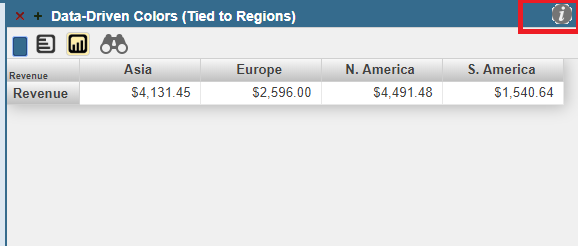
I want to include Info icon on DeepSee-Widget title bar like the image below. And when I click or hover on the icon it should display some information about the widget. I tried with the options available in Widget settings and referred InterSystems's documention as well, I couldn't find a way to get this.
Please help me to achieve this. Thanks in advance.
The REST webservice works perfectly when run on SOAP UI. This end point server is an https site that uses basic authentication (uname and pwd). But when I run the request through an Enslib.Rest.Operation using a configured SSL and stored credentials, I get an "unauthorized" error, unless I explicitly hard code the password in the operation class. HS Version is 2014.1 .
I have 2 questions. Pardon me, they are both related!!
I have a global that defines the instance that Ensemble is running under. I want to use this as part of another Global so I don't have to hard code a path.
For Example
^OSUWMCInstance = "TestClin"
^OSUMCLDAP("LDAPKey") = "/ensemble/^OSUWMCInstance/mgr/LDAPKeyStore/"
Is this possible?
Thanks
Scott
Hi everybody,
we have some legacy ZEN applications build upon CSS2 style definitions. We moved the application due to an upgrade to a newer version of cache (2017.2.1). Anyway I have in mind that in one of the prior relases css3 style interpretation was enforced by ZEN and you could explecitly tell the framework to use CSS2 by setting a global. Anyway I can´t found any hints in the docs on that. Does anyone of the %ZEN gurus have this in mind?
best regards,
sebastian
Hi,
is there a way to tell Caché to ignore the order of elements when hosting a SOAP-based webservice?
At the moment I keep getting the Error-Code #6237 (Unexpected tag in XML input) when the request is not in the exact same order as defined.
Looking forward for your answers.
Regards,
Thomas
csession can be called with a variety of arguments:
Hi, I want to use linux system to develop cache, but I dont want to use wine, any other way to???
Working with a client who has two TryCache instances on his W10 machine. Trying to bring in globals from a text file which works fine in my environment but on his, he cannot make ^%GI accept a file from his C drive. His Cache is on C as is mine. Checking the path and the file name carefully, it is accurate. D ^%GI and enter the path with filename (as works fine for me on my system) and he gets a message [unavailable] and when he hits enter out of that message, he sees Cannot import from THIS device. I think I'm missing a config or security setting of some kind but I don't know what it is.
I work for a large NHS Trust in the UK and we are using Healthshare and we process 1000s of messages each day. Many of these are standard HL7 messages however for several months now we also pickup and drop off 1000s of PDF files.
We have our message purge set to 365 as we have to keep a years worth of messages as we have a retrieval and send process that enables us to replay any set of messages to any destination which we use to prepopulate end systems with activity and result history.
I have a process which is passed a .rtf within a GlobalBinaryStream. I am trying to then output just the .rtf to a folder on a server, but not even sure where to start.
Is there a Built in Operation that I can pass the GlobalBinaryStream to which will then write the file to a folder, or do I need to use a custom class for the operation?
Thanks
Hi community,
I'm in a proyect that I have to load data that cames from 3 different sources and one of these sorces is a csv file that contain the name of a switch and the name of a port. My cube have also this information, but I have to show only the values that match with this information. I'm trying to filter the cube through this method below, the problem was the result of the method is not only a value, it is an array with many values and I must use the IN operator and not this "&" symbol. I wanted to know if it's possible or not?
Result of : ‘acc23-mqui2.redip.clGi1/17’,’acc01-mqui2.
Is there a class Method that will return the number of OBX segments under the OBR segments? I see method ChildCountGet
and ChildCountGet is that the correct method any any examples how to use it?
Hi,
I have a question related with EnsLib.SQL.OutboundAdapter adapter.
Is there a way to open an oracle transaction and do either commit or rollback depending on the query result?
Is posible to keep open an oracle transaction to execute a lot of queries on different methods on the same business operation and do a commit when the business process finished?
Thanks and Best Regards
Sergio Vidal
I wrote a ZAUTHENTICATE.mac a couple of months back, and found recently that it is creating coredumps on almost a nightly basis. I think I have figured out this problem to be not clearing out my MsgSearch after I am doing 2 of them within the code.
1. Get User Attibutes from AD
2. Get User Groups From AD
So while I am trying to cleanup the code I thought it would be a good time to add a Certificate and TLS to the mix since I should of been using that all along.
When I try to compile through Atelier (Compile Project), I noticed that in compilation with error it returns this message 'Failed to read /api/atelier/v1/ ...':
No additional Atelier files to synchronize.
Compile failed: Failed to read /api/atelier/v1/ERP/action/compile?flags=ck
Compile failed: Failed to read /api/atelier/v1/ERP/action/compile?flags=ck
Compile failed: Failed to read /api/atelier/v1/ERP/action/compile?flags=ck
Compile failed: Failed to read /api/atelier/v1/ERP/action/compile?flags=ck
The following code allows a user to view the audit settings of their instance. Run the code by running the class method "test":
class objectscript.checkAudit Extends %RegisteredObject
{
classmethod test() {
w "Checking for Auditing...",!
Set SYSOBJ = ##class(Security.System).%OpenId("SYSTEM")
If +SYSOBJ = 0 Set SYSOBJ = ##class(Security.System).%New()
i SYSOBJ.AuditEnabled {
w "Security Auditing is enabled for the following services",!
s rs=##class(%ResultSet).%New("Security.Events:ListAllSystem")
s sc=rs.Execute()  If $$$ISERR(sc) Do DisplayError^%apiOBJ(sc) Quit
while rs.%Next() {
d:rs.Data("Enabled")="Yes" rs.%Print()
}
d rs.Close()
Hi,
this is a public announcement for the first release of Intersystems Cache Object-Relational Mapper in Python 3. Project's main repository is located at Github (healiseu/IntersystemsCacheORM).
CacheORM module is an enhanced OOP porting of Intersystems Cache-Python binding. There are three classes implemented:
CacheClient This is the super class of CachePython module. It wraps two functions from intersys.pythonbind module pythonbind3.connection() and pythonbind3.database().
CacheQuery A subclass of CacheClient that wraps methods and adds extra functionality in intersys.pythonbind.databaseand intersys.pythonbind.query classes
CacheClass A subclass of CacheClient, that wraps methods and adds extra functionality in intersys.pythonbind.databaseand intersys.pythonbind.object classes
The intersys.pythonbind package is a Python C extension that provides Python application with transparent connectivity to the objects stored in the Caché database.
I'm trying to have my REST service return the entire data set for one of our legacy globals. Currently I am parsing the object from a SQL statement into generic objects to be returned like this:
Set specimenArray=[]
WHILE resultSet.%Next() {
Set specimen = {}
Set specimen.SpecimenId= resultSet.SpecimenId
Set specimen.ProjectId = resultSet.ProjectId
Set Oref = specimenArray.%Push(specimen)
}
Set tProxy = specimenArray.%ToJSON()
set %response.Status = 200
set %response.
Hi,
My testers are getting this Internal Server Error inconsistently. There is no specific steps to reproduce this error. Can you any one explain when will we get this error in DeepSee.
Thanks in advance.