I want to show my script which I use for a completion in bash, for ccontrol and csession.
I am trying to calculate a dimension percentage for WFRole on a child cube named MbMRouteHistoryInitiatorObj joined to a parent cube named MbmQaSObj by using a calculated member dimension within MbmQaSObj.
If I use the calculated member dimension value expression of [WFRole].[H1].[WFRole].CurrentMember/ [WFRole].[All WFRole].%ALL in the child cube MbMRouteHistoryInitiatorObj, the percentages work correctly.
I am not able to calculate the same percentage using the value expression [MbmRouteHistoryInitiatorObj].[WFRole].[H1].[WFRole].CurrentMember/ [MbmRouteHistoryInitiatorObj].[WFRole].
Hi, after installed Healthshare 2015.2, all the tables previously correctly listed working with Healtshare 2014.1 are NOT listed anymore. TrakCare tables are not listed in the catalogue, nor by the WinSQL Intellisense.
Does anybody know a trick or have a hint to resume this useful functionality back?
Thanks.
Hello guys,
I've built a simple rule , as follows:
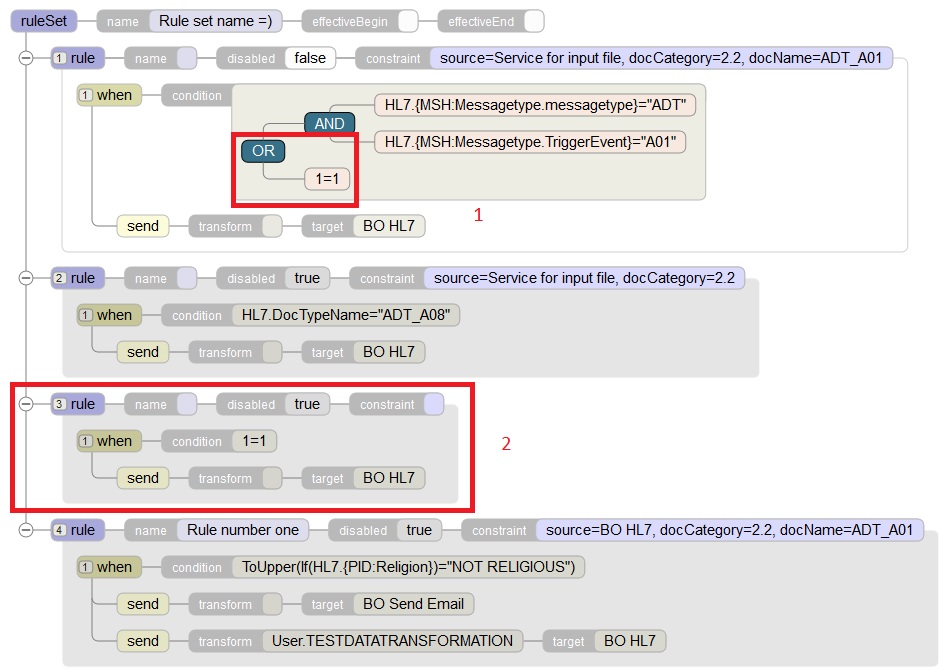
Thing is, in rule 2, the operation succeeds, the message reachs BO HL7, but in rule 1 it does not go through. In rule 1, I have two different conditions, but they are linked by an OR and one of the conditions is simply IF 1=1.
Do you guys have any clue on why rule 1 does not reach BO HL7?
Thanks
I've created a CSP page to take in a base64 value from a <textarea> and decode it. When I run it I get the error . Any ideas?
Error: <ILLEGAL VALUE>zOnPageBODY+28^csp.decode.1
ErrorNo: 5002
Here is my code
<form method="post" action="">
<table>
<tr><td><textarea rows="40" cols="200" name="submitstring"></textarea></td></tr>
<tr><td><select name="decodeoption"><option>Decode</option><option>Encode</option></select><input type="submit"/></td></tr>
<tr><td> </td></tr>
<tr><td><h2>Result</h2></td></tr>
<tr><td>
<script language=Cache runat=server>
Set tString = $Get(%request.
Here's a code snippet to calculate the length of a class or a package in lines of code:
ClassMethod ProjectLength(Mask As %String = "%Package%")
{
    Set count = 0
    Set sql =     "SELECT Name "_
                "FROM %Dictionary.ClassDefinition "_
                "WHERE NOT Name %STARTSWITH '%sqlcq' AND Name LIKE ? AND GeneratedBy IS NULL"
    Set rset = ##class(%SQL.Statement).%ExecDirect(, sql, Mask)

    While rset.%Next() {
        Set class = rset.%Get("Name")
Do ##class(%Compiler.UDL.TextServices).GetTextAsArray(, class, .Hi!
Here is the question in Russian Forum regarding roots extracting.
In Caché ObjectScript we use exponentiation operator (**) to raise an exponent to power. F.e. let's raise 3 to power of 3:
USER> write 3**3

27
And we use the same operator to extract the root.
USER> write 27**(1/3)

2.999999999999999963
And 2.999999999999999963 is not 3, obviously.
How to extract roots properly in Caché ObjectScript?
Long story short, I created some test data, then deleted it. The database (cache.dat) is 67 GB in size (was around 1 GB before tests).
How do I compact that?
In the HL7 Annotations available in the Management Portal, at the message type and message structure levels, there are columns for 'Explicit Usage' and 'Implicit Usage'. In nearly all cases, the values in these two columns match, but at least for message types RAS and RGR, they don't.
What's the meaning of explicit and implicit in the annotations?
Thanks,
Liz
Earlier in this series, we've presented four different demo applications for iKnow, illustrating how its unique bottom-up approach allows users to explore the concepts and context of their unstructured data and then leverage these insights to implement real-world use cases. We started small and simple with core exploration through the Knowledge Portal, then organized our records according to content with the Set Analysis Demo, organized our domain knowledge using the Dictionary Builder Demo and finally build complex rules to extract nontrivial patterns from text with the Rules Builder Demo.
This time, we'll dive into a different area of the iKnow feature set: iFind. Where iKnow's core APIs are all about exploration and leveraging those results programmatically in applications and analytics, iFind is focused specifically on search scenarios in a pure SQL context. We'll be presenting a simple search portal implemented in Zen that showcases iFind's main features.
I have a MySQL server with "posts" table.
I also have a Caché server with "downloadedposts" table.
They are connected from Caché to MySQL via SQL Gateway
I want to keep Caché table synced with MySQL one (MySQL "posts" table is a master copy), so periodically Caché queries MySQL server and downloads data. So far so good, and if a record appears or changes in MySQL table, Caché downloads the changes.
The problem I'm encountering is that sometimes rows would be deleted from MySQL "posts" table.
How do I synchronize deletions?
can I suggest a tweak to the functionality when browsing the list of articals,
when you click on a new page number / next page, the content change, but the position within the page remains at the bottom. It would make much more sense to display the next page of articles, and immediately jump back to the top of the page to continue reading.
Steve Glassman is on vacation today so in his place I wanted to announce the availability of a new kit for the 2016.2 Field Test. The kit details are: 2016.2.0.665.0
There is a wide range of changes to the 2016.2 Field Test, 145 of them in total. You can find a complete listing here:
https://wrc.intersystems.com/wrc/WRC.StreamServer.cls?FILE=/wrc/FieldTe…
Bill McCormick
Director of Product Management
I am pleased to announce the next 2016.2 field test kit, 2016.2.0.677.0.
I haven’t sent an update to this thread in a while and it should come as no surprise that there has been quite a lot of development going on since I wrote about build 632. In fact, there have been almost 300 changes covering most areas of the product.
How can one delete a draft post? I could not, so far, find out.
Dan
a) Choose Add comment b) Write some text in comment (e.g. 'test') c) Click preview d) Edit comment content (e.g. 'test 2') d) Click preview again e) Notice that preview shows comment content before editing (e.g. 'test')
Can anybody share a code looking for 'dead' locks?
It's not trivial to find such locks manually when there are many records in lock table.
I am testing application code and want to simulate error conditions.
I am trying to use the following to define a custom error with a class method.
$SYSTEM.Status.Error($$$GeneralError,"Any text here")
My class method code looks like this....
set RunStatus=$System.Status.Error($$$GeneralError,"DXL Testing Run Error")
Class compile fails because the $$$GeneralError is unknown.
ERROR: DBMS.Reports.TaskPage.1(5) : MPP5610 : Referenced macro not defined: 'GeneralError'
TEXT: set RunStatus=$System.
InterSystems is pleased to announce that Caché and Ensemble 2016.1.1 are now available on all supported platforms.
This followup announcement adds all the OpenVMS versions that were excluded in the announcement last week.
If you go to your profile and click the "Friends" tab there are 3 sub tabs:
- View All Friends (/friends)
- Your Requests (/friends/pending)
- Friend Requests (/friends/flagged)
For me, the first two tabs are identical. Given the "pending" URL, I'm assuming the second tab is supposed to be pending requests. So that's one issue. I'm not even sure what /flagged is supposed to be, but it lists 4 of my 5 friends. On top of that, the layout is reversed (icons on the right, names on the left).
In this article I'll describe how to set up web services and/or REST services using EWD 3.
Since EWD 3 is designed to be modular, you can construct the environment that exactly meets your needs, but for much of the time you'll probably find that the pre-built EWD 3 ewd-xpress super-module does most of what you need because it hooks together all the core EWD 3 and other building-blocks you'll need:
- the Node.js web server that pretty much everyone now uses: Express
- Caché (via the ewd-qoper8-cache module, which, in turn, relies on the cache.
As Rob explained in an earlier post, Caché's Node.js interface allows you to create Web Services and REST Services using the very modular EWD 3 framework.
These services by default return a JSON response with Content-Type: application/json and the response body contains the JSON you return using the finished() method, so:
finished({ test: 'test response' });
returns
{ "test": "test response" }
with a HTTP content-type of application/json
For other external services and tools like e.g.
My manager wants to send a couple of people to one of InterSystems's courses about developing Ensemble productions. I work in a healthcare setting, but my group does not do much work with HL7 interfaces. We mainly use Ensemble to implement custom (non-HL7) interfaces and web services/clients.
With this in mind, which of the two available courses would make the most sense for us - Building Healthcare Productions or Building Business Productions? Has anyone taken one or both and, if so, which would you recommend?
Hi -
I'm trying to rewind a cursor back to the first row after looping part of the way through the implied result set, but I'm not finding a way to make this happen, is there some such iterator variable or directive that I can leverage to accomplish this?
I could code around it by pulling identifiers and/or values into a local array, and then hand code up an iterator over my local results copy, but this feels like a "redesigning of a wheel" approach, and I thought I would check before I start down this path.
Thanks
Job Description
Caché Objects Web Developer

An excellent opportunity exists for an enthusiastic Caché Objects full stack web developer to join our rapidly growing company based near Old Street.
The Job
Our customers use our software to manage events, from small meetings to high-profile conferences and shows. The quality of our software is critical to their success, and critical to our business.
The successful candidate will join our agile software development team and will play a key role in ensuring that we deliver great software to our customers.
If I wanted to build a web-based dashboard that monitored various HIE transactions where would I start?
Examples of measures would be Provide & Registers by Facility, Patient Views by facility or even PHR related data.
I have a successful POC that uses nodejs, html and SQL but I think it makes more sense to use Intersystems technology all the way around, I just don't know where to begin.
CSP for the web piece I assume? How would I access the data, for instance all P&R requests on the BUS? Any other tips or starting points? Maybe examples of a similar project?
We do not have a DeepSee license
I can see mention of it online - http://www.intersystems.com/our-products/cache/tech-guide/chapter-3/ - but nothing in the docs on how to implement. Does anyone have any experience with this? We've managed to implement Hibernate and JDBC connections to Cache DBs fine (these are documented!).
Thanks very much :)
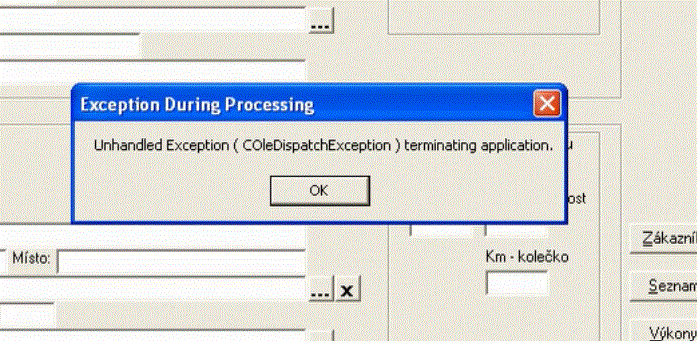
Customer is using an ancient MSM based client Workstation for their application and they made a small change to their server code. They introduced property of %Double() and discovered an issue. The MSM workstation is not able to retrieve any property of an object instance that holds value of $double(0). see images illustrating the issue.
I'm posting this to DC intentionally before I eventually send it to WRC so others can comment.
Dan
Image 1 - data

image 2 - UI
Hello,
I am looking for a routine or global that can help me see what is the REST Operation output. Similar to ISCSOAP for SOAP web services operation.
Thanks
Raghu
Hi,
I am looking for a mapping from SDA collections to the HS Analytics (HSAA) data model. Specifically HS.SDA3.Container.Observations to the tables (Couldn't find all the fields in HSAA.Observation). Can someone help? Thanks
Regards
Joseph Thottungal