Hey Developers,
Watch the video from our Tech Video Challenge:
Hey Developers,
Watch the video from our Tech Video Challenge:
Here is what I currently have:
Hi Community!
Our 💡 InterSystems Ideas Contest 💡 has come to an end. 26 new ideas that followed the required structure were accepted into the contest!
They all focus on improving InterSystems IRIS and related products, highlighting tangible benefits for developers once the ideas are implemented.
And now let's announce the winners...
.jpg)
✓ 388 new members joined in July
✓ 15,296 posts published all time
✓ 17,095 members joined all time

If you’ve ever watched a true artisan—whether a potter turning mud into a masterpiece or a luthier bringing raw wood to life as a marvelous guitar—you know that magic isn’t in the materials, but in care, craft, and process. I know this firsthand: my handmade electric guitar is a daily inspiration, but I’ll admit—creating something like that is a talent I don’t have.
Yet, in the digital world, I often see people hoping for “magic” from generative AI by typing vague, context-free prompts like “build an app.” The results are usually frustratingly shallow—no artistry, no finesse.
If one of your packages on OEX receives a review you get notified by OEX only of YOUR own package.
The rating reflects the experience of the reviewer with the status found at the time of review.
It is kind of a snapshot and might have changed meanwhile.
Reviews by other members of the community are marked by * in the last column.
I also placed a bunch of Pull Requests on GitHub when I found a problem I could fix.
Some were accepted and merged, and some were just ignored.
So if you made a major change and expect a changed review, just let me know.
#InterSystems Demo Games entry
The Trial AI platform leverages InterSystems cloud services including the FHIR Transformation Service and IRIS Cloud SQL to assist with clinical trial recruitment, an expensive and prevalent problem. It does this by ingesting structured and unstructured healthcare data, then uses AI to help identify eligible patients.
Presenters:
🗣 @Vic Sun, Sales Engineer, InterSystems
🗣 @Mohamed Oukani, Senior Sales Engineer, InterSystems
🗣 @Bhavya Kandimalla, Sales Engineer, InterSystems
I am brand new to using AI. I downloaded some medical visit progress notes from my Patient Portal. I extracted text from PDF files. I found a YouTube video that showed how to extract metadata using an OpenAI query / prompt such as this one:
ollama-ai-iris/data/prompts/medical_progress_notes_prompt.txt at main · oliverwilms/ollama-ai-iris
I combined @Rodolfo Pscheidt Jr https://github.com/RodolfoPscheidtJr/ollama-ai-iris with some files from @Guillaume Rongier https://openexchange.intersystems.com/package/iris-rag-demo.
I attempted to run
python3 query_data.
Hi, Community!
Are you building applications in a healthcare setting? See how InterSystems FHIR Server can help:
Hey Community! New rewards have arrived on Global Masters 🎁
With our July update, we’ve added some fresh new options for you to choose from! The rewards catalog is now packed with even more exciting ways to exchange your points for something truly useful, , and well-deserved If you’ve been saving up your points, now’s the perfect time to treat yourself!
.png)
➡️ Enter Global Masters to check out available prizes*.
🧩 Want to learn how to earn points faster? You can find tips and guidance here
Thirteen years ago, I attained dual undergraduate degrees in electrical engineering and math, then promptly started full-time at InterSystems using neither. One of my most memorable and stomach-churning academic experiences was in Stats II. On an exam, I was solving a moderately difficult confidence interval problem. I was running out of time, so (being an engineer) I wrote out the definite integral on the exam paper, punched it into my graphing calculator, wrote an arrow with “calculator” over it, then wrote the result.
The extension and source code are now available
After having some discussions at Global Summit and using a lot of package managers in my day to day development (npm,nuget,Chocolatey, etc) in addition to recently using the InterSystems Package Manager for some CICD process I'm building using Intersystems IRIS and IRIS 4 Health, I wanted an easy and integrated way to search/view/install packages related to the Intersystems tech stack.
Hi everyone,
I’m working with an existing InterSystems IRIS server that hosts several web applications and namespace-specific code and data. I’d like to reverse-engineer the current environment into a %Installer.Manifest file so I can store it in Git and manage its changes.
My goal is to:
I understand that %Installer is declarative and wasn’t necessarily designed to reflect a running system.
Overview I'm excited to announce the release of testcontainers-iris-node, a Node.js library that makes it easy to spin up temporary InterSystems IRIS containers for integration and E2E testing. This project is a natural addition to the existing family of Testcontainers adapters for IRIS, including testcontainers-iris-python and testcontainers-iris-java.
Why testcontainers-iris-node? As a Node.js developer working with InterSystems IRIS, I often faced challenges when setting up test environments that mimic production. testcontainers-iris-node solves this by leveraging the testcontainers-node framework to create isolated IRIS environments on-demand.
This is particularly valuable for:
Features
Why Randomization is Key When Splitting Data for Machine Learning
Post:
Essentially, Machine Learning is about learning from data. Having "good" data leads to better models, and more importantly, the quality of the information being used plays a crucial role in improving prediction accuracy.
One critical step in the process is how we separate our data into training and validation sets. If this isn’t done properly, we risk introducing bias, overfitting, or unrealistic performance expectations for the model.
Well... It's time for testing. We know that often, it's already over. So, what now? Can I improve the quality of my development?
The answer is: YES. Yes, you can. The Toolqa tool aims to do just that. It's a facilitator. What's its goal?
To ensure that APIs meet pre-established business requirements, while also protecting against <sarcasm> future failed attempts </sarcasm> to destroy your application, website, app, or anything else that uses your API.
Now you might be wondering, how does this happen? Where's the magic?
The ToolQA.tool.
Hey Community!
We're happy to share the next video in the "Code to Care" series on our InterSystems Developers YouTube:
Hi everybody,
A customer would like to connect an IRIS database to Metabase BI. But Metabase does not have a connector that supports the IRIS database.
Metabase only supports these databases:
- Amazon Athena
- BigQuery (Google Cloud Platform)
- Druid
- MongoDB (recommend version 4.2 or higher)
- MySQL (recommend version 8.0.33 or higher, as well as MariaDB version 10.4 or higher)
- Oracle
- PostgreSQL
- Presto
- Redshift (Amazon Web Services)
- Snowflake
- SparkSQL
- SQL Server
- SQLite
- Vertica
And a few others.
However, it is possible to create a driver for Metabase that connect to IRIS.
Sometimes your client may request documentation of your BI or interoperability project in a formal document. In this case, MS Word is a good alternative, as it has an advanced editor that allows you to generate professional documentation. Now it's possible!
The iris4word app has this functionality!
| Final MS Word Document | Word Template |
.png) |
.png) |
.png) |
.png) |
the iris4word get BI asset list and metadata using the InterSystems IRIS BI REST API documented on (https://docs.intersystems.com/healthconnectlatest/csp/docbook/DocBook.UI.Page.cls?KEY=D2CLIENT_rest_api).
Hello everyone,
I would like to ask whether it is possible to run InterSystems API manager (IAM) on OpenShift. Is there some documentation describing how to do it? I was searching the forum as well as the internet and I have not found much unfortunately.
Any hints would be highly appreciated.
Best regards
Martin Zukal
In this section, we will explore how to use Python as the primary language in IRIS, allowing you to write your application logic in Python while still leveraging the power of IRIS.
Word documents are widely used in the market. Users frequently create contracts, memos, resumes, reports, analyses, and other documents that may require data from or captured by InterSystems IRIS. However, IRIS does not have an API, SDK, library, or adapter for this. This limitation no longer exists.
The new Open Exchange library iris4word (https://openexchange.intersystems.com/package/iris4word) delivers an ObjectScript SDK where the developer passes any %DynamicObject as a parameter, a Word file template and then receives a ready document, with the structure and formatting defined in its template.
.png)
Let's start with a simple motivating question: over the past 14 days, what are my most common errors in the Application Error Log?
Answering this through the management portal or terminal is an annoying manual process - we should just be able to use SQL. Fortunately, there are a few class queries to help with this in the SYS.ApplicationError class in the %SYS namespace. You can answer the question for a single date with something like:
select "Error message",count(*)
from SYS.If you are investigating complex structured Globals this can become
a rather boring typing exercise. Different from Global Explorer in
System Management Portal Global-Inspector allows a kind of drill-down
to dig deeper and deeper by subscript levels.
You also have the option to see the stored content or to show only
the subscript structures.
Globals storing SQL Tables are probably not so thrilling, but in SYSTEM
space you find real trees with completely different branches and twigs.
Global-Inspector can run in browser or from terminal command line.
Hi, I'm wondering what are the diferences between a method or classmethod with the language set at tsql and a querry writen in sql.
If anyone know if there is some difference and what they are, I would be glad to learn. 😊
Hi,
I have a code that copy a method to another class for analysis purpose.
I also want this method to appear first in the source code to easily use it in VSCode with the classmethod debug button and not search it in the numerous method of the modified class.
Is there a way to do such a thing?
I tried the placeAfter keyword but I can't find a way to make it really work as I want. Is their other ways to control the order of methods?
Hi Community!
Welcome to Issue #23 of the InterSystems Ideas newsletter! These have been very busy two months, so let's look at the latest news from the Ideas Portal, such as:
✓ General Statistics
✓ Results of InterSystems Ideas Contest
✓ Community Opportunity Ideas
.png)
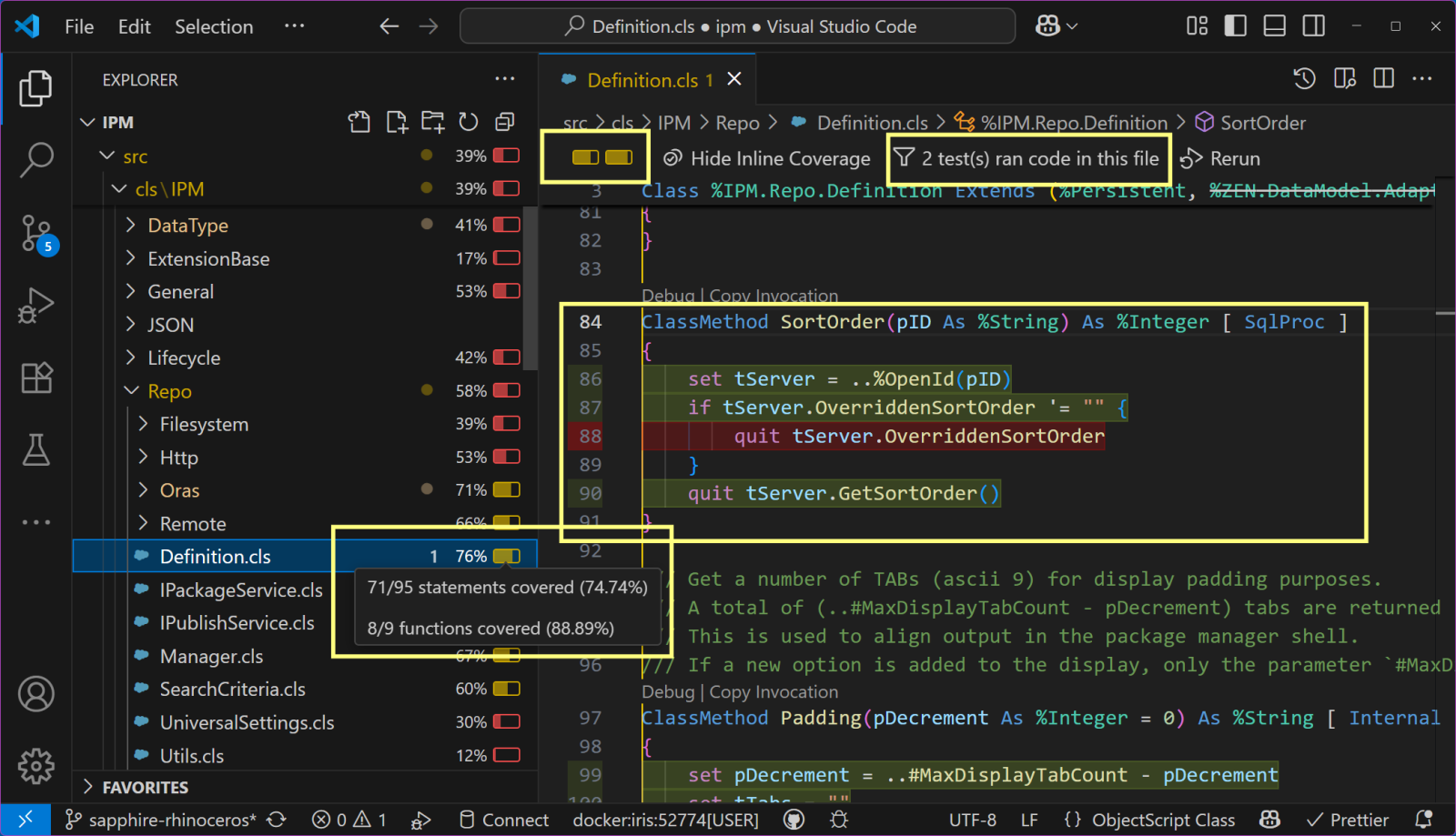
The new version of InterSystems Testing Manager which I released last week brings @Timothy Leavitt's cool
Test Coverage Tool to VS Code, and is my entry for the 2025 Developer Tools contest.
Here's a teaser screenshot showing how the unit tests of the IPM project don't yet cover a feature that apparently allows an IPM repository to override its sort order.
Now that we have a good understanding of Python and its features, let's explore how we can leverage Python within IRIS.
Sending emails is a common requirement in integration scenarios — whether for client reminders, automatic reports, or transaction confirmations. Static messages quickly become hard to maintain and personalize. This is where the templated_email module comes in, combining InterSystems IRIS Interoperability with the power of Jinja2 templates.
Jinja2 is a popular templating engine from the Python ecosystem that enables fully dynamic content generation.