Now Under Heavy Rotation, Your IrisCluster Secrets

A few days before Kubecon, the external-secrets-operator went GA with 1.0.0 and is set to ride shotgun for Kubernetes Secrets Management and put Vault in the backseat. You can glance at the "Providers" list for the solution and immediatley understand that you can leave the "which Secrets Manager" conversation to others while you do your job utilizing external secrets on your IrisCluster workloads, which by my count with the operator and a single IrisCluster is more than a fistful of secrets of different types, even under a single tenant. So let them sprawl, the secrets managers that is, not the secrets.

4 0
1 44

Power your IrisCluster serviceTemplate with kube-vip

If you're running IRIS in a mirrored IrisCluster for HA in Kubernetes, the question of providing a Mirror VIP (Virtual IP) becomes relevant. Virtual IP offers a way for downstream systems to interact with IRIS using one IP address. Even when a failover happens, downstream systems can reconnect to the same IP address and continue working.

The lead in above was stolen (gaffled, jacked, pilfered) from techniques shared to the community for vips across public clouds with IRIS by @Eduard Lebedyuk ...

Articles: ☁ vip-aws | vip-gcp | vip-azure

This version strives to solve the same challenges for IRIS on Kubernetes when being deployed via MAAS, on prem, and possibly yet to be realized using cloud mechanics with Manged Kubernetes Services.

1 1
0 51

Mirror Your Database Across the Galaxy with Seeding

Hello cpf fans! This distraction I used the "seed" capability in IRIS to provision an entire IrisCluster mirror, 4 maps wide with compute starting from an IRIS.DAT in a galaxy far far away. This is pretty powerful if you have had a great deal of success with a solution running on a monolithic implementation and want it to scale to the outer rim with Kubernetes and the InterSystems Kubernetes Operator. Even though my midichlorian count is admittely low, I have seen some hardcore CACHE hackers shovel around DATS, compact and shrink and update their ZROUTINES, so this same approach could also be helpful shrinking and securing your containerized workload too. If you squint and feel all living things around you, you can see a glimpse of in place (logical) mirroring in the future as a function of the operator and a migration path to a fully operational mirrored Death Star as the workload matures.


0 0
0 58

IKO Helm Status: WFH

Here is an option for your headspace if you are designing an multi-cluster architecture and the Operator is an FTE to the design. You can run the Operator from a central Kubernetes cluster (A), and point it to another Kubernetes cluster (B), so that when the apply an IrisCluster to B the Operator works remotely on A and plans the cluster accordingly on B. This design keeps some resource heat off the actual workload cluster, spares us some serviceaccounts/rbac and gives us only one operator deployment to worry about so we can concentrate on the IRIS workloads.

3 1
1 56

"Haul" a Portable Registry for Airgapped IrisClusters

Rancher Government Hauler streamlines deploying and maintaining InterSystems container workloads in air-gapped environments by simplifying how you package and move required assets. It treats container images, Helm charts, and other files as content and collections, letting you fetch, store, and distribute them declaratively or via CLI — without changing your existing workflows. Meaning your charts and what have yous, can have conditionals on your pull locations in Helm values, etc.

If you have been tracking how HealthShare is being deployed via IPM Packages, you can certainly appreciate the adoption of OCI compliance storage for the packages themselves using ORAS... which is core to the Hauler solution.

3 0
1 41

Target Practice for IrisClusters with KWOK

KWOK, Kubernetes WithOut Kubelet, is a lightweight tool that simulates nodes and pods—without running real workloads—so you can quickly test and scale IrisCluster behavior, scheduling, and zone assignment. For those of you wondering what value is in this without the IRIS workload, you will quickly realize it when you play with your Desk Toys awaiting nodes and pods to come up or get the bill for provisioning expensive disk behind the pvc's for no other reason than just to validate your topology.

Here we will use it to simulate an IrisCluster and target a topology across 4 zones, implementing high availability mirroring across zones, disaster recovery to an alternate zone, and horizontal ephemeral compute (ecp) to a zone of its own. All of this done locally, suitable for repeatable testing, and a valuable validation check mark on the road to production.

0 0
0 40

Background

For a variety of reasons, users may wish to mount a persistent volume on two or more pods spanning multiple availability zones. One such use case is to make data stored outside of IRIS available to both mirror members in case of failover.

Unfortunately the built-in storage classes in most Kubernetes implementations (whether cloud or on-prem) do not provide this capability:

7 2
3 156

A step by step implementation path to a cross regional stretched IrisCluster with Mirroring using the Intersystems Kubernetes Operator (IKO), Google Cloud Platform, and Tailscale.

I am giving this distraction the code name "Compliment Sandwich" for a reason yet to be realized, but I'd rather the community go right for the jugular shooting holes in a solution that implements wireguard based connectivity for our workloads in general, as I would like to refine it as a fall project leading up to KubeCon in Atlanta and if I miss the mark, Ill get it done before Amsterdam.

6 1
1 110

Another step in this implementation path, adding cross cloud, cross regional stretched IrisCluster with Mirroring + Disaster Recovery using the Intersystems Kubernetes Operator (IKO) and Tailscale

Though trivial, Id like to go multi-cloud with the stretched IrisCluster for a couple of reasons to socialize the power of Wireguard when it supplies the network for a properly zoned IrisCluster by adding another mirror role to Amazon Web Services in the Western United States based datacenter in Oregon.

4 0
1 75

Background

For a variety of reasons, users may wish to mount a persistent volume on two or more pods spanning multiple availability zones. One such use case is to make data stored outside of IRIS available to both mirror members in case of failover.

Unfortunately the built-in storage classes in most Kubernetes implementations (whether cloud or on-prem) do not provide this capability:

6 1
1 135

Background

For a variety of reasons, users may wish to mount a persistent volume on two or more pods spanning multiple availability zones. One such use case is to make data stored outside of IRIS available to both mirror members in case of failover.

Unfortunately the built-in storage classes in most Kubernetes implementations (whether cloud or on-prem) do not provide this capability:

11 1
4 237

#InterSystems Demo Games entry


⏯️ Auto-scaling made easy in GKE with InterSystems Kubernetes Operator (IKO)

Kubernetes horizontal pod auto-scaling (HPA) is the key to handle the unpredictable compute workload in healthcare systems. IKO helps orchestrating the IRIS container deployment in Kubernetes including the capability to configure HPA. This demo uses XSLT processing as an example to showcase this type of elasticity.

🗣 Presenter: @Simon Sha, Sales Architect, InterSystems

https://www.youtube.com/embed/npCs5_yX_xg
[This is an embedded link, but you cannot view embedded content directly on the site because you have declined the cookies necessary to access it. To view embedded content, you would need to accept all cookies in your Cookies Settings]

9 0
0 62

The IKO will dynamically provision storage in the form of persistent volumes and pods will claim them via persistent volume claims.

But storage can come in different shapes and sizes. The blueprint to the details about the persistent volumes comes in the form of the storage class.

This raises the question: we've deployed the IrisCluster, and haven't specified a storage class yet. So what's going on?

You'll notice that with a simple

10 1
1 393

The IKO allows for sidecars. The idea behind them is to have direct access to a specific instance of IRIS. If we have mirrored data nodes, the web gateway will (correctly) only give us access to the primary node. But perhaps we need access to a specific instance. The sidecar is the solution.

Building on the example from the previous article, we introduce the sidecar by using a mirrored data node and of course arbiter.

7 1
1 415

We now get to make use of the IKO.

Below we define the environment we will be creating via a Custom Resource Definition (CRD). It lets us define something outside the realm of what the Kubernetes standard knows (this is objects such as your pods, services, persistent volumes (and claims), configmaps, secrets, and lots more). We are building a new kind of object, an IrisCluster object.

9 1
2 596
Article
· Mar 2, 2024 4m read
IKO - Lessons Learned (Part 1 - Helm)

The IKO documentation is robust. A single web page, that consists of about 50 actual pages of documentation. For beginners that can be a bit overwhelming. As the saying goes: how do you eat an elephant? One bite at a time. Let's start with the first bite: helm.

What is Helm?

Helm is to Kubernetes what the InterSystems Package Manager (IPM, formerly ObjectScript Package Manager - ZPM) is to IRIS.

14 2
5 639

image

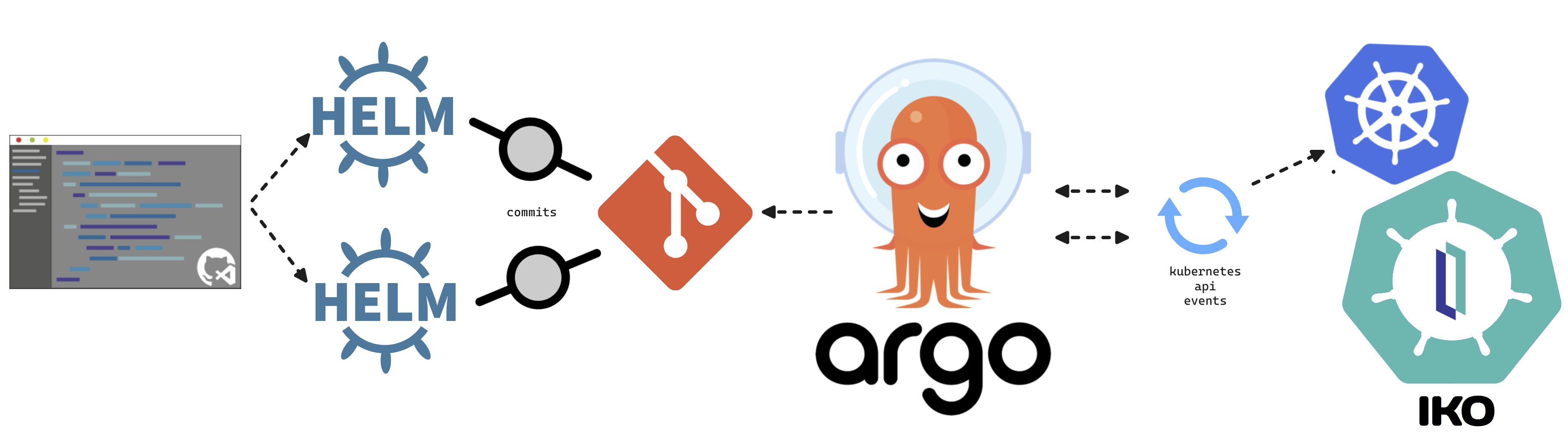
This article will cover turning over control of provisioning the InterSystems Kubernetes Operator, and starting your journey managing your own "Cloud" of InterSystems Solutions through Git Ops practices. This deployment pattern is also the fulfillment path for the PID^TOO||| FHIR Breathing Identity Resolution Engine.

7 3
1 831

This week I was able to demo a proof of concept for our FMS interface on traffic cop architecture to my team. We are working on modernizing an Interoperability production running on mirrored Health Connect instances. We deploy IRIS workloads on Red Hat OpenShift Container Platform using InterSystems Kubernetes Operator (IKO). We can define any number of replicas for the compute stateful set where each compute pod runs our Interoperability production. We introduced Horizontal Pod Autoscaler (HPA) to scale up the number of compute pods based on memory or CPU utilization.

5 0
0 440

My team works on implementing an Interoperability solution utilizing InterSystems Kubernetes Operator on Red Hat OpenShift container platform.

We are trying to determine how many messages we can process in any given time. We have a Feeder app running in 10 containers sending 50k messages each to a load balancer all beginning at the same time.

Messages are received via HTTPS protocol by webgateway containers.

Interoperability production runs in compute pods with persistent data, journals, and WIJ volumes.

1 1
1 490

Hello,

I work on deploying IRIS using Kubernetes operator and Red Hat OpenShift. I encouraged another team working on Java application to consider using IRIS as database. My team deployed IRIS cluster using two mirrored data pods for the other team. The other team asked me for the connection information.

To learn how to use Java with IRIS, I attempted to deploy two apps from Open Exchange:

https://openexchange.intersystems.com/package/CRUD-GLOBALS-IRISNATIVEAPI...

2 1
0 336

The InterSystems Kubernetes Operation (IKO) version 3.3 is now available via the WRC download page and the InterSystems Container Registry.

IKO simplifies working with InterSystems IRIS or InterSystems IRIS for Health in Kubernetes by providing an easy-to-use irisCluster resource definition. See the documentation for a full list of features, including easy sharding, mirroring, and configuration of ECP.

IKO 3.3 Highlights:

  • Support for 2021.2 and 2022.1 editions of InterSystems IRIS & IRIS for Health
  • Support for Kuberentes 1.21
  • Deploy common System Alerting and Monitoring (SAM) configurations as part of your irisCluster
  • InterSystems API Manager (IAM) can now also be deployed and managed as part of the irisCluster
  • Automatic tagging of mirror pair active side, so a service can always point to the active mirror member.
2 0
0 261

Hey Developers,

Watch as the presenter uses IKO to deploy the WebGateway, SAM, and InterSystems API Manager with the latest version of the InterSystems Kubernetes Operator:

IKO: The InterSystems Kubernetes Operator (Version 3.0)

https://www.youtube.com/embed/KRUMYz6eGhE
[This is an embedded link, but you cannot view embedded content directly on the site because you have declined the cookies necessary to access it. To view embedded content, you would need to accept all cookies in your Cookies Settings]

4 0
0 436

Introduction
Several resources tell us how to run IRIS in a Kubernetes cluster, such as Deploying an InterSystems IRIS Solution on EKS using GitHub Actions and Deploying InterSystems IRIS solution on GKE Using GitHub Actions. These methods work but they require that you create Kubernetes manifests and Helm charts, which might be rather time-consuming.
To simplify IRIS deployment, InterSystems developed an amazing tool called InterSystems Kubernetes Operator (IKO). A number of official resources explain IKO usage in details, such as New Video: Intersystems IRIS Kubernetes Operator and InterSystems Kubernetes Operator.

6 2
2 1.1K

Hey Developers,

New video is already on InterSystems Developers YouTube:

Deploying & Upgrading IRIS with Kubernetes Operator

https://www.youtube.com/embed/TnHfrWv6s5Y
[This is an embedded link, but you cannot view embedded content directly on the site because you have declined the cookies necessary to access it. To view embedded content, you would need to accept all cookies in your Cookies Settings]

1 0
0 265

Hi Developers,

The new video from Global summit 2019 is already on InterSystems Developers YouTube:

⏯ Intersystems IRIS Kubernetes Operator

https://www.youtube.com/embed/PvlDp6xLQ5U
[This is an embedded link, but you cannot view embedded content directly on the site because you have declined the cookies necessary to access it. To view embedded content, you would need to accept all cookies in your Cookies Settings]

1 4
0 780

Episode 20 of Data Points features a conversation with Bob Kuszewski about the Kubernetes and the InterSystems Kubernetes Operator (IKO). Take a listen to hear about some of the use cases and features of IKO, plus how it compares to InterSystems Cloud Manager (ICM) within the cloud space.

https://5e18edf067eb59-03854285.castos.com/player/579162
[This is an embedded link, but you cannot view embedded content directly on the site because you have declined the cookies necessary to access it. To view embedded content, you would need to accept all cookies in your Cookies Settings]

1 0
0 161