How to understand the "sets" of this "$system.OBJ.GetQualifiers" method?


InterSystems IRIS is a Complete Data Platform
InterSystems IRIS gives you everything you need to capture, share, understand, and act upon your organization’s most valuable asset – your data.
As a complete platform, InterSystems IRIS eliminates the need to integrate multiple development technologies. Applications require less code, fewer system resources, and less maintenance.
How to understand the "sets" of this "$system.OBJ.GetQualifiers" method?
Downloaded the IRISHealth Community Version for ensemble learning but not able to see ENSDEMO Namespace. Not able to figure out how to get it.
Hey Developers,
Get an introduction to the new template editor. In this video, we'll also tell you about recent use cases:
Hi! I'm banging my head to the wall with HMAC authentication. I have tried to implement this various ways but nothing seems to work.
If someone could help on this it would be great!
Here is a code that I have tried and working Javascript example, tested on Postman.
Set requestTimeStamp = $ZDATETIME($HOROLOG,-2)
Set nonce = ..getRandomString()
Set signatureRawdata = Appid_requestTimeStamp_nonce
Set keyUTF8 = $zconvert(Appkey,"O","UTF8")
Set signatureRawdataUTF8 = $zconvert(signatureRawdata,"O","UTF8")
Set tSigningKey = $SYSTEM.
 In a previous article, I talked about the implemented package manager commands (generate, list, load).
In this article I want to talk about other commands.
In a previous article, I talked about the implemented package manager commands (generate, list, load).
In this article I want to talk about other commands.
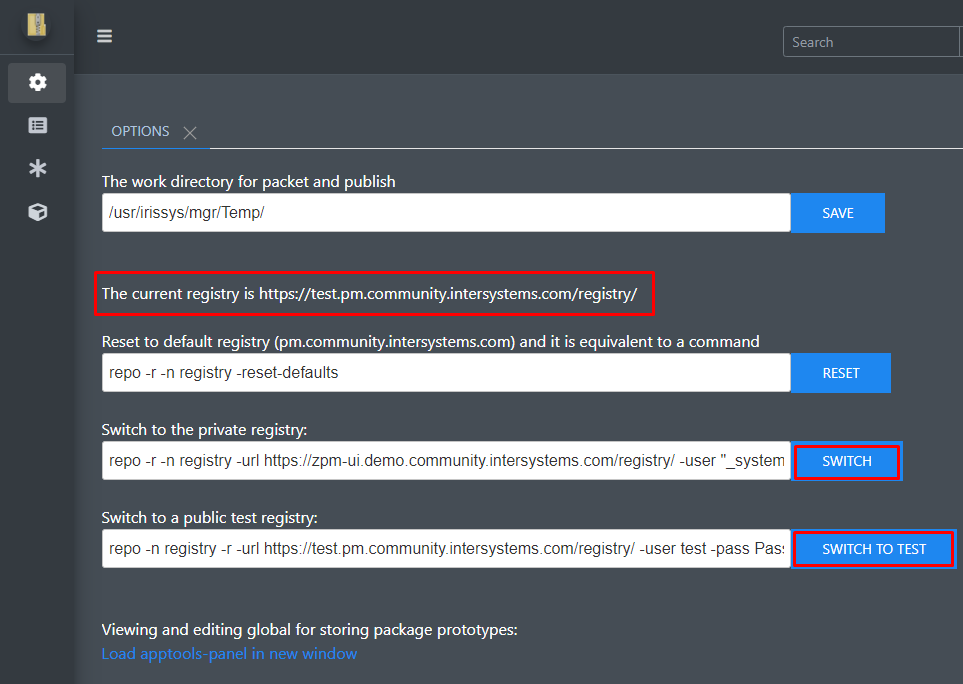
On the Option tab, you can see which current case is set and switch
To see the list of packages in the current register, click on the search button.
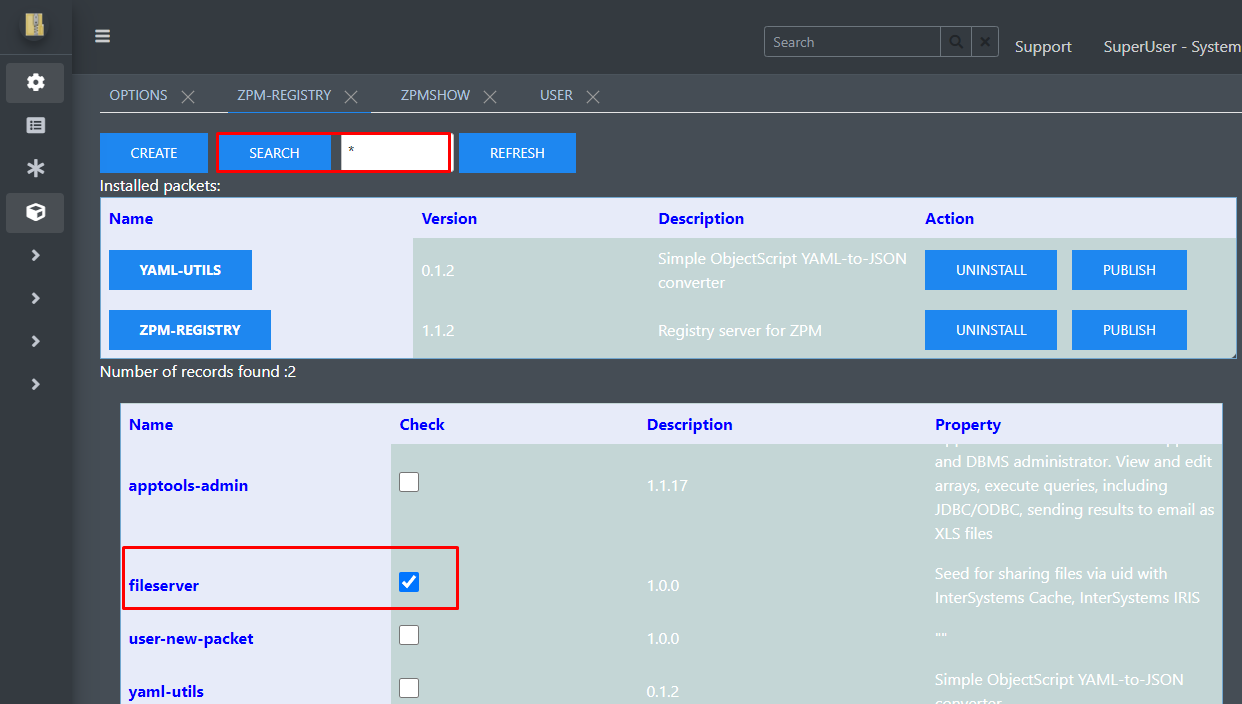
To install a package in the current namespace, you need to check the selected package and click the install button.
Hi Community,
I published my new app (https://openexchange.intersystems.com/package/global-mindmap) online to write an InterSystems Mindmap with you. Write your mind notes and help to build the InterSystems Mindmap. I will transform the final result in an article.
Access: http://ymservices.tech:3000
Thanks
I have a few Radio buttons, some of which have to have the same value. I need to know which one the user have selected, so I am using text, however it does not work well so far.
Example:
I have 4 Radio buttons: Apple, Pear, Lemon and Orange, with values: Apple, Pear have Value 1, and Lemon and Orange have Value of 2
(this unfortunatelly cannot be changed for this particular application)
I need to figure out that the user picked specifically Apple, so I am using text as follows:
var FruitSelected=$('[name='Nameoftheradiobuttonhere]:checked').parent().
Hello communty.
I searched a way to transform a HL7 Message to Persistent. I found a way how to create Data Transformation from Mangment Portal -> Data Transformation Interface. But my task is to create somthing similar to that tool in my web site interface. And the question is: Is There way to create something like new instance of Data Transformation class "
Thank you!
Hi Team,
I want to implement functionality in Intersystems IRIS for Health 2021.1. Which Received FHIR JSON from FHIR Repository and Convert them into HL7 different versions by Message type. Can anyone help me with this?
Thanks,
Harshdeep Acharya
Hi Team,
I would like to save the array subscript with in double quotes
eg sub1=111,sub2=444 (these values are dynamic)
set array(sub1,sub2)=""
It will be saved as array(111,444)=""
but I want to save it as array("111","444")=""
I am trying to save it from the class like """"_sub1_"""" but its not displaying as expected.
Kindly do the need full.
Thanks in Advance
Hi Team,
Thanks in advance for reading my question.
I first converted HL7 to FHIR using SDA. Now, I want to convert the same FHIR resources to an FHIR JSON file. Is that possible?
If yes, give me a solution for that?
Harshdeep Acharya
Software Developer
Before this project, I built zpm packages almost by hand. I edited the module.xml file, inserted resources into it and copied the resources to disk, then checked the correctness of the assembly. I was tired of it and I decided to make this work easier for myself.
I present to the contest zpm-generate-ui resource manager, which represents the ui for selecting packages, classes, globals and web applications for creating zpm… modules, for subsequent export to the current registry or repository for deployment in the same or another instance.
Generate module.
Hey Community,
Ready for the next contest? We are glad to invite you all to the 19th InterSystems online programming competition:
🏆 InterSystems Globals Contest 🏆
Duration: March 21 - April 10, 2022
In prizes: $10,000
InterSystems Reports Server stores system tables in an IRIS instance of your choice. How is this configured?
Read this article if:
I am working on a setup using the iris docker image (iris:2020.4.0.547.0). I need the timezone to be a different timezone than the host. Is there a way to do that by passing in an options / variable?
Hi, I’m using $ZDATETIME to return the following
I would like to return just the YYYYMMDDHHMM i.e. stripping out the seconds.
Does $ZDATETIME have an option for this?
Hi,
The company I work for has one software application that uses an IRIS database, with almost all the others using SQL databases.
On a SQL database, we can create local tables and create views. These are invaluable when it comes to reporting, and everyone here is quite up to speed with using SSMS to create functions, stored procedures, etc.
However, when it comes to IRIS, no-one seems to know anything.
Hi Developers!
Here're the technology bonuses for the InterSystems IRIS Globals Contest 2022 that will give you extra points in the voting:
See the details below.
I need to turn off Journalling for a particular database programmatically.
How can I make it happen?
Hi Community,
Don't miss the new video on InterSystems Developers YouTube:
InterSystems IRIS Business Intelligence allows you to keep your cubes up to date in multiple ways. This article will cover building vs synchronizing. There are also ways to manually keep cubes up to date, but these are very special cases and almost always cubes are kept current by building or synchronizing.
The build starts by removing all data in the cube. This ensures that the build is starting in a clean state. The build then goes through all records specified by the source class.
.png)
The PDF version (when you click article title, the link to the pdf it is showed) allows you click and go to the article. Enjoy!
I have a rather simplistic JSON Object of this structure:
{"id":<someid>,"value":<some string>,"details":
 [{"id":<someid>,"value":<some string>,"details":
  [{"id":<someid>,"value":<some string>,"details":
   [{"id":<someid>,"value"}
   ,{"id":<someid>,"value"}
   ,{"id":<someid>,"value"} ]
  ,[{"id":<someid>,"value":<some string>,"details":
     [{"id":<someid>,"value"}
    ,{"id":<someid>,"value"} ] ]
 ,{"id":<someid>,"value":<some string>} ] }
The depth and number of depth elements are variable.
It's a finger snip to work it down with %DynamicObject.
Selective Build is a BI feature in InterSystems IRIS (introduced in version 2020.1). Selective Build allows you to build specific elements of your cube while keeping your cube online.
Before getting into the details of Selective Build, a brief recap of the different phases during a regular cube build is important.
Hey Developers,
Enjoy watching the new video on InterSystems Developers YouTube channel:
Hey Coommunity,
Learn about InterSystems globals, the data model native to InterSystems IRIS® data platform that makes data storing efficient and provides the flexibility your data needs:
I am having trouble formatting %Time to a JSON format. I have tried configuring the parameter "FORMAT" of my property but that didn't work. For some reason, it keeps putting a Z and the end of the time.
Property:
Setting the Property through a custom function which is used in the DTL:
Let's assume that we have already connected a data source to Adaptive Analytics, created a project and added tables there.
Now we will prepare Adaptive Analytics for work. First, we need to select data from tables, to make it available for the future report. To do this, we need to create dimensions from the columns of the tables. Dimensions are usually created to break down our data into categories, such as what city the user lives in, or what month a purchase was made in.
Hi Community,
We are pleased to invite all the developers to the upcoming InterSystems Globals Contest Kick-off Webinar! The topic of this webinar is dedicated to the Globals contest.
In this webinar, we’ll show you how to deal with Globals to implement different data models and sophisticated indexes. As always, our experts will answer the questions on how to develop, build, and deploy Globals solutions using InterSystems IRIS.
Date & Time: Monday, March 21 – 11:00 AM EDT
Speakers:
🗣 @Daniel Kutac, Senior Sales Engineer
🗣 @Joel Solon, Senior Technical Trainer
🗣 @Timothy Leavitt, Development Manager
🗣 @Evgeny Shvarov, InterSystems Developer Ecosystem Manager
IMPORTANT NOTE InterSystems no longer provides a separate InterSystems Reports Server container. To run containerized InterSystems Reports Server, use Logi Reports Server container and your InterSystems Reports Server license. Documentation.
InterSystems Reports is powered by Logi Report (formerly named JReport), a product of Logi Analytics. InterSystems Reports is supported by InterSystems IRIS and InterSystems IRIS for Health. It provides a robust modern reporting solution that includes:
- Embedded operational reporting which can be customized by both report developers and end users.
- Pixel-perfect formatting that lets you develop highly specific form grids or other special layout elements for invoices, documents, and forms.
- Banded layouts that provide structure for aggregated and detailed data.
- Exact positioning of headers, footers, aggregations, detailed data, images, and sub-reports.
- A variety of page report types.
- Large-scale dynamic report scheduling and distribution including export to PDF, XLS, HTML, XML, and other file formats, printing, and archiving for regulatory compliance.
InterSystems Reports consists of:
- A report designer, which provides Design and Preview Tabs that enable report developers to create and preview reports with live data.
- A report server which provides end users browser-based access to run, schedule, filter, and modify reports.
From InterSystems documentation.
This article focuses on the Server part of InterSystems Reports and provides a guide on running Report Server in containers while persisting all the data.