InterSystems Ensemble is a complete and easy-to-use integration platform that enables users to connect people, processes, and applications in record
time.
InterSystems Ensemble is a complete and easy-to-use integration platform that enables users to connect people, processes, and applications in record
time.
Introduction
This document is intended to provide a survey of various High Availability (HA) strategies that can be used in conjunction with InterSystems Caché, Ensemble, and HealthShare Foundation. This document also provides an overview of the various types of system outages that can occur, as well as how each strategy would handle a given outage, with the goal of helping you choose the right strategy for your specific deployment.
Executive Summary
InterSystems HealthShareÆ and InterSystems EnsembleÆ both provide a rapid integration and development platform with built-in capabilities for the high-speed processing of HL7 messages. For the purposes of HL7 v2 message routing the two products are equivalent in performance. For brevity, this document will just say Ensemble in many places but it should be taken to apply equally to both products.
We have recently completed a performance and scalability benchmark of Ensemble version 2015.1, focusing on HL7 version 2 messaging.
Introduction
Software services, in a service-oriented architecture (SOA), can be used again and again in many different business processes, making for a very flexible, efficient, and vibrant business and information technology infrastructure. Providing, of course, that IT has the right platform in place for modeling business processes and implementing the SOA. Using the InterSystems Ensemble product as an example, this paper examines two key technologies that are absolutely essential for successful SOA implementation, but missing from most SOA development platforms.
Introduction
In healthcare, the outcome of a life-or-death decision can depend on the available information. To help deliver the right information at the right time and place, healthcare organizations traditionally have used HL7 interface engines to share data among clinical applications.
But the world of healthcare information technology is changing so rapidly thatHL7 interface engines are no longer sufficient. The technology landscape now includes new protocols and architectures, and the business environment has changed as well.
What is Integration
Integration of enterprise applications and data to simplify and automate business processes has become an important focus for many CIOs. It refers to both the tasks of integrating data and applications, as well as to software products that provide integration frameworks and associated tools. Integration enables the sharing of data and business functions across applications.Integration has become popular because most traditional enterprise applications were custom built to address a specific business need.
A business case for the transition from eGate to InterSystems EnsembleÆ From interface engine to integration platform Healthcare IT is evolving so rapidly that the term "HL7 interface engine" may soon become extinct.
Introduction
Running the business efficiently and delivering solid value to customers have always been hallmarks of successful companies. However, today's companies have to cope with much more. For example, over the past few years it has become increasingly important for U.S. organizations to devote appropriate resources to the issues of corporate governance and regulatory compliance. Organizations of all types have tightened internal controls as a result of new regulations and increased investor focus on corporate oversight.
The Business Processing Language - for orchestration and long-running business processes.
Ensemble can orchestrate calls to external systems. Very often this is done to implement or automate a long-running business process - that is, real business processes where people interact with a series of different systems to complete complex tasks. BPL (the Business Processing Language) provides a graphical way to create these orchestrations.
How do you balance the need to achieve an early success with SOA against the requirement for an architecture that will deliver long term success? You don't want to get bogged down in architectural committees for three years, but you don't want to make short term decisions that will be roadblocks to long term success.
If your first project is to deploy a small number of reusable services in a matter of months but you know that four years from now you might have hundreds of services, an enterprise SOA infrastructure and specialized governance technology you have a dilemma.
Introduction
Application integration at its simplest is often just one application sending a message to another to notify it of some change. Perhaps when a patient arrives at a hospital, the registration system will send a message to clinical systems so they have all demographic data ready to use. Of perhaps it is just a nightly file transfer from the sales system to the accounting system.
But modern application integration platforms or suites can do a lot more than this to help applications work together and add real value to the enterprise.
Are you new to Ensemble? InterSystems provides several tools to learn the basics of Ensemble and get on your way to becoming an expert in the technology. Before installing Ensemble, take a look at the Ensemble Technology Overview and Getting Started with Ensemble in documentation. Respectively, these documents explain features and major components of Ensemble as well as how to install the software.
Introduction
HL7 V2 message routing solutions often have hundreds of business services, processes and operations. Inevitably things will go wrong and you have to monitor the production to be able to react quickly and resolve any problems before they can become serious issues.
Ensemble includes some powerful alerting capabilities that can help, but if you aren't careful you will be inundated with alerts and your inbox more or less becomes a copy of the event log defeating the object of the exercise.
Introduction
This paper describes how Ensemble behaves after a system crash or similar uncontrolled shutdown or failover. Ensemble is normally configured to start processing messages automatically when the operating system restarts or when the system has failed over to a cluster member or mirror member. No manual intervention is required. But, in order for your system to robustly handle system failure and restart, you must understand how Ensemble handles these conditions and develop your productions using the rules and guidelines in this document.
Ensemble is based on message flow, and a data transformation is a way to convert from one message type to another. DTL (Data Transformation Language) adds a layer to this - it provides a graphical way to do the conversion. This is really helpful because most of the time, people with domain-specific knowledge may not have extensive coding skills. However, you always have the ability to do some coding, so if you need or want to, this is available.
DTL has several components: the data transformation engine, the language itself, and the DTL editor.
An introduction to virtual documents
Ensemble virtual documents enable your productions to work with large and complex documents with little overhead.
What is a virtual document?
A virtual document is a special kind of Ensemble message, for use with Electronic Data Interchange (EDI) messages and with XML documents.
How are virtual documents different from standard messages?
The body of any Ensemble message is represented by a persistent class that has one property for each value that the message is intended to carry.
Hello Greetings-
I am exploring on converting HL7 to FHIR.
1. I saw there are built in DTLs “FHIR.FromSDA” and “FHIR.ToSDA” to convert SDA -> FHIR and FHIR -> SDA. Similarly Do Intersystems have DTLs for HL7 -> FHIR and FHIR -> HL7?
2. The reason why I am asking is, I see in HSLIB namespace HS->GateWay->HL7->HL7toSDA3 and HS->GateWay->SDA3->SDA3toHL7 DTLs. Like-wise I am trying to locate HL7 -> FHIR and FHIR -> HL7. Please help me to locate them
3. If there are no built-in DTLs for converting HL7 -> FHIR and FHIR -> HL7, what is the process to achieve this?
Thanks much in-advance.
Thanks,
Surya
hi, i find it very intersting topic, i'm working actually on a project based on intersystems plateform, my question is:
- when i develop a BPL and its corresponding rules, where can i go to extract defined rules code on (xdata) in the routine data base
Can You please let us know the end to end procedure to accept SOAP messages in Ensemble Production.
Hi, Select * from "tablename" query is not displaying any data in SQL->Management portal but the columns name are being displayed with a message "0 row(s) affected". The data's are displaying in the application as well as with the same query if i run it in terminal. I have tried purging & rebuilding indices etc..., Please help me how can i display these data.
Thanks
Hi community,
i've a problem since monday on my all productions which use Healthshare, and i've all times the same error message , can you help me please?
Thank's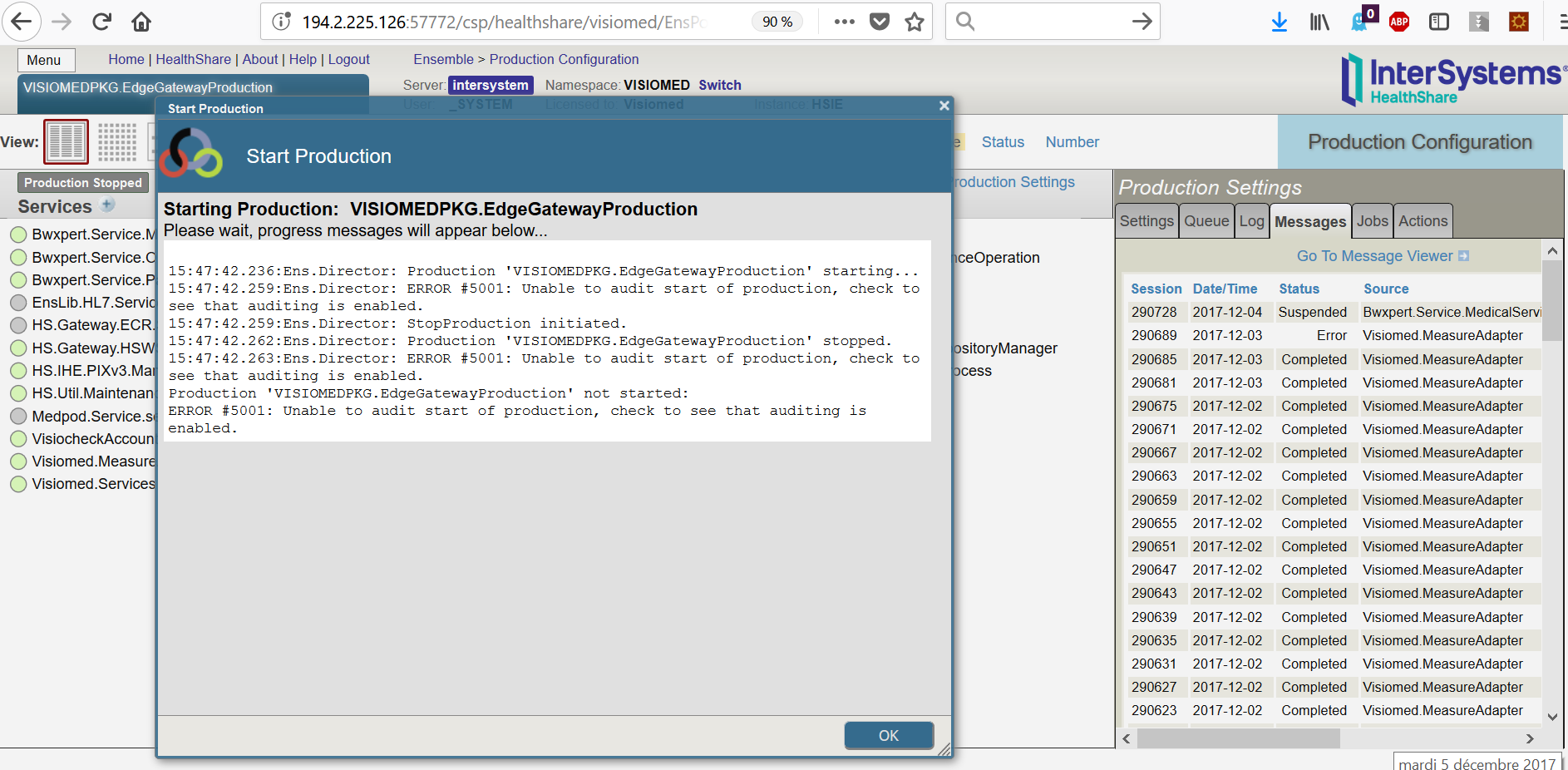
Can You please let us know the end to end procedure to accept SOAP messages in Ensemble Production.
Can we suppress a message in DTL ? I have a use case where I have to do lot of processing to decide if particular message is Valid or not.
I can definitely feed it to a new Process(and Routing Rule) and suppress it there, but I was trying to avoid a new component and was trying to see if I can suppress it in DTL it self.
Thanks
I have a service that that I would like to use to poll the database table in MySQL server 2012 and get an id to use if the condition is met but have trouble achieving this here is what I have so far any suggestions please.
Method OnProcessInput(pInput As EnsLib.SQL.Snapshot, Output pOutput As %RegisteredObject) As %Status
{

  set pRequest=##class(SamsReq).%New()
      set pRequest.pID=pInput.Get("pID")


< set sc=.Can You please let us know the end to end procedure to accept SOAP messages in Ensemble Production.
Hopefully a quick question regarding the SendFormDataURL() class method. I have the following:
Set tSC = ..Adapter.SendFormDataURL(..Adapter.URL,.restResponse,"POST",,,pRequest)
I get the following error response.
| ERROR #5001: ERROR <Ens>ErrHTTPStatus: Received non-OK status 500 from remote HTTP server: 'HTTP/1.1 500 Internal Server Error' : <?xml version="1.0" encoding="UTF-8" standalone="yes"?> <exc:exception xmlns:exc="http://mywebsite.com/ri/exception"> <message>The request content type must be application/xml</message> </exc:exception> |