I added extra OBX segments and I need to renumber OBX 4 so they are sequential.
.png)

InterSystems Ensemble is a complete and easy-to-use integration platform that enables users to connect people, processes, and applications in record
time.
I added extra OBX segments and I need to renumber OBX 4 so they are sequential.
Hello
We are pretty new to Ensemble and we are considering on using a default setup for our production. Let me explain the situation. We have one sender that sends HL7 ADT messages to our system. We have 60+ other systems that need to recieve ADT messages. We where thinking on a few ways on how to do the setup.
Setup1:
We create one big ADTRouter that contains a first mapping. The result is send to another big ADTRouter that contains all the filters/expressions and mappings for the recieving systems.
Hi everyone,
I'm working on a DTL that transforms an HL7 message (EnsLib.HL7.Message) to an XML document (EnsLib.EDI.XML.Document).
The target XML is based on a custom schema and has an element like:
What I need is for the output to show:
<deceasedDateTime xsi:nil="true"/> when the source HL7 value is empty, for eg:
<portalPatientUpdate xmlns:xsi="http://www.w3.
Hey everyone.
I'm currently looking at a process where we're utilising the Class Ens.StreamContainer, and was looking to do some deletions outside of any purge routines.
Having been burned before, I wanted to make sure that deleting the container also deletes the contents within.
From looking in the class, the %OnDelete ClassMethod appears to be removing an index from a search table and nothing more.
Am I looking in the right place, or is there a extended class for Ens.StreamContainer that does in fact delete the %Stream.Object
contained within the Ens.StreamContainer?
I need to add an extra blank OBX segment after a segment containing text, Total Cost:
I get the OBX segment but it is in incorrect location.
It should be after the line containing Total Cost:
It needs to contain:
code:
If (tOBXText[ "Total Cost:") {
Set tSegmentOBX = ##class(EnsLib.HL7.Segment).%New()
Set tSegmentOBX.SegType = "2.3:OBX"
Set tSC = tSegmentOBX.SetValueAt("OBX", 0, "set")
Set tSC = pOutput.
I am receiving the garbled text due to incorrect encoding or decoding. I tried to use the $zconvert function to convert it into the normal text but failed to do that. Can anybody suggest what I have to use to convert that into normal text?
Example: Garbled text that I am getting is "canââ¬â¢t , theyââ¬â¢re".
how can I get the classMethod name ?
like we get class name using "$CLASSNAME($THIS)", same way I need class Method ?
We are receiving the report in text format and it has special characters like ', - like that in the text. Source system is using the UTF8 encoding format hence the text is showing as ' � ' . Is there a way to convert the utf8 to actual character in the DTL.
Thank you,
This article shares analysis in solution cycle for the Open Exchange application TOOT ( Open Exchange application )
A button on a web page can capture the users voice. IRIS integration could manipulate the recordings to extract semantic meaning that IRIS vector search can then offer for new types of AI solution opportunity.
.png)
The fun semantic meaning chosen was for musical vector search, to build new skills and knowledge along the way.
I have dynamic sql select query ,
Set resultset = ##class(%ResultSet).%New()
set sql = "SELECT COUNT(*) FROM "_tableName_" WHERE "_fieldName_">='"_fromDate_"' AND "_fieldName_"<='"_currentDate_"'"
SET SC = resultset.Prepare(sql)
SET SC = resultset.Execute(sql)
How can I print/view the count ?
I need to make changes to OBX 5 which shows as immutable
I have tried ConstructClone, ThrowOnError, and Streams but I can't get the syntax correct
Example
OBX|1|TX|2000.02^REASON FOR REQUEST^AS4|142|REASON FOR REQUEST: Total Cost: 0.00||||||O
^^^^ remove "REASON FOR REQUEST" ^^ add cr/lf so down stream reports can be formatted more easily
I have the code done to parse out the "REASON FOR REQUEST" but I need to make the OBX 5 show the change.
Before:
OBX|1|TX|2000.
InterSystems FAQ rubric
You can use the WriteToConsoleLog method of the %SYS.System class to write any message to the console log.
The following is an example:
%SYS>write ##class(%SYS.System).WriteToConsoleLog("xxxxx log message",0,0)
1
For details on the parameters that can be specified in the WriteToConsoleLog method, please refer to the following document:
Is there a generic process for "walking" the structure of a virtual document - eg an HL7 message (EnsLib.HL7.Message) or an XML document (EnsLib.EDI.XML.Document).
At least we'd want to be able to visit all "nodes" (HL7 fields or sub-fields, XML nodes) in the virtual document and be able to work out/generate the Property Path (so we could call "GetValueAt").
We can just about come up with something generic for HL7, since it only nests down to 4 levels within each segment, though we're using numeric Property Path's at that point rather than symbolic ones (MSH:1.3 etc).
I have a HL7 DTL in which I'm doing a lookup to a table based on a code value in the IN1:3 field. That incoming code may have a 1 to 1 mapping, or 1 to many mapping in a table. If it's a 1 to many, the values in the lookup table are comma delimited. If it's 1 to 1, that IN1 segment will map straight across. If it's one to many, I need to create additional IN1 segments. For example, if the incoming code maps to three, I need to map the original IN1 segment with one of the mapped codes, then create two additional IN1 segments with the other 2 codes for a total of 3 IN1 segments.
I have text coming in CCDA file as below:
virus vaccine
<sup>1</sup>
I want to get the entire value available inside the content tag. Can anybody please help me out how to get this?
Hello there 🙋♂️,
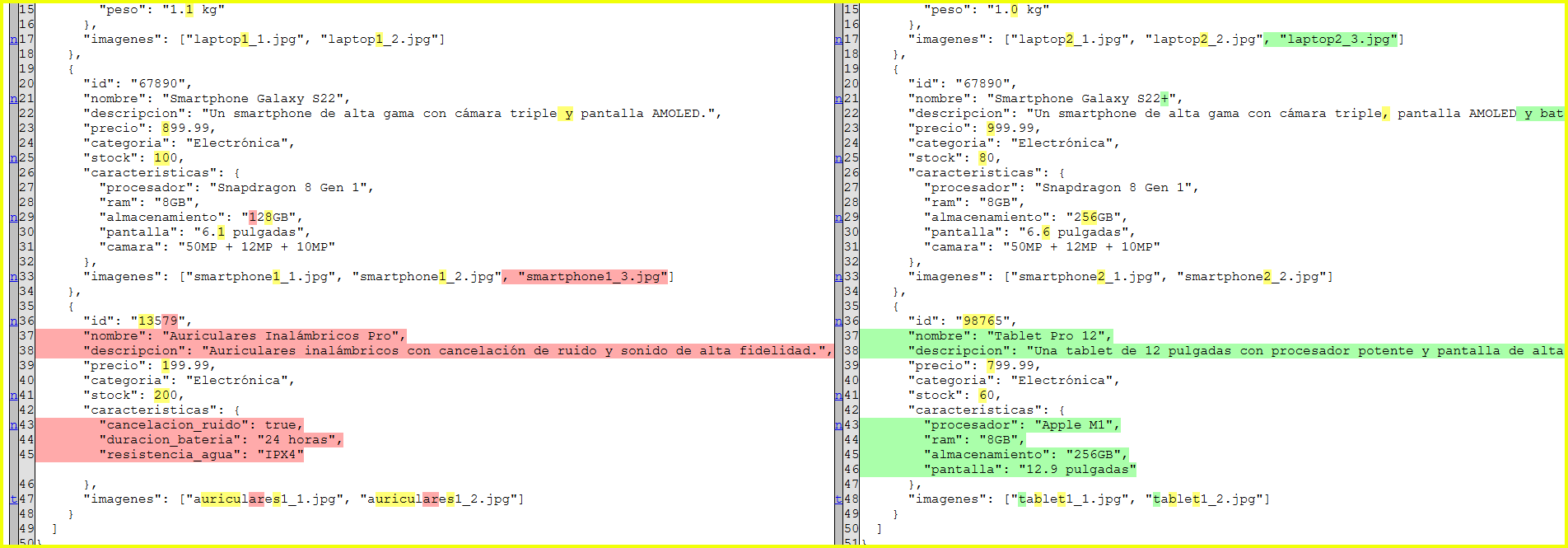
I'm looking towards a functionality alike Python's difflib, but made with Intersystems products. I already know could embed Python code within IRIS but thought maybe there was a development already done for handling deltas, with a different approach or extra utils.
Even if I find such a library after comparing both might still go with difflib or any other more suitable. Intend to use it for a cross-environment checklist/check tool.
Please find below a sample of HTML rendering computed and made with difflib, with a few lines of code:
thanks ! best regards,