Hey Coommunity,
Learn about InterSystems globals, the data model native to InterSystems IRIS® data platform that makes data storing efficient and provides the flexibility your data needs:
A database model is a type of data model that determines the logical structure of a database and fundamentally determines in which manner data can be stored, organized and manipulated. The most popular example of a database model is the relational model, which uses a table-based format.
Hey Coommunity,
Learn about InterSystems globals, the data model native to InterSystems IRIS® data platform that makes data storing efficient and provides the flexibility your data needs:
Hey community! How are you doing?
I hope to find everyone well, and a happy 2022 to all of you!
Over the years, I've been working on a lot of different projects, and I've been able to find a lot of interesting data.
But, most of the time, the dataset that I used to work with was the customer data. When I started to join the contest in the past couple of years, I began to look for specific web datasets.
I've curated a few data by myself, but I was thinking, "This dataset is enough to help others?"
So, discussing the ideas for this contest with @José.
i'm trying to extend both the MemberEnrollment and the MedicalClaim objects in HS. The CareProvider is perfect for some of my extensions (Operating provider, referring provider, third-party insurer), but the documentation says https://docs.intersystems.com/irisforhealthlatest/csp/docbook/DocBook.U…:
.png)
I need something that is just like a CareProvider, and I will be using the CarePRoviderType as a CodeTableDetail.
Why is CareProvider excluded? Does this mean I can't add property HS.Local.SDA3.MemberEnrollment.PHPProvider as HS.SDA3.CodeTableDetail.
When designing a hierarchy in DeepSee, a child member must have only one parent member. In the case where a child corresponds to two parents, the results can become unreliable. In the case where two similar members exist, their keys must be changed so that they are unique. We will take a look at two examples to see when this happens and how to prevent it.
There are a handful of states with a city named Boston. In my sample data, I have records from both Boston, MA and Boston, NY. My dimension is defined as: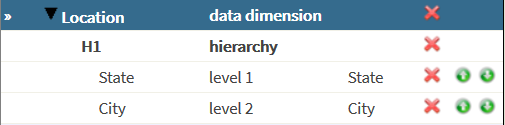
City and State are simply strings in my case.
Let's consider you would like to efficiently store your historical data in a similar structure than the one used for your current data, but without sharing the same physical storage (ie : not in the same global). What is the most efficient way to do it ?
Below a simple class of your current data :
Class data.current.person Extends (%Persistent, %Populate)
{
Parameter DEFAULTGLOBAL = "^on.
Hi developers!
As you probably noticed in IRIS 2021 the names of globals are random.
And if you create IRIS classes with DDL and want to be sure what global was created you probably would want to provide a name.
And indeed you can do it.
Use WITH %CLASSPARAMETER DEFAULTGLOBAL='^GLobalName' in CREATE Table to make it work. Documentation. See the example below:
Hey developers!
Sometimes we need to insert or refer to the data of classes directly in globals.
And maybe a lot of you expect that data structure of global with records is:
^Sample.Person(Id)=$listbuild("",col1,col2,...,coln).And this article is a heads up, that this is not always true, don't expect it as granted!
Hi everyone,
I want to talk about our project and use the dataset theme for this contest.
Our intention never was to be a data curator, especially because sometimes my precious data means a lot for me, but not for the rest of the world.

We want to go a step further and empower the user to find the perfect dataset for their needs.
Our project is a bridge between the data science community and the developer's community using InterSystems IRIS to achieve this mission.
For those of you who might be new to IRIS, and even those who have used Cache or IRIS for some time but want to explore beyond its usually-assumed boundaries and practices, you might want to dive into this detailed exploration of the database engine that is at its heart, and discover just what you can really do with it, going way beyond what InterSystems have done with it for you.
You'll discover that it's actually a hugely powerful yet incredibly simple storage engine that allows you to model any kind of database you wish, once you understand and master its simple, basic principles.
Over the past year or so, my team (Application Services at InterSystems - tasked with building and maintaining many of our internal applications, and providing tools and best practices for other departmental applications) has embarked on a journey toward building Angular/REST-based user interfaces to existing applications originally built using CSP and/or Zen. This has presented an interesting challenge that may be familiar to many of you - building out new REST APIs to existing data models and business logic.
Kazimir Malevich, "Athletes" (1932)
"But of course you don't understand! How can a person who has always traveled in a horse-drawn carriage understand the feelings and impressions of the express traveler or the pilot in the air?"
Kazimir Malevich (1916)
We’ve already addressed the topic of why object/type representation is superior to SQL for implementing subject area models. And those conclusions and facts are as true now as they have ever been. So why should we take a step back and discuss technologies that drag abstractions back to the global level, where they had been in the pre-object and pre-type era? Why should we encourage the use of spaghetti code, which results in bugs that are hard to track down, and which relies only on virtuoso developer skills?
There are several arguments in favor of transmitting data via SQL/REST/GraphQL-based APIs as opposed to representing them as types/objects:
If you need write your organization Data Architecture and map to the InterSystems IRIS, consider following Data Architecture Diagram and references to the intersystems iris documentation, see:
.png)
Hi
we are implementing HIE and wan to get expert opinion on facility registry setup. Below are some example and which method we should adapt.
Hi Developers!
Here're the technology bonuses for the InterSystems Multi-Model Contest that will give you extra points in the voting:
See the details below.
For the benefit of those who want to use the Document Database (DocDB) capabilities within InterSystems IRIS, and specifically the REST API it provides, I put together a Postman Collection that provides samples for several basic calls.
For example:
.png)
Hi All, I am a Data Architect and am trying a method of deploying alter statements onto Cache DB.
My Data Modeling tool generates alters as this.. So question is if the Cache has a way to rename table? If so what is it?
ALTER TABLE <SchemaName>.GROUP_TYPE_NODES RENAME TO GROUP_TYPE_10082019140110000
;
This is giving error.
SQL Error [25] [37000]: [SQLCODE: <-25>:<Input encountered after end of query>]
[Location: <Prepare>]
[%msg: < Input (IDENTIFIER) encountered after end of query^ALTER TABLE xxx.GROUP_TYPE_NODES RENAME>]
Hi Developers!
Here're the technology bonuses for the InterSystems Multi-Model Contest that will give you extra points in the voting:
See the details below.
I have an application with maps that render and edit geographic data in a some layers using KML - geo data represented into XML file with layers, polygnons, points and metadata associated with it. Some maps are in GeoJSON too.
Is it DocDB the better option?
Hi,
I'm trying (and not succeeding) to build an index based on a collection property combined with a property, like:
For example, I have a class with this properties:
The, I try to create a simple index of one of the AnotherObject properties and I can compile and it creates the right index:
Index Test On (ListOfProp(ELEMENTS).Name);
But when I add a "normal" property, compiler miserably fails:
Index Test On (Simple, ListOfProp(ELEMENTS).
During my search for a snapshot of a persistent object,
I met a feature that I would like to share as it could be useful in some special situations.
My trigger was to have a before- and an after-image during unit testing.
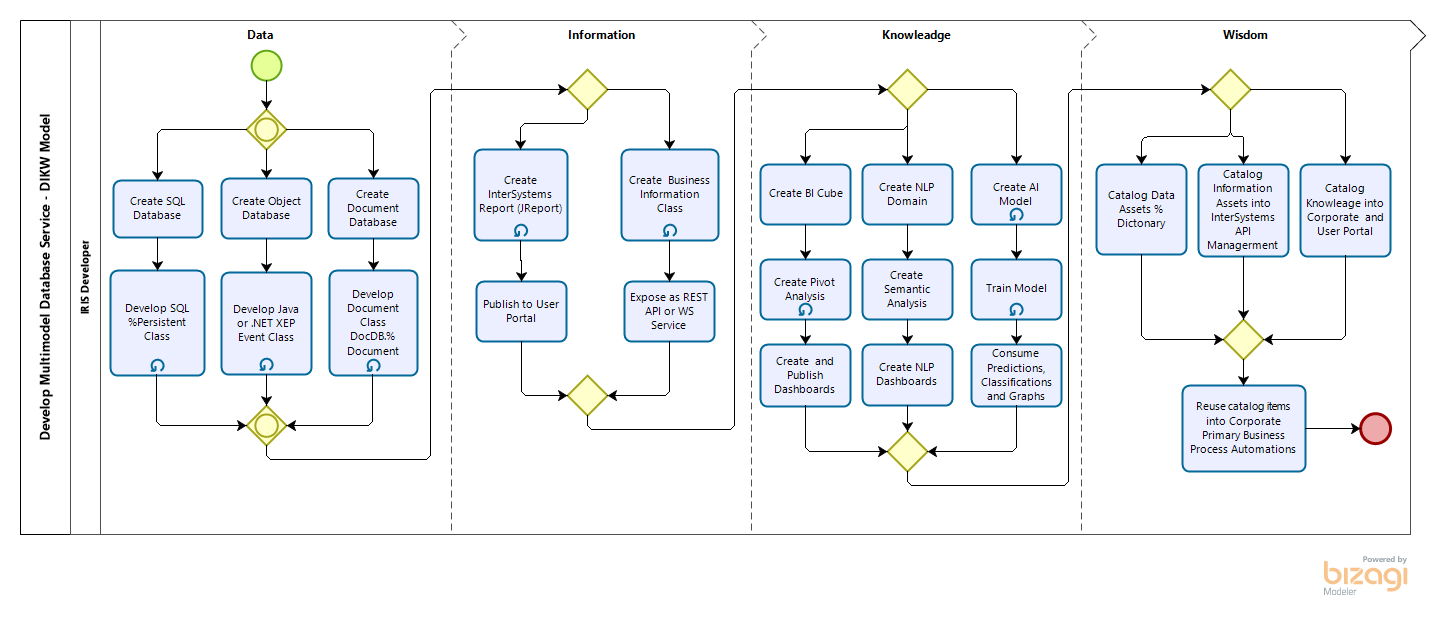
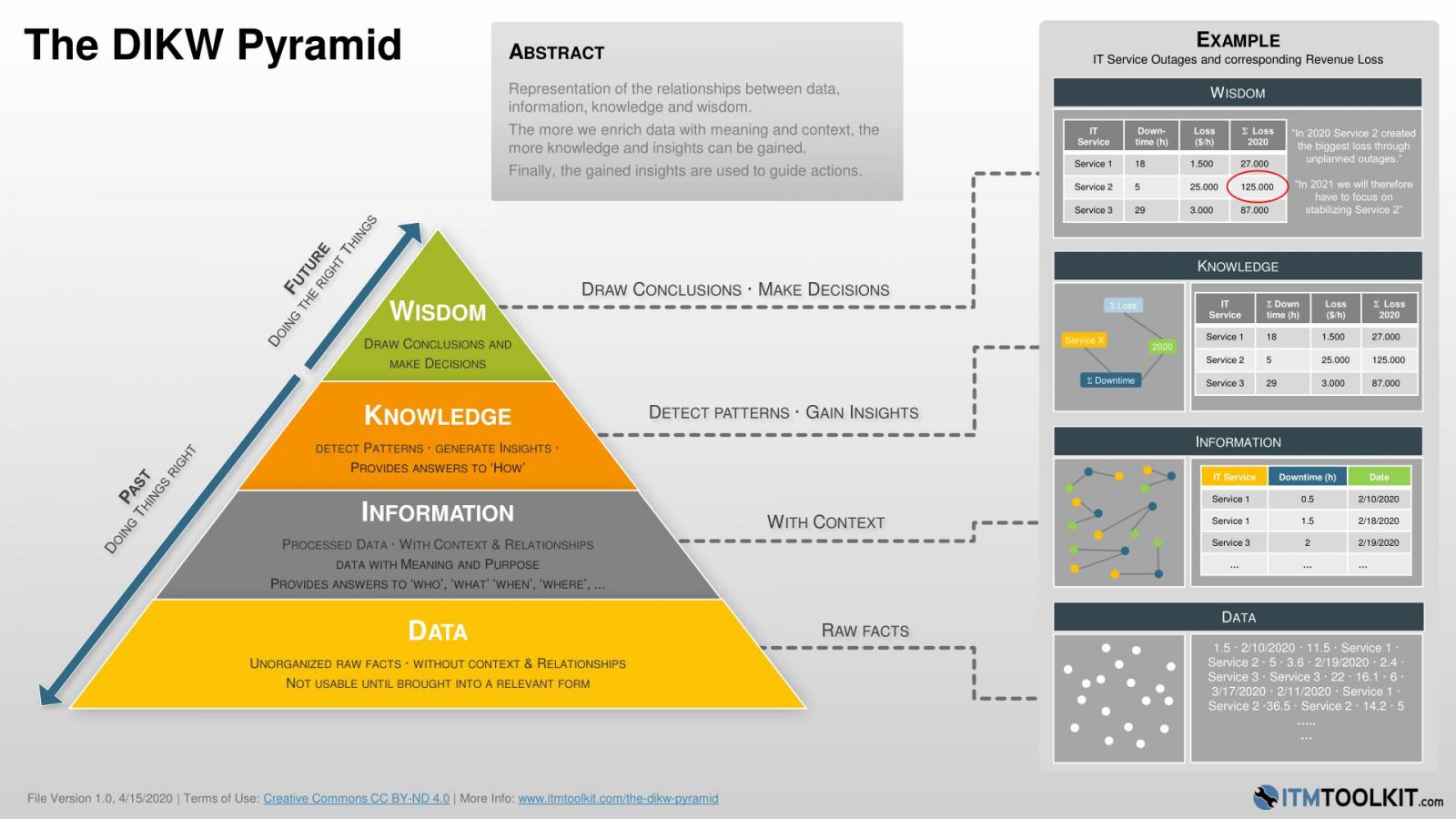
The InterSystems IRIS has functions that allows create DIWK digital services. A few products have the ability to transform data into wisdom, according to the following pyramid.
With IRIS we build data in many formats and purposes (SQL, Document and Object). Using InterSystems IRIS Reports (JReport) or creating business classes exposed as REST or WS services to deliver to applications and people for consume. So knowleage can be also produced from data and information creating BI and AI projects (with IntegratedML or ML Toolkit).
What is the best free/open source option to generate the database diagram (MER) to the iris or cache persistent classes?
In this article I'd like to share with you a phenomena that is best you avoid - something you should be aware of when designing your data model (or building your Business Processes) in Caché or in Ensemble (or older HealthShare Health Connect Ensemble-based versions).
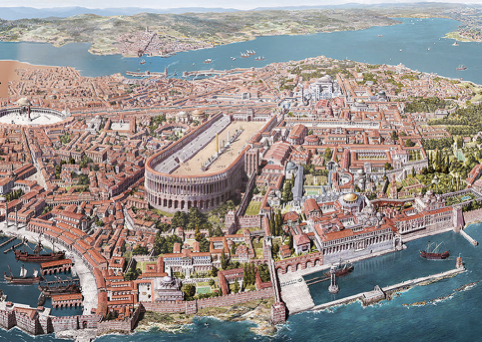
Constantinople in the 5th century AD
(It was possible for people to build grandiose buildings and vehicles without the use of computers and robots 1,600 years ago.)
If you assign dimensionless numbers to physical parameters in your code, you risk misunderstandings and errors when calculating and converting between units of measurement.
Hi,
I have two namespaces
I mapped the NSOne.Msg.Req package in namespace NSOne. In Atelier, I can see NSOne.Msg.Req in my NSOne. But, when I try to execute line 2 above, it tells me :
{
    "status": {
        "errors": [
            {
"error": "ERROR #5002: ObjectScript error: <PROTECT>^NStwo.Api.Hi Community,
New video, recorded by @Stefan Wittmann, is already on InterSystems Developers YouTube:
Hi Community!
Enjoy watching the new video on InterSystems Developers YouTube, recorded by @Joel Solon, InterSystems Senior Technical Trainer:
In many projects I was faced with storing hierarchical data (tree) in classes.
By tree, I mean such data, where each node has a parent node — an object of the same class.
Many examples of such data can be given. For example, a catalog in the online store. Suppose that this online store sells books, in this case, the category tree might look like this: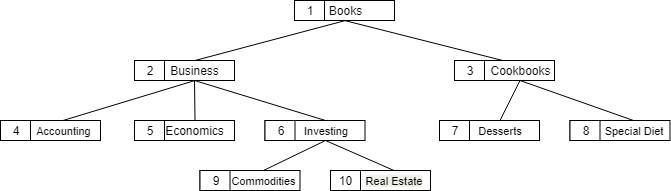
The number in front of the name is the category ID.
For storage, you can create classes:
The MyApp.Category class is used to store the category tree and contains the property “Parent” - reference to the same class.
Hi all
Is there a data model for the Ensemble EnsLib_HL7 tables in the database? A client wants to run some SQL and would like some documentation about table relationships.
Thanks in advance
Ian
