#ChatGPT

0 Followers · 42 Posts

ChatGPT is an artificial intelligence (AI) chatbot developed by OpenAI. It is built on top of OpenAI's GPT-3.5 and GPT-4 families of large language models (LLMs) and has been fine-tuned using both supervised and reinforcement learning techniques.

Question Evgeny Shvarov · Jun 9, 2023

Hi folks!

How can I change the production setting programmatically?

I have a production that is a solution that uses some api-keys, which are the parameters of Business Operations but of course cannot be hard-coded into the source code.

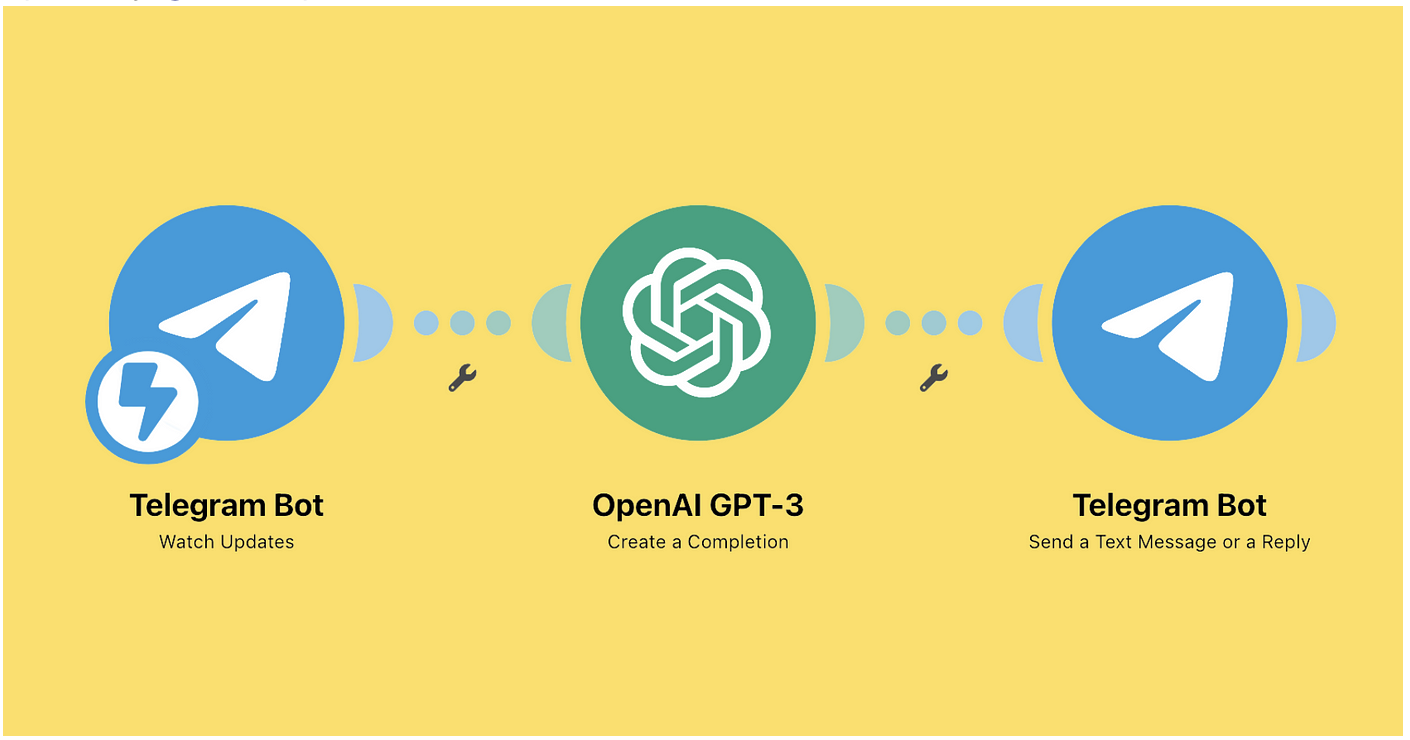
E.g. here is the example of such a production that runs a connection of Telegram and ChatGPT.

And it can be installed as:

zpm "install telegram-gpt"

But now one needs to setup the key manually before using the production, having the following setting:

I'd like to set up it programmatically so one could install it as:

zpm "install telegram-gpt -D Token=sometoken"

How can I make it work?

18
0 1037
Article Sowmiya Nagarajan · Jul 7, 2023 6m read


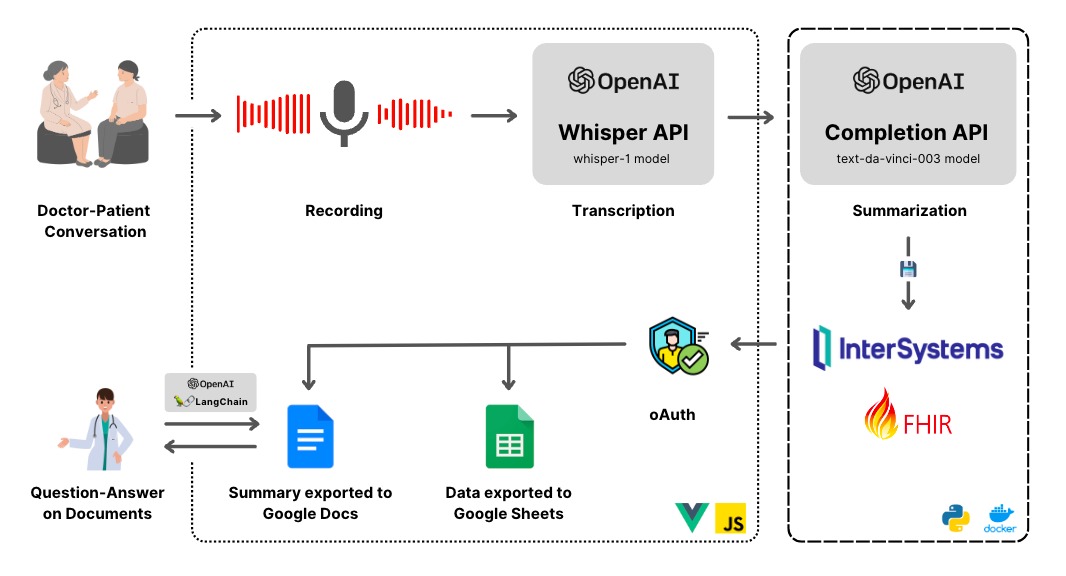
The continuing convergence of AI technologies and healthcare systems has brought forward many compelling advancements. Let's set the scene. If you have interacted with dynamic models like ChatGPT, you might have, like many of us, begun to envision its application using your unique datasets. Suppose in the healthcare sector you wish to link this technology with Electronic Health Records (EHR) or Electronic Medical Records (EMR), or perhaps you aim for heightened interoperability using FHIR's resources.  It all boils down to how we transfer/receive contextual-data to/from LLMs available in

1
1 604
Article Ikram Shah · Jul 4, 2023 3m read

Problem

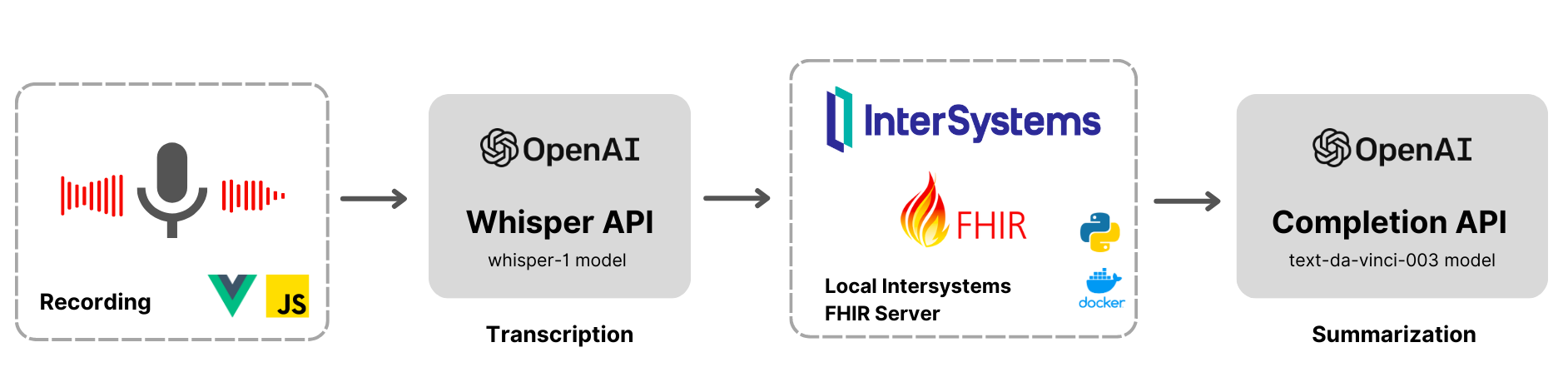
In a fast-paced clinical environment, where quick decision-making is crucial, the lack of streamlined document storage and access systems poses several obstacles. While storage solutions for documents exist (e.g, FHIR), accessing and effectively searching for specific patient data within those documents meaningfully can be a significant challenge.

Motivation

AI has made document search remarkably powerful. Question and answering over docs has never been easier with open-source tools like Chroma and Langchain to store and use vector embeddings to query across Generative AI APIs.

0
2 735
Article Muhammad Waseem · Jul 4, 2023 6m read

As an AI language model, ChatGPT is capable of performing a variety of tasks like language translation, writing songs, answering research questions, and even generating computer code. With its impressive abilities, ChatGPT has quickly become a popular tool for various applications, from chatbots to content creation.
But despite its advanced capabilities, ChatGPT is not able to access your personal data. So in this article, I will demonstrate below steps to build custom ChatGPT AI by using LangChain Framework:

0
1 13130
Article Alex Woodhead · Jun 15, 2023 6m read

Demonstration example for the current Grand Prix contest for use of a more complex Parameter template to test the AI.

Interview Questions

There is documentation. A recruitment consultant wants to quickly challenge candidates with some relevant technical questions to a role.

Can they automate making a list of questions and answers from the available documentation?

Interview Answers and Learning

One of the most effective ways to cement new facts into accessible long term memory is with phased recall.

In essence you take a block of text information, reorganize it into a series of self-contained

0
0 1585
Article Evgeny Shvarov · Jun 8, 2023 2m read

Hi Community!

Just want to share with you an exercise I made to create "my own" chat with GPT in Telegram.

It became possible because of two components on Open Exchange: Telegram Adapter by @Nikolay Solovyev and IRIS Open-AI by  @Kurro Lopez 

So with this example you can setup your own chat with ChatGPT in Telegram. 

Let's see how to make it work!

8
1 728
Article Seisuke Nakahashi · Apr 27, 2023 2m read

Let's say you have Python including variable-length arguments methods. How can you call it from ObjectScript? 

deftest1(*args):return sum(args)
  
deftest2(**kwargs):
  a1 = kwargs.get("a1",None)
  a2 = kwargs.get("a2",None)
  return a1+a2

You can call this "a.py" from ObjectScript as below.  For **kwargs argument, create Dynamic Object in ObjectScript and put it into methods with <variablename>... (3 dots) format. 

set a=##class(%SYS.Python).Import("a")
    write a.test1(1,2,3)   ;; 6set req={}
    set req.a1=10set req.a2=20write a.test2(req...)   ;; 30


Do you

0
1 341
Article Oleh Dontsov · Apr 18, 2023 2m read

In recent years, artificial intelligence technologies for text generation have developed significantly. For example, text generation models based on neural networks can produce texts that are almost indistinguishable from texts written by humans.
ChatGPT is one such service. It is a huge neural network trained on a large number of texts, which can generate texts on various topics and be matched to a given context. 

A new task for people is to develop ways to recognize texts written not only by people but also by artificial intelligence (AI).

1
0 552
Article Zhong Li · Mar 28, 2023 10m read

​Keywords: ChatGPT, COS, Lookup Table, IRIS, AI 

Purpose


Here is another quick note before we move on to GPT-4 assisted automation journey. Below are some "little" helps ChatGPT had already been offering,  here and there, during daily works. 

And what could be the perceived gaps, risks and traps to LLMs assisted automation, if you happen to explore this path too. I'd also love to hear anyone's use cases and experiences on this front too. 

Lookup tables


One of the simplest tasks could be Lookup tables.

3
2 721
Article Zhong Li · Jan 23, 2023 11m read

Fun or No Fun - how serious is it?


Large language models are stirring up some phenomena in recent months. So inevitably I was playing ChatGPT too over last weekend, to probe whether it would be a complimentary to some BERT based "traditional" AI chatbots I was knocking up, or rather would it simply sweep them away. 
A thought comes to mind while playing. By going slightly theoretical or philosophical, eventually interoperability standards such as HL7 and FHIR etc are kind of "languages", right? HL7 has its own grammar, rules, vocabulary and even dialects - every system speaks its own tone.

3
1 1163