A method to convert certain non-readable ASCII characters in a

InterSystems Caché is a multi-model DBMS and application server. See more details here.
InterSystems Caché is a multi-model DBMS and application server. See more details here.
A method to convert certain non-readable ASCII characters in a
This was what I first wrote. Here is the test, first putting in an invalid value:
Deployment Type? (G)ateway or (I)HE: F
Invalid Choice
Deployment Type? (G)ateway or (I)HE: G
Hello,
I am trying to integrate the Git with Studio. I have followed the below process to achiche Git tab in my Studio for Namespace
https://github.com/intersystems-ib/cache-git-studio
But I am getting the below error when I trying to Add the file. GitCodecache is my git repository.
fatal: c:/GitCodecache/cls/User/Testing.xml: 'c:/GitCodecache/cls/User/Testing.xml' is outside repository
class '%Studio.SourceControl.Interface', method 'GetStatus':
Hi,
I have a stored procedure which would generate a standard Cache String and it would be called through JDBC and I would
dump the result in java console/standard output.
What kind of characters should I use in COS so when output get send back to Java side, it knows it contains new line character ?
Thank for your help.
How to install Cache 2015 in linux with webserver NGINX?
By default, Analyzer executes queries as components are added. Often, there are times where you may know exactly what you are looking to do, and you do not want Analyzer to execute 5 queries as you drag and drop items onto rows/columns and select your filters. This is where toggling Auto-execute off can help.
How to know the severity, priority, urgency of error in InterSystems cache
Hi,
I've organized my repository using TortoiseSVN. I was careful to use only svn commands while creating my file structure. Now all Subversion commands are working at the command line but not from within my IDE (Cache Studio). Basically I'm trying to write a plug-in for my IDE to use Subversion from within the Studio. Trying to integrate Subversion into my IDE, something like Subclipse, but for Cache Studio. The error occurred after reorganizing my code into directories. For example at the command-line, svn info and svn status and all other commands work perfectly. All Subversion commands work at the command prompt!
Hi Group, I've followed the instructions from the documentation to configure LDAP and Ensemble to authenticate, however, I'm unable to authenticate using an account in the LDAP. The user is able to authenticate in a Linux shell. I have added the ObjectClass of IntersystemsAccount and the 3 group definitions to the schema. Other than adding the user to this group, do I have to change the user's objectClass at all?
This is not on active directory - it is a Linux based LDAP solution (slapd).
Hi,
I am saving 2000 objects of a class in a loop.
In one environment it is taking a total of 86 seconds and in another environment it is taking 0.55 seconds.
The code (the class and the code for save) is same for both the environment. I have Ensemble 2012.1.5.956
Can somebody help me to identify the cause of the discrepancy. Is there any memory or any other setup which may cause the problem.
Thank you in davance,
Susobhan
Hi All,In CSP how to call one method to another method (i.e) i created one script language as cache from that one script to another script that one also a cache script ,how to call the script.
Please will correct the code:
a is a perse Unicode to Unicode mapping value.Str=other status. It is how to convert English to french .
I am sending an HTTP request to cache class:
s rObj=##class(%Net.HttpRequest).%New()
s rObj.Server="www.xyz.com"
s rObj.Https=1
s rObj.SSLConfiguration="xyz"
s rObj.ContentType="application/json"
d rObj.EntityBody.Write("payload in json format")

s sc=rObj.Post("/csp/ns/xyz.cls")
The request gets to the OnPreHTTP class method
Class xyz Extends %CSP.Page [ ProcedureBlock ]
{

ClassMethod OnPreHTTP() As %Boolean
{
    q 1

}

}
The question is how to retrieve the request payload in the OnPreHTTP method.
I am trying to write some code that takes in a string and does a serverside transformation of it to find embedded URLs and replace it with clickable links. I found the following regex for Javascript which is rated highly on StackOverflow;
    replacePattern1 = /(\b(https?|ftp):\/\/[-A-Z0-9+&@#\/%?=~_|!:,.;]*[-A-Z0-9+&@#\/%=~_|])/gim;
    replacedText = inputText.replace(replacePattern1, '<a href="$1" target="_blank">$1</a>');
And I tried to do the following in Caché ObjectScript but it's not working:
I use Cache Instance. I'm trying to implement OAuth 2.0 in Cache instance.
Is it possible to use Cache instance as Client and Server?
And What is the Difference between CLIENT and AUTHSERVER instance?
Why is it used? I want to know which instance use which type of application?
Has anyone ever worked with a load balance for ECP servers access? If yes, wich one?
What are the pros and cons of such a solution? We use ECP servers as data servers via ODBC, thanks!
I created the sample rest services in Cache, I also set output in JSON format.
Can anyone explain how to pass JSON in Rest Services using POSTMAN?
Thanks.
Hi all,
I've created a WebApi and I've deployed in our development environment. So we test calling http://localhost:57772/Client/login and it works.
Now, I wondering how to change the port to call in pre production environment.
I've changed the port in the business service object, but it is ignored.
Other workaround is change the WebServerPort in System > Configuration > Startup Setting but it changes for all environment (connect to managment portal, etc..)
Is there any way to change the port of the WebApi to redirect to 80 (for example) u other one?
Best regards,
Francisco
I created a simple CRUD operation using Rest Services in Cache.
 Class EX.example Extends %CSP.REST
{

XData UrlMap
{
<Routes>
<Route Url="/insert/:loc/:ssn/:name" Method="GET" Call="hello"/>
<Route Url="/update/:key/:loc/:ssn/:name" Method="GET" Call="iam"/>
<Route Url="/delete/:key" Method="GET" Call="there"/>
<Route Url="/findid/:key" Method="GET" Call="now"/>
</Routes>
}

ClassMethod hello(name As %String, ssn As %String, loc As %String) As %Status
{
s mName=$zcvt(name,"U"),mKey=ssn,mLoc=loc
s ns=$namespace
znspace "USER"
try{
s obj=##class(Sample.Classes).%New()
s obj.
Hi all,
I have the following problem with a WebApi that I've developed in EBS.
I have a GET method that reads the parameters and puts into a message to process.
XData UrlMap [ XMLNamespace = "http://www.intersystems.com/urlmap" ]
{
<Routes>
<Route Url="/login" Method="GET" Call="Login"/>
</Routes>
}
ClassMethod Login() As %Status
{
set login = %request.Get("login")
set password = %request.Get("password")
set app = %request.Get("app")
I'm trying to implement Crud operation in rest services.
I'm confused about this implementation.
Is it possible to call rest services method in CSP pages?
If not means, can you tell me another way?
I need some examples or reference to implement Crud operations.
Thanks
Hi, I tried the new rest file in User namespace. But I couldn't run it.
Here the Code:
 Class com.Testing Extends %CSP.REST
{

XData UrlMap
{
<Routes>
<Route Url="/insert" Method="POST" Call="one"/>
<Route Url="/print" Method="POST" Call="two"/>
<Route Url="/update" Method="POST" Call="three"/>
</Routes>
}

ClassMethod one()
{
Write "This is 1st Method!!"
Quit
}

ClassMethod two()
{
Write !,"This is 2nd method"
Quit
}

ClassMethod three()
{
Write
As more people join Developer Community, and with increasing efforts to promote code sharing, I'd like to draw fresh attention to this post I wrote a year ago. It spotlights a feature within the class compiler which is both useful and dangerous. When importing code (e.g. from an XML export of classes received from someone), it's worth considering the risks.
Even if that post doesn't seem relevant to you at the moment you may wish to note it for the future. A handy way of doing this is to click the star icon at the end of it.
This is the code here:
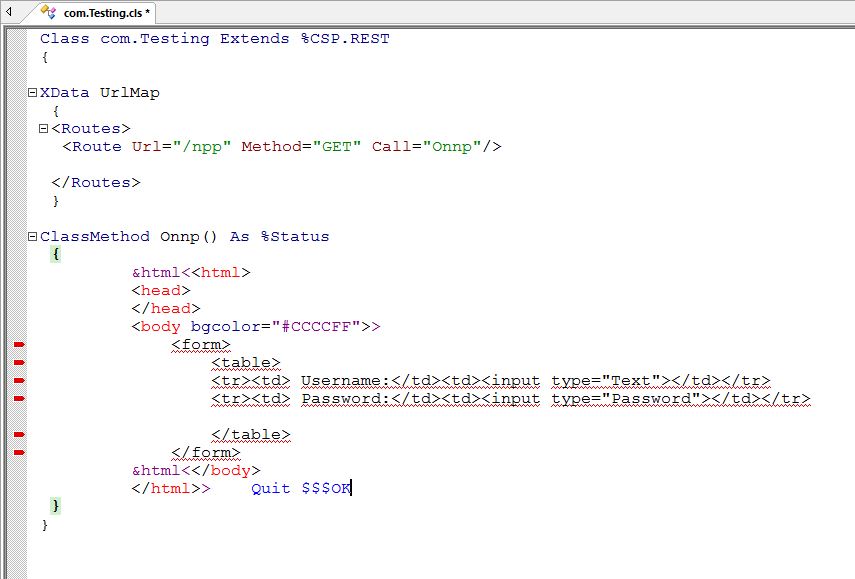
I got error in form tag declaring
Can anyone help me to resolve this error!!
Any recommendations, to this VMware disk type debate, with Cache installations in particular?
Thick Provision Lazy Zeroed
Thick Provision Eager Zeroed
Thin Provision
Hi!
Consider I have a class Package.Data with Property UniqueStringValue as %String.
I introduced the Index for this property:
Index ValueIndex on UniqueStringValue [Unique];
It works well. But if I try to check if there is an object with the certain value in code like this:
if ##class(Package.Data).ValueIndexExists(value)
this expression fails, if value="value", even if there is an instance with instance.UniqueStingValue="Value"
How can I set the index to prevent saving case sensitive values in this class?
The recent announcement of a collision for the SHA-1 hash algorithm has caused some consternation:
Here is some background to help put this in perspective.
Cryptographic hash functions can have a variety of properties. The property at issue here is:
"Collision resistance - it is computationally infeasible to find any two distinct inputs x, x' which hash to the same output, i.e., such that h(x) = h(x')."
(Menezes, van Oorchot, and Vanstone, "Handbook of Applied Cryptography", section 9.2.
Hi everyone, I have and Zen Mojo application, it's all working but I have some doubts about what is recommended to use: There is some reports of employees, for example, and actually I'm using some plugins : "Excelent export" to generate Excel reports and "jspdf" to generate PDF reports in client side.
I have an REST service, that receives the request, process and returns JSON, after client side receive the response it's processed.
- This can be slow/bad in applications with large data?
- It's better/recommended to use ZenReports even with ZenMojo applications?
While I can see the benefits that $ZSTORAGE could have if used properly, I have not seen it used in the environments I have worked in. I was wondering if there are any developers that promote its usage.
If used properly, I would imagine it could be highly effective in maximizing free memory since some processes will never go over X amount, while others may very well need much more.