1. vscode extensions : intersystems.language-server-2.8.0@linux-arm64.vsix
2. api/atelier web application is enabled
3. vscode connect failed.
1. vscode extensions : intersystems.language-server-2.8.0@linux-arm64.vsix
2. api/atelier web application is enabled
3. vscode connect failed.
.png)
The most upvoted idea on the InterSystems Ideas Portal—garnering 74 votes—requests a lightweight version of IRIS. While the platform has grown into a powerful data engine, many projects require only its SQL database capabilities. This article demonstrates how to build an unofficial, compact IRIS Community Edition image focused solely on core database functionality, reducing the image size by over 80%.
This project produces an unofficial, experimental image of InterSystems IRIS Community Edition.
While IRIS today includes rich functionality—interoperability, analytics, machine learning, system management, etc.—many projects only require its core SQL capabilities. The official Community Edition Docker image is approximately:
IRIS Light reduces that to:
This makes it suitable for:
There is a Master Table within IRIS that I am populating from Epic but want to share it with our Enterprise Application Development Team (Web). As a test I was able to use _SYSTEM from postman to execute the following.
POST /api/atelier/v1/xxxx/action/query HTTP/1.1
Host: xxxxxxxx
Content-Type: application/json
Authorization: ••••••
Cookie: CSPSESSIONID-SP-443-UP-api-atelier-=00f0000000000AKyLjBfUvU$MpFD8UT8y$EoNKNw1ixZeXN4_Q; CSPWSERVERID=hzZAT5rb
Content-Length: 86
{"query": "SELECT * FROM osuwmc_Epic_Clarity.DepartmentMaster WHERE ID = '300000000'"}Dear Community,
As the 🎄 Festive Season 🎄 approaches, we’re excited to send our warmest wishes your way. May your holidays be filled with the joy of 🧑💻 learning, 🫂 connecting with fellow developers, and the thrill of new ideas and challenges waiting in the year ahead!
(1).jpg)
Looking back on 2025, we’re delighted to celebrate another year of remarkable achievements together with YOU, our incredible members:
I am migrating from HealthShare 2015 to Health Connect 2025 as part of an infrastructure upgrade. We have several C# .NET Razor web apps that interact with HealthShare using the InterSystems.Data.CacheClient assembly, and the Cache Object Binding Wizard for .NET to build the C# proxy classes. This has worked flawlessly for about 6 years.
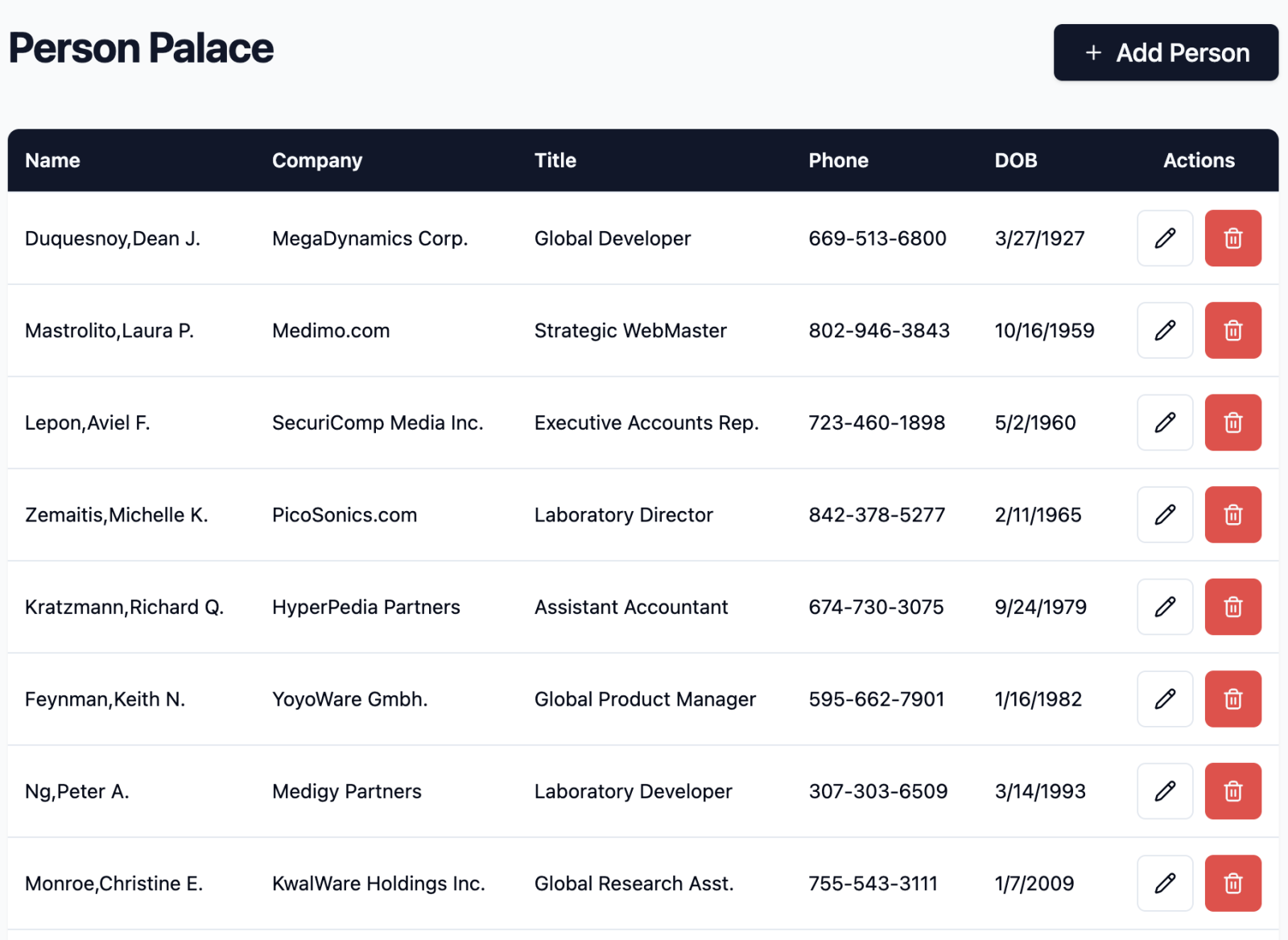
The demo is based on the raw class descriptions.
The data classes used are Address, Person, Employee, Company
For a more attractive demo, a JSONtoString method by ID was added.
Hi all, it's me again for sharing what I am studying recently.😓
Recently, I am studying how to setup OAuth2 authentication for the InterSystems FHIR repository. And I found the following articles are very good and easy to follow.😁
✓ 283 new members joined in December
✓ 15,873 posts published all time
✓ 18,218 members joined all time
Has anyone tried to authenticate IRIS client in Snowflake using Key Pair Auth as described in this doc?
I have been struggling sometime with trying to take a FHIR Bundle Response, extract the "entry.resourceType", extract the MRN and Name from the Patient FHIR Response...
Going through learning.intersystems.com, it suggested that I try using fhirPathAPI to parse and search my response for certain values, however I am not sure my syntax is correct. Using the AI code, it suggested to set my tree = "Bundle.entry.resource.resourceType"
I was wondering if anyone had a way to automate creating the Query String for a FHIR Request?
Using HS.FHIRServer.Interop.Request in my development I have to specify the following...
I was wondering.... if my source had variable number of fields if there was a way to automate the build for the QueryString when doing a Patient Search?
I am trying to replicate a way to use FHIR as a way to query the EMR instead of using a MS SQL Stored Procedure that is populated via HL7 ADT to query.
Using a WSDL and the SOAP wizard I created a WebServiceClient, and Operation to send an encoded message to a Vendor. But the vendor is now sending back an HL7 in the SOAP response.
I tried updating the Operation to Extend EnsLib.HL7.Operation.ReplyStandard, but still use the EnsLib.SOAP.OutboundAdapter. When I did this it broke my Operation and would not compile with the following error...
I am looking for a way to capture Data Quality issues with the Source data that is populating HealthShare Provider Directory. 1 way is to use Managed Alerts, but since it could be multiple Providers and different messages it seems silly to alert on every message that has the error. Instead, I was thinking of using the Workflow Engine so it could populate a Worklist for someone to review and work.
Looking over the Demo.Workflow Engine example, I am not comprehending on how to send a task to the Workflow manager to populate the worklist from a DTL.
According to the Documentation EnsLib.Workflow.TaskRequest has the following fields...
I want to be able to capture the Source, Session ID, and any other Identifiers outside of the Error so it will show up on the Task List.
I am struggling how to build a csp template for me to be able to capture additional fields to send to the Workflow Operation.
Hey Developers,
Enjoy the new video on InterSystems Developers YouTube
⏯ HealthShare Vision & Roadmap - Fueling Faster AI Adoption Through Trusted Health Data @ READY 2025
I'm new to HealthShare. I've installed a demo using the HS.Util.Installer helper, now I'm playing with its FHIR Gateway (which is the HSFHIR namespace). When I try to create a new resource of type Patient using HTTP POST, HealthShare responses with
{
"resourceType": "OperationOutcome",
"issue": [
{
"severity": "error",
"code": "not-supported",
"diagnostics": "<HSFHIRErr>InteractionNotSupported",
"details": {
"text": "Interaction 'create' is not supported for resource type 'Patient'."
}
}
]
}
Hi Developers!
Consider I have a persistent class derived from %Persistent and I want it to be derived from %JSON.Adaptor to enjoy all the JSON features.
Can I do it programmatically?
So, it'd be wonderful to have a method in some util class that makes it happen? Something like:
Do ClassUtil.AddAncestor("MyPackage.MyPersistentClass","%JSON.Adaptor")
Any ideas?
You probably know this situation:
Some time ago, you found a very special $ZU function for a very specific type of problem. Some kind of mystical formula. It became popular and was used by many developers throughout your code and across all your installations.
Several versions and updates later, you are informed by ISC that your mystical $ZU is deprecated and no longer supported. You are advised to replace it with a new $something().
I built a BP, that every time that a message is received from a BS, it executes
set isAuth=##class(%SYS.OAuth2.AccessToken).IsAuthorized("EpicFHIRPOC",,,.accessToken,.idtoken,.responseProperties,.error)
if 'isAuth {
set tSC=##class(%SYS.OAuth2.Authorization).GetAccessTokenClient("EpicFHIRPOC", "*",, .error)
set isAuth=##class(%SYS.OAuth2.AccessToken).IsAuthorized("EpicFHIRPOC",,,.accessToken,.idtoken,.responseProperties,.error)
}When working with InterSystems Interoperability (Iris / Health Connect / Ensemble), configuration data is often spread across many production items: services, processes, operations, adapters, and their settings.
A common operational or security need is to answer questions like:
The ObjectScript utility below solves exactly that problem by exporting selected configuration settings into a CSV file.
Here is what is currently used.
..CurrentDateTime("%Y%m%d%H%M%S")
The format is not the issue.
I need to make it our current time as it is five hours ahead.
How can I access the header property of either of these.
Or, if I can't do that, subtract five hours or the equivalent time in seconds.
example, if I receive 20201224161922, how can I make it 20201224111922?
Thanks,
Jonathan
Overview
Embedded Python is a game-changer for InterSystems IRIS, offering access to the vast Python ecosystem directly within the database. However, bridging the gap between ObjectScript and Python can sometimes feel like translating between two different worlds.
To make this transition seamless using embeddedpy-bridge.
As I am iterating through the FHIR JSON Response from a Patient Search, I am running into an issue where the extracted values are not being popualted into the Response object that I have created. If I do a $$$LOGINFO on them they will show up in the Object log, however if I try the following for example I get an error.
set target.MRN = identifier.value
|
Here is my Ens.DataTransform
Hi developers!
There is a neat feature of ObjectScript classes - Query element, which allows you to write in a clear SQL (without any & or ()), pass parameters to it and call it from ObjectScript as do QueryNameFunc() or via Call SQLProcedureName via SQL, .e.g.
Query MyQuery(p as%String) as%SQLQuery [SQLProc]
{
SELECT * FROM MyTable
WHERE Name=:p
}All works fine, but when I tried to use the same for a DELETE statement see the following error:
SELECT expected, DELETE found ^ DECLARE Q1 CURSOR FOR DELETE
Is the Query element for SELECT only? What am I doing wrong? )
I am trying to centralize our FHIR queries into a single BP object that would send the FHIR query to the EMR, interpret the response into a %Persistent structure that could be sent back to the requestor. In theory it seemed like it would work but I am running into an issue..
I'm trying to login and seeing the message 'Unexpected request - client_id'. Could you please have a look?
Up until early this year, I haven't been not doing much coding at all -- I had gotten sick of it.
Hi developers!
Happy holidays!
In ObjectScript there is neat option to log errors - call Log() method of an exception intance, e.g.:
ClassMethod MyMethod() {
Try {
w1/0
}
Catch e {
do e.Log() // logging error in the app logwrite"the error happened: "_e.DisplayString()
}
}Is there anything like that for Embedded Python? e.g:
ClassMethod MyMethod() [Language = python] {
try:
print(1/0)
except ZeroDivisionError as e:
// how can I log e into IRIS App Error Log here?
print("Caught exception: " + str(e))
}Any ideas?
Hey Developers,
Enjoy the new video on InterSystems Developers YouTube
⏯ Inside Vector Search - Technical Innovations In InterSystems IRIS @ READY 2025