Hi,
I've organized my repository using TortoiseSVN. I was careful to use only svn commands while creating my file structure. Now all Subversion commands are working at the command line but not from within my IDE (Cache Studio). Basically I'm trying to write a plug-in for my IDE to use Subversion from within the Studio. Trying to integrate Subversion into my IDE, something like Subclipse, but for Cache Studio. The error occurred after reorganizing my code into directories. For example at the command-line, svn info and svn status and all other commands work perfectly. All Subversion commands work at the command prompt!
Hi Group, I've followed the instructions from the documentation to configure LDAP and Ensemble to authenticate, however, I'm unable to authenticate using an account in the LDAP. The user is able to authenticate in a Linux shell. I have added the ObjectClass of IntersystemsAccount and the 3 group definitions to the schema. Other than adding the user to this group, do I have to change the user's objectClass at all?
This is not on active directory - it is a Linux based LDAP solution (slapd).
Hi,
I am saving 2000 objects of a class in a loop.
In one environment it is taking a total of 86 seconds and in another environment it is taking 0.55 seconds.
The code (the class and the code for save) is same for both the environment. I have Ensemble 2012.1.5.956
Can somebody help me to identify the cause of the discrepancy. Is there any memory or any other setup which may cause the problem.
Thank you in davance,
Susobhan
Hi All,In CSP how to call one method to another method (i.e) i created one script language as cache from that one script to another script that one also a cache script ,how to call the script.
I am looking for a general overview of how you would attach a document to a patient record in healthshare. For instance, an Advance Directive or Living Will.
Here are some starter questions:
- What format is required, if any? Can it be a PDF or DOC?
- How can/should it be submitted? HL7? XDS.b? Embedded in a CCD?
Sorry for the open endedness. Any info would be helpful while I research this.
Please will correct the code:
a is a perse Unicode to Unicode mapping value.Str=other status. It is how to convert English to french .
I am sending an HTTP request to cache class:
s rObj=##class(%Net.HttpRequest).%New()
s rObj.Server="www.xyz.com"
s rObj.Https=1
s rObj.SSLConfiguration="xyz"
s rObj.ContentType="application/json"
d rObj.EntityBody.Write("payload in json format")

s sc=rObj.Post("/csp/ns/xyz.cls")
The request gets to the OnPreHTTP class method
Class xyz Extends %CSP.Page [ ProcedureBlock ]
{

ClassMethod OnPreHTTP() As %Boolean
{
    q 1

}

}
The question is how to retrieve the request payload in the OnPreHTTP method.
So I finally decided to try out Atelier after having used Studio for who knows how many years. I primarily edit int files directly and am used to all the keyboard shortcuts in Studio. I was fiddling with the preferences under keys but have not got Atelier to behave very well for:
F2 = Jump to next bookmark
<Ctrl><F2> = Toggle bookmark
<F3> = Find Next, <shift><F3> = Find Previous
I can't find any equivalent to F12 to open the currently highlighted routine and jump to that entry point.
Should these things work in Atelier? Do others use these keys heavily like I do?
Can Atelier connect to an Ensemble server that only accepts https connections?
How do I configure that? I did try an ssh into such server and Atelier over that but it didn't seem to work.
Any suggestions?
Thanks,
Chris
How can I create a calculated field that will give me the grand total of a column? For instance, if I have a row that has 200, 300, 500, 600, how do I get the Grand Total?
I have already used the wrench under Column Options as % of Total so, I can't use that option.
I am trying to write some code that takes in a string and does a serverside transformation of it to find embedded URLs and replace it with clickable links. I found the following regex for Javascript which is rated highly on StackOverflow;
    replacePattern1 = /(\b(https?|ftp):\/\/[-A-Z0-9+&@#\/%?=~_|!:,.;]*[-A-Z0-9+&@#\/%=~_|])/gim;
    replacedText = inputText.replace(replacePattern1, '<a href="$1" target="_blank">$1</a>');
And I tried to do the following in Caché ObjectScript but it's not working:
The >/</= etc. operands in named filters are great... except they won't work with measures ('native' or calculated - and what a boon it would be if they could work with both).
Are there any plans to add this capability?
And are there any plans to have a 'named filter' control within widgets that would let you change the operand?
Thanks.
I use Cache Instance. I'm trying to implement OAuth 2.0 in Cache instance.
Is it possible to use Cache instance as Client and Server?
And What is the Difference between CLIENT and AUTHSERVER instance?
Why is it used? I want to know which instance use which type of application?
-
How can I create a calculated field to give the previous date. For example, I need to create a pivot table that shows total payments posted for the prior day.
-
How to create a calculated field to show average daily collections divided by the number of the days passed in a month. So, for today, it would be the average daily collections divided by 4days.
Thanks!
Has anyone ever worked with a load balance for ECP servers access? If yes, wich one?
What are the pros and cons of such a solution? We use ECP servers as data servers via ODBC, thanks!
I created the sample rest services in Cache, I also set output in JSON format.
Can anyone explain how to pass JSON in Rest Services using POSTMAN?
Thanks.
Hello
I recently spent some time with Atelier, and tried to use it's inherited (from Eclipse) XSL transformation capabilities.
I have installed Exlipse XML Editor and Tools and Orangevolt XSLT - as it provides Saxon XSLT processor.
I have XSLT 2.0 transformation defined, that uses isc:evaluate() callback function to perform some server side code.
And here is my problem: when I try to run XSL transformation of a file in my project, then as soon as the processor hits isc:evaluate() it fails.
Hi all,
I've created a WebApi and I've deployed in our development environment. So we test calling http://localhost:57772/Client/login and it works.
Now, I wondering how to change the port to call in pre production environment.
I've changed the port in the business service object, but it is ignored.
Other workaround is change the WebServerPort in System > Configuration > Startup Setting but it changes for all environment (connect to managment portal, etc..)
Is there any way to change the port of the WebApi to redirect to 80 (for example) u other one?
Best regards,
Francisco
Hi
I need to process a very large Batch file which contains HL7 charges which we pull using FTP. I need to loop through the file and do some checks and then split the large Batch file in to individual messages. These individual messages then gets process through a different module to create a output batch of different format
I created a simple CRUD operation using Rest Services in Cache.
 Class EX.example Extends %CSP.REST
{

XData UrlMap
{
<Routes>
<Route Url="/insert/:loc/:ssn/:name" Method="GET" Call="hello"/>
<Route Url="/update/:key/:loc/:ssn/:name" Method="GET" Call="iam"/>
<Route Url="/delete/:key" Method="GET" Call="there"/>
<Route Url="/findid/:key" Method="GET" Call="now"/>
</Routes>
}

ClassMethod hello(name As %String, ssn As %String, loc As %String) As %Status
{
s mName=$zcvt(name,"U"),mKey=ssn,mLoc=loc
s ns=$namespace
znspace "USER"
try{
s obj=##class(Sample.Classes).%New()
s obj.
Hi all,
I have the following problem with a WebApi that I've developed in EBS.
I have a GET method that reads the parameters and puts into a message to process.
XData UrlMap [ XMLNamespace = "http://www.intersystems.com/urlmap" ]
{
<Routes>
<Route Url="/login" Method="GET" Call="Login"/>
</Routes>
}
ClassMethod Login() As %Status
{
set login = %request.Get("login")
set password = %request.Get("password")
set app = %request.Get("app")
I'm trying to implement Crud operation in rest services.
I'm confused about this implementation.
Is it possible to call rest services method in CSP pages?
If not means, can you tell me another way?
I need some examples or reference to implement Crud operations.
Thanks
Hi, I tried the new rest file in User namespace. But I couldn't run it.
Here the Code:
 Class com.Testing Extends %CSP.REST
{

XData UrlMap
{
<Routes>
<Route Url="/insert" Method="POST" Call="one"/>
<Route Url="/print" Method="POST" Call="two"/>
<Route Url="/update" Method="POST" Call="three"/>
</Routes>
}

ClassMethod one()
{
Write "This is 1st Method!!"
Quit
}

ClassMethod two()
{
Write !,"This is 2nd method"
Quit
}

ClassMethod three()
{
Write
As more people join Developer Community, and with increasing efforts to promote code sharing, I'd like to draw fresh attention to this post I wrote a year ago. It spotlights a feature within the class compiler which is both useful and dangerous. When importing code (e.g. from an XML export of classes received from someone), it's worth considering the risks.
Even if that post doesn't seem relevant to you at the moment you may wish to note it for the future. A handy way of doing this is to click the star icon at the end of it.
Our client is a test out of 2016.1 (Build 656U) Healthshare that wants to do a one way SSL connection to our Java 1.7/Tomcat 8.0 server. We have yet to come up with a secure cipher set that Healthshare and Java agree on for the handshake. So far we've had to use these ciphers identified which are not recommended (though it does do a handshake properly). Our definition of "secure cipher set" comes from this best practices section 2.3 and ideally we'd like to use the ciphers identified. Are any of these available in HealthShare 2016+?
If your Ensemble environment is actually a HealthShare one, here's a snippet of information that I wasn't able to find in the documentation.
When a namespace is HealthShare-enabled it gets some mappings added to it in order to fetch stuff from the HSLIB database. The most obvious mapping is a package mapping that gives your namespace all the HS.* classes.
Far less obvious is that your namespace will also be fetching/filing Test.* classes from the HSLIB database. So if you thought that, say, Test.
In a comment on this post in the Field Test - 2016.2 community Bill McCormick suggested using Atelier's "Check for Updates" option from the Help menu. Here's what I get:

Clicking "Yes" gets me here:

Looks like I need to use the "Add..." button:

What URL should I enter here?
When I go to the 2016.2 FT download page I'm also offered a link to the Atelier Beta:

That link takes me to a page showing a date from the end of last year:

Is this one slipping behind the full 2016.2 FT program, or is the page showing outdated information?
This is the code here:
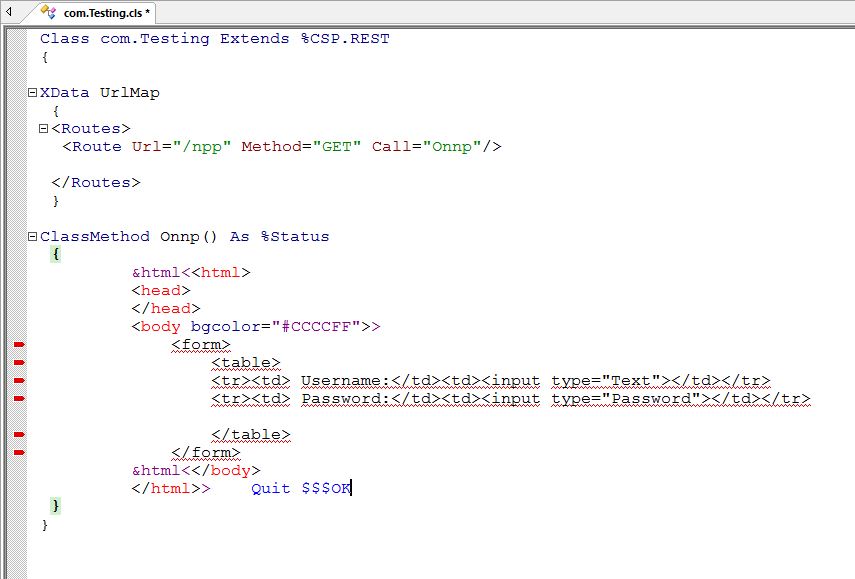
I got error in form tag declaring
Can anyone help me to resolve this error!!
Any recommendations, to this VMware disk type debate, with Cache installations in particular?
Thick Provision Lazy Zeroed
Thick Provision Eager Zeroed
Thin Provision