Hello glabal masters,
I am trying to develop WAS using Cache and Spring Framework.
The ON DUPLICATE KEY UPDATE is not working.
SQL is a standard language for storing, manipulating and retrieving data in relational databases.
Hello glabal masters,
I am trying to develop WAS using Cache and Spring Framework.
The ON DUPLICATE KEY UPDATE is not working.
The documentation only provides the syntax but does not provide any sample DDL for this case.
I am modifying some DB2 queries to Cache SQL but always meet some errors, please provide a sample query for this case.
Thanks.
I have a SQL procedure that I call into and it does some processing and passes back any data validations that fail. I would like to receive those message in my operation and act upon the message received .The question is how do you get output messages from a stored procedure I am using MsSQL 2012 with ensemble
Hello Global masters!
I developed Web with Spring framework (JAVA, Jdbc Cache) and I wrote SQL when I made it.
And Window program with VB6, Cache Object and VisM.
Is there a significant performance gap? SQL and Cache Object?
same function, same computer performance just different Java and VB6.
Thank you.
Minsu.
Hello Global masters.
I am junior developer about Intersystems cache in South Korea.
I want to develop process management program on server.
My code :
TESTPID(IP) ;
#include %syPidtab
Set Rset = ##class(%ResultSet).%New("%SYS.ProcessQuery:ListPids")
d Rset.Execute()
&sql(SELECT ClientIPAddress, Pid INTO :ClientIPAddress, :Pid
FROM %SYS.ProcessQuery
WHERE ClientIPAddress = :IP)
While Rset.Next()
{
i SQLCODE'=0 w !,"SQL Error "_SQLCODE continue ; 100 means process does not exist (halted)
I Rset.GetData(1) = Pid D
. w !,Rset.GetData(1)," ",ClientIPAddress," ",Pid
//Set rs=$SYSTEM.Process.Terminate(Pid)
//If rs'=1 {
// Write "Terminate Fialure "_" Pid "_Pid,!
//}
//Else {
// W "Sucess",!
// }
// }
}
d Rset.Close()
QMy new question regards connecting to the external database to insert the data. I have the following code:
#include %occInclude// winsurge6// insert winsurge data into cancer registry database
Compiling routine : winsurge6.MAC
ERROR:winsurge6.MAC(30) : SQLCODE=-30 : Table 'WINSURGE_RESULT_FACT' not found within schemas: CANREG,SQLUSER
Detected 1 errors during compilation in 0.026s.
I'm not sure what this error indicates. I've tried a few different things regarding the #SQLCompile Path=canreg and the
&sql(WINSURGE_RESULT_FACT
Any insights, news, alternatives or experience about sequence pattern querying like with Oracle's MATCH_RECOGNIZE, more declarative, less simple direct COS way? Both obvious solutions (shadowing data to oracle cloud or implementing MATCH_RECOGNIZE compiler in COS from scratch) seem big overkill.
I have a lookup table and record batch Table I would like to do a count on the records stored in that batch by counting the number of records in that batch that have a certain key on the responseKey column. This column keys are stored in the look up table for comparison. So I would like to do a join sql pivot that will use my keys stored in the lookup as columns and count as values
so far I have managed to do this but this is not efficient I would like to fire that sql once not on every count
SELECT * FROM
(
SELECT tMatch.DataValue, Count(*)
FROM ResponseRMAP.Record bRecord
JOIN Match ON tMatch.TableName = 'Match' AND tMatch.KeyName = bRecord.ResponseCode
WHERE bRecord.%ParentBatch = 55

)
Hi,
The following sql statement is working through the SMP but couldn't make it work through the code.
The table is a linked table to oracle db.
Tried to change the date property in the linked table class from %Date to %String and also tried using %SQL.Statement and %Library.ResultSet
this work through SMP:
INSERT INTO PACKAGE.SOME_TABLE_NAME

(EFFECTIVE_START_DATE,MORE,DATA,HERE)

VALUES (to_date ('2018-04-01','yyyy-mm-dd'),123,456,789)
In the code i'm using '?' in the statement for the parameters.
How to convert SQL persistent classes to JSON output - I have tried 1 option but appears to be very lengthy process.
I have many other SQL storage's defined and have to expose them as well to JSON. Can anyone please suggest a better approach.
My column names usually match with my Json properties.
My User.TestClass is the class with GetJsonList() as my method to return /output JSON formatted data.
The Code tried and SQL storage structure are as follows -
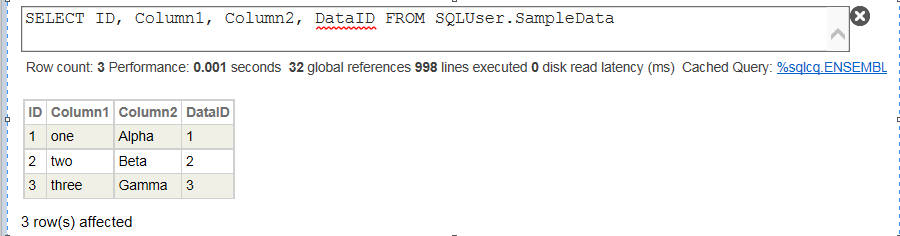
Class User.TestClass Extends %RegisteredObject
{
ClassMethod GetJsonList() As %Status
{
Set SQL="SELECT ID, Column1, Column2, DataID FROM SQLUser.
This is a sample Ensemble/Health Connect production which demonstrates how to receive an HL7 order (ORM) inbound from a file, extract fields (in this case, basic demographic information), and insert those into a table in an external SQL database via ODBC.
Included in the zip file:
I am tasked with using CACHE to insert data retrieved from a CACHE data base and insert it into an sql database. The columns in the sql table that I am trying to insert data into have names that contain underscores such as "ACCESSION_DATE" I found a utility in CACHE to connect to the sql data base and perform inserts. I have the data I need to insert. I need to pass the data into the sql utility referencing the column names.
I tried using indirection to set the data into underscored variables, but that isn't allowed in cache object script.
Anyone have suggestions as to how to do that?
Will an upgrade from 2015.2 to 2017.1.2 or higher freeze the query plans from 2015.2? Is there some minimum source version where this will work?
Has anyone use any other setting then -1 on the Stay Connected setting on a SQL.OutboundAdapter? I am having issues with a particular database and wonder if it would be beneficial since I only connect once a day to read the data from the Adapter to create an HL7 message.
Thanks
Scott Roth
Morning guys I have a SQL operation that I use to read data and results to a record map. But seems to have trouble saving the objects to a record map as I get this message
ERROR ErrException:
zInsertObject+2^%Library.RelationshipObject.1 -- logged as '-' number - @''
please help here is my code let me know if I missing anything thank you in advance
Method OnRequest(pRequest As DQToolsSet.PrimaryMessageREQ, Output pResponse As HSCIC.DBS.RequestRBAT) As %Status
{
 #dim status as %Status=$$$OK
    #dim resultSet as %SQL.StatementResult

    set pobject=##class(%FileCharacterStream).%New()

    set preq=##class(HSCIC.DBS.RequestRBAT).%New()


 set status=..Adapter.ExecuteQuery(.resultSet,..GetTheSubmissionData(pRequest.pMonth, pRequest.pApp, pRequest.pRef, pRequest.pInPat))

nbsp;if ($$$ISOK(status))
 {
  While (resultSet.%Next(.status) && $$$ISOK(status))
  {
  set ppResponse=##class(HSCIC.DBS.RequestRMAP.Record).%New()
     set ppResponse.RequestCode=resultSet.Get("recType")
        set ppResponse.PatientID=resultSet.Get("ClientID")
        set ppResponse.DOB=resultSet.Get("DOB")
        set ppResponse.Property4=resultSet.Get("u1")
        set ppResponse.Property5=resultSet.Get("u2")
        set ppResponse.NHSNumber=resultSet.Get("NNN")
        set ppResponse.Surname=resultSet.Get("Surname")
        set ppResponse.AltSurname=resultSet.Get("u3")
        set ppResponse.GivenName=resultSet.Get("GivenName1")
        set ppResponse.AltGivenName=resultSet.Get("u4")
        set ppResponse.SpineGender=resultSet.Get("Gender")
        set ppResponse.Address1=resultSet.Get("a1")
        set ppResponse.Address2=resultSet.Get("a2")
        set ppResponse.Address3=resultSet.Get("a3")
        set ppResponse.Address4=resultSet.Get("a4")
        set ppResponse.Address5=resultSet.Get("a5")
        set ppResponse.PostCode=resultSet.Get("Postcode")
        set ppResponse.AltAddress1=resultSet.Get("p1")
        set ppResponse.AltAddress2=resultSet.Get("p2")
        set ppResponse.AltAddress3=resultSet.Get("p3")
        set ppResponse.AltAddress4=resultSet.Get("p4")
        set ppResponse.AltAddress5=resultSet.Get("p5")
        set ppResponse.AltPostCode=resultSet.Get("p6")
        set ppResponse.GPCode=resultSet.Get("GPCode")
        set ppResponse.GPPracticeCode=resultSet.Get("PracticeCode")
        set ppResponse.NewField3=resultSet.Get("u5")
        set ppResponse.NewFiel23=resultSet.Get("u6")

   set status=ppResponse.%Save()
   set pobject=ppResponse

  set pResponse=##class(HSCIC.DBS.RequestRBAT).%New()

   if ($$$ISOK(status))
   {
    set status=pResponse.Records.InsertObject(pobject)
    set status=pResponse.Records.%Save()

      }


  }
  }
}Hi all.
I have some problem with getting data from external source (PostgreSQL) via JDBC and load it in DeepSee and I resolved some problems while writing this question :)
So..Below I proved my steps of working:
S Connection=##class
Hi all,
I have an operation which uses the SQL outbound adapter to query a data source set up using a system DSN on the server which uses the Intersystems ODBC35 driver (this is a cache db hosted elsewhere).
Whenever Ensemble runs the following query:
SELECT lnkdid,
c_fastsearch_code,
c_drugfull
FROM JAC.drug_basic
WHERE c_drugfull LIKE 'Para%'
No data is returned, however running the same query via SQL Server Management Studio, all expected rows are returned.
Also if I run the following via Ensemble:
SELECT lnkdid,
c_fastsearch_code,
c_drugfull
FROM JAC.
I came across How to import a tab separated text file into a SQL table programmatically?, which appears to indicate that I can pass the filename and all records will be imported. However, when I put use the Import method only a single record gets imported. However, all records are imported if I use the management console to import the file by selecting it and choosing the options.
Has anyone ran into this in the past?
Hi all,
I am new in Cache. I have to update a record with a long text field, for that, I am using ODBC but the issue is that it is returning an error when I execute the ODBC SQL statement because the field contains some commas, colon, double quotes, single quotes, and CR LF characters.
There is a way to escape this chars? I have seen I can save the field when I replace the single quotes with a double single quote (it's -> it''s) but I can not save the information when the field contains double quote chars. What about the other chars?
It is often necessary to sort the results of a query on a string field containing a combination of alphabetic and numeric characters. In cases like this the default string collation may not always return the data in the expected sequence.
An example of this may be where a select from Samples.Person should order the results by the street address, but firstly ordered by the street number part as numeric, and then by the street name.
The default query will return the results as follows:
SELECTName,Home_Street
FROMSample.Person
ORDERBYHome_Street
| Name | Home_Street |
|---|---|
| Eastman,Richard W. |
I am working my way through some SQL documentation.
The documentation follows and my question comes after.
A query supplied to %Prepare() can contain input host variables, as shown in the following example:
  SET minage = 80

  SET myquery = 3

  SET myquery(1) = "SELECT %ID AS id, Name, DOB, Home_State"

  SET myquery(2) = "FROM Person WHERE Age > :minage"

  SET myquery(3) = "ORDER BY 2"

  SET qStatus = tStatement.%Prepare(.myquery)
This talks about input host variables
I thought that input host variables only work with Embedded SQL, not Dynamic SQL
Thank you
I don't quite understand the %NOMERGE mentioned in the documentation.
http://docs.intersystems.com/latest/csp/docbook/DocBook.UI.Page.cls?KEY=RSQL_from#RSQL_from_nomerge
Is there any specific example provided to illustrate the idea?
Thanks.
Hi,
I am afraid I am stuck again. I have ensemble connected with a MsSQL database and I have a service that calls a store procedure. All is working, and I can get strings from the database in the service. The problem is that the data the store procedure returns is suppose to be an HL7 message so I need to convert the string into HL7 format. I have been using the ##class(EnsLib.HL7.Message). ImportFromString method but although I have a valid HL7 message from the string received from the DB.
I noticed that the subscript of the index map is actually the collated field (%SQLUPPER).
Is String the only data type going through this transformation? Any other data type would also go through this transformation?
Thanks.
I'm trying to learn how To use SQL in CACHE, so I hope I don't bore you with "Dumb" questions....
I'm getting "ERROR #6022: Gateway failed" message following this line of code.
s sc=gc.Prepare(hstmt,pQuery)
This line of code comes from an example I found in the documentation. pQuery is the "Select" statement setting up the variables and tables I'm trying to pull information from.
What does that error indicate?
Thank you.
Hi, I am trying to execute a store procedure within an ensemble operation to connect to aMsSQL database and I am having problem to pass the input arguments... I have tried several things but only one seems to work and it is not the ideal solution.
This is the code that works...as you can see the parameter is added to the sql query...not the best solution but the only that works at the moment.
My question is actually about IDKEY since Primary Key is the common concept of SQL.
Why do we need IDKEY? In what kind of scenario, the IDKEY would be different from Primary Key?
Thanks.
This might be more of a math problem than a Caché question.
I have a SQL query that joins two tables. I want to assign a unique ID to each row of the product table.
What's the chance of collision if I append the GUIDs and truncate the result to 50 characters? Is there a good way to solve this without updating the clients?
Last week, we announced the InterSystems IRIS Data Platform, our new and comprehensive platform for all your data endeavours, whether transactional, analytics or both. We've included many of the features our customers know and loved from Caché and Ensemble, but in this article we'll shed a little more light on one of the new capabilities of the platform: SQL Sharding, a powerful new feature in our scalability story.