Given:
class Foo.Bar extends Ens.BusinessOperation
{
Parameter SETTINGS = "Whatever:Basic";
}
class Foo.Baz extends Foo.Bar
I want to somehow drop "Whatever" as a setting from Foo.Baz. How can I do this?
In healthcare, interoperability is the ability of different information technology systems and software applications to communicate, exchange data, and use the information that has been exchanged.
Given:
class Foo.Bar extends Ens.BusinessOperation
{
Parameter SETTINGS = "Whatever:Basic";
}
class Foo.Baz extends Foo.Bar
I want to somehow drop "Whatever" as a setting from Foo.Baz. How can I do this?
I would like to know which are the best practices of using Streams in Interoperability messages.
I have always use %Stream.GlobalCharacter properties to hold a JSON, or a base64 document, when creating messages. This is fine and I can see the content in Visual Trace without doing anything, so I can check what is happening and resolve issues if I have, or reprocess messages if something went wrong, because I have the content.
But I think this is not the best way of using Streams.
Been testing out the Production Validator toolkit, just to see what we can/not do with it. Seems really interesting and there seem to be some use cases for it that can really streamline some upgrades (or at least parts of upgrades) but I was running into so many hurdles with the documentation. I am curious if anyone else has used it.
Did you experience any issues getting it working? Any clarification that you would have liked in the documentation? any use cases that you worked through that made it particularly valuable? etc?

Any time a change is made to the configuration of a running Production, an update is needed to apply any changes in configuration or default settings to the running Production. This has historically been a manual step by the user. Now, if the CCR Client Tools cause a running Production to need update, the Production is updated automatically. This means users will no longer have to navigate to the Production Configuration page and click the 'Update Production' button every time they load an ItemSet.
Sometimes your client may request documentation of your BI or interoperability project in a formal document. In this case, MS Word is a good alternative, as it has an advanced editor that allows you to generate professional documentation. Now it's possible!
The iris4word app has this functionality!
| Final MS Word Document | Word Template |
.png) |
.png) |
.png) |
.png) |
the iris4word get BI asset list and metadata using the InterSystems IRIS BI REST API documented on (https://docs.intersystems.com/healthconnectlatest/csp/docbook/DocBook.UI.Page.cls?KEY=D2CLIENT_rest_api).
In this section, we will explore how to use Python as the primary language in IRIS, allowing you to write your application logic in Python while still leveraging the power of IRIS.
Sending emails is a common requirement in integration scenarios — whether for client reminders, automatic reports, or transaction confirmations. Static messages quickly become hard to maintain and personalize. This is where the templated_email module comes in, combining InterSystems IRIS Interoperability with the power of Jinja2 templates.
Jinja2 is a popular templating engine from the Python ecosystem that enables fully dynamic content generation.
#InterSystems Demo Games entry
In this demo, InterSystems IRIS Interoperability comes alive in an amazing, game-like user experience based on our Ultimate Control Tower demo. We visualize machines in a virtual 3D factory building, interacting with InterSystems IRIS in real time—displaying current statuses and sensor data, simulating machine outages and predictive maintenance scenarios, and triggering workflow tasks and actions in InterSystems IRIS. By using a mobile app on a tablet—and even a VR headset for a fully immersive experience—we unleash the power of InterSystems IRIS.
Presenters:
🗣 @Stephan Mohr, Sales Engineer, InterSystems
🗣 @Jannis Stegmann, Sales Engineer, InterSystems
🗣 @Benjamin Kiwitz, Intern, InterSystems
🗣 @Tuba Incedag, Intern, InterSystems
Hello InterSystems Community,
I'm working with HealthShare, and need to create a user account for our development environment with specific access requirements.
My IRIS Haiku:
Store all things with care

Interop'rability

IRIS unites usHello again,
We are still seeking feedback on our two new HealthShare Unified Care Record certification exam designs. This is your opportunity to tell us what knowledge, skills, and abilities are important for Certified HealthShare Unified Care Record Specialists.
The feedback surveys are open until July 20th, 2025. All participants are eligible to receive 7000 Global Masters points for each survey they complete!
Interested in sharing your opinions? See the original post for more details on how to weigh-in on the exam topics.
I am seeking work with InterSystems HealthConnect/Cache. My experience is working with Rules and DTLs, plus message search, and export of components.With 10 years of dedicated expertise in SOA and ESB platform development, I have successfully designed and implemented enterprise-level integration solutions for large organizations, driving significant improvements in system interoperability and business efficiency.I have actively developed and supported HL7 V2/V3 、FHIR、XML/JSON interfaces.I reside in China. Available for full-time or contract positions, with remote work options preferred.
Hi community,
A few weeks ago I published an API accelerator call Memoria, Is a very simple way to minimize the time and network traffic to and end-point, I hope could be useful.
The link in openexchange: https://openexchange.intersystems.com/package/memoria
Regards!
Hello, good morning, thank you so much for reading this question. ☺️🙂👍
We are developing a code to get information about our Production's items: services, processes and operations.
We know we can get various configurations of a given item: Category, Port, Enabled...
But we wonder how we could get the date time of the last mesage (most recent) received in an item.
To give a code snippet a small section of the code we have developed (and tested), it looks like:
[...]

For i=1:1:tProduction.Items.Count() {
    #dim item as Ens.Config.Item
    set item = tProduction.
This is a template for a Flask application that can be deployed in IRIS as an native Web Application.
git clone
cd iris-flask-template
python3 -m venv .venv
source .venv/bin/activate
pip install -r requirements.txt
docker-compose up
The base URL is http://localhost:53795/flask/.
/iris - Returns a JSON object with the top 10 classes present in the IRISAPP namespace./interop - A ping endpoint to test the interoperability framework of IRIS.Is anyone using DICOM Interoperability in IRIS for Health configured in Mirror?
I'm asking because I'm not sure how to handle where the DICOM messages are stored.
For some reason DICOM use the filesystem to store raw messages, the directory used can be configured in the StorageLocation production settings, obviously this is a big issue if/when a mirror failover occur.
Unfortunately in IRIS it's not possible to change the DICOM storage from file stream to global stream.
Has anyone came across this issue?
Hello Everyone,
The Certification team of InterSystems Learning Services is developing two new HealthShare Unified Care Record certification exams, and we are reaching out to our community for feedback that will help us evaluate and establish the contents of the exams. Please note that these exams will replace our HealthShare Unified Care Record Technical Specialist exam that we plan to retire in January 2026. Certifications earned in this technology before the exam’s retirement will remain valid for five years from the date of achievement.
How do I provide my input?
IRIS and Ensemble are designed to act as an ESB/EAI. This mean they are build to process lots of small messages.
But some times, in real life we have to use them as ETL. The down side is not that they can't do so, but it can take a long time to process millions of row at once.
To improve performance, I have created a new SQLOutboundAdaptor who only works with JDBC.
Extend EnsLib.SQL.OutboundAdapter to add batch batch and fetch support on JDBC connection.
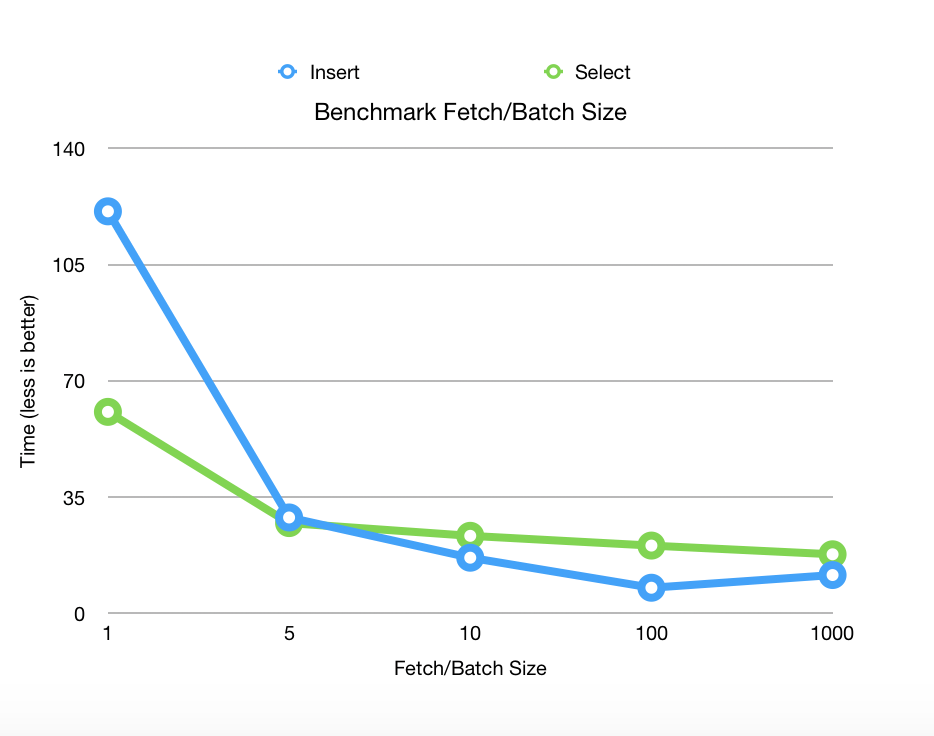
Benchmarks released on Postgres 11.2 with 1 000 000 rows fetched and 100 000 rows inserted on 2 columns.

You know that feeling when you get your blood test results and it all looks like Greek? That's the problem FHIRInsight is here to solve. It started with the idea that medical data shouldn't be scary or confusing – it should be something we can all use. Blood tests are incredibly common for checking our health, but let's be honest, understanding them is tough for most folks, and sometimes even for medical staff who don't specialize in lab work. FHIRInsight wants to make that whole process easier and the information more actionable.

Hi Developers!
We are happy to present the bonuses page for the applications submitted to the FHIR and Digital Health Interoperability Contest 2025!
See the results below.
IRIS supports CCDA and FHIR transformations out-of-the-box, yet the ability to access and view those features requires considerable setup time and product knowledge. The IRIS Interop DevTools application was designed to bridge that gap, allowing implementers to immediately jump in and view the built-in transformation capabilities of the product.
.png)
Hi Community,
In this article, I will introduce my application iris-fhir-bridge
IRIS-FHIR-Bridge is a robust interoperability engine built on InterSystems IRIS for Health, designed to transform healthcare data across multiple formats into FHIR and vice versa. It leverages the InterSystems FHIR Object Model (HS.FHIRModel.R4.*) to enable smooth data standardization and exchange across modern and legacy healthcare systems.
Profiling CCD Documents with LEAD North’s CCD Data Profiler
Ever opened a CCD and been greeted by a wall of tangled XML? You’re not alone. Despite being a core format for clinical data exchange, CCD's are notoriously dense, verbose, and unfriendly to the human eye. For developers and analysts trying to validate their structure or extract meaningful insights, navigating these documents can feel more like archaeology than engineering.

Let me introduce you to FHIRCraft, a lightweight tool to generate synthetic FHIR resources.
Now, you might be thinking:
“But wait — doesn’t Synthea already do that, and with tons of resources?”
Exactly — and that’s precisely why I created this app.
FHIRCraft is designed to generate simpler, smaller, and more focused FHIR resources. Unlike Synthea, it doesn’t aim to simulate entire patient histories or clinical workflows. Instead, it helps when you’re just getting started with FHIR — when you want to test things incrementally, or explore how specific resources behave in isolation.
Hi Developers,
We are happy to announce the new InterSystems online programming contest dedicated to all things health-related:
🏆 InterSystems FHIR and Digital Health Interoperability Contest 🏆
Duration: May 12 - June 1, 2025
Prize pool: $12,000
After we rolled out a new cointainer based on containers.intersystems.com/intersystems/irishealth:2023.1 this week, we suddenly noticed that our FHIR Repository started responding with an Error 500. This turns out to be caused by PROTECT violations on the new HSSYSLOCALTEMP namespace and database used by this version of the IRIS for Health FHIR components.
The trick to solve that is to add the "%DB_HSSYSLOCALTEMP" to the Web Application(s) that handle FHIR Requests. You can script that by running the following Class method in the namespace(s) that define these Web Applications:
do ##class(HS.We’re issuing a point release for InterSystems IRIS, IRIS for Health, and Health Connect 2025.1 — version 2025.1.0.225.1 — to address a critical interoperability issue affecting users who leverage System Default Setting enabled business hosts.
What’s the issue?
In certain configurations where a Business Host is marked as System Default Setting enabled, applying new settings via the UI may incorrectly indicate that changes were applied, even though the necessary restart did not occur.
I'm creating a Business Process that:
The Business Process is created with BPL, and objects are stored in BP context. When I execute this Process, in the 3rd point the object obtained in first transformation doesn't exist. It's empty.
In the previous article we have reviewed how to install our EMPI in standalone, so we are ready to start the basic configuration of our EMPI.
First of all we have to do an initial basic configuration, we can access to the configuration from the Configuration menu of our Registry.
.png)
Selecting that option will allow to us to edit the basic configuration table of the Registry:
.png)
In this menu we have to add the following parameters and update the value of one of them:
| KEY | VALUE | DESCRIPTION |
| \HSPI\LinkageDefinition | Local.Linkage. |
Business Process is adding control characters.
Input HL7 shows no control characters in Notepad ++
.png)
Output
.png)
.png)
Code:
{
#dim tStatus As %Status = $$$OK
#dim eException As %Exception.AbstractException
#dim tOBXText As %String
#dim tItemNumberCount As %Integer = 0
#dim tItemNumberProcessed As %Integer = 0
#dim tTotalCostSegment As %Integer = 0
#dim tOrderType As %String
#dim i As %Interger = 0
#dim tOBXKey As %Integer = 0
#dim tOBXTextChanged As %String
////
Set pOutput = pRequest.