New
Our Pharmacy team would like us to convert...
¼ test character and ½ test character and ¾ test character andto more like
1/4 test character and 1/2 test character and 3/4 test character andIs this possible?
IRIS supports Data Transformation Language (DTL) for describing data transformations. DTL is an XML language. Ensemble provides wizards and graphical tools for creating, editing, and testing DTL transformations. A data transformation is a Caché class like the following. If you prefer you can use Studio to edit the class definition directly and bypass the wizards and graphical tools.
Our Pharmacy team would like us to convert...
¼ test character and ½ test character and ¾ test character andto more like
1/4 test character and 1/2 test character and 3/4 test character andIs this possible?
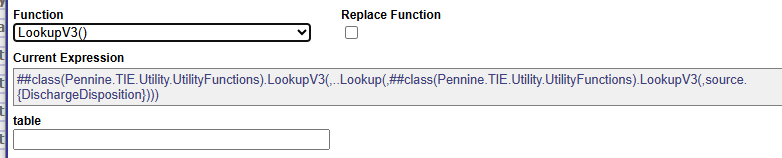
Currently have an extension of the ..lookup function as a custom version of the lookup. Is there any easy way to get it to display it as a list of the lookup tables
ClassMethod LookupV3(table As %String = "",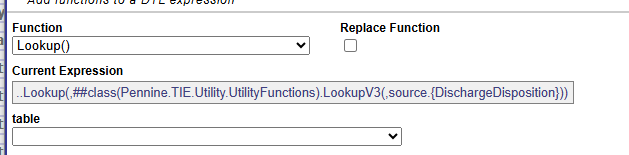
and the one i'm trying with
v2026.1 was just released as GA, and one of the features I'm looking forward to using is the DTL Explainer feature.
This allows you to take a Data Transformation, and with a click of a button get a human-readable description of the transformation (which you can also use as the basis for the DTL Description).
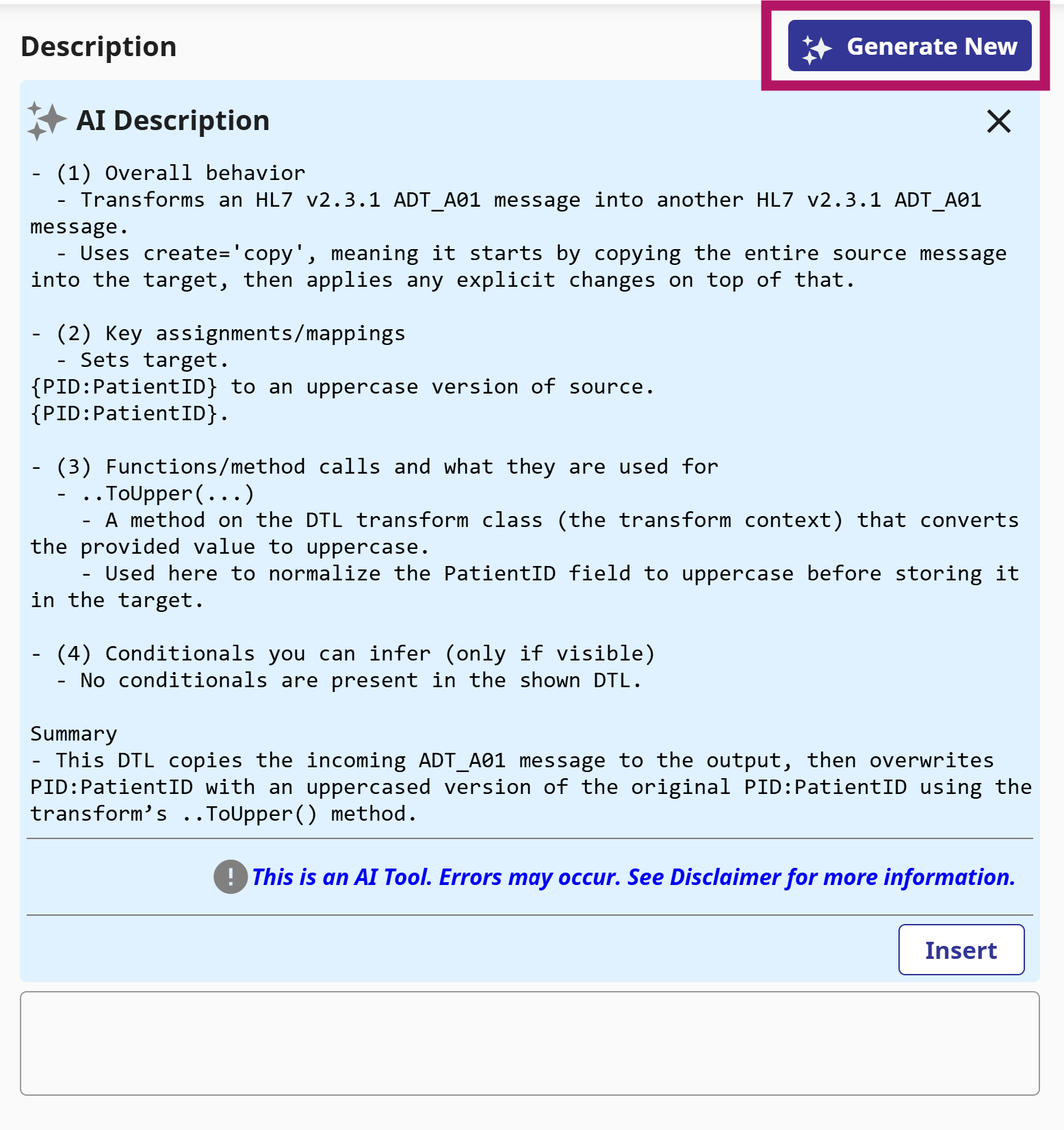
For complex DTLs, especially ones you didn't write yourself, or you did but a long time ago, this will allow you to get a clear quick understanding of what it's doing.
I thought I knew how to return a Response from a Business Process back to the Source Config Name, but I guess not.
I am working on a Proof of Concept, that the Request Message Class would determine a "Route" within a Business Process to make a FHIR call (search, read) to our External FHIR repository, and return back the HS.FHIR.DTL.vR4.Model.Resource.xxxxxxx as a Response to the Source Config Name.
I have the FHIR part working, however now that I have the data in the form of HS.FHIR.DTL.vR4.Model.Resource.
It's been a while since the new UI for Productions and DTL was published as a preview and I would like to know your opinions about it.
WARNING: This is a personal opinion, totally personal and not related with InterSystems Corporation.
I'm going to start with the Interoperabilty screen:
.png)
The style is sober and without frills, following the line of cloud services design, I like it.
But, always a but...or maybe two:
JSON
JSON (JavaScript Object Notation) is a lightweight, text-based format designed for structured data interchange. It represents data objects consisting of key–value pairs and arrays, and it is entirely language-independent.
Hi, Community!
Building integrations with InterSystems products? Find out about the latest UX enhancements available in version 2025.3!
Building Integrations: A New User Experience Version 2025.3
In this video, @Aya Heshmat, Product Manager for HealthShare® Health Connect, walks through:
💡You can opt into these enhancements for an improved experience with navigation and monitoring, as well as streamlined DTL creation and testing!
I'm generating a XML (Enlib.EDI.XML.Document) using a Subtransformation within a DTL. Writing this XML-Document to the filesystem works good, but in the XML-File is missing the header line (<?xml version=1.0 encoding=UTF-8?>):
.png)
What do I have to do to get the header in my XML-File?
Any help is appreciated.
I was wondering if anyone had a way to automate creating the Query String for a FHIR Request?
Using HS.FHIRServer.Interop.Request in my development I have to specify the following...
.png)
I was wondering.... if my source had variable number of fields if there was a way to automate the build for the QueryString when doing a Patient Search?
I am trying to replicate a way to use FHIR as a way to query the EMR instead of using a MS SQL Stored Procedure that is populated via HL7 ADT to query.
As I am iterating through the FHIR JSON Response from a Patient Search, I am running into an issue where the extracted values are not being popualted into the Response object that I have created. If I do a $$$LOGINFO on them they will show up in the Object log, however if I try the following for example I get an error.
set target.MRN = identifier.value
|
Here is my Ens.DataTransform
Class osuwmc.Epic.FHIR.DTL.I am trying to centralize our FHIR queries into a single BP object that would send the FHIR query to the EMR, interpret the response into a %Persistent structure that could be sent back to the requestor. In theory it seemed like it would work but I am running into an issue..
"Warning on Message body 5@osuwmc.Epic.FHIR.DataStructures.PatientSearch.Record'
/ 229 because Status 'ERROR <Ens>ErrException: <PROPERTY DOES NOT EXIST>Transform+3 ^osuwmc.Scott.FHIR.DemoOutboundHL7Message.1 *DocType,osuwmc.Epic.FHIR.DataStructures.PatientSearch.Record -- logged as '-'
Trying to check date in DTL.
Want to throw a custom error not the default one from the $ZDTH. It does in the try as will write "Error" when testing the DTL but the actual error not showing. Report errors is turned on. I also tried the THROW logic from best practices but that doesn't work either. $SYSTEM.Status.DisplayError(status) does display what the error should be returned.
 try
 {
    set tDateH = $ZDATEH(tDateofDeath, 8)
 }
 catch ex
 {
  w "error"
 set status = $$$ERROR($$$GeneralError,"Custom error message")
 do $SYSTEM.Status.DisplayError(status)
do $SystemStatus.The Interoperability user interface now includes modernized user experiences for the DTL Editor and Production Configuration applications that are available for opt-in in all interoperability products. You can switch between the modernized and standard views. All other Interoperability screens remain in the Standard user interface. Please note that changes are limited to these two applications and we identify below the functionality that is currently available.
To try out the new screens prior to upgrading, you can download the 2025.
Hello. I need to transform a message
FROM:
MSH|^~\&|
SCH||61490||
PID|1||
RGS|1||1
AIS|1||
AIS|2||
AIS|3||
AIL|1||
AIP|1||
TO:
MSH|^~\&|
SCH||61490||
PID|1||
RGS|1||1
AIS|1||
AIL|1||
AIP|1||
RGS|1||1
AIS|2||
AIL|1||
AIP|1||
RGS|1||1
AIS|3||
AIL|1||
AIP|1||
The RGS, AIS, AIL and AIP are all under the RGS group. The one RGS segment that comes in will be copied across the group. If 3 AIS segments come in then I need 3 RGS groups, if 2 I need 2 RGS groups etc.
In my DTL (screenshot below) I have currently hardcoded the RGS index (1,2,3) but this will not be sufficient incase 4 AIS segments are sent in.
InterSystems IRIS interoperability production development involves using or writing various types of components. They include services (which handle incoming data), processes (which deal with the data flow and logic), and operations (which manage outgoing data or requests). Messages flowing through those components constantly require being adapted to consuming applications. Therefore,Data transformations are by far the most common component in interoperability productions.
In the early stages of data transformation development, thetest tool from the Management Portal becomes quite handy.
Is there a way to Remove specific all Addresses from a Provider.Individual.Address before reinserting the Addresses from an HL7 message in Provider Directory?
Most fields we can call %clearFields() however since Addresses come from multiple locations we need to isolate and treat Addresses from this HL7 source as a snapshot.
Thanks
Scott
Hi Everyone,
Please suggest/share best practices and sample questions that would help me to secure InterSystems HL7 specialist Certification.
In this section, we will explore how to use Python as the primary language in IRIS, allowing you to write your application logic in Python while still leveraging the power of IRIS.
Hey Community,
Watch this video to learn about AI Co-Pilot, which simplifies DTL coding and offers personalized assistance which makes it accessible to users with varying levels of technical expertise:
⏯ Accelerate DTL Coding with AI Cloud Service @ Global Summit 2024
I am making a FHIR request against Epic, in when I get the Response back using "fromDao" I am extracting the stream into HS.FHIRModel.R4.Patient. However, the patient's name comes back as name within a list that references HS.FHIRModel.R4.SeqOfHumanName.
I am receiving a FHIR response bundle back with a resource of patient. Using fromDao, I attempted to take the stream and put it into FHIRModel.R4.Patient but it is not mapping correctly. When I attempt to take FHIRModel.R4.Patient and write it out using toString(), all I am seeing is the resource
{"resourceType":"Patient"}
so the response is not mapping correctly to FHIRModel.R4.Patient. How have others handled this? Do I need to translate it to an SDA since it does fit the model format?
I am trying to add a value to my concatenation string and the value is not being inserted in the right place. I am adding onto this code from another developer and cannot seem to get it to work. The only code I have added is underlined in bold red.
This is how the translated HL7 message looks:
OBX|1|CE|CDX^History||Specimen 1 Clinical History: CLINICAL HISTORY\.br\\.br\Specimen 2 Clinical History: CLINICAL HISTORY 2\.br\Specimen 1 Suspected Clinical Diagnosis\.br\Specimen 3 Clinical History: HISTORY 3\.
Hi all,
My team is exploring options for handling timezone offsets in DTL and we’re wondering if there are any built-in methods available — ideally low-code or no-code solutions. Specifically, we're looking for a way to adjust timestamps based on the date and whether Daylight Saving Time (DST) is in effect.
For example, if an HL7 message has an MSH-7 value of 20250518144529, it should be converted to 20250518144529-0500 (Central Daylight Time), but if the timestamp were 20250218144529, it should be 20250218144529-0600 (Central Standard Time).
We have a scenario where we use the best practice article of a BP and DTL to split up HL7 messages mainly ORUS
https://community.intersystems.com/post/splitting-oru-messages-using-ob…
It is really useful but we have this code in many places that we are trying to consolidate it in one place.
We do not want to split it at the first stage in our rules as there is a lot of messages that go to sink. So we are trying for specific rules and the incoming hl7 matches certain rules and classified for certain downstream systems that it is then split and transformed.
I'm creating a Business Process that:
The Business Process is created with BPL, and objects are stored in BP context. When I execute this Process, in the 3rd point the object obtained in first transformation doesn't exist. It's empty.
As part of a process to generate FHIR XML bundles from HL7 messages, I have a subtransform transforming segments of an MDM_T02 message into a section of XML (EnsLib.EDI.XML.Document). So far this has worked well although I've encountered strange behaviour when making use of an xmlns attribute, whereby the attribute's name is duplicated despite the schema and DTL editor displaying it correctly.
.png)
.png)
Here's a snippet of the div.xmlns definition from the XSD schema used
.png)
Has anyone else encountered this? Any help is much appreciated
We are receiving an ORU message and the vendor is requesting that we append a new OBX segment at the end of the message and I wanted to reach out to see what options might be available.
So far, I tried the append action in the DTL editor with a single OBX-3 field but it seems to be appending to the field directly instead of creating a new OBX. I've started looking into if whether I could use a function but wanted to first check with the experts on the Discussion here in case there's an easier way to accomplish this. Thank you.
Hi, Community!
🐍Great news—you can now use Python to customize your productions and add custom code!
I am struggling with returning a SQL Query Result that may have multiple rows that can be searched.
 set query = "SELECT Facility FROM FROM osuwmc_EnterpriseDirDB.RelationshipMedCtrID WHERE OSUmedcenterID = ?"
 SET rset = ##class(%SQL.Statement).%New()
 SET qStatus = rset.%Prepare(query)
 SET rset = rset.%Execute($Get(ID))
 do rset.%Display()
I need to take the values that are returned and say search them for a single value. How would I go about returning the EnsLib.SQL.Snapshot into a Array or List for it to be searchable.