Guys,
Can you please guide me to create a RESTful API in our cache with JSON response.
Guys,
Can you please guide me to create a RESTful API in our cache with JSON response.
Caché will not change the cryptographic settings in an existing TLS configuration when you upgrade. This means that unless you've updated them yourself, you're still using the values from the very first version you started using SSL in.
If you've upgraded since creating your TLS configurations, take a moment to look at the enabled protocols and ciphersuites to make sure you've enabled all the versions you want, and disabled the old versions you don't want.
When executing a business process I'd like to share the Login Token from an external system retrieved via one of my business operations across multiple process instances. This means I need to persist the token somewhere. What would be the best approach/pattern to implement this?
The primary idea I had was to store the token and a timestamp in a persistable object and then write a single method in the Business Operation that retrieves the token.
Dear community!
I'm currently working on MessagePack implementation by using Cache ObjectScript.
I try to choose suitable representation for binary array.
Should I use $lb or $c or smth else for it?
How do I set an URL when I post a httpRequest via SendFormArray of my Ensemble Business Operation. Here is my code:
Class CareHome.RestApiClient Extends EnsLib.REST.Operation
{
Parameter INVOCATION = "Queue";
Method Login(pRequest As CareHome.Request.LoginRequest, Output pResponse As Ens.StringResponse)
{
set tURL = ..Adapter.URL_"login/login"
set httpRequest = ##class(%Net.HttpRequest).%New()
set httpRequest.ContentType="application/json"
do ..ObjectToJSONStream(pRequest,.jsonStream,"aeliw")
set httpRequest.EntityBody = jsonStream
set tSC = ..Adapter.
Initial questions have been answered. Expanded the post with actual code (see below)
So, I'd like to update one (and preferably) more context-fields in my ensemble BPL business process based upon the information in the request that initiates said BPL proces. I got a few questions about that:
1. First, I can't get it to work. Specifically, in the BPL process I call the business rule with my request as context and expect it to put it results in context.Boolean. The business rule nicely updates the context.Boolean but the conditional logic looks at specific fields in the request (i.e. if request.
I have an application in Cache 2013 (No Ensemble) which need to consume a REST web API over internet.
Can somebody please help me by pointing out the documentation or provide me code sample for consuming the REST API from a routine/class.
I am using Cache 2008 (No Ensemble) .
Hello!
Suppose I have a package with classes which I want to rename. All these classes are persistent and they already have a lot of data stored.
The best I can think of to do is the following:
5. finishes successfully.Hello.
We're about to implement an application that could use WebSockets intensely so before we head to that direction we need to figure out about how some few things work. That being said, anyone care to give me some enlightenment?

This is (the end) of a series of programming challenges for beginners and experienced Caché programmers.
For an introduction : go to article https://community.intersystems.com/post/advent-code-2016-day1-no-time-t…
This is the 25th and last challenge of the 2016 series of Advent of Code.
In this challenge, you have to send a signal out, using the assembunny code interpreter that we had to make in earlier challenges.
There is one extra instruction added to the assembunny language, which outputs a value (out x).
Using the instructions as input (see http://adventofcode.
Greetings!
Hopefully someone has an answer on this, I cannot find any example or understand from the documentation how to acheive this.
I have a SOAP header subclass
Class AddressType Extends %SOAP.Header
{
Parameter ELEMENTQUALIFIED = 1;
Parameter MAXLEN;
Parameter NAMESPACE = "urn:registry:1";
Parameter XMLNAME = "urn:LogicalAddress";
}
In my %SOAP.WebClient I use it like this:
set customHeader = ##class(AddressType).%New()
do ..HeadersOut.SetAt(customHeader,"AddressType")
Which results in
Is there any way to specify in which order indices are built during:
So far I think they are built by name order.
This is a series of programming challenges for beginners and experienced Caché programmers.
For an introduction : go to article https://community.intersystems.com/post/advent-code-2016-day1-no-time-t…
Today, you need to find your way through a maze (again). There are 8 points of interest in the maze, and you have to visit them all, starting with point 0.
You may visit some points more than once, in random order. The challenge is to find the shortest path through the maze while visiting all points.
Dear community!
I have problem with index NULL value. Unique index doesn't work for this case. If I use insert and one of parameter is "NULL". Message of constraint doesn't appear and row is inserted into table successfully. How Can I use index with NULL?
Class TestClassIndx Extends %Persistent
{
Property name As %String [ Private ];
Property age As %String [ Private ];
Property country As %String [ Private ];
Index IndextestUniq On (name, age, country) [ Unique ];
}
INSERT INTO TestClassIndx (name,age,country) VALUES ('1','2',NULL)
Best Regards
Hi everyone!
I'm restoring big database (1.8 Tb) from full backup to another host.
This host is weak (4Cpu 4GB RAM), so ^DBREST already works for 50 hours.
Is it possible to view restore process progres? I would like to know what time it will take to complete?
Hi Guys,
Can you please guide me on how to develop the machine learning concepts like as Chatbots, voice recognition, etc...
If any lead would be appreciate.
Thanks in Advance.
Thanks and Regards,
Arun Kumar Durairaj.
I have been working on a project in our Dev environment which resulted in processing a few (million) HL7 messages, and I thought it would be a good idea to purge the namespace in a controlled way. My concern was when it hit the day where the scheduled task would purge 'the day of a million messages', it would fill the Journal Drive quite dramatically and would happen overnight resulting in triggering a response from the poor person on out of hours support.
I ran the below query in three different modes. Coordinated Universal Time is 5 hours ahead of Eastern Time so there is difference in value from column 1 and column 2 in ODBC, Display mode, but not in Logical Mode. By default the query executes in ODBC mode when we query the data from outside world(via ODBC connection).
I don't know why query 2 and query 3 outputs different from query 1.
Query 1. Ran in Logical mode, DATEPART() took in memory stored timestamp data(stored in UTC)
'Hour ' returned are same for both the columns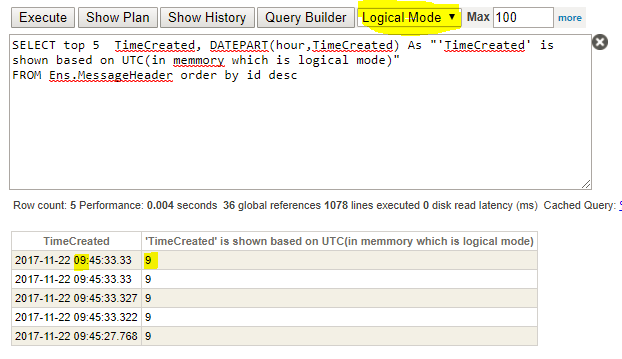
Query 2.
This is a series of programming challenges for beginners and experienced Caché programmers.
For an introduction : go to article https://community.intersystems.com/post/advent-code-2016-day1-no-time-t…
Remember the assembunny language we had to code on day 12 (https://community.intersystems.com/post/advent-code-2016-day12-leonardo…)?
There is a new instruction we have to implement which toggles an instruction x lines away (further or back).
inc becomes dec, and all other one-argument instructions become inc.I have an Ensemble installation and just build my first RestService (using %CSP.Rest that forwards them to my Business Service). This works nice and fine when I use postman to make REST calls over http (port 57772). However when I attempt to make a request using https over port 443 I receive the following error:
<!DOCTYPE HTML PUBLIC "-//IETF//DTD HTML 2.0//EN">
<html>
    <head>
        <title>404 Not Found</title>
    </head>
    <body>
        <h1>Not Found</h1>
        <p>The requested URL /csp/healthshare/fcoffice/rest/ping was not found on this server.</p>
        <hr>
        <address>Apache/2.4.18 (Ubuntu) Server at <MyUrl.Com> Port 443</address>
    </body>
</html>Dear community!
What do you think about webinar "Declarative programming on COS"? I want to do such one.
I am going to tell about main points of declarative programming and how you can implement it in your real projects.
Please feel free to write your opinion here.
Please if you wish to become a member of such webinar write me a message to atygaev.mi@gmail.com with subject "webinar".
Hi, Community!
Check the second Developer Community Video of the week:
Backup and Restore for Federated Systems
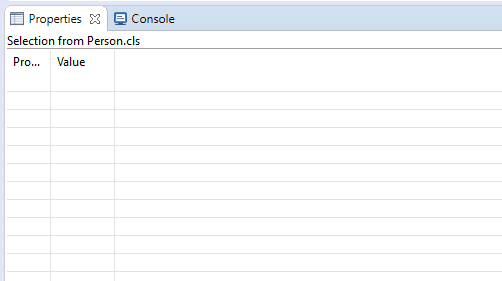
I am in Atelier editing a Class.
I want to look at the window or pane that shows my Properties,
I get to the tab that show Properties and their Value as shown below.
Now, how do I get the properties from my Class into the image below?
This is a series of programming challenges for beginners and experienced Caché programmers.
For an introduction : go to article https://community.intersystems.com/post/advent-code-2016-day1-no-time-t…
The goal of today's challenge is to copy data from one disk to another, problem is that the disks are not directly connected. Luckily they are in a huge grid, and you have to find a way to copy the data through adjacents disks, while honoring the disk usage (you cannot copy to a disk where data is already stored).
The input is a df-like disk usage listing.
Hi all! We have just released a new online course, Getting Started with ICM, that provides an introduction to InterSystems Cloud Manager (ICM) -- one of the new technologies coming with the release of InterSystems IRIS!
Hi, Community!
Please welcome a new session recording from Global Summit 2017:
Backup Essentials - Protecting Your Data
Hello, this is going to be a stupid question, yea I know, there are no stupid questions.
Say, I have an Object Property, Name or Count or Title, or whatever.
How can I get a list, or find out all the different ways it can be expressed?
Example:
-Property Name As %Name;
-Property Name As %String="me"
-Property Name As %String [ Required];
But what other parameters, keywords, restrictions, lists, etc. that I can apply to this Property?
I have been search the I/S documentation and so far at least, I cannot find that sort of information, or in one place.
This is a series of programming challenges for beginners and experienced Caché programmers.
For an introduction : go to article https://community.intersystems.com/post/advent-code-2016-day1-no-time-t…
The challenge of day 21 is about scrambling passwords.
There are a few functions you need to implement that will do operations on a string :
- swap position X with position Yswap letter X with letter Y
Given the instructions in your puzzle input (look for a full explanation to http://adventofcode.com/2016/day/21), what's the scrambled version of the initial string abcdefgh ?
Hi there,
The problem is, that I need use the property value of datacombo in other datacombo with parameter.
The follow a example code:
<dataCombo id="Grupo_Producto" name="Grupo_Producto" dataBinding="bdGrupo" size="40"
label="(*) Grupo" dropdownWidth="400" dropdownHeight="100" loadingMessage="Cargando..."
columnHeaders="Codigo, Nombre"
queryClass="Innova.CL.Core.BD.Configuracion.Operacional.Grupo" queryName="obtieneGrupoProd"
sqlLookup="SELECT Nombre FROM Innova_CL_Core_BD_Configuracion_Operacional.
Hello Community,
I have a simple question but somehow hard to find the solution:
this is a property in my class:
Property RelationAID As ZenCrm.Relationtypes;
this is my method to save:
ClassMethod PopulateMatrix(tvar1, tvar2) As %Status
{
set RelationMatrix=##class(ZenCrm.RelationMatrix).%New()
set RelationMatrix.RelationAID= tvar1
set RelationMatrix.RelationAType= tvar2
do RelationMatrix.%Save()
quit $$$OK
}
However the 'set' line does not work for the 'related properties.
I have tried: set RelationMatrix.Relationtypes.RelationAID but this failed.
Any suggestion? thanks!