New
Article Iryna Mykhailova · Feb 20 3m read

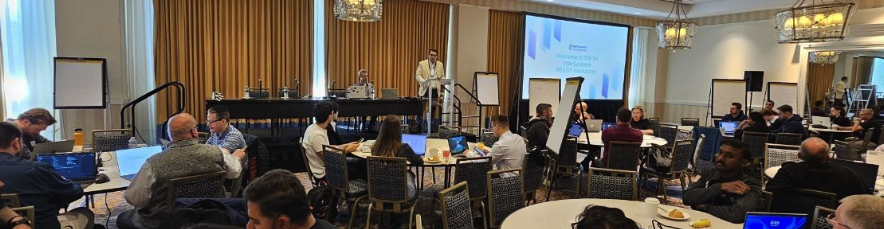
I'm happy to share that I was invited to present on the Developer Ecosystem and how it helps everyone become better programmers at the meetup during Iberia READY 2026. Thus, I had a chance to participate in this great event. And you have a chance to see how it went on, because as usual, I will share photos and impressions!

When I arrived, the first thing I saw was the Developer Zone and my presentation about the Ecosystem 🤩

6
0 88
New
InterSystems Official Daniel Palevski · Feb 24

The 2018.1.12 maintenance releases of InterSystems Caché®, InterSystems Ensemble®, and HealthShare® Health Connect are now Generally Available (GA). 

Please share your feedback through the Ideas Portal using the category Post-Release Feedback so we can build a better product together.

Documentation

You can find the detailed change lists & upgrade checklists on this page:

Early Access Programs (EAPs)

There are many EAPs available now. Check out this page and register to those you are interested.

0
0 67
New
Article Ashok Kumar T · Feb 24 2m read

In the modern healthcare landscape, finding clinically similar patients often feels like looking for a needle in a haystack. Traditional keyword searches often fail because medical language is highly nuanced; a search for "Heart Failure" might miss a record containing "Congestive Cardiac Failure."

I am excited to share iris-medmatch, an AI-powered patient matching engine built on InterSystems IRIS for Health. By leveraging Vector Search, this tool understands clinical intent rather than just matching literal strings.

0
0 71
Announcement Anastasia Dyubaylo · Feb 13

Hi Community!

We’re excited to announce the launch of a new, hands-on training program:

 🧑‍💻 Developing FHIR Applications Using Python 🧑‍💻

This cohort-based course takes developers from FHIR fundamentals to advanced, real-world healthcare interoperability solutions, with deeper, more practical coverage than typical industry offerings and a strong focus on production-ready skills using InterSystems technology.

3
1 111
Article Henry Pereira · Feb 14 3m read

cover

You’ve seen how tools like Lovable are shaking up web development. People are spinning up entire apps just by talking to an AI, almost like pair‑programming on steroids.

Now imagine bringing that same “vibe coding” experience into healthcare. know, it sounds crazy. Healthcare is complex, full of regulations, and usually gives us a headache just thinking about the interoperability rules.

That’s exactly the space where withLove lives: an AI‑Native, Low‑Code platform built entirely on InterSystems IRIS for Health.

1
0 50
Article Marco Bahamondes · Jun 24, 2025 3m read

Introduction

InterSystems IRIS allows you to build REST APIs using ObjectScript classes and the %CSP.REST framework. This enables the development of modern services to expose data for web apps, mobile apps, or system integrations.

In this article, you'll learn how to create a basic REST API in InterSystems IRIS, including:

  • A persistent data class
  • A REST class with GET and POST methods
  • A web application to expose the API
  • A full demonstration using Docker

4
3 340
Question Enrico Parisi · Feb 19

I need to reproduce a table (in fact a view, but let's start with a simple table 😊) in IRIS as the currently used in Oracle.

I need to expose/project one column to JDBC as CLOB, in my class I have the corresponding property defined as:

Property GlobStream As %Stream.GlobalCharacter;

In JDBC this column is projected as LONGVARCHAR, this is compliant with the documentation but I need to project it as CLOB.

In addition, I'm no expert in JDBC but wit seems that LONGVARCHAR has a Maximum Length 32,700 characters in JDBC, not quite enough for an arbitrary stream.

8
0 92
New
Article Pierre-Yves Duquesnoy · Feb 23 1m read

The InterSystems Ready 2026 Conference  is approaching fast — it's a great time to prepare and check your knowledge before attempting one of the Certification exams onsite .

InterSystems certifications aren't easy: you need to practice with questions aligned to the real exam objectives.

exam-prep.es is a free platform built for exactly that: practice, identify weak spots, and show up better prepared.

0
5 103
Question Hannah Sullivan · Aug 24, 2023

I have a persistent class (GetOrgUpdatesResponse) that has a property which is a list of another persistent class (Organization).

What would be the best way to cascade deletes so that on deletion of a parent row each object in the list property is then also deleted? 

I have included a sample of my classes here for clarity

Class Integration.ISIS.BO.SyncOrg.Custom.GetOrgUpdatesResponse Extends (%Persistent, Ens.
12
1 666
New
Discussion Jorge Jaramillo Herrera · Feb 23

Hello everyone,
I’m looking to implement Continuous Training (CT) as part of an MLOps strategy for some data science projects in IRIS. I want to automate the full cycle:

- Monitoring model performance & accuracy degradation.
- Retraining models automatically.
- Validating and updating production models.

I’ve looked into IntegratedML, but it seems more focused on the SQL interface for training (AutoML). Even with the new Custom Models (beta), which allows for more flexibility with Python, it doesn't seem to provide the "Continuous" orchestration out of the box.

I’d like to know:

0
0 38
New
Question Jainam Shah · Feb 22

Hi everyone,

I am currently integrating a Sysmex analyzer with InterSystems Ensemble/IRIS using a Moxa NPort 5110. I have successfully verified the physical and serial layers, but I am facing two specific issues: a protocol sync error and a persistent TCP connection state.
Environment:
Interface: ASTM.

Gateway: Moxa NPort 5110 (TCP Client Mode).

Server: Ensemble Business Service (EnsLib.ASTM.Service.TCPService).

Port: xxxx.

Current Status & Observations:
Serial Layer: Verified. The Moxa "Async Monitor" shows RxCnt increasing when the instrument sends data. Hardware pins (DSR/CTS) are ON.

1
0 42
Article Evgeny Shvarov · May 9, 2025 3m read

Hi developers!

Observing the avalanche of AI-driven and vibe-coding developer tools that have been appearing lately almost every month with more and more exciting dev features, I was puzzled whether it is possible to leverage it with InterSystems IRIS. At least to build a frontend. And the answer - yes! At least with the approach I followed.

Here is my recipe to prompt the UI vs InterSystems IRIS Backend:

  1. Have the REST API on the IRIS side, which reflects some Open API (swagger) spec.
  2. Generate the UI with any vibe-coding tool (e.g., Lovable) and point the UI to the REST API endpoint.
  3. Profit!

Here is the result of my own exercise - a 100% prompted UI vs IRIS REST API that allows to list, create, update delete entries of a persistent class (Open Exchange,frontend source, video):

What is the recipe in detail?

7
2 371
New
Article Robert Cemper · Feb 21 1m read

If one of your packages on OEX receives a review, you get notified by OEX only of YOUR own package.
The rating reflects the experience of the reviewer with the status found at the time of review.
It is kind of a snapshot and might have changed meanwhile.
Reviews by other members of the community are marked by * in the last column.

I also placed a bunch of Pull Requests on GitHub when I found a problem I could fix.
Some were accepted and merged, and some were just ignored.
So if you made a major change and expect a changed review, just let me know.

2
0 54
New
Article Lorenzo Scalese · Feb 20 6m read

Introduction

The standard %Net.HttpRequest library in InterSystems IRIS is powerful and comprehensive, but it can be verbose for simple operations. Writing an HTTP request often requires several lines of code to instantiate the class, configure the server, the port, HTTPS, add headers, and finally send the request.

When testing in the terminal, this configuration quickly becomes too heavy, and usually ends up with the creation of temporary methods...

FastHTTP was designed to address this need. This utility class provides a fluent and concise interface to perform HTTP calls in a single line, while automatically handling the underlying complexity (SSL/TLS, URL parsing, JSON encoding, headers, etc.).

1
4 184
Article Eric Fortenberry · May 30, 2025 3m read

Have you ever needed to change an IP or port before deploying an interface to production? Needed to remove items from an export? What about modifying the value(s) in a lookup table before deploying? Have you wanted to disable an interface before deploying? What about adding a comment, category, or alert setting to an interface before deploying to production?

If you’ve ever needed to make any changes to an interface or lookup table before deploying to production, then Export Editor is for you!

1
0 195
Article Evgeny Shvarov · Jul 14, 2022 2m read

Hi Community!

@Joan Pérez published a review that it is not very clear what applications are available for InterSystems Package Manager. Thanks Joan! Indeed it deserves a post.

There at least two ways I know to showcase them:

1. Run find command in zpm:

IRISAPP>zpm

=============================================================================
|| Welcome to the Package Manager Shell (ZPM).                             ||
|| Enter q/quit to exit the shell. Enter ?
0
0 300
New
Article Alyssa Ross · Feb 20 6m read

One objective of vectorization is to render unstructured text more machine-usable. Vector embeddings accomplish this by encoding the semantics of text as high-dimensional numeric vectors, which can be employed by advanced search algorithms (normally an approximate nearest neighbor algorithm like Hierarchical Navigable Small World). This not only improves our ability to interact with unstructured text programmatically but makes it searchable by context and by meaning beyond what is captured literally by keyword.

In this article I will walk through a simple vector search implementation that Kwabena Ayim-Aboagye and I fleshed out using embedded python in InterSystems IRIS for Health. I'll also dive a bit into how to use embedded python and dynamic SQL generally, and how to take advantage of vector search features offered natively through IRIS.

0
0 138
Article Sergey Lukyanchikov · Jul 22, 2021 26m read

Challenges of real-time AI/ML computations

We will start from the examples that we faced as Data Science practice at InterSystems:

  • A “high-load” customer portal is integrated with an online recommendation system. The plan is to reconfigure promo campaigns at the level of the entire retail network (we will assume that instead of a “flat” promo campaign master there will be used a “segment-tactic” matrix). What will happen to the recommender mechanisms? What will happen to data feeds and updates into the recommender mechanisms (the volume of input data having increased 25000 times)? What will happen to recommendation rule generation setup (the need to reduce 1000 times the recommendation rule filtering threshold due to a thousandfold increase of the volume and “assortment” of the rules generated)?
  • An equipment health monitoring system uses “manual” data sample feeds. Now it is connected to a SCADA system that transmits thousands of process parameter readings each second. What will happen to the monitoring system (will it be able to handle equipment health monitoring on a second-by-second basis)? What will happen once the input data receives a new bloc of several hundreds of columns with data sensor readings recently implemented in the SCADA system (will it be necessary, and for how long, to shut down the monitoring system to integrate the new sensor data in the analysis)?
  • A complex of AI/ML mechanisms (recommendation, monitoring, forecasting) depend on each other’s results. How many man-hours will it take every month to adapt those AI/ML mechanisms’ functioning to changes in the input data? What is the overall “delay” in supporting business decision making by the AI/ML mechanisms (the refresh frequency of supporting information against the feed frequency of new input data)?
0
1 857