New
Article Lorenzo Scalese · Feb 20 6m read

Introduction

The standard %Net.HttpRequest library in InterSystems IRIS is powerful and comprehensive, but it can be verbose for simple operations. Writing an HTTP request often requires several lines of code to instantiate the class, configure the server, the port, HTTPS, add headers, and finally send the request.

When testing in the terminal, this configuration quickly becomes too heavy, and usually ends up with the creation of temporary methods...

FastHTTP was designed to address this need. This utility class provides a fluent and concise interface to perform HTTP calls in a single line, while automatically handling the underlying complexity (SSL/TLS, URL parsing, JSON encoding, headers, etc.).

1
2 151
Article Lorenzo Scalese · May 22, 2025 9m read

Introduction

MonLBL is a tool for analyzing the performance of ObjectScript code execution line by line. codemonitor.MonLBL is a wrapper based on the %Monitor.System.LineByLine package from InterSystems IRIS, designed to collect precise metrics on the execution of routines, classes, or CSP pages.

The wrapper and all examples presented in this article are available in the following GitHub repository: iris-monlbl-example

1
2 250
Article Lorenzo Scalese · Apr 8, 2025 10m read

Introduction

Database performance has become a critical success factor in a modern application environment. Therefore identifying and optimizing the most resource-intensive SQL queries is essential for guaranteeing a smooth user experience and maintaining application stability. 

This article will explore a quick approach to analyzing SQL query execution statistics on an InterSystems IRIS instance to identify areas for optimization within a macro-application.

Rather than focusing on real-time monitoring, we will set up a system that collects and analyzes statistics pre-calculated by IRIS once an hour.  This approach, while not enabling instantaneous monitoring, offers an excellent compromise between the wealth of data available and the simplicity of implementation. 

We will use Grafana for data visualization and analysis, InfluxDB for time series storage, and Telegraf for metrics collection.  These tools, recognized for their power and flexibility, will allow us to obtain a clear and exploitable view.

More specifically, we will detail the configuration of Telegraf to retrieve statistics. We will also set up the integration with InfluxDB for data storage and analysis, and create customized dashboards in Grafana. This will help us quickly identify queries requiring special attention.

To facilitate the orchestration and deployment of these various components, we will employ Docker.

logos.png

0
4 390
Article Lorenzo Scalese · Nov 24, 2023 4m read

Hi community!

In this article, I'm excited to introduce my latest application, Journal File Indexer. The development of this application is rooted in the portal idea  DPI-I-270.  

In short, this application lets you load and index a log file in a database.  

Why?

If you've ever used the log file search function in the management portal, you may have encountered a timeout error or even a blank page. This problem usually occurs when searching a large journal file. Journal File Indexer solves this problem by considerably increasing the speed of searches once the file has been loaded into the database.  

Another problem arises during the restoration process. When searching for global entries in a log file to restore old or new values, the management portal doesn't have this specific functionality. A routine must therefore be coded to achieve this. Journal File Indexer comes to the rescue, incorporating a restore function!

3
1 429
Article Lorenzo Scalese · Nov 10, 2023 13m read

Hi, developers!

Currently, I'm working on a project that requires highly dynamic event management. In the context of the Java programming language, my first instinct should be to opt for the "Observer Pattern", which is an approach to managing interactions between objects by establishing a notification mechanism. It allows multiple observers to react to changes in the state of a subject autonomously, promoting code flexibility and modularity. If you are not familiar with this design pattern, check out Wikipedia to find more information about it.


While it's natural and commonly used in certain programming languages as Java and C++, in ObjectScript, it's quite a different story.

3
5 986
Article Lorenzo Scalese · Aug 16, 2023 11m read

Hi developers!

Today I would like to address a subject that has given me a hard time. I am sure this must have been the case for quite a number of you already (so-called “the bottleneck”). Since this is a broad topic, this article will only focus on identifying incoming HTTP requests that could be causing slowness issues. I will also provide you with a small tool I have developed to help identify them.

Our software is becoming more and more complex, processing a large number of requests from different sources, be it front-end or third-party back-end applications. To ensure optimal performance, it is essential to have a logging system capable of taking a few key measurements, such as the response time, the number of global references and the number of lines of code executed for each HTTP response. As part of my work, I get involved in the development of EMR software as well as incident analysis.  Since user load comes mostly from HTTP requests (REST API or CSP application), the need to have this type of measurement when generalized slowness issues occur has become obvious.

5
9 1457
Question Lorenzo Scalese · Aug 7, 2023

Hi!

Currently, I'm working on a script using %SYS.Journal API.

My journal files are compressed, following the documentation the compression is zstd.

I tried to unzip a file with zstd tool, ex: 

apt-get update
apt-get install zstd

zstd -d 20230806.001z -o 20230806.001

20230806.001z        : 92.03%   (909312 => 836859 bytes, 20230806.001) 

Unfortunately, the unzipped file is invalid:

Write##class(%SYS.Journal.File).IsValidJournal("/usr/irissys/mgr/journal/20230806.001")
2
0 573
Question Lorenzo Scalese · Jun 14, 2023

Hello!

I would like to find all classes not up to date in a namespace programmatically.

With IRIS Studio, we can see the single "+", but I don't know how to do that with a script.

Set sql = "SELECT ID, Name FROM %Dictionary.ClassDefinition WHERE NOT ID %STARTSWITH ?"Set params($Increment(params)) = "%"Set tResult = ##class(%SQL.Statement).%ExecDirect(, sql, params...)

If (tResult.%SQLCODE'=0)&&(tResult.%SQLCODE'=100) Set sc = $$$ERROR($$$SQLError, tResult.%SQLCODE, tResult.%Message) Quit sc

While tResult.%Next() {
    // if class not up to date ??
}
1
0 232
Article Lorenzo Scalese · Feb 14, 2023 9m read

Hi Community,

I would like to take advantage of our topic on capture for Health Data Warehouses (on DC-FR) to show you how to quickly create HTTP SOAP and REST clients. IRIS, as well as applications available on Open Exchange offers solutions to generate them from a WSDL or a swagger specification.

SOAP client

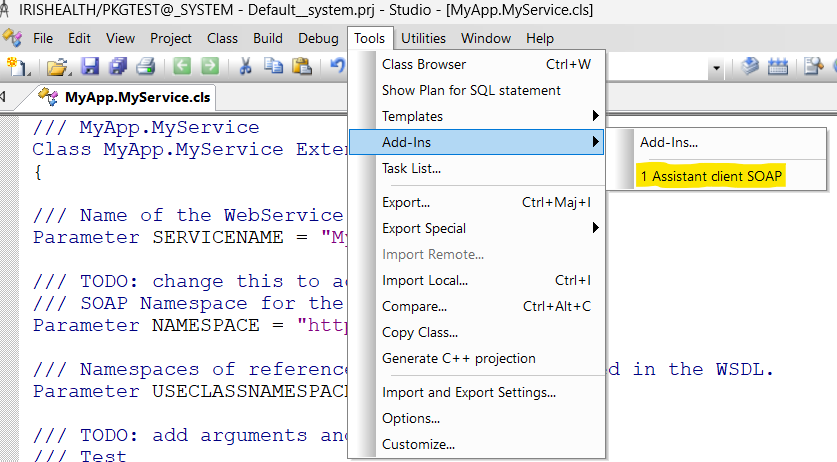
Nothing could be easier than creating a SOAP client. All you need is the WSDL.A wizard is available from the IRIS Studio. It allows you to generate not only your classes for a web service client but also the “Business Services” and “Business Operations” if you want to consume them with the interoperability framework.


4
2 964
Article Lorenzo Scalese · Feb 7, 2023 9m read

Hi Community,

In the first part, we describe all packages, used libraries and REST services.

Now, I would like to add some details about converter and validator services.

By default, OpenAPI-Suite sends an HTTP request to converter.swagger.io if the specification version is less than 3.0 and another HTTP request to validator.swagger.io to simplify the structure of the specification document.  

Although the usage of online utilities is convenient, in some cases it could be better to have our own instance of the converter and validator.  For example, if OpenAPI-Suite is provided on a server in an organisation for ObjectScript developers, it may be preferable to avoid requests to external services (privacy, avoid request rate limits). 

Just run: 

docker run -d -p 8085:8080 --name swagger-converter swaggerapi/swagger-converter:latest
docker run -d -p 8086:8080 --name swagger-validator-v2 swaggerapi/swagger-validator-v2:latest
2
2 597
Article Lorenzo Scalese · Feb 1, 2023 17m read

Hi Community,

I would like to present my last package OpenAPI-Suite, this is a set of tools to generate ObjectScript code from an OpenAPI specification version 3.0.  In short, these packages allow to: 

  • Generate server-side class.  It’s pretty similar to the generated code by ^%REST but the added value is the version 3.0 support.
  • Generate HTTP client classes.
  • Generate client production (business services, business operation, business process, Ens.Request, Ens.Response) classes.
  • A web interface to generate and download the code or generate and compile directly on the server.
  • Convert specification from version 1.x, 2.x to version 3.0.
23
6 1468
Article Lorenzo Scalese · Nov 10, 2022 8m read

REST API for Security Package

Hi community,

In this article, we will learn how to set up a REST API for the IRIS Security Package. We will be able to create users, roles, add applications, etc... by simple HTTP requests as well as generate a client application in ObjectScript.

Requirements

We need :

  1. An IRIS instance (installation kit or docker).
  2. ObjectScript package manager (ZPM).
  3. (Optional) A second IRIS instance to generate an ObjectScript client.

We will use a set of existing applications and libraries on OpenExchange. The package manager (ZPM) will make their installations much easier.

1
0 816
Article Lorenzo Scalese · Jul 21, 2022 11m read

Hi community,

This is the third article in the series about initializing IRIS instances with Docker. This time, we will focus on Enterprise Cache Protocol (ECP).

In a very simplified way, ECP allows configuring some IRIS instances as application servers and others as data servers. Detailed technical information can be found in the official documentation.

This article aims to describe:

  • How to script the initialization of a data server, and how to script the initialization of one or more application servers.
  • How to establish an encrypted connection between these nodes with Docker.

To do this, we

0
2 1037
Article Lorenzo Scalese · May 30, 2022 3m read

Hi Community,

Recently, I migrated a series of Objectscript repositories from XML to UDL format.
After the migration, I was a bit disappointed by the presentation on the GitLab web interface.

Since Objectscript syntax is supported by GitHub, I thought It would be also supported by GitLab. Unfortunately, the library used by GitLab to highlight the code does not have an extension to support Objectscript.

GitLab uses the library Rouge, which can highlight over 200 languages. This is a library written in Ruby (see the GitHub page), but Objectscript is not in the list.
So, I decided to develop an

1
2 635
Article Lorenzo Scalese · Apr 22, 2022 8m read

Apache Web Gateway with Docker

Hi, community.

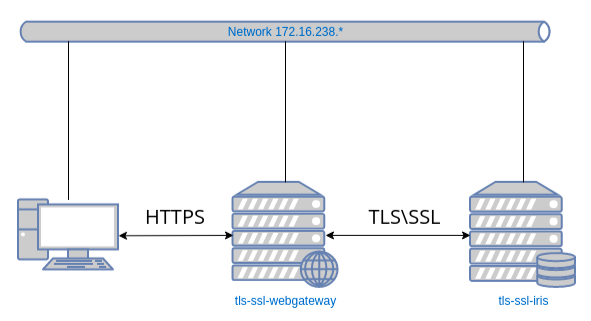
In this article, we will programmatically configure an Apache Web Gateway with Docker using:

  • HTTPS protocol.
  • TLS\SSL to secure the communication between the Web Gateway and the IRIS instance.

image

We will use two images: one for the Web Gateway and the second one for the IRIS instance.

All necessary files are available in this GitHub repository.

Let’s start with a git clone:

git clone https://github.com/lscalese/docker-webgateway-sample.git
cd docker-webgateway-sample

Prepare your system

To avoid problems with permissions, your system needs a user and a

15
8 2168
Question Lorenzo Scalese · Apr 16, 2022

Hi Community,

When we terminate a process that is in a transaction, the system (fortunately) performs a rollback.

As part of some troubleshooting, I'm wondering if there's a way around this behavior to avoid rollback (or force commit) before termination.

Recently we had an issue on a test server with a process stuck in a huge transaction (around 100GB).

The out-of-control process was suspended and then terminated causing a rollback.

In the case of a test server, this is not really a problem.

If it happens on a production system, depending on the situation we might prefer to avoid rollback (journal

6
1 735
Article Lorenzo Scalese · Apr 4, 2022 6m read

Hi Community,

This article describes the small ZPM module global-archiver.
The goal is to move a part of a global from a database to another database.

Why this package?

A typical use case is read-only data sequentially added to your database that you can never delete.
For example:

  • User log access to patient medical data.
  • Medical documents versioning.

Depending on the intensive usage of your application, these data could highly increase your database size.
To reduce the backup time, it could be interesting to move these data to a database dedicated to the archive and make a backup of this

5
0 391
Article Lorenzo Scalese · Feb 8, 2022 11m read

History

VersionDateChanges
V12022-02-08Initial release
V1.12022-04-06Certificates generation with sh file instead of pki-script
Using environment variables in configuration files

Hi Community,

Have you already set up a mirrored environment? Does it have a private network, virtual IP address, and SSL configuration? After doing this a couple of times, I realized that it is long, and there are a lot of manual actions required to generate certificates and configure each IRIS instance. It is a pain in the neck for people who often have to do this.

For example, a Quality Assurance team

2
1 1296
Article Lorenzo Scalese · Apr 21, 2021 2m read

Hi Everyone,

In the previous article, we combine ZPM with Config-API to load a configuration on module loading\install.
It could be useful for small applications, but for a large application, it's not convenient.

You can need to create multiple namespaces and install many zpm modules on different namespaces.
Using the configuration document on zpm load\install is a problem for this special case.
Moreover, even if you need only one module and one namespace, ZPM client is designed to install on the current namespace and it's not possible to switch to another namespace during the install.
So, If

3
0 418
Article Lorenzo Scalese · Apr 15, 2021 6m read

Hi Developers,

In the previous article, we describe how to use config-api to configure IRIS.

Now, let's try to combine the library with the ZPM client.
The goal is to load a configuration document during zpm install at the configure phase.

For this exercise, a template repository is available here (this is based on objectscript-docker-template ).

We attempt to :

  • Create a database MYAPPDATA.
  • Set Globals mapping for dc.PackageSample.*.
  • Add a user named SQLUserRO with read-only SQL role access.
  • Add an SSL Configuration named SSLAppDefault.
  • Create a REST application /rest/myapp.

The configuration

7
1 378
Article Lorenzo Scalese · Apr 15, 2021 6m read

Hi Developers,

Writing a script for the application deployment can be very interesting to ensure rapid deployment without forgetting anything. config-api is a library to help developers to write configuration scripts based on a JSON document.

Implemented features :

  • Set system settings.
  • Set security settings.
  • Enable services.
  • Configure namespaces, databases, mapping.
  • Export existing configuration.
  • All features are exposed with a RESTful API.

This library is focused on IRIS configuration to help applications deployment.

19
0 1017
Article Lorenzo Scalese · Nov 15, 2020 8m read

Hi Community,   OpenAPI-Client Gen has just released, this is an application to create an IRIS Interoperability Production client from Swagger 2.0 specification.   Instead of the existing tool ^%REST that creates a server-side REST application, OpenAPI-Client Gen creates a complete REST Interoperability Production client template.

Install by ZPM:

zpm "install openapi-client-gen"

  How to generate production from Swagger document?   It's very simple.

Open a terminal and execute:

Set sc = ##class(dc.openapi.client.Spec).generateApp(<applicationName>, <Your Swagger 2.0 document>>)

  The first

12
0 1337
Article Lorenzo Scalese · Apr 27, 2020 1m read

Hi community,

This article to give a description of my small library JSON Filter.

Why JSON Filter?

Search, sort data are common operations.

But … How to do this with JSON data?

You can use a %DocDB, It’s a good way for storing JSON and index the main properties.

However, JSON document is very flexible. It isn’t always possible (and not recommended) to index each properties to process the wished queries. A manual processing on a data subset is may be required.

In my opinion, this is not a funny part of the job. It’s a repetitive code with many loops etc...

JSON filter allows to process these

1
1 593