In v2026.1 we introduced support for a more robust and real-life secure authorization for your FHIR endpoints.
This is achieved by using SMART on FHIR v2 fine-grained scopes.

InterSystems IRIS for Health™ is the world’s first and only data platform engineered specifically for the rapid development of healthcare applications to manage the world’s most critical data. It includes powerful out-of-the-box features: transaction processing and analytics, an extensible healthcare data model, FHIR-based solution development, support for healthcare interoperability standards, and more. All enabling developers to realize value and build breakthrough applications, fast. Learn more.
In v2026.1 we introduced support for a more robust and real-life secure authorization for your FHIR endpoints.
This is achieved by using SMART on FHIR v2 fine-grained scopes.

READY is right around the corner, and this year the Application Services team from InterSystems will be hosting a Embedded Git Users GroupMeeting during the conference!This will be held Thursday, April 30th during breakfast from 7:30 – 8:30 (breakfast will be served at the meeting room starting at 7:00am).
A very important feature for HL7 FHIR has been introduced with the release of v2026.1 - the support for SMART on FHIR v2 fine-grained granular Scopes.
This enables you to be much stricter and more accurate in the access you provide to the data in your FHIR repository.
Part of this new support is to refuse requests that don't match the scopes, but an even more interesting ability is to filter the results according to the provided scopes.
I am regularly contacted by customers about memory sizing when they get alerts that free memory is below a threshold, or they observe that free memory has dropped suddenly. Is there a problem? Will their application stop working because it has run out of memory for running system and application processes? Nearly always, the answer is no, there is nothing to worry about. But that simple answer is usually not enough. What's going on?
Consider the chart below. It is showing the output of the free metric in vmstat
Hi Community,
If you’re new to InterSystems, check out the InterSystems Developer Hub.
Start working with InterSystems technologies — install InterSystems IRIS, connect to it, run something real, or try products directly in a browser-based interactive environment (no setup required).
If you’re wondering where to begin, here’s what you’ll find there:
Developer Onboarding Guide — a structured walkthrough of what InterSystems IRIS is and how to set it up
Quickstarts — short, practical guides to get you from zero to a working setup:
The 2026.1 release of InterSystems IRIS® data platform, InterSystems IRIS® for Health, and InterSystems Health Connect™ is now Generally Available (GA). This is an Extended Maintenance (EM) release.
Hi Community,
Take a look at these new videos in online learning, and get familiar with new features and interfaces in the latest release of InterSystems® products. All videos are also available in the Learning Services YouTube channel.
Plus, check out a video for new ObjectScript developers, and a guide for HealthShare® users upgrading their deployments.
I created a persistent class with all the associated classmethods that will be needed. I am going to use it as a temp storage for data.
Hi, Community!
Are you working with large tables? See how partitioning helps you manage and query your data:
This demo walks you through the new Table Partitioning feature in IRIS SQL, explaining what it does and how it works along the way. We'll only use a few dozen rows to prove the concept, but obviously the capability is focused on datasets many orders of magnitude larger.
If you'd like a shorter, higher-level introduction to Table Partitioning, check out the online learning module Managing Tables with Partitioning in InterSystems IRIS
ℹ️ Table Partitioning is included in IRIS 2026.1 as an experimental feature
Since our previous announcement, we have introduced several incremental improvements to the client‑side editing experience in VS Code. These updates focus on preserving developer‑authored formatting when synchronizing with the server.
Client‑side *.cls files previously lost certain formatting details during compilation, including keyword casing (e.g., classmethod → ClassMethod), normalization of blank lines between class members, and removal of line breaks within parameter lists.
The George James Software team is looking forward to going to National Harbor for READY 2026!
As part of the conference, we'll be hosting our Deltanji Source Control User Group:
Date: Wednesday, April 29th
Time: 8 - 9am (breakfast will be provided)
Location: Azalea 1
RSVP by emailing laurelj@georgejames.com.
We'll be showing what will be included in the next release of Deltanji, version 8.2, as well as providing an opportunity for questions and discussion. We welcome both current and prospective users to join us.
Hi Guys,
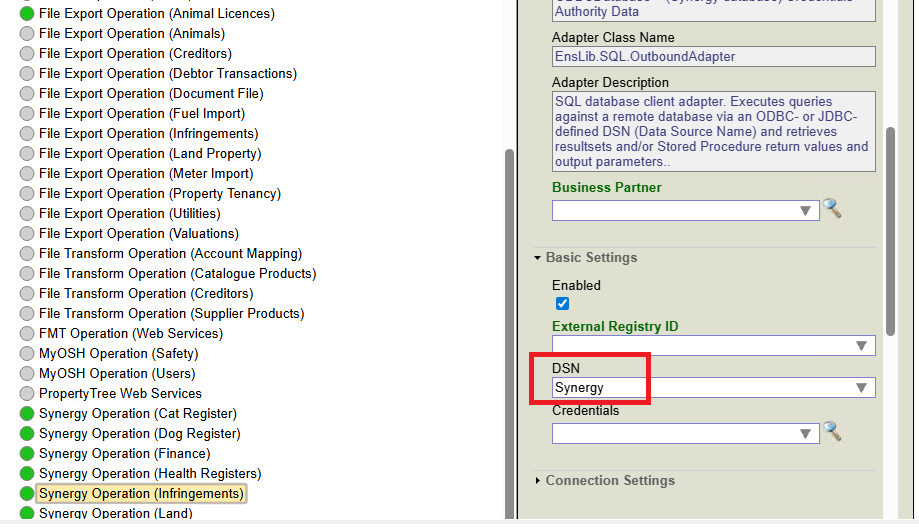
I've this Business operation pointing to my DSN as below
where its calling the this method, but for some reason its not recognizing Ens.Util.LookupTable class
Hi Team,
We are currently running InterSystems Caché 2018 on an IBM AIX server and would like to configure the Cache instance to start automatically when the server boots or is rebooted.
Could you please provide the recommended steps or any official scripts/guidelines to enable auto-start for the Cache instance (QA2018) on AIX?
Additionally, if there are any best practices or prerequisites (such as filesystem mount options, service dependencies, or startup order) that we should consider, please share those as well.
Thanks,
Ganesh
Hi Community,
Are you looking for resources to help your team onboard? Use these guides to get started!

Updated 04/17/26
Hi Community,
Looking for a way to onboard your team with InterSystems IRIS® for Health? Unlock the full potential of this platform by using these InterSystems learning resources. With a mix of online and in-person training, you can support various roles in your organization and equip your team for success.

InterSystems FAQ rubric
There is data, such as execution log data, that you do not want to return to its previous state even if a rollback occurs during a transaction. The above requirement can be met by placing that data in the IRISTEMP database, which will not be rolled back.
Temporary Globals and the IRISTEMP Database
By mapping the table entities you do not want to roll back to this database, you can retain the information after the rollback.
Introduction
InterSystems IRIS Adaptive Analytics is an optional extension that provides a business-oriented, virtual data model layer between InterSystems IRIS and popular Business Intelligence (BI) and Artificial Intelligence (AI) client tools. Adaptive Analytics is powered by AtScale, the AtScale documentation can be found at this link: https://documentation.intersystems.atscale.com
This article will showcase some AtScale features that can facilitate data analysis:
Aggregates
The 2025.1.4 and 2024.1.6 maintenance releases of InterSystems IRIS® data platform, InterSystems IRIS® for Health, and InterSystemsHealth Connect™ are now Generally Available (GA). These releases include the fixes for a number of recently issued alerts and advisories, including the following:
|
Alert ID |
Product & Versions Affected |
Risk Category & Score |
Explicit Requirements |
|
IF-9262 |
InterSystems IRIS® for Health InterSystems Health Connect™ versions |
System Stability Concern: 5 (High) |
FHIR and Health interoperability issues may cause upgrade failures and unexpected or adverse product behavior. |
Hi, every one. Again, it's me!!😀😀
Recently I was trying to organize some learning materials for InterSystems IRIS😆, and realized that the resources are actually quite scattered.🤐
So I put together a list here—grouped by categories—for anyone who:
Also adding some of my own experience on what worked (and what didn’t, may be only not work for me🤫🤐).
If you don’t know where to begin, start here:
While starting with Intersystems IRIS or Cache, developers often encounter three core concepts: Dynamic Objects, Globals & Relational Table. Each has its role in building scalable and maintainable solutions. In this article, we'll walk through practical code examples, highlight best practices, and show how these concepts tie together.
1. Working with Dynamic Objects:
Dynamic objects (%DynamicObject and %DynamicArray) allow developers to manipulate JSON-like structures directly in Objectscript. They are especially useful for modern applications that need to parse, transform or generate JSON.
|
Advisory ID |
Product & Versions Affected |
Risk Category & Score |
Explicit Requirements |
|
IF-9396 |
InterSystems IRIS® for Health InterSystems Health Connect™ versions |
System Stability Concern: 3 |
Deployments with non-default path-prefixes will not serve FHIR Server UIs. |
This past weekend we ran into something odd. When we failed over our mirror from 2022.1.3 to 2025.1.3 the one of the Business Rules that was on what became the Primary (2025.1.3), had a rule within it that was removed back in January. When the Failover occurred, we had to scramble to backup, disable, and remove the Rule that shouldn't have been there.
Both the Data and Code live within the same IRIS.dat that is the main MIRROR database for that Namespace.
If this happened to one Class file, could it happen to others we do not know about?
Hi Developers!
Currently I have 2000+ lines in a class, and I think it's a lot already? What are the best practices?
if 10K lines OK? How do you cope with it? Please share?

A question that quickly arises when configuring IAM (aka Kong Gateway) is how many routes should be created to reach all the business objects in an IRIS API.
A common mistake is to create one route per business object, unnecessarily multiplying the number of routes.
Claude Code has a strong understanding of IRIS, but unexpected issues still occur.
The first issue is one that has already happened several times and is likely to continue occurring if not properly addressed.
In IRIS, the collation for string data (%String) is set to SQLUPPER by default. As a result, when data is retrieved via SQL, it may be returned in uppercase (for example, when sorting and aggregating with GROUP BY).
Hi developers!
In a method I need to return a result as a dynamic object aka JSON Object. And here is my logic:
Classmethod Planets() as %DynamicObject {
set val1="Jupiter"
set val2="Mars"
// this doesn't work! cannot compile
return {"value1":val1, "value2":val2}
}So I need to do the following:
Since I started using Claude Code, my motivation to create things has skyrocketed.
Previously, even if I wanted to build something, actually doing the coding felt like a hassle, so unless there was a very strong need, I rarely went as far as programming. But now, if I just jot down the specifications, Claude Code handles the rest automatically, resulting in a dramatic improvement in productivity.
I come from a generation native to ObjectScript, so I used to feel some hesitation when it came to switching to Python.
Is there a way to delete a message in a routing rule? For example, an HL7 message doesn't qualify for a rule, but instead of the message being passed on to the next rule, you delete the message.