Hi, devs!
In ObjectScript I can refer to a class parameter as:
write ..#ParameterName
How do I do the same in Embedded Python?
Embedded Python refers to the integration of the Python programming language into the InterSystems IRIS kernel, allowing developers to operate with data and develop business logic for server-side applications using Python.
Hi, devs!
In ObjectScript I can refer to a class parameter as:
write ..#ParameterName
How do I do the same in Embedded Python?
This article aims to give an introduction to what gRPC is and an example of how to play with the official Hello World using IRIS Embedded Python.
You can find all the code exposed here, in this project repo.
The is an API architectural style based on the RPC protocol. The project was created by Google in 2015 and is licensed under Apache 2.0. Currently, the project is supported by the .
We started to use Azure Service Bus (ASB) as an enterprise messaging solution 3 years ago. It is being used to publish and consume data between many applications in the organization. Since the data flow is complex, and one application’s data is usually needed in multi applications the “publisher” ---> ”multiple subscribers” model was a great fit. The ASB usage in the organization is dozens of millions of messages per day, while IRIS platform is having around 2-3 million messages/day.
Hi developers!
Those who code IRIS solutions in VSCode using Docker often use the convenient ObjectScript menu, which contains links to Management Portal, Class Reference, Unittest portal, Productions, etc.
While drilling down to a Dev Container to code Embedded Python there is no such option, at least within my settings:
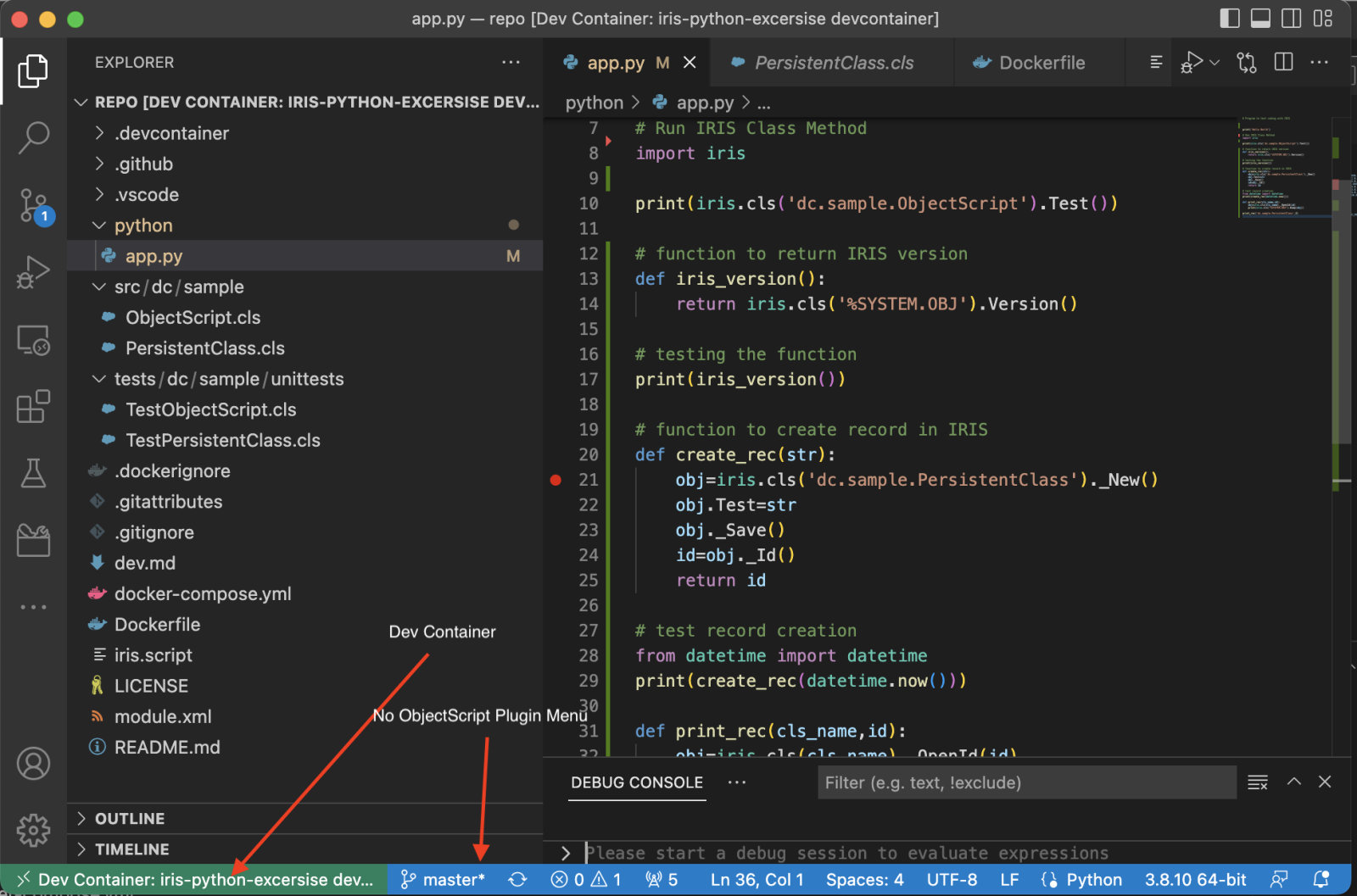
So I don't know how to connect to it.
Thoughts?
Hi developers!
Let me share with you a minimal embedded python template, that I can recommend as a starting point for any general project with InterSystems IRIS that will use embedded python.
Features:
Let's discuss the features below!
Hi, devs!
What's the way to call the methods of %SYSTEM class from python?
I tried this way:
print(iris.cls('_SYSTEM.OBJ'and getting an error: Traceback (most recent call last): File "<input>", line 1, in <module> RuntimeError: iris.class: error finding class
Here is how it works in ObjectScript:
USER>wThoughts?
Hi folks!
I'm playing with Embedded python with IRIS trying to do some 'hello-world' exercises.
I'm running IRIS in container and have the following python code:
# Program to test coding with IRIS'Hello World'# Run IRIS Class Method So, when I execute it, I get the following:
$ /usr/irissys/bin/irispython /irisrun/repo/python/app.py
Hello World
Traceback (most recent call last):
  File "/irisrun/repo/python/app.py", line 7, in <module>
    import iris
  File "/usr/irissys/lib/python/iris.py", line 14, in <module>
    from pythonint import *
ImportError: IrisStart failed: IRIS_ACCESSDENIED (-15)In this GitHub based on Guillaume and I have created this example of all the import CRUD operations usable using ONLY Python on IRIS and using Flask.
Using the IRIS ORM or by simply doing SQL requests as both methods are seen in the GitHub.
This is a template of a REST API application built in python in InterSystems IRIS. It also has OPEN API spec, can be developed with Docker and VSCode.

Easy, easy, I'm not promoting a war against the machines in the best sci-fi way to avoid world domination of Ultron or Skynet. Not yet, not yet 🤔
I invite you to challenge the machines through the creation of a very simple game using ObjectScript with embedded Python.
I have to say that I got super excited with the feature of Embedded Python on InterSystems IRIS, it's incredible the bunch of possibilities that opens to create fantastic apps.
Let's build a tic tac toe, the rules are quite simple and I believe that everyone knows how to play.
Folks!
Could you please share any best practices on how to debug Embedded Python code?
Given I have the following class method:
ClassMethod HideShip() As %Status [ Language = python ]
{
    import"BoardStorage"
And when I run it shows the following error:
USER>d ##class(eshvarov.sample.SeaBattle.GamePython).HideShip()

D ##CLASS(eshvarov.sample.SeaBattle.GamePython).HideShip()
^
<THROW> *%Exception.PythonException <THROW> 230 ^^0^D ##CLASS(eshvarov.sample.SeaBattle.GamePython).HideShip() <class 'KeyError'>: Invalid args -
Hi, devs!
Consider you have an arbitrary global with an unknown amount of indexes.
How to print all the values to the terminal with Embedded Python?
Hi folks!
I'm working with a global via Embedded Python as a class method. I init the handler for a global via:
gl=iris.gref("^Global"What is the way to check the value at index ^Global("x","y")? E.g.:
In ObjectScript I'd do the following:
set^GlobalHow do I do the same in Embedded Python?
I checked the documentation, but haven't found an answer.
Hi Community,
Join us for an InterSystems Developer Meetup during TechCrunch Disrupt 2022!
We’ll be meeting on Wednesday, October 19th at Bartlett Hall, located at 242 O’Farrell St. (just a few short blocks from the Moscone Center) starting at 6 pm through 8:30 pm PT, where speakers will discuss how developers can bring the code to the data, not data to the code with Embedded Python and Integrated ML on InterSystems IRIS.
Food and drinks will be served accompanied by discussions.
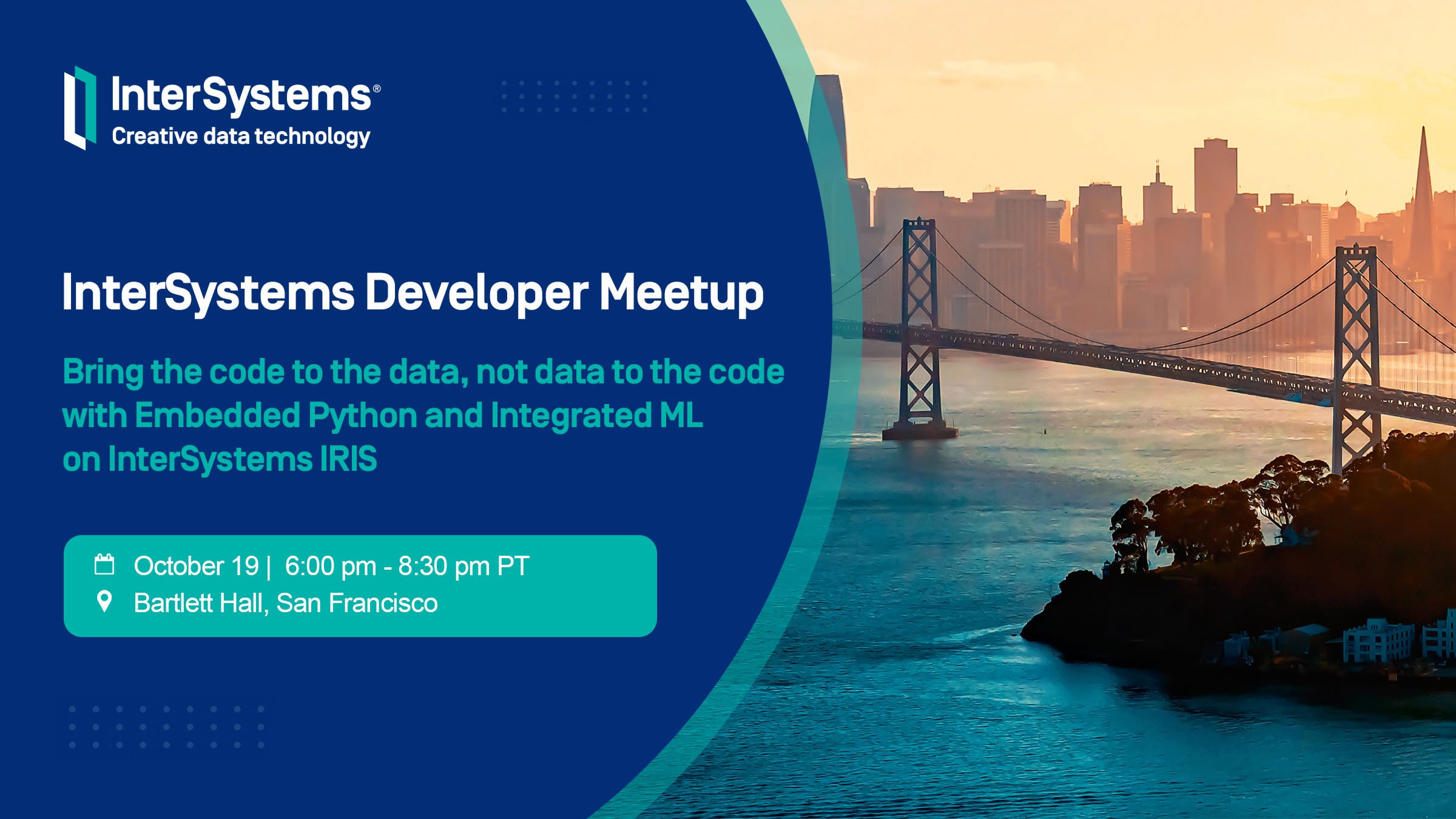
Agenda:
The aim of this proof of concept is to show how the gRPC protocl can be implemented with the IRIS ineroperabilty module.

On this schema, we can see that the gRPC Service is hosted by IRIS.
This service must invoke the IRIS interoperability module. For that it transforms the protobuf messages to IRIS messages.
The gRPC client is host by a Flask server for demo purpose, the gRPC client can also be invoke by the python script.
syntax = "proto3";
package users;

service Users {
  rpc CreateUser (users.CreateUserRequest) returns (users.CreateUserResponse);
  rpc GetUser (users.GetUserRequest) returns (users.GetUserResponse);
}

message User {
  uint32 id = 1;
  string name = 2;
  string dob = 3;
  string company = 4;
  string phone = 5;
  string title = 6;

}

message CreateUserRequest {
  User user = 1;
}

message CreateUserResponse {
  User user = 1;
}

message GetUserRequest {
  uint32 id = 1;
}

message GetUserResponse {
  User user = 1;
}

You may know it but IRIS is a database with the ability to execute code.
The code execution part is called an Application Server.
Today IRIS supports natively two languages: ObjectScript and Python.
Executing code is good, knowing how to organize it is better.
Organizing code is software architecture, not everyone has the desire or knowledge to create such a solution.
To do this, many programming languages offer what we call Frameworks.
Hi Developers,
Python has a large and powerful ecosystem that contains thousands of libraries and packages available, especially in data science.
Therefore, I wanted to have a first try in using a recent feature of IRIS called Embedded Python, to simply import a python library called datetime, generate data with a timestamp component and persist it in InterSystems IRIS for Health Data Platform. The same will work on IRIS Data Platform as well.
Hello,
I'm looking for a way to write a stored procedure or something to return a ResultSet with Embedded Python.
My goal is the following:
I have a Goal table with a Text field that is free text.
CREATETableId
I would like to create a procedure that returns all the entities (in the iKnow sense) in a new Entity column.
Python code, i would like to use :
'This is a test of the Python interface to the iKnow engine. another sentence to test this program with.'Expected result :
How do I go about it ?

Hi Community,
In this article I will demonstrate the functionality of my app iris-energy-isodata .
Application is accessing energy data (production, demand and supply) from the major Independent System Operators (ISOs) in the United States to ensure sustainable consumption and production patterns (SDG's 12)
Application is using python library isodata , Production EXtension PEX along with Embedded Python.
Date and Time is an important factors in our life. Because all applications are engaging based on Date/Time. But our world is split into multiple time zones. if our product is launched in the world, to maintain the history of events we are definitely required to convert all times to our local time or UTC ( Coordinated Universal Time ). As I know, many known programming languages of C#, JavaScript, Java, etc., provided the library to convert the date and time. i.e with a time zone name we can be able to convert without knowing the UTC offset.
TZ database doesn't exist in InterSystems products.
This repository is a demonstration of IntegratedML and Embedded Python.

In the previous articles, we learned the basics of using IMAP protocol to handle messages from mailboxes in an e-mail server. That was cool and interesting, but you could take advantage of implementations created by other ones, available in libraries ready to use.
One of the improvements to the IRIS data platform is the ability to write Python code alongside ObjectScript in the same IRIS process. This new feature is called Embedded Python. Embedded Python lets us bring to our ObjectScript code the power of the huge .
Hi Developers!
Here're the technology bonuses for the InterSystems "Sustainability" Interoperability Contest 2022 that will give you extra points in the voting:
See the details below.

In the August Learning Services newsletter, see how you can get hands-on with healthcare analytics tools, Embedded Python, and InterSystems Package Manager. If you're new to InterSystems ObjectScript, try out a learning path to get started!
In this article you will have access to the curated base of articles from the InterSystems Developer Community of the most relevant topics to learning InterSystems IRIS. Find top published articles ranked by Machine Learning, Embedded Python, JSON, API and REST Applications, Manage and Configure InterSystems Environments, Docker and Cloud, VSCode, SQL, Analytics/BI, Globals, Security, DevOps, Interoperability, Native API. Learn and Enjoy!
Machine Learning is a mandatory technology to build advanced data analysis and automate manual activities with excellent efficiency.
Hey Developers,
Enjoy watching the new video on InterSystems Developers YouTube channel:
I am aware that we have 5 License Units on Community Edition. But I have issues figuring out how it's working.
I have Community Edition
USER>write $system.License.KeyCustomerName()
InterSystems IRIS Community
Freshly started system, only terminal session open, so, only one license units used, and 4 left. As expected
USER>write $system.License.LUConsumed()
1
USER>write $system.License.LUAvailable()
4
Quote from documentation - $SYSTEM.License.MaxConnections() returns the maximum number of connections a user can make while consuming one license unit.
USER>write $system.License.MaxConnections()
25
Hi Developers!
We have great new articles for your to read and enjoy, thanks to our wonderful participants of the 3rd InterSystems Tech Article Contest: Python Edition!
And now it's time to announce the winners!
Let's meet the winners and their articles:
Continuing to observe the possibilities of Django, and usage with IRIS. The first we have looked how to define models and connect to tables already existing in IRIS, than we extended embedded Django Administration portal, with an ability to see what data we have in that models, with filters, editing and even pagination.
Time to go to real action, now we a going to create some REST API, on Django, based on the same data, we used before from the package posts-and-tags.
To do so, we will use Django REST Framework
Django REST framework is a powerful and flexible toolkit for building Web APIs.
Some reasons you might want to use REST framework:

Hey Community!
Here are the bonuses for participants' articles that take part in InterSystems Tech Article Contest: Python Edition:

Following this GitHub we will see how the FIX protocol can be implemented easily using IRIS and Python.
If you don't have much time focus on the Send a Quote before the Order part near the end, as it will, in a matter of minute, tell you how to send a Quote Request followed by an Order Request and show you the result from the server, and that in no more than five clicks.
Implementation of the fix protocol using an IRIS python container for the initiator and a regular python container for the acceptor.