#Embedded Python

4 Followers · 307 Posts

Embedded Python refers to the integration of the Python programming language into the InterSystems IRIS kernel, allowing developers to operate with data and develop business logic for server-side applications using Python.

Documentation.

New
Article Geet Kalra · Jun 2 3m read

In the previous article, we used pyprod to create production components while relying on the UI for production configuration. That same production can now be defined entirely in Python:

from intersystems_pyprod import Production, ServiceItem, ProcessItem, OperationItem

iris_package_name = "HelloWorld"

class MyProduction(Production):
    services = [
        ServiceItem(
            "MyServiceName",
            "HelloWorld.MyService",
            host_settings={"target": "MyProcessName"},
        )
    ]
    processes = [
        ProcessItem(
            "MyProcessName",
            "HelloWorld.MyProcess",
            host_settings={"target": "MyOperationName"},
        )
    ]
    operations = [
        OperationItem("MyOperationName", "HelloWorld.MyOperation")
    ]
6
0 148
New
Article Guillaume Rongier · Jun 2 9m read


In the previous IoP article, I showed how IoP can expose Python messages to DTL by generating JSON schemas. That is useful when the message is primarily a Python object and we want the IRIS tooling to understand its structure.

This time, the direction is a little different.

Starting with IoP 3.7.1, a PersistentMessage can now be a native IRIS message body class. The Python class is still the source code you write, but the generated IRIS class extends Ens.MessageBody

0
1 27
New
Article Mihoko Iijima · May 28 31m read

Vector search is a retrieval method that converts text, images, audio, and other data into numeric vectors using an AI model, and then searches for items that are semantically close. It enables “semantic similarity search” from free text, which is difficult with keyword search alone.

However, in real use, I encountered cases where results that are “close in meaning” but logically the opposite appeared near the top of the search results.

This is a serious issue in situations where affirmation vs. negation matters. If the system returns the wrong answer, the impact can be significant, so we cannot ignore this problem.

This article does not propose a new algorithm. I wrote it to share a practical way I found useful when semantic search fails due to negation.


0
2 74
New
Article Guillaume Rongier · May 27 7m read

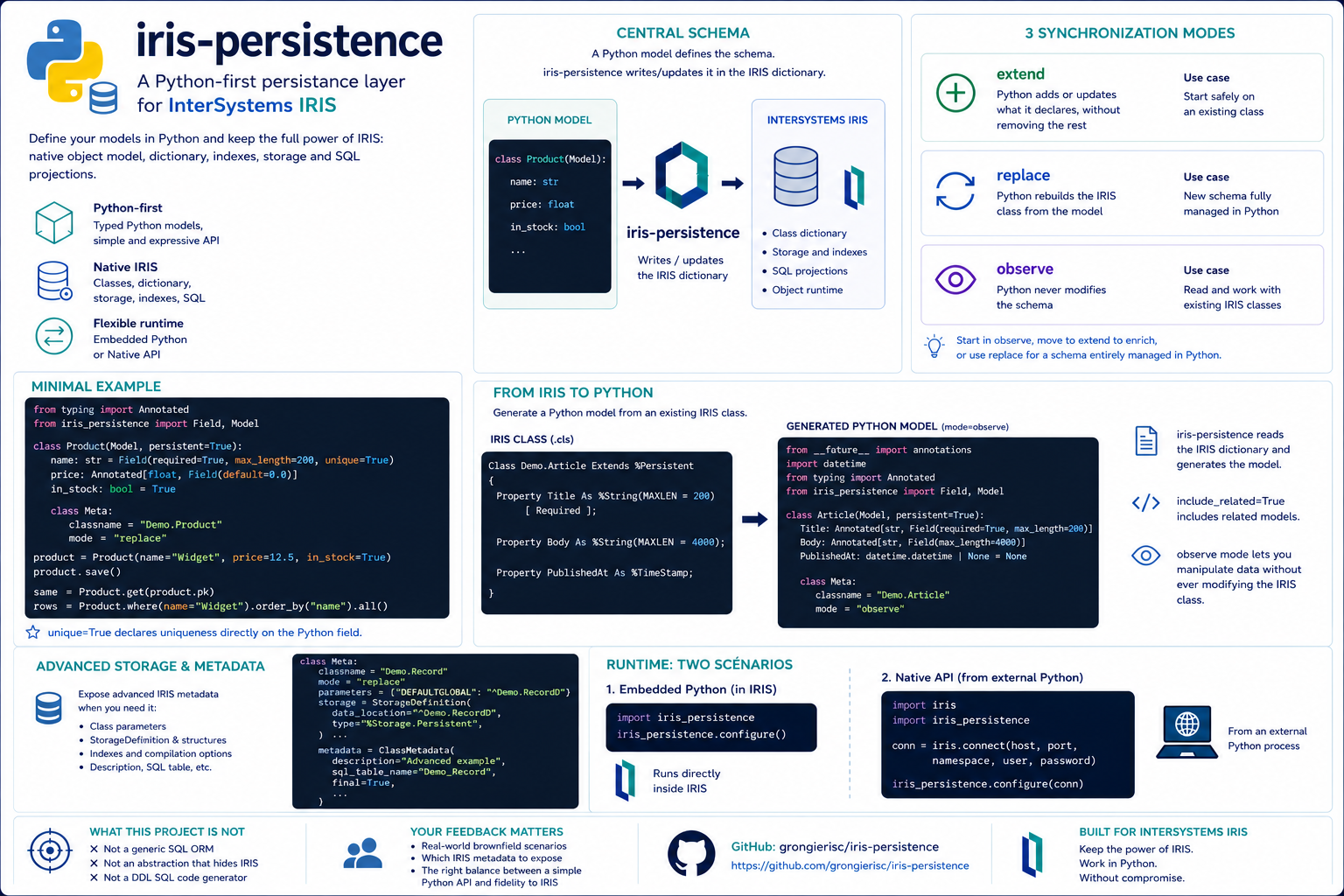
With Embedded Python and the Native API, it is becoming increasingly natural to write part of IRIS application logic in Python. But one question quickly comes up: how can you manipulate IRIS persistent objects from Python without losing the connection to the native object model, class dictionary, indexes, storage, and SQL projections?


iris-persistence explores that question. The project provides a Python object persistence layer for InterSystems IRIS, inspired by %Persistent

1
1 68
Article Guillaume Rongier · May 12 7m read

InterSystems IRIS globals are one of the platform's core strengths: they store hierarchical data in a direct, ordered, and efficient structure. But when working from Python, manipulating globals can sometimes feel closer to a low-level API than to the natural habits of the language.

The iris-global-reference project provides a Python layer on top of IRIS globals. Its goal is simple: make access to globals more readable, more idiomatic, and easier to integrate into modern Python code, without hiding the underlying hierarchical model.

1
3 121
Article Guillaume Rongier · May 18 8m read


When developing Python applications with InterSystems IRIS, you can quickly end up with several execution contexts:

  • Python launched directly by IRIS with Embedded Python;
  • a regular python3 process that loads the Embedded Python libraries from a local IRIS installation;
  • an external Python application that connects to IRIS through the official native driver.

These three cases are useful, but they do not behave exactly the same way for imports, system configuration, object APIs, and SQL access.

0
3 92
Article José Pereira · May 10 15m read

Data privacy regulations such as GDPR, LGPD, and HIPAA demand that organizations know exactly where Personally Identifiable Information (PII) lives inside their databases. Yet in practice, most teams rely on manual inventories, tribal knowledge, or external scanning tools that require data to leave the database engine — a process that itself creates privacy and security risks.

This article presents an MVP that takes a different approach: it runs PII detection inside InterSystems IRIS using Embedded Python, analyzing data where it lives and never exporting it to an external process.

3
0 118