There is documentation for single dolalr macros but $$$ dollar seems to be referenced on individual pages or not at all.
Hey Community!
We're happy to share the next video in the "Code to Care" series on our InterSystems Developers YouTube:
⏯ From Words to Molecules: How AI Is Transforming Medicine and Beyond
InterSystems IRIS Adaptive Analytics version 2025.4.1 is now available from the InterSystems Software Distribution page. This release includes AtScale 2025.4.1 and is compatible with the existing Adaptive Analytics User-Defined Aggregate Function (UDAF) file - 2024.1. New features included in AtSCale's 2025 releases include:
- Several MDX improvements to better handle null values and semi-additive measures like year-to-date.
- New parameters to enable setting the visibility of calculations and calculation groups in BI tools.
- Support for inbound query crossjoins that return empty cells
For
ObjectScript doesn't include any built-in method for appending one JSON dynamic array to another. Here's a code snippet I use that's equivalent to the JavaScript concat() method.
Call it with any number of arguments to concatenate them into a new array. If an argument is a dynamic array, its elements will be added. Otherwise the argument itself will be added.
ClassMethod ConcatArrays(pArgs...) As %DynamicArray
{
set outArray = ##class(%DynamicArray).%New()
for i=1:1:pArgs {
set arg = pArgs(i)
if ($IsObject(arg) && arg.%IsA("%DynamicArray")) {
set iter = arg.%GetIterator()
whileLet’s shine a light on the amazing authors and contributors of our October Article Bounty! 💙
Huge thanks to everyone who joined in and shared their knowledge.
A special mention goes to those who created brand-new articles and shared their expertise — each received 5,000 points 🎉
1. @Robert Cemper >> "Sample for Beginners with Streams in IRIS"
2. @Vachan C Rannore >> "What I’ve Learned from Multiple Data Migrations"
3. @Harshitha >> "Tips on handling Large data"
And also to those who joined the challenge and helped us in the search for interesting articles (each received 30 points 🙌):
Hey Community!
We're happy to share a new video from our InterSystems Developers YouTube:
CCR users can now take advantage of an enhanced syntax for substituting pre-defined tokens with live URL links within phase-related text fields. In addition to the existing <env> token which automatically updates to reflect the Environment of the relevant CCR Record, CCR now introduces three new keywords: <smp> , <smpPrefix> , and <homepage>.
The new <smp> token automatically replaces itself with the URL of the Management Portal's homepage for the System associated with the CCR Record in the Environment that most recently received changes to the Record.
For one of our customers I had to integrate with the AFAS imageconnector endpoint /imageconnector/{imageId}?format={format}. This endpoint returns in a json message with the image as a base64-encoded string property, in addition to the mimetype for the image:
/// Image Object
Class Mycustomer.Model.AfasGet.Image Extends (%SerialObject, %XML.Adaptor, %JSON.Adaptor)
{
/// file data (base64 encoded)
Property Filedata As %String(%JSONFIELDNAME = "filedata");
/// MimeType e.g. "image/jpeg"
Property MimeType As %String(%JSONFIELDNAME = "mimetype");
}
In the Message class, we tried handling this
So, you checked your server and saw that IRISTEMP is growing too much. There's no need to panic. Let’s investigate the issue before your storage runs out.
Step 1: Confirm the IRISTEMP Growth Issue
Before assuming IRISTEMP is the problem, let’s check its actual size.
Check the Free Space
Run the following command in the IRIS terminal:
%SYS>do ^%FREECNTWhen prompted, enter:
Database directory to show free space for (*=All)? /<your_iris_directory>/mgr/iristemp/If the output shows very low free space, IRISTEMP is filling up your storage like an overstuffed closet. But if the free space is fine, yet
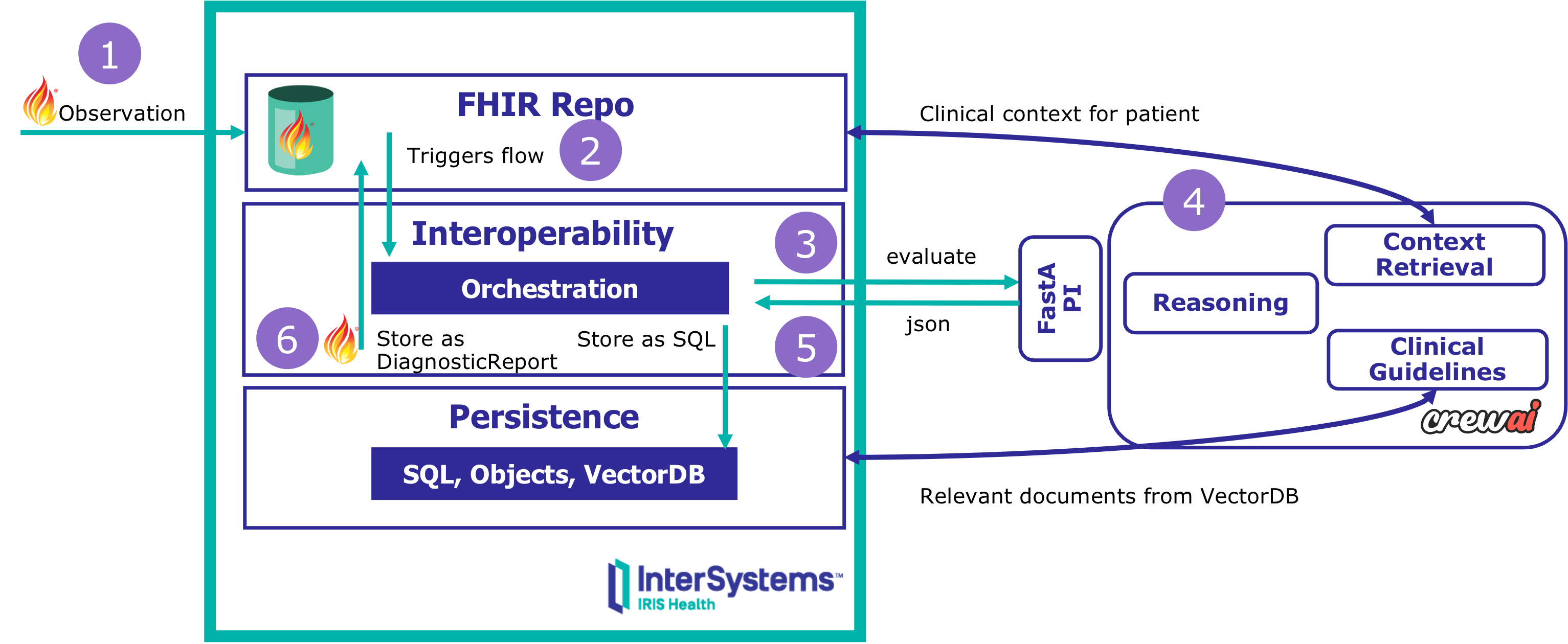
When we create a FHIR repository in IRIS, we have an endpoint to access information, create new resources, etc. But there are some resources in FHIR that probably we wont have in our repository, for example, Binary resource (this resource returns a document, like PDF for example).
I have created an example that when a Binary resource is requested, FHIR endpoint returns a response, like it exists in the repository.
First of all, we need a Namespace and a FHIR endpoint. After this, we need to configure an Interoperability production that will be connected to the FHIR endpoint.
Introduction
My guess is that most IRIS developers create their applications using its native ObjectScript language or, if using an external language, then most likely using either Java, Python or perhaps C++.
I suspect that only a minority have considered using JavaScript as their language of choice, which, if true, is a great shame, because, In my opinion and experience, JavaScript is the closest equivalent to ObjectScript in terms of its ability to integrate with the IRIS's underlying multi-dimensional database.
In this article I'd like to lay out the case for JavaScript as a first-class
Hello
This article follows up on the question I had asked the community UDP Adapter not working
In this article, I will present to you
1) What is "UDP"?
2) The current state of Iris with UDP
3) My solution with the UDP adapter
1) What is "UDP"?
UDP stands for User Datagram Protocol. It is one of the core protocols of the Internet Protocol (IP) suite, used for transmitting data over a network. Here are some key features of UDP:
- Connectionless: UDP does not establish a connection before sending data, which means it can send messages (datagrams) without prior handshaking.
- Unreliable: There is no
.png)
Mirror Your Database Across the Galaxy with Seeding
Hello cpf fans! This distraction I used the "seed" capability in IRIS to provision an entire IrisCluster mirror, 4 maps wide with compute starting from an IRIS.DAT in a galaxy far far away. This is pretty powerful if you have had a great deal of success with a solution running on a monolithic implementation and want it to scale to the outer rim with Kubernetes and the InterSystems Kubernetes Operator. Even though my midichlorian count is admittely low, I have seen some hardcore CACHE hackers shovel around DATS, compact and shrink and update their ZROUTINES, so this same approach could also be helpful shrinking and securing your containerized workload too. If you squint and feel all living things around you, you can see a glimpse of in place (logical) mirroring in the future as a function of the operator and a migration path to a fully operational mirrored Death Star as the workload matures.
.png)
High-Performance Message Searching in Health Connect
The Problem
Have you ever tried to do a search in Message Viewer on a busy interface and had the query time out? This can become quite a problem as the amount of data increases. For context, the instance of Health Connect I am working with does roughly 155 million Message Headers per day with 21 day message retention. To try and help with search performance, we extended the built-in SearchTable with commonly used fields in hopes that indexing these fields would result in faster query times. Despite this, we still couldn't get some of these queries to finish at all.
Introducing IRIS DocDB Explorer: A Sleek UI for Managing JSON Documents in InterSystems IRIS
IRIS offers a dedicated feature for storing and retrieving JSON documents using DocDB, without requiring a predefined schema.
Developers often need a quick and intuitive way to browse, create, and edit documents without switching between multiple tools or writing repetitive code. To solve this, I creatediris-docdb-ui — a CSP-based open-source application that provides a clean, responsive interface for interacting with DocDB effortlessly.
Over time, while I was working with Interoperability on the IRIS Data Platform, I developed rules for organizing a project code into packages and classes. That is what is called a Naming Convention, usually. In this topic, I want to organize and share these rules. I hope it can be helpful for somebody.
Disclaimer: This guide is a good fit for Interoperability projects.
Hey Community,
Enjoy the new video on InterSystems Developers YouTube:
⏯ Analytics and AI with InterSystems IRIS - From Zero to Hero @ Ready 2025
For example, I'm creating a customer at front end interface. I want to list down all the routines and child sub routines that are called at backend in mumps/cache. What's the best way to do it?
Yes, that's right, a Cache 2017.1 question. Let's all take a trip in the Wayback Machine.
The company I'm working for is in the process of starting to use the %UnitTest framework, and we are experiencing some errors in the code with some existing logic.
- Using InterSystems Embedded Analytics – Virtual December 1-5, 2025
- Embed analytics capabilities in applications and create the supporting business intelligence cubes.
- This 5-day course teaches developers and business intelligence users how to embed real-time analytics capabilities in their applications using InterSystems IRIS® Business Intelligence.
- This course presents the basics of building data models from transactional data using the InterSystems IRIS BI Architect, exploring those models and building pivot tables and charts using the InterSystems IRIS BI Analyzer, as well as
Only method/routine executed as "do Method..." is included into $ESTACK.
How can I modify a method or routine that returns a value so it can be included in $ESTACK?
Example upon executing via Studio Debug ($ESTACK is converted to string with ">" delimiter):
Expected: stackstr = %Debugger.System.DebugStub > LogGenerate > Entry > DirChain > Attributes > LogNew > LogSize > LogFormat > LogWrite
Processes DirChain, LogNew, LogSize, LogFormat are executed as "If Method..."
Process Attributes is executed as "set a = Attributes..."
Current: stackstr = %Debugger.System.DebugStub >
Hi All,
First I want give a Shout Out to @Theo Stolker and @Rupert.Young. Because they helped me with the solution.
When you're using the EnsLib.SQL.Snapshot as a Property in the Response Message to return Snapshot data (,e.g.: from Business Operation to Business Process,) the Snapshot data won't be cleaned with the Purge messages task/service.
Class ResponseMessage Extends Ens.Response
{
Property SnapshotProp As EnsLib.SQL.Snapshot;
}
The data will be stuck in the global: ^Ens.AppData. You can find it with this query in System>Globals: ^Ens.AppData("EnsLib.SQL.Snapshot",
.png)
The reference is
This year, our InterSystems Developer Community turns 10 years old — and we’re inviting YOU to take part in the celebration!
We’re creating a special community video filled with greetings and memories from members worldwide. Want to join in? It’s simple:
▶️ Record a short clip (1-2 mins) where you:
- Share a favorite highlight or memorable moment from your time in the Developer Community
- Send your congratulations on the 10th anniversary 🎊
We’ll combine the contributions into one big celebratory video for everyone to enjoy! 🎬✨
👉 Click here to record your video

– 35 new announcements
– 65 new questions
– 8 new discussions
✓ 290 new members joined in October
✓ 15,665 posts published all time
✓ 18,166 members joined all time
Hey Community!
We're happy to share a new video from our InterSystems Developers YouTube:
⏯ Source Control Interoperability Productions in a Decomposed Format @ Ready 2025
Hi everyone,
I'm dealing with a situation where LOAD DATA operations — especially large batches with data inconsistencies — are consuming a lot of disk space. I've noticed that the same error messages are being repeatedly logged in the %SQL_Diag.Result and %SQL_Diag.Message tables, which is significantly increasing the size of the database.
One idea was to move these diagnostic tables to a separate database with a configured size limit, but before going down that path, I'd like to ask:
Is there a simpler or more efficient way to handle this?
For example:
- Can we limit the number of repeated logs?
Hello,
I am currently facing the task of retrieving or sending HL7 messages from a web API. Since we only send HL7 messages via internal sockets, web APIs are relatively new to me.
The following is my plan for the new interface:
I have created a new custom business service that periodically sends requests to a business process.
Environment:
Targeted *.inc file (with hundreds of defined macros) is in use throughout the application and included into every class declaration.
Statement "set a = $$$TestIf(3)" is included into a classmethod with no other code in. Expected output 5
Same macro options in *.inc:
#define TestIf(%arr) if %arr>0 QUIT 5
#define TestIf(%arr) if (%arr>0) {QUIT 5}
Issue:
failure to compile class with the same error on all tried definition options as:
.png)
HTTP and HTTPS with REST API
Hello
The HTTP protocol allows you to obtain resources, such as HTML documents. It is the basis of any data exchange on the Web and a client-server protocol, meaning that requests are initiated by the recipient, usually a Web browser.
REST APIs take advantage of this protocol to exchange messages between client and server. This makes REST APIs fast, lightweight, and flexible. REST APIs use the HTTP verbs GET, POST, PUT, DELETE, and others to indicate the actions they want to perform.
When we make a call to a RESt API, what actually happens is an HTTP call. The API receives this call and according to the requested verb and path, the API performs the desired action. In the case of the Iris implementation we can see this clearly in the URLMap definition area: